Figure 22 graphically designs the
overall primary age category breakdown for lunar/solar separations entailed
with the genealogy of the nine Antediluvian Patriarchs. Circle diagrams for each generation depict
the given primary age employed by the Bible
in consecutive order. Mayan Calendar
terminology helps to discern lunar/solar calendar times. Full
comprehension for the enormous stretches of recorded calendar time interchanges
260-day-Tzolken-sacred-years with 360-day-Tun-years. The 360-day-Tun-year was the midpoint
length of year and the central average between 354-day-lunar-year and
365-day-solar-years.
Tzolken-sacred-years consistently counted 260-days during every
365-day-Haab-solar-year. Mayan
360-day-Tun-years broadly describes the term used here in conjunction with
Mesopotamian calendar systems that apply 360-days as a midpoint length of
year. Throughout lunar/solar reckoning,
the 360-day-Tun-year focused upon 12-lunar-moon-months of about 30-days each. Longer times require more precise rendering. An average 360-day midpoint length fell
between 12-lunar-moon-months of about 29.5-days each or 354-days, and the
365-day-solar-year. Many cultures added
a special 5-day celebration to the 360-day-Tun-year. The lunar-side time split intercalates 5-days
or 6-days to advance the 12-month lunar year to 360-days. Solar-side time split adds
about 5-days every year to 360-Tun-years to achieve the more familiar
365-day-solar-year. Antediluvian Calendar methods result from actual
observations and signify a pattern of ancestry that reaches into extreme
prehistory.
Primary 130-Tun-Year
Age of Adam Figure
22a
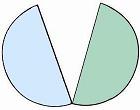
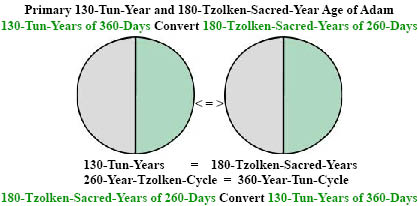
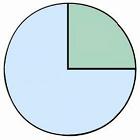
Adam has a given primary 130-Tun-year age that contains 360-day-Tun-years. The conversion process multiplies 130-Tun-years by 360-day-Tun-years to find the total number of days in the primary 130-Tun-year age of Adam. Further division by 260-day-Tzolken-sacred-years into the total number of days facilitates the converted, primary 180-Tzolken-sacred-year age of Adam picture in figure 4. Figure 3 shows the green shaded primary 130-Tun-year age of Adam as half of the 260-year-Tzolken-sacred-cycle. Figure 4 is the equivalent representation that portrays the green shaded and converted, primary 180-Tzolken-sacred-year age of Adam. The 260-day-Tzolken-sacred year orientated agricultural growing seasons and significant religious festivals. A composite 365-year-solar-cycle matches the 365-day-solar-year to portray the basic triune durations that imply using days and years together as a single numerical term. Doubling the primary 130-Tun-year age of Adam for 260-Tun-years subtracts 360-day-Tun-years from the solar 365 "year of years". The first solar-side time split attributes 105-Ethiopic-years to the primary age of Seth.
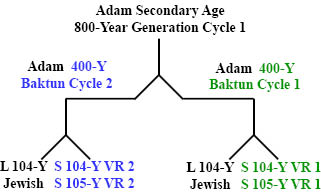
Secondary 800-Year Generation Cycle Age of Adam Figure 20 and 21
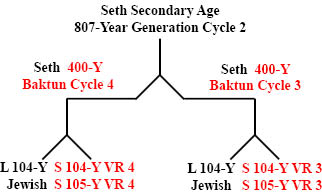
The secondary age category includes time measured according to 400-year-Baktun-cycles. The 400-year-Baktun-cycle doubles to achieve the 800-year Generation Cycle. Doubling the 400-year-Baktun-cycles allowed ancient time reckoning to extend the calendar computations. Each Patriarch from Adam through Jared counted a repeating 800-year Generation Cycle. Ages of Adam and the Holy of Holies designate 400-year-Baktun-cycles as lunar/solar years by the suffix “-l/s-.” The Mayan 20-year lunar/solar cycle renders the term Katun that describes one 20-year-l/s-cycle. Twenty Katuns are therefore one 400-year-Baktun-cycle or 400-l/s-years. The Katun 20-year-l/s-cycle combines a lunar-side time split lasting 105-days with a solar-side time split that also lasts 105-days. The total intercalary time was 210-days for every 20-year-l/s-cycle. Numerical matching occurs when a Katun 20-year-l/s-cycle increases for 20 multiples. Each 400-year-Baktun-cycle includes 105-years of lunar-side time split and 105-years of solar-side time split. The combined Baktun 400-year-l/s-cycle generates 210-years of lunar/solar separation time.
Secondary ages for all Patriarchs measure from the birth of the next son until the death of the Patriarch father. The Antediluvian Calendar series applies the 800-year Generation Cycle in repeating fashion to each character. Primary ages distinguish the time from birth until fathering the next named character. Secondary ages increment by adding individual Baktun 400-l/s-years as a complete unit. This interpretation begins the first of two 400-year-Baktun-cycles at birth and ends the first of two 400-year-Baktun-cycles when the Patriarch fathers his next son. In figure 20 and figure 21, multiple 400-year-Baktun-cycles cumulatively add 400-l/s-year increments to the secondary age category. Sequential numbering begins the first 800-year Generation Cycle with 800-y GC 1 for Adam in figure 21. The first 800-year Generation Cycle includes two 400-year-Baktun-cycles, noted as 400-y BC 1 & 2, underneath in first column. The secondary age category on the next line shows the cumulative 400-800-l/s-y total incrementing by 400-year-Baktun-cycles.
The secondary age midpoint level describes the time of begetting the next character. The end of the first 400-year-Baktun-cycle is the midpoint age level that coincidentally begins the second 400-year-Baktun-cycle for Adam and marks the birth of his son, Seth. Primary age category divisions depend upon respective solar-side time splits. The end of the first 400-year-Baktun-cycle for Adam signals the end of 130-years in the primary age. A second 400-year-Baktun-cycle completes the first 800-Generation Cycle and the first 260-year-Tzolken-sacred-cycle for Adam. All primary age category listings declare time segments dictated by solar-side time splits of the next 400-year-Baktun-cycle. The midpoint age level through the secondary age 800-years corresponds to the midway position through the primary age 260-year-Tzolken-sacred-cycle.
Every 400-year-Baktun-cycle generates 210-years of lunar/solar separation time. The solar-side time split divides lunar/solar separation time in half. All 400-year-Baktun-cycles provide 105-years of solar-side time split. Two periods having 105-years of solar-side time split add for each 800-year Generation Cycle. The entire 800-year Generation Cycle provides 210-years of solar-side time split. Primary ages for Seth, Cainan and Jared alternate masculine, solar-side time split computations with feminine, lunar-side time split computations regarding Adam, Enos and Mahalaleel in the sequence.
Adam and Seth
365-Days-and-Year-Solar-Cycle
Figure 22b
Approximations apply 11-days of lunar/solar separation time between 354-day-lunar-years and 365-day-solar-years. Jewish Calendar 19-year Metonic cycles result in 209-days of lunar/solar separation, which are divided into 7-intercalary months. Comparable 20-year cycles evidence 210-days of lunar/solar separation time that also evenly divide by 7-intercalary months using 30-days each. Time splitting attributes 105-days to the lunar-side and 105-days to the solar-side of recognition over a 20-year lunar/solar cycle. Every 365-day-solar-year separately assigns one 260-day-Tzolken-sacred-year. Another 105-day portion completes the 365-day-solar-year. In Mayan terms, 20 multiples of 20-year lunar/solar cycles produce one 400-year-Baktun-cycle seen with the Sun Kingdoms' Calendars. Two 400-year-Baktun-cycles add to make one 800-year Generation Cycle. The 800-year Generation Cycles provides secondary age category steps documenting the series of Antediluvian Patriarchs.
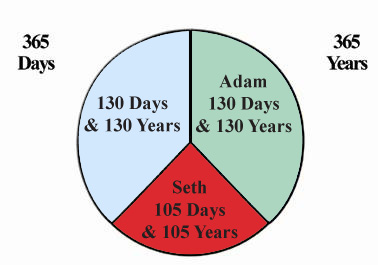
Six exact lunar/solar divisions diagram the Biblical primary ages of Adam, Seth, Enos, Cainan, Mahalaleel and Jared. Adam, the originator of the Antediluvian Calendar, halves the 260-year-Tzolken-sacred-cycle. The correlated lineage chain begins with the green right semicircle (figure 22a) for the primary 130-year age of Adam that bisects a 260-year-Tzolken-sacred-cycle having 360-day-Tun-years. In the right semicircle, 130-Tun-years are green shaded to duplicate figure 2. Adam’s primary 130-Tun-year age contrasts the opposing red next 130-Tun-years.
Primary 105-Year Age
of Seth Figure
22c
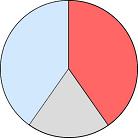
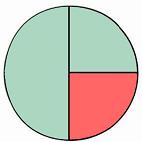
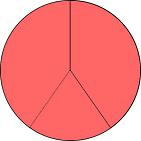
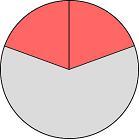
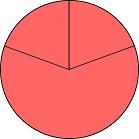
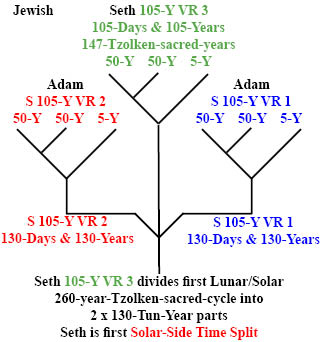
Moving to the upper right circle of figure 18b provides Seth's first solar-side time split generation after Adam. Strata levels in the primary age category describe lunar/solar intersections using solar-side time splits. Solar-side time splits segregated the elements of the 260-year-Tzolken-sacred-cycle. Adam's primary 130-Tun-year age designates green shade in the upper right pie section of the second circle (Figure 18b). The upper left pie section is the shaded equivalent 130-Tun-years to juxtaposition an entire 260-year-Tzolken-sacred-cycle within 365-years. The lower pie section differentiates the primary 105-year age of Seth from the 260-year-Tzolken-sacred-cycle intrinsic to 365-years. Seth's primary 105-year age means the solar-side separation half of 210-years of lunar/solar separation time has been evaluated for each 400-year-Baktun-cycle of the Sun Kingdoms' Calendar. Two 105-year-solar-side separations divide to get one 105-year-solar-side time split for Seth's primary age when the first 400-year-Baktun-cycle doubles to reach the second 800-year Generation Cycle following Adam. Seth is the first generation after Adam and the first solar-side time split of the ancestry.
The primary age combination for Adam and Seth concludes a 365-year-solar-cycle. Seth’s primary 105-year component measured solar-side reckoning during the third 400-year-Baktun-cycle 3. Differing from the first 260-year-Tzolken-sacred-cycle made with 360-day-Tun-years, Seth’s 105-years corrected for solar-side time split. A 364-day-Ethiopic-year enables the last 5-years to be accounted in the primary age.
The 364-day-Ethiopic-year suits cascaded time layers for Seth. A 100-days-and-years single term continues with the last 5-years in the primary age category. A calendar year of 364-days provides 105-days in 105-years. The last 5-years of Seth’s primary 105-year age multiply by the Ethiopic 364-days in Eqn. 16. Exactly 1,820-days divide by the 260-day-Tzolken-sacred-year to secure the last 7-Tzolken-sacred-years in the secondary age category (Eqn.17). Both the primary age 5-years and the secondary age 7-sacred-years are congruent to 1,820-days. The last 5-years in Seth’s 105-year primary age equal the whole number integer 1,820-days. Time beyond the 800-year Generation Cycle equals 7-Tzolken-sacred-years, which add in the secondary 807-sacred-year age of Seth.
Secondary 807-Year Age of Seth Figure 20 and 21
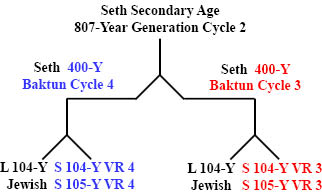
All 800-year Generation Cycle character ages are elements of the secondary age category. The end of the third consecutive 400-year-Baktun-cycle adds the first half of Seth’s 800-year Generation Cycle. The secondary age halfway, midpoint age level signals the end of 105-years in the primary age. The end of the third 400-year-Baktun-cycle indicates 1200-l/s-years for the secondary age category total. Figure 20 lists two 400-year-Baktun cycles that number 3 and 4 in the first column. Directly under Seth is the 1200-1600-l/s-y range in figure 21. Four steps of 400-year-Baktun-cycles divide the primary ages according to the first and third, odd Baktun 400-year multiples. A fourth 400-year-Baktun-cycle adds to Seth’s secondary age category to conclude Seth’s 800-year Generation Cycle and 1600-l/s-years cumulative for the Patriarchs. The second and fourth even Baktun 400-year multiples end the total primary l/s component. Adam’s total primary age is 260-years and Seth’s primary 105-year age is the solar-side time split encountered for the third 400-year-Baktun-cycle.
The Bible includes additional time beyond Seth’s secondary 800-year Generation Cycle. The second 800-year Generation Cycle represents 1600-l/s-years externally to the primary age category. Seth’s secondary 800-year Generation Cycle is the major part in the secondary 807-year age of Seth and 7-Tzolken-sacred-years remain. Extra time between 100-years and 105-years in the primary 105-year age of Seth is 5-years. A 364-day-Ethiopic-calendar-year multiplies for 1,820-days extra time (Eqn. 11). The reverse conversion using 364-day-Ethiopic-years is exactly 7-Tzolken-sacred-years of 260-days each (Eqn. 12). Added to the repeating 800-year Generation Cycle for Seth, the result is the secondary 807-year age of Seth (Eqn. 13). The 800-year Generation Cycle was a repeating value for the remaining genealogy.
Figure 21 provides a Mayan version and a Judaic version of the Antediluvian Calendar. The Mayan version adapts the 104-year Venus Rounds and consequently, two 52-year Calendar Rounds. For comparison, the Judaic version associates a 105-year Venus Round with 50-year Jubilee Cycles. Both cases calculate the cascaded operation of a 364-day-Ethiopic-year by numerically matching 1-day to 1-year. The third 400-year-Baktun-cycle ends at the secondary midpoint age at 1200-l/s-years. Lunar/solar separation time was 210-years that divided for the masculine energy 105-year-solar-side time split. Diagrammed in figure 22c, Seth is the green right half of 210-years of solar-side time split. The red left side identifies the second 400-year-Baktun-cycle in Seth’s secondary 800-year Generation Cycle.
A necessary conversion from 105-Ethiopic-years having 364-days each to 260-day-Tzolken-sacred-years enables the lineage to follow the pattern from Adam. Under Seth in figure 21, the whole number integer of 147-Tzolken-sacred-years is the converted answer. A 360-day-Tun-year converted Adam’s primary 130-year age to 180-Tzolken-sacred-years (figure 3). Converting the primary 105-year age to the solar-side 364-day-Ethiopic-years requires substitution. Solar-side time splits replace 360-day-Tun-years with 364-day-Ethiopic-years. Reasons behind this discrepancy are not mathematical, but rather ideological. The 360-day-Tun-year predominantly was a central point between lunar years and solar years. Comparable themes transcend a 360-year-Tun-cycle made up of 260-day-Tzolken-sacred-years. Nighttime, lunar and starlight observations directly influenced evening calendars. Notions of dividing the lunar month into four equal parts kept harmony with dividing year into four equal parts. Four Royal Stars segmented the 364-day-Ethiopic-year into four 90-day quadrants. Four days were reserved for the two equinoxes and solstices. While these four stars evenly commanded the year, they do accrue in the final 4-days at the end of a 364-day-Ethiopic-year. The last, 365th-day is a capstone day and we (men) have been admonished not to include this day in the regular computations of the year.
Solar-side time splits lasting 105-days relate to several layers of the ancient system. Starting with the 260-day-Tzolken-sacred-year, there are 104-days until the Ethiopic year ends. A Katun 20-year-l/s-cycle produces 105-days of solar-side time split when the leap-day fraction of about 0.25-days every year is included. Next, the 400-year-Baktun-cycle shifts the reckoning to 105-years of solar-side time split. The Mayan 104-year Venus Round and the sister Judaic 105-year Venus Round illustrate solar-side time splits as a starlight time split. There is one more tier to the spiritual hierarchy. The star Sirius plays a role by dividing 4-year patterns having 1460-days into four different 260-day-Tzolken-sacred-years and four different 105-day-solar-side time splits. Identical math divides the 1,460-year Sothic Cycle into four different 260-year-Tzolken-sacred-cycles and four different 105-year-solar-side time splits.
In addition to the secondary age category 800-year Generation Cycle for Seth, there are 7-Tzolken-sacred-years. The 364-day-Ethiopic-year suits cascaded time layers for Seth. A 100-days-and-years single term continues with the last 5-years in the primary age category. A calendar year of 364-days provides 105-days in 20-years and 105-years for every 400-year-Baktun-cycle. The last 5-years of Seth’s primary 105-year age multiply by the Ethiopic 364-days in Eqn. 45. Exactly 1,820-days divide by the 260-day-Tzolken-sacred-year to secure the last 7-Tzolken-sacred-years in the secondary age category (Eqn.46). Both the primary age 5-years and the secondary age 7-sacred-years are congruent to 1,820-days.
Primary
90-Tzolken-Sacred-Year Age of Enos Figure 22d
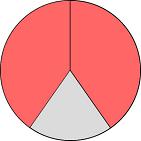
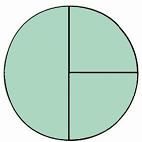
The primary 90-Tzolken-sacred-year age of Enos described in figure 3 justifies the third quarter of the circle on the right side of figure 22d. Numerical matching aligns the 260-day-Tzolken-sacred-year with a 260-year-Tzolken-sacred-cycle. The 260-year-Tzolken-sacred-cycle sets aside increments by halves and quarters. Conversions to 360-day-Tun-years aid in demonstrating the interlocking types of years. Enos provides the third quarter of the 260-year-Tzolken-sacred-year. The primary 90-Tzolken-sacred-year age multiplies by 260-day-Tzolken-sacred-years for 23,400 days. Dividing 23,400-days by 360-day-Tun-years converts the primary age of Enos to 65-Tun-years that quarters the 260-year-Tzolken-sacred-cycle. Adam's primary 130-Tun-year age is the left half component of 260-years in the circle picturing the second generation after Adam. The end of Enos' converted primary 65-Tun-year age adds the third quarter to the 260-year-Tzolken-sacred-cycle. The alternating pattern established by Adam's 130-Tun-years and connection to the 260-year-Tzolken-sacred-cycle, crosses over Seth's era to the given primary 90-Tzolken-sacred-year age of Enos. In between, the first solar-side time split of Seth signifies 364-day-Ethiopic-years that match X-number of days to X-number of years. Seth’s primary 105-Ethiopic-year age evaluates by multiplying 105-years by 364-day-Ethiopic-years. The primary age of Seth is 38,220-days, which convert to the integer 147-Tzolken-sacred-years. Lunar/solar separation alternates 360-day-Tun-years with 364-day-Ethiopic-years to project the second solar-side time split by Cainan.
Secondary 815-Year Age of Enos Figure 20 and 21
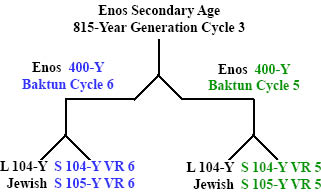
The secondary 815-year age of Enos adds 800-year Generation Cycle 3 to the secondary age total in figures 20 and 21. Two 400-year-Baktun-cycles are numbered 5 and 6 in the above figures. The first 400-year-Baktun-cycle 5 begins when Seth’s second 400-year-Baktun-cycle 4 ends. Under Enos in figure 21, the entry 400-y BC 5 & 6 spans the third 800-year Generation Cycle 3, noted as 800-y GC 3. The first 400-year-Baktun-cycle 5 begins at 1600-l/s-years and ends at the same time as Enos’ primary 90-Tzolken-sacred-year age ends. Figure 21 shows the range 2000-2400-l/s-years that mark the midpoint age level and the endpoint age level for Enos. Each midpoint age is the halfway point during the secondary 800-year Generation Cycle for all six named characters, Adam through Jared.
Additional time separately adds 15-years to the 800-year Generation Cycle for Enos. Seth’s secondary 807-year age included the extra 7-Tzolken-years, which equal 1820-days and five 364-Ethiopic-years. The primary 105-year age of Seth signals the end of 400-year-Baktun-cycle number 3. At the 1200-l/s-year midpoint age level, 7-Tzolken-sacred-years or 5-Ethiopic-years measure accumulated 364-day-Ethiopic-years after the last 5-years in one 365-year-solar-cycle. Equation 17 finds the total 1820-days for the identified 7-Tzolken-sacred-year portion of Seth’s secondary 807-year age. Seth’s 7-Tzolken-sacred-year supplemental time multiplies by the 260-day-Tzolken-sacred-year for 1820-days. Equation 18 multiplies 5-Ethiopic-years by 364-day-Ethiopic-years to arrive at the same total, 1820-days. Seth's primary 105-Ethiopic-year age had been the solar-side result after the third 400-year-Baktun-cycle 3.
x 260 day-Tzolken-sacred-year
= 1820 days
Uses a 365-year-solar-cycle with
364-day-Ethiopic-year
x 364-day-Ethiopic-years
= 1,820 days extra in 5-Etiopic-years of 364-days
¸ 260
day-Tzolken-sacred-years
= 7-Tzolken-sacred-years
x 2 for Second 400-year-Baktun-cycle 5
= 3,640-days
= 10-Ethiopic-years of 364-days
+ 5-Ethiopic-years
= 10-Ethiopic-years
Seth’s second 400-year-Baktun-cycle 4 in figures 20 and 21 doubles the extra time beyond 5-Ethiopic-years or 7-Tzolken-sacred-years recorded. From Seth’s midpoint age 1200-l/s-years to the secondary age endpoint 1600-l/s-years, the extra time doubles for 10-Ethiopic-years or 14-Tzolken-sacred-years (Eqn. 20). There are 3,640-days additional to the primary age category for Seth. Seth’s first 400-year-Baktun-cycle 3 reflects 5-Ethiopic-years that add with a 100-days-and-years single. The total primary 105-Ethiopic-year age for Seth reveals a 365-year-solar-cycle incorporated 364-day Ethiopic-years. The 364-day-Ethiopic-year precludes the final 365th-day from ordinary computations. Primary age years did increment normally, however. A primary age 365-year-solar-cycle effectively coins twice Adam’s primary 130-Tun-year age with one 260-year-Tzolken-sacred-cycle, plus Seth’s primary 105-Ethiopic-year age. Seth’s second 400-year-Baktun-cycle 4 leads to 10-Ethiopic-years at the endpoint of the secondary age category 1600-l/s-year total.
The first 400-year-Baktun-cycle 5 for Enos adds another 5-Ethiopic-year segment to the secondary age category. The midpoint age level for Enos is 2000-l/s-years. Completing Enos’ third 800-year Generation Cycle 3, the next 400-year-Baktun-cycle 6 adds 400-l/s-years to end the secondary age category at 2400-l/s-years. Figures 20 and 21 show the two 400-year-Baktun-cycles as 400-y BC 5 & 6 and the secondary age category levels as 2000-2400 l/s-y, respectively. The secondary age category total adds 5-Ethiopic-years to the primary age 10-Ethiopic-years for 15-Ethipic-years (Eqn. 21). Enos’ secondary 815-year age includes the third 800-year Generation Cycle 3 plus 15-Ethiopic-year gained from primary age calculations.
Primary
70-Tzolken-Sacred-Year Age of Cainan Figure 22e
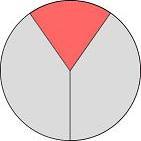
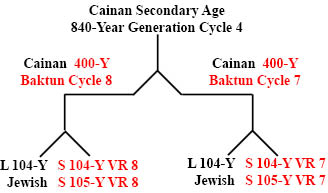
Seth's primary 105-Ethiopic-year age alternates beyond Enos to arrive at Cainan's primary 70-Tzolken-sacred-year age. Cainan's primary 70-Tzolken-sacred-year age represents figure 4 by transiting to the second circle graph down on the right hand side of figure 18d. Seth's first solar-side primary 105-Ethiopic-year age becomes the green portion that converts to 147-Tzolken-sacred-years mentioned in the text. The next red shaded side for symmetrically doubles 105-Ethiopic-years to make 210-Ethiopic-years. Switching to 365-Tzolken-sacred-years derives the second solar-side time split for Cainan. The converted 147-Tzolken-sacred-year primary age likewise doubles for 294-Tzolken-sacred-years. Seth’s converted and doubled 294-Tzolken-sacred-years subtract to answer about 70-Tzolken-sacred-years for the primary age of Cainan. The concept of 365-Tzolken-sacred-years then subtracts the equivalent doubled, primary 294-Tzolken-sacred-years for 70-Tzolken-sacred-years indicated for Cainan in the lower sector. Lunar/solar separation time accrues the second solar-side time split of Cainan. Furthermore, Cainan's given 70-Tzolken-sacred-years correspond with a 70-days-and-years term that Sirius hides below the horizon. Continuing the 260-year-Tzolken-sacred-cycle begun by Adam, Mahalaleel's primary 65-Tun-year age reverts to 360-day midpoint years that alternate with Cainan's primary Tzolken-sacred-year age. Jared identifies the third solar-side time split.
Secondary 840-Year
Age of Cainan Figure
20 and 21
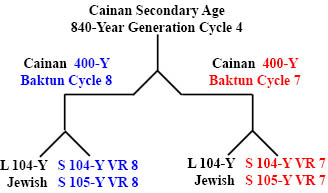
The secondary 800-year Generation Cycle 4 provided by Cainan first includes 400-year-Baktun-cycle 7 that ends the midpoint age at 2400-l/s-years. Cainan’s second 400-year-Baktun-cycle 8 finishes the fourth 800-year Generation Cycle 4 by counting to 3200-l/s-years in Figure 20 and 21. Two primary age 105-year solar-side time splits add together for each 800-year Generation Cycle. Completion of Cainan’s secondary 800-year Generation Cycle 4 multiplies for 8 different 105-year solar-side time splits in the secondary age category. Another way to consider the additional 40-Ethiopic-year span mentioned for the secondary 840-year age of Cainan would multiply the primary age 5-Ethiopic-years recorded for Seth by 8 different sets of 105-year solar-side time split.
Primary 65-Tun-Year
Age of Mahalaleel Figure 22f
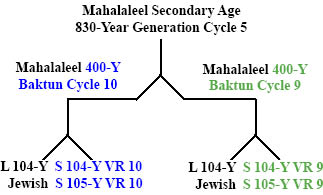
Mahalaleel completes the primary age category 260-year-Tzolken-sacred-cycle. Mahalaleel’s primary 65-Tun-year age is the counterpart of Enos' third quadrant in the 260-year-Tzolken-sacred-cycle. In the third circle down on the left, the green lower right quarter is the shaded renewal of figure 6. Formation of the 260-year-Tzolken-sacred-cycle is complete at the end of Mahalaleel's primary 65-Tun-year age. Mahalaleel alternates with Cainan's given primary 70-Tzolken-sacred-year age. Mahalaleel’s primary 65-Tun-year age divides Cainan’s second solar-side time split from Jared’s third solar-side time split.
Secondary 830-Year
Age of Mahalaleel Figure 20 and 21
Primary
162-Ethiopic-Year Age of Jared Figure 22g
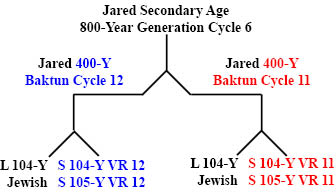
Jared's secondary 800-year Generation Cycle repeats Adam's 800-year Generation Cycle. The lunar/solar calendar system had achieved a significant era that transcended the splitting of time. A new pattern of lunar/solar recognition beyond Jared starts another 260-year-Tzolken-sacred-cycle in the primary age category. Later primary ages replace the 260-year-Tzolken-sacred-cycle with 360-Tzolken-sacred years to evolve the next two layers of primary age time. Figure 18 graphically summarizes the overall breakdown of nine primary age category lunar/solar time divisions. Figure 18 begins with figure 18a for the primary 130-Tun-year age of Adam and ends with figure 18h for Enoch, the seventh Patriarch.
Primary ages for Enos and Mahalaleel, then provide the third and fourth quarter fractions of 260-year-Tzolken-sacred-cycle. Enos and Cainan act as a pair to alternate scriptural 260-day-Tzolken-sacred-years from Adam's 130-Tun-years, and Seth's 105-Ethipic-years of 364-days each. Mahalaleel transfers alternation in symmetrical fashion back to 360-day-Tun-years. Mahalaleel concludes the 260-year-Tzolken-sacred-cycle. Seth and Jared have primary ages given in 364-day-Ethiopic-years in order to count solar-side time splits. Adam, Enos and Mahalaleel have primary ages given in 360-day-Tun-years. Proportional eras interlace by segregating lunar/solar separation times and defining them differently for solar-side time splits. Seth, Cainan and Jared correlate to the first, second and third respective solar-side halves of lunar/solar separation times.
Present Jewish Calendar reckoning adds all primary age category elements to date the creation at 3,761 B.C.E. Using 19-year Metonic lunar/solar cycles, 1,656 years sum prior to the Deluge. Secondary age 800-year Generation Cycles are irrelevant to standard Jewish Calendar chronology. Christian chronologies often use the Jewish creation date to begin at 4,004 B.C. The Egyptian Calendar begins between 4,236 BCE and 4,241 B.C.E. by counting three 1,460-year Sothic Cycles backwards from the year 139 A.D. Archeological codices that usually begin about 3,113 B.C.E. generate most Sun Kingdoms' chronologies. Symbiotic harmony of the three systems help to compromise variations in lineal time measurement and special beliefs. Figure 18 formulates new chronology with full exploration of lunar/solar calendar information for advanced appreciation of early character ages.
Altogether, nine different lunar/solar divisions stretch for nine 800-year Generation Cycles or 7,200 years. The primary 500 sacred year age of Noah accounts for another 500 years, and 100 years more, add to obtain the total 7,800 years from Adam's era until the Great Flood of Noah. Distinct primary age, and secondary age, categories expand authentic viewpoints of the remote past. Still preserved in modern times, ancient 19-year and 20-year lunar/solar cycles are the foundations for later time reckoning. Preluding the common 19-year Jewish Calendar cycles of today, lunar/solar cycles lasting 20-years were employed. Sun Kingdoms' Calendars used 20-year lunar/solar cycles, while neither specifically the same in name nor exact meanings, were applicable to similarly gain the 400-year-Baktun-cycle pattern. Evolving the Sun Kingdoms' Calendar system, 800-year Generation Cycles shared assigned correlations with the lunar/solar calendar following Adam. The calendars deciphered by the genealogy in figure 12 appears to have truncated, thereby distributing the three oldest main calendar branches in world history. Entreating shared characteristics, the lunar/solar calendar by Adam was the earliest format known.
Secondary 800-Year Age of Jared Figure 20 and 21
Breakdown of
Lunar/Solar Time Divisions
Figure 22
Primary 130-Tun-Year Age of Adam Figure 22a
Adam is 130-Tun-Year Half of a
260-Year-Tzolken-Sacred-Cycle
20 Multiples x 20 Year Lunar/Solar Cycle = 400 Year-Baktun-Cycle of Mayan Calendar 130-Years are 1st
Lunar/Solar Time in Primary
Age Category

800-L/S-Years 400-L/S-Years Secondary Age Category
Second 400-Year
First 400-Year
Baktun-Cycle Baktun-Cycle
First
800-Year Generation Cycle
Primary 130-Tun-Year Age of Adam Figure 22a
Adam and Seth 365-Days-and-Year-Solar-Cycle Figure 22b
Adam Twice = 130-Ethiopic-Years Figure 22b
Primary 105-Year Age of Seth Figure 22c
Seth is First Solar-Side Time
105-Ethiopic-Years 147-Tzolken-Sacred
Years Seth
Primary Age is Green 210-Year-Solar-Side
Time 800-year
Generation Cycle Seth 105-Ethiopic-Years
of 364-Days Each =
147-Tzolken-Sacred-Years Secondary
Age Category 1600-L/S-Years 1200-L/S-Years Fourth
400-Year Third 400-Year Baktun-Cycle Baktun-Cycle Second
800-Year Generation Cycle
Cainan 50-Ethiopic-Years 70-Tzolken-Sacred-Years

260-Year-Ethiopic-Cycle
of 364-Days Each 364-Tzolken-Sacred-Year-Cycle
of 260-Days Each
Seth is
First Solar-Side Time
Primary 90-Tzolken-Sacred-Year Age of Enos Figure 22d
Enos 90-Tzolken-Sacred-Years is Third Quarter 360-Tzolken-Sacred-Year Cycle
Enos Quarters the 360-year-Tun-Cycle That Equals
360-Tzolken-Sacred-Years Figure 22d
Adam 130-Tun-Years 180-Tzolken-Sacred-Years First
Half of 260-Tun-Year-Cycle 360-Tzolken-Sacred-Year
Cycle Secondary
Age Category 2000-L/S-Years Fifth
400-Year Baktun-Cycle Third
800-Year Generation Cycle 2400-L/S-Years Sixth
400-Year Baktun-Cycle
Enos Quarters the 360-year-Tun-Cycle
That Equals 360-Tzolken-Sacred-Years
Figure 22d
Primary 70-Tzolken-Sacred-Year Age of Cainan Figure 22e
Primary
70 Tzolken-Sacred-Year Age of
Cainan 365 Tzolken-Sacred-Year-Cycle - 294
Tzolken-Sacred-Years =
70 Tzolken-Sacred-Year Age of Cainan Eighth
400-Year Seventh 400-Year Baktun-Cycle Baktun-Cycle Fourth
800-Year Generation Cycle
Cainan is Second Solar-Side Time


Cainan is Second Solar-Side Time
Primary 65-Tun-Year Age of Mahalaleel Figure 22f
Mahalaleel is 4 th
Quarter of 260 Year-Sacred-Cycle
Figure 22f
130 Years for Adam + 65 Years Converted for Enos + 65 Years for Mahalaleel 260 Year Sacred Cycle Tenth
400-Year Ninth 400-Year Baktun-Cycle Baktun-Cycle Fifth
800-Year Generation Cycle Adam 130-Tun-Years 180-Tzolken-Sacred-Years First
Half of 260-Tun-Year-Cycle 360-Tzolken-Sacred-Year
Cycle Mahalaleel 65-Tun-Years are Fourth Quarter 260-Year-Tzolken-Sacred-Cycle

Primary
65-Year Age of Mahalaleel Completes
260-Year-Tzolken-Sacred-Cycle Figure
22f
Primary 162-Ethiopic-Year Age of Jared Figure 22g
Jared is Third Solar-Side Time
50-Ethiopic-Years 70-Tzolken-Sacred-Years Cainan
Primary Age is Green 50-Ethiopic-Years 70-Tzolken-Sacred-Years
Twelfth
400-Year Eleventh 400-Year Baktun-Cycle Baktun-Cycle Sixth
800-Year Generation Cycle 260-Year
Ethiopic-Cycle of 364-Days Each 364-Tzolken-Sacred-Year-Cycle
of 260-Days Each


Jared is
Third Solar-Side Time
65-Ethiopic-Years of 364-Days Each Primary 65-Year Age is Mortal Secondary 300-Year Age
is Heavenly 65 Years + 300 Years 365 Years Lifespan Total for Enoch 300-Years
Thirteenth 400-Year Baktun-Cycle
Seventh 800-Year Generation Cycle
365-Years of Enoch Figure 22h
Breakdown of
Lunar/Solar Time Divisions
Figure 22
Through the eyes of the ancients, 365-days and 365-years numerically match in a 365-days-and-years singular term. Discussion in the text elaborates on specific premises regarding mixed years in the primary age. Enoch's emphasis on an epoch lasting 365-years underscores main principles discovered in analyzing the Egyptian Calendar and mystical information concerning eternal life. Outlined earlier, transition to primary age application of 364-Tzolken-sacred-years decides the next eighth and the ninth generations of the Antediluvian Calendar.
Lunar/solar separation times of Seth
and Cainan decrease both secondary age 800-year Generation Cycles belonging to
Methuselah and Lamech. Methuselah's difference of
18-Tzolken-sacred-years, plus Lamech's difference of
205-Tzolken-sacred-years add for 223-Tzolken-sacred-years. Central to the exchange process, Jared's
converted primary 224-Tzolken-sacred-year age equals 224-Tzolken-sacred-years
using the given primary 162-Ethiopic-year age of Jared. The situation of Mahalaleel
and Enoch had parenthetically subdivided a 130-Tun-year half of a
260-year-Tzolken-sacred-cycle. Jared's
converted primary 225-Tzolken-sacred-year age assigned the third solar-side
time split in accordance with the first two solar-side primary ages of Seth and
Cainan. Beyond Enoch's era, doubling
Jared's primary 224-Tzolken-sacred-year age sums 448-Tzolken-sacred-years. The next two generations are Methuselah and Lamech. that divide at the halfway position between the next two
generations for dual segments of 224-Tzolken-sacred-years. The calendar chain continues to reserve the
second 224-Tzolken-sacred-year age for division with regard to the secondary
ages of Methuselah and Lamech. A fourth stage of lunar/solar separation has
developed the seventh and eighth generations following Adam and prior to Noah's
era.
Numerical matching enables a 365-day-and-year single term. Especially noteworthy is the use of 20 multiples of the 20-year-Katun-cycle or a 400-years-Baktun-cycle. Lunar/solar time amounts 210-days after 20-years. The matching pattern identifies 210-years of lunar/solar time split after the 400-year-Baktun-cycle. Solar-side separation halves 210-years to extract 105-years that were significant for every 400-year-Baktun-cycle. Twice 400-years made the root 800-year Generation Cycle. The 260-day-Tzolken-sacred-year year leaves 105-days every year. The 800-year Generation Cycle became the major baseline to evaluate primary age lunar/solar intersections. A complex genealogical pattern is established where 800-years repeats in each Antediluvian character's secondary age. Extra time greater than a standard 360-day-Tun-year cumulatively adds 260-day-Tzolken-sacred-years to increase the secondary 800-year Generation Cycle age. Figure 18 groups 800-year Generation Cycles to define primary age levels, or halfway positions during the entire genealogy. The second 400-year-Baktun-cycle adds to the cumulative secondary age category total. Solar-side developments during the second half of an 800-year Generation Cycle mirror the primary age. Figure 18 describes the method of evolving secondary ages for the Patriarchs. The chronology assigns excess time to the ancestry beyond the secondary 800-year Generation Cycle of Adam through the secondary 800-year Generation Cycle age of Jared.
The Patriarch Enoch presented a new dimension to this calendar system. The sixth generation after Adam and the seventh lunar/solar division, Enoch ascertains the first quarter of a new 260-year-Tzolken-sacred-cycle in the primary age category. The given primary 65-Tun-year age of Enoch is shown by the green first quarter in figure 19h and figure 20. Enoch’s primary 65-Tun-year age leaves 195-Tun-years remaining in the 260-year-Tzolken-sacred-cycle.
Enoch’s secondary 300-Tun-year age represents the blue three-quarter section of the 364-year-Tzolken-sacred-cycle. The given combination amounts to 365-Ethiopic-years that have 364-days each. Enoch's spiritual revelations and heavenly observations capture the essence of archaic feelings toward time.
21. 130 Year Primary Age of Adam
+ 105 Year Primary Age of Seth
= 235 Years Sum First
Lunar/Solar Division Primary Age of Adam,
and Second Lunar/Solar Division Primary 105 Year Age of Seth
+ 65 Year Converted, Primary 90 Sacred Year Age of
Enos
= 300 Years Sum Third Lunar/Solar Division Primary
Age of Enos
+ 50.5 Years Converted, Primary
70 Sacred Year Age of Cainan
= 350.5 Years Sum Fourth Lunar/Solar Division Primary Age of Cainan
+ 65 Year Primary Age of Mahalaleel
= 415.5 Years Sum Fifth
Lunar/Solar Division Primary Age of Mahalaleel
+ 162 Year Primary Age of
Jared
= 577.5 Years Sum Sixth Lunar/Solar Division Primary Age of Jared
+ 65 Year Primary Age of
Enoch
= 642.5 Years Sum Seventh
Lunar/Solar Division Primary Age of Enoch
135 Years Converted, Primary 187 Sacred
Year Age of Methuselah
= 777.5 Years Sum Eighth
Lunar/Solar Division at Primary Age,
and Life Span Linear Summation for Lamech, and Approximates to:
= 777 Years of 360 Days Each to Match Lamech, Total Sacred Years
In all the known
history of the world, there are only about twenty-five different forms of the
calendar. About half of these comprise
the class of lunar/solar calendars.
Lunar/solar calendars and associated theology were widespread throughout
ancient civilization. Cultures emerging
in the
All primary ages of the Antediluvian Patriarchs from Adam to the Great Flood of Noah are added for 1,656 years, giving the recorded summation found in traditional Jewish Calendar dating of 3,761 years B.C.E. for the Creation of the world. Separated by 800-year Generation Cycles, the primary ages sum to provide the initial 1,656-years from Creation to the Deluge. Archbishop Ussher is credited with using Jewish Calendar dating to arrive at 4,004 B.C.E. The Mayan Calendar date of 3,113 B.C.E. comes from the Dresden Codex and compiled by translating stone carvings. Egyptian starting calendar dates between 4,236 B.C.E. and 4,241 B.C.E. come from hieroglyphs, Egyptology concerning Pharaoh Dynasties and a few Greek writings. The 1,460-year Sothic Cycle retraces three times. Our Holy Bible is the key to the past.
Are you a pastor, educator or a student of the Holy Bible? Timeemits.com seeks anointed people to review and contribute to the Ages of Adam ministry. Ancient lunar/solar calendars like the Jewish and Mayan calendars provide the background to understanding early time. Ancient calendars of the Holy Bible use differences between the moon and sun, numerical matching and a 364-day calendar year to describe X-number of days that match with X-number of years. Ages of Adam is a free read at http://www.timeemits.com.
Clark Nelson is webmaster for www.timeemits.com and author of Ages of Adam and sequel, Holy of Holies. Contact article@timeemits.com for more information. © Copyright 2006 Clark Nelson and timeemits.com All Rights Reserved.