Holy_of_Holies $ 34.95 New Instant Download - August 2019 Holy_of_Holies.pdf from Payloadz SKU HoH Password Sent with download link from Payloadz to Your Email
All Rights
Reserved. No Part of this book may be reproduced or
utilized in any form or by any means, electronic or
mechanical, including photocopying, recording, or by any
information storage and retrieval system, without permission
in writing from the publisher.
A Derivative Work of Ages_of_Adam ISBN
1-59109-557-3 and Calendars_of_Creation
Library of Congress Catalog Card Number: TX 3-582-384
Printed in U.S.A. ISBN – TBA
Please
support Time Emits Holy_of_Holies ministry by visiting
sponsors, links or with a small offering.
Thanks for helping via our Paypal.com Donation. You will
need to have a Paypal.com account.
Time Emits Advancements in Calendar Science through Bible Study.
Time Emits offers a unique ministry. Dedicated to the nature and
use of time, Time Emits has a special website that publicizes
Holy Bible calendar research. The Holy_of_Holies develops the
calendar material by defining Lunar/Solar Primary Age and
Secondary Age time splits for Adam, Seth, Enos, Cainan,
Mahalaleel, Jared, and Enoch. Christian_Era_Calendars help to
explain New Testament events. Holiday celebrations blend with
the memories of our lives. The author's personal Testimony
section reflects associated information. Time Emits recognizes
this Bible calendar research may combine with other fields of
science and religious institutions. Other materials include
website links, noteworthy reports, selected testimonies and time
related products and services. Time Emits is both an offering
and a business enterprise. Multiple reprints subject to resale
are protected. Acknowledgements and links to Time Emits are
requested.
Ancient Calendars of the Holy Bible subtitles timeemits
Holy_of_Holies website. Starting from original seven
day weeks and lunar phases, progression toward 360-day
midpoint years involves lunar/solar calendars.
Genesis chapter 5 details the begat genealogy
of Adam using the Antediluvian Calendar.
The very ancient calendar system stems
variations in the Jewish, Egyptian,
Mesoamerican and the 364 day calendar year.
Advancements in calendar research
and the Holy Bible
announce a new discovery. The Begat Genealogy of Adam
in chapter 5 of Genesis measures time
according to ancient lunar/solar calendars.
Long ago, the Lord
embedded lunar/solar calendar use within the
earliest scripture.
The sun and moon were heavenly timekeepers for
the ancients. Observation was the only way to
determine a calendar. The Creative Week helped
plant early seeds of faith with scripture recording
the oldest pattern. To the immemorial ones of
antiquity, the keys of time unlocked the doors to the
spirit and soul, and to eternal life. Operation
of the calendar is the most precious lasting
wisdom that humanity will ever grasp.
The ages of
Adam and Seth reveal an impactful
discovery that will someday change how archeologists
address universal chronology. Calendar
systems map world history according to
different beginnings. Some follow Jewish
tradition and put the Creation
date some 5,778 years ago (2017) or about 3,761
years BCE. Others credit Archbishop Ussher
with calculating in 1,701 AD that Creation
took place in 4,004 BCE. The Egyptian
Calendar begins between 4,236 BCE and
4,241 BCE, along with Egyptian mythology
explaining the world's Creation.
Starting dates depend on star observation in Egypt,
since that is the only way primal society
had to mark calendar years. Another plan
estimates the starting Mayan Calendar
date to be 3,113 BCE. Shared calendar
characteristics enable deeper inspection of prehistoric
time reckoning. Sacred texts and
current science provide clues needed to reconstruct
the oldest biblical history. Important
traits gathered from past calendar time
streams become braided together to
obtain hybrid insight. Three ancient
calendar systems form the world's oldest
trunk line of calendar science. God used a
lunar/solar calendar to write listed
ages for the Antediluvian Patriarchs. The
family of Adam heralds new
chronology from the earliest time.
God's eternal time
is the heavenly realm. Calendars are the human
way to measure portions of God's
eternity. Days, weeks, months, and years
are all components of the calendar. Time builds to
longer periods that usually involve multiples of
years. A 10-year decade is a multiple
of ten years. The 100-year century and the 1000-year
millennium are larger multiples of years. Our
modern year is a solar year with nearly 365 and one-fourth days per year.
We measure the year by watching the sun's
position against the stars. If you have ever
missed an appointment or arranged schedules, you
know what a precise calendar means to us.
General agreement unites people who use the same
version of the calendar.
Very early people applied
these same time concepts to their calendar. They
used two luminaries in the Bible, namely
the sun and moon. The greater luminary was
of course, the sun. The sun's daytime
position was sited to the horizon to
mark the solar year. Nighttime phases
of the moon marked the other half of lunar/solar
time. Solar and lunar chronology is
everlasting. Lunar/solarcalendar
arithmetic is crucial to understanding time
reckoning patterns. Essential intercalary
time was added in the form of lunar/solar
separation time in this work. The original,
simple lunar/solar calendar system grew
for multiples of years, hundreds of years and
even thousands of years. The Creative
Week begins the calendar and the age of
Judeo-Christianity. Imagine the spiritual
insights of our Patriarchs. The greatest
achievements, civilizations, kings, floods, joys,
famines, wars, fears and tears would all come and
go. My God,
humanity is marvelous and unknown.
The grandeur of lunar/solar time reckoning
unfolds before us. The earliest Bible
followers required astronomy, mathematics and
communication skills necessary to transfer
such astonishing information down through the
society. Tremendous layers, or steps of time
increment the lunar/solar sequence. Ages
recorded for Adam and his descendants
highlight a very sophisticated culture. An epic
time scale of these proportions suggests a
people with remarkable abilities.Present
viewpoints diminish the abilities of
prehistoric humans. Biblical stories
and mythology lend new appreciation
involving religious ideals. An evolved
social structure persevered to maintain the
lunar/solar calendar system. Early humanity
was endowed with comprehension and aptitude equal
to modern people. The calendar is a door to the
awesome power of the Lord.
Ancient calendars provide the tools we need
to reconstruct this early calendar system
of Genesis.
The three oldest known calendars furnish
lunar/solar reckoning insights. The Jewish
Calendar, the Egyptian Calendar and the ancient
Mesoamerican Calendars contribute variations
in time parameters. Time cycles are a
necessary calendar focal point,
delivering composition that
may imply names and meanings outside
traditional creeds. Pursuant research should not
be misconstrued. Fragmentary evidence from other
calendar systems, such as the calendar of
Enoch, seventh descendant from Adam is
incorporated. We will be using other sacred
texts, like the Dead Sea Scrolls,
the Book of Jubilees and information from
various Hebrew Encyclopedias. We will penetrate
to the past extreme.
Calendar knowledge is sacred ground to the Lord.
Readers should conform to study this
material with a reverent posture. We seek
a closer walk with God rather than transgress with
impiety in our hearts. Our learning
objectives embrace multicultural faiths. Participants
cross spiritual borders by observing
Sabbaths or holidays. Active worship
enhances the speed and efficiency
of prayer calling. Religious
calendar
celebrations foster the future time
projections necessary to achieve
desired
results.
Ancient calendars of the Holy Bible
center lunar/solar time analysis upon Judeo-Christian
teachings.
People long ago knew calendar secrets lead to
the supernatural. Priests and
astronomers once shared the class of religious
elect. They created futures for social
benefit. Responsibility for controlling
information was the hallmark of the elders.Privileged groups including royalty and
Shaman priests performed cultural
steering according to ceremonies marked by
the agricultural calendar. Offerings
and sacrifices integrate with festivals. Superstitions,
prophecies and visions had significance. Ancient
religion tended to wrap calendar
secrets in mythology and oral stories for
broader acceptance. Righteous victory in
one camp was another’s evil curse. Hidden temple
rites of the Egyptian neophyte priest
exhibit an occult theme. Secret doctrines
from the fallen angel, Enoch have
influential aspects via calendar impressions.
Ruling authorities always assert mystical lore.
Traditional Judeo-Christianity recognizes one
omnipotent Almighty.
Followers believe all things are subordinate to God. In a
spiritual dimension, we tend to class events within
the kingdoms of good and evil. Calendar
research manages a very fine line between these
schools of thought. There are numerous arguments on
each side. Spiritual forces are largely
subjective and personal. Prevailing opinion,
emotion, level of intent and other factors weigh
in our personal judgment. We have to exercise
caution here. There are reasons behind all
the secrecy. Time is fluid and dynamic
in nature. The Lord
works in mysterious ways.
maybe
At this point, I should insert some of my personal
testimony. I started linking 19 and 20-year cycles of
lunar/solar time reckoning and Mesoamerican Calendars.
Definite calendar agreements had attracted my
intuition. Previously, I had not studied any of the
mechanics of the Jewish calendar. I knew very little
about Judaism, or its associated calendar. I had only
read that it was extremely old. I wanted to see if
there were relationships between the Jewish calendar
and those of the Americas.
Entry
to the Holy_of_Holies directs Holy Bible
discussion about sacred calendar writings. Ancient
calendar mathematics expose time quantified by the
Antediluvian Calendar of the Patriarchs
thousands of years ago. Genesis chapter 5
includes the "begat" family descendants following
Adam. Entire lunar/solar epochs describe
lifetime rule like the ancestry of Kings and
Pharaohs.
Preparation is necessary to continue this discussion of the
Holy Bible and some of the world's oldest and most
sacred writings. The numbers recorded are absolute,
precise definitions of ancient calendar mathematics perhaps
10,000-years ago. The Antediluvian Patriarchs, or
pre-flood fore fathers, are generally considered simply leaders.
The Patriarchs include the "begat" family
descendants following Adam in chapter 5 of Genesis. Entire lunar/solar epochs
describe lifetime rule like the ancestry of Kings
and Pharaohs. A Primary Age
measures years from birth to fatherhood of the next named
son for each character. A Secondary Age then
follows until the character's death. All Primary Ages
form the Primary Age Category and Secondary Ages
constitute the Secondary Age Category. The Bible
sums Primary and Secondary Ages to give a lifetime age
total for each character.
In Old Testament days, the Holy of Holies or the
Most Holy Place was the most sacred part of a Temple.
Levite priests were the only people allowed to enter the
Holy of Holies during special worship times. Priests
burned incense and performed sacrificial ceremonies. The famous
Ark of the Covenant adorned this Most Holy Place.
The Holy of Holies was usually located toward the rear
of the Tabernacle and surrounded by a thick curtain (Exodus
Ch. 25-40). Inside the Holy of Holies, a golden
lamp stand, table, incense altar and bronze altar usually
accompanied the Ark of the Covenant. The table held the
Bread of the Presence. The Ark and most Tabernacle
furnishings had rings and carrying poles. Sheets of gold covered
portable furnishings.
The calendar of Moses signifies ancient Judaism
for those aspiring to be “priests forever on the order of
Melchizedek” (Psalms 110:4). A symbolic Temple
Curtain Figure 1 for this version of the Holy_of_Holies
is shown. The Bread of the Presence in this case is the
body of the church. Portability of the Holy_of_Holies
mixes early customs with the progress of technology. Levite
priests once learned and practiced the sacred rites of
worship. The reading audience inherits the responsibility.
Our study will span the named Patriarchs from Adam through
Enoch. The calendar information dispersed is
equally holy. Holy_of_Holies
is the sequel to Ages_of_Adam.
A review of calendar material presented in Ages_of_Adam
first introduces a separate Holy_of_Holies
article format. Characters following the “begat” genealogy
of Adam and Seth include Enos, Cainan, Mahalaleel, Jared and
Enoch. Genesis used a lunar/solar calendar
to measure lifetime ages for the Antediluvian Patriarchs.
Six 800-Year Generation Cycles plus the age of Enoch
together span some 5200-Years of the Mayan Great Cycle.
God specifically told Moses to build the Ark
of the Covenant for the liberated Hebrews. Leviticus
combines the Jewish sacred calendar year of feasts and
festivals with relevant topics about holiness.
Rules for keeping 7-day Sabbaths have supreme
importance. Various movements within Judaism
perpetuate associated customs. Physical objects of ritualistic
worship decorate ceremonies.
The Ark of the Covenant has represented Judaism
at large for the last six thousand years of the Jewish
Calendar. The Ark was a consecrated object that
symbolized a portable Most Holy Place for the Temple.
Joshua later led the Israelites across the Jordan River near
Jericho. When the priests who carried the same Ark
reached the Jordan River and their feet touched the water's
edge, the water from upstream stopped flowing. This miracle
demonstrates the power of the Lord resting upon the Ark
of the Covenant in the midst of the river Jordan (Joshua
3:17).
Seven repetitions in the Jewish Calendar, the Ark
of the Covenant and operant use of the 50-Year
Jubilee Cycle demonstrate supernatural powers.
Among the miracles noted is the wall collapse at
Jericho (Joshua 6:3 - 16). At dawn each morning,
Joshua's people encircled the city once a day for six days.
“Men of war” were to lead a procession of seven
priests blowing seven trumpets. Behind the
priests, the Ark of the Covenant followed. The Lord
commanded the people following the Ark not to make any
word or noise with their voice. Everyone shouted on the day
Joshua selected. On the seventh day, the promenade
encompassed the walls of Jericho seven times in the
same manner. Joshua advised the people to shout on the
seventh pass when they heard the ram's horn (shofar).
The huge walls of Jericho fell down flat. The children of
Israel captured the entire city.
The Lord's wrath demands equal respect. King Uzziah of
Judah learned that pride can be one's downfall. Uzziah
transgressed against the Lord his God by
entering the Most Holy Place with intentions of burning
incense upon the altar. When confronted by Azariah the priest
and eighty others, the reserved practice of burning incense to
the Lord in the Temple became apparent. The
priests warned King Uzziah. King Uzziah became angry, and while
still holding a censor to burn incense, he was afflicted.
Leprosy broke out on Uzziah's forehead at that very moment. King
Uzziah was a leper, forced to live separate and excluded for the
rest of his life (2 Chronicles 26:18).
These two examples help illustrate the importance of maintaining
Temple sanctity and especially the Holy of
Holies. Torah scrolls, Holy Bible and
other documentary evidence derive media used to accurately
convey God's Word as incidental to the
fundamental knowledge gained. Sacred calendar
information is a very dedicated part of that Word,
and reflects the kind of knowledge with which Moses left
Egypt. Gold laden artifacts and incense were merely
ritualistic. The essence of a living God is abstract
without form or flesh. The oldest scriptural
knowledge supplemented the Exodus venture.
Patriarchal Ages were measured long ago by lunar/solar
and extended stellar/solar calendars. King
lists and spiritual rulers often shared the heavenly
realm. Accompanying theology that aligns lunar/solar
calendar machinery with lives of prevailing
rulers once weighed heavily upon ancient records.
Special mediators between God above and mortal people
below, the Antediluvian Patriarchs provide new
revelation.
Calendar research of the Holy
Bible begins with basic lunar counting
procedures. Spiritual connotations and literal translations aid
our present understanding. Ideas of God coming
between, separating and dividing time expand to include
multifold months and years. Worship principles encompassed
lunar/solar calendars of ancient people far and wide. The
Jewish Calendar is the oldest l/s calendar still in
continuous use. A survey of the Jewish Calendar and its
19 year-l/s-cycle traces the origins back to the Exodus.
Agricultural feasts and festivals were ordained by scripture.
Intercalary days add 7-months or about 209-days, in
unceasing 7-day weeks to keep the lunar-side on
track with the solar-side. The Jewish Calendar
is a lunar/solar model to help explore similar calendar
instruments.
Ancient people of the Mediterranean coastlands, Mesopotamia
and the Yucatan Peninsula shared lunar/solar calendar
concepts and religious practices. Past evidence already
exists to secure a vantage point that renders pre-historical
culture. Calendar Tools develop to apply
consistent lunar/solar perceptions to other time reckoning
systems. A 360-day length of year centers every
year between 354 day-lunar-years and 365 day-solar-years.
The architecture of stepped temples, mythical lore
and sacred texts document relationships long ago. Ruling
authorities often displayed calendar records on standing
stones or sacred pillars. Engravings and testimonials
provide supporting grounds. Extended treatment of lunar-side
and solar-side components create lunar/solar calendars
for numbered multiples of years. Mystical interpretation
aligns gods and deities with cosmology.
Jewish, Egyptian and Mesoamerican Calendar
techniques are useful examples of ancient past calendars.
The Egyptian Calendar recognizes a 1,461-Year Sothic
Cycle. Converging pyramid slopes introduce
cascaded time thinking. Controlling stars, named
for gods, exerted influence during set astronomical
cycles. Numerical matching of X-number of Days &
Years was a common characteristic of ancient calendars.
Identical lunar/solar origins led to using 210-days,
or 7-months of 30-days each, in a 20 year l/s-cycle.
Mesoamerican 20 year l/s-cycles square to become
400-Year Baktun Cycles. Numerical matching scaled
the intercalary 210-days to signify 210-years
for every 400-Year Baktun Cycle. Two 400-Year Baktun
Cycles add together to create an 800-Year Generation
Cycle. The 800-Year Generation Cycle repeats for
each character from Adam to Jared in the Secondary
Age Category. Some features and folklore
surrounding the Egyptian Calendar transferred to the Western
Hemisphere as early as 2700 BCE.
The Jewish Calendar is the Lord's eternal
domain. Based on the simple idea of separating, dividing
and coming between, natural differences between light
and darkness are measured by the Jewish Calendar.
Extending the Jewish Calendar beyond the first day (Genesis 1:4-5) adds greater
time cycles. Lunar weeks, then entire months,
and finally differences between lunar years and solar
years become foundational time keepers. Adam, Seth,
Enos, Cainan, Mahalaleel, Jared
and Enoch form the calendar lineage of Antediluvian
(pre-flood) Patriarchs (forefathers). The pattern of
lunar/solar calendar order remains consistent for
these seven Patriarchs. The style of counting
lunar/solar calendar years during Adam's time
persisted with 50-Year Jubilee Cycles through the Exodus.
Perpetuating the ancestry of these historical figures, and the
blessed line toward Jesus
Christ (I Chronicles,
Luke 3:23-38), the Jewish
Calendar is the procedure to measure time.
The Jewish Calendar harmonizes with the supernatural
acts of God.
Certain Jewish feasts and festivals common to Judaism
and adapted by Christianity glorify the Lord. Celebrations preserve
the Testament of the Hebrews and the Holy Bible. Since the
beginning of recorded history, the Jewish Calendar has
been in effect. Minor changes, modifications and intercalations
have caused slight variations in the Jewish lunar/solar
calendar since earliest days of the Creation. The
concept of 19-year or 20-year lunar/solar calendar cycles
branched many times over literally thousands of years.
The Jewish lunar/solar calendar indeed was the standard
for Old Testament
chronology. The 19-year pattern is a convention based
upon lunar moon months. The society marking ages prior
to the Deluge mixed l/s features later inherited by Mayan
and Egyptian calendar versions. Mobile groups had
practical requirements for a maternally linked lunar-side
calendar. Hunters and traveling bands looked up at night
in order to learn the monthly progress. Every 20 year
l/s-cycle is a variation of the 19 year l/s-cycle.
In contrast to the 19-year l/s pattern that requires
209-intercalary-days, the 20 year l/s-cycle
approximates the difference between lunar and solar sides
of the calendar to 210-days. Almighty God of the early Israelites could
easily be worshiped at appointed times by roving tribes.
Nomadic people face two distinct disadvantages with the 19
year l/s-cycle calendar. Decisions were necessary to
calculate an exact month. A reference such as sighting
the new moon crescent can arguably vary over one, two or
even three days. The difficult task of keeping careful notes
during 19-years certainly was problematic. Unequal
divisions of months and hence, years negate the
possibility of extensive calendars.
Lunar/solar 20-year cycles suggest a fixed society with
solar calendar worship directed toward a masculine Baal or
Seth god. Both Semitic Baals and Egyptian Seths mutually shared
masculine fertility roles involving the solar-side of
l/s calendar recording. The stable 20 year l/s calendar
was easier to manage over extended periods and the
logical alternative for longer calendar systems. Fixed
obelisks and sacred pillars localized patronage to a
particular area. The 20 year l/s-cycle is a dominant
sequence belonging to solar-side calculations and paternal
worship. Cosmology of the zodiac and astronomical
physics appear embedded in Egyptian mythology.
Stories concerning Osirus and sun-god Ra contain
numeric remnants of calendar study.
A special place called the Holy
of Holies was common to ancient Judaism
and compares with Egyptology. Entry to this area of
the temple was limited to the religious elect.
Reasons for protecting this very sacred calendar
material preserved the social framework of theocracy. Supernatural
occurrences manifested in predictable ritual and behavior
inside the Holy of Holies.
Seemingly random magical instances occasionally
transpired upon worshiping participants.
By testimony and spiritual occurrences written in the Holy Bible, we accept proof
of miraculous deeds. Optimizing our lives to seek Him
is a fundamental purpose of time. A substantial relationship
exists between time and the Holy
Spirit. Very old time cycles in this vein can awaken
dormant magical forces. Virtually untapped resources
having divine properties are exposed. Raw manifestations
directly happen when one has an elevated level of spiritual
awareness. The discerning person often realizes paranormal
situations through personal dreams and emotions.
Some instances can alter the physical form world. Our
search to know the ways and mindset of God may lead to spontaneous
and unexpected actions. Religion reserves Sabbaths and
other worship times to connect people with the Almighty.
These numbers and their meanings are the actual
building blocks of time itself. Time Emits continues the
quest to do calendar research in conjunction with the Holy Bible. The Holy_of_Holies details
similar calendar practices and analysis for the Antediluvian
Patriarchs from Enos, the grandson of Adam,
to Enoch. Penetrate hundreds and even thousands of
years, unto the foundations of the world with the eternal Lord. The Holy_of_Holies follows Ages_of_Adam to deliver an
ultimate message to those who have understanding.
Ages for the Antediluvian Patriarchs listed in Genesis incorporate the Mayan
400-Year Baktun Cycle and the 800-Year Generation
Cycle. The calendar was long-standing for the intriguing
culture that recorded ages prior to the Deluge. Very
ancient people were aware of supernatural tendencies
reliant upon precise calendar times. Names for individual
deities symbolically link with numbered times. We
access intangible, spiritual connotations by
drilling deeply into the past. Resources exist to satiate
appetites for magic, both flagrant and overwhelming.
Legends and calendar evidence survives to indicate Mesoamerican
culture adopted l/s calendar traits. Individual calendars
of the Yucatan Peninsula branched to become the Aztec,
Incan and Mayan Calendars. Gears often serve to illustrate
Mesoamerican 52-Year Calendar Round operations, although
no actual gears were used. The bulk of this work refers to
accepted Mayan nomenclature for established time
cycles. The 260 day-Tzolken-sacred year and civil
360 day-Tun-year multiplied together in the 52-Year
Calendar Round. Egyptian and Mayan Calendars
add a special 5-holiday period at the end of the year. A
360 day-Tun-year lengthens for the complete 365
day-Haab-solar-year. Background material gained from the ancient
Jewish, Egyptian and Mayan Calendars allows us to
penetrate more deeply than ever before. The Book(s)
of Enoch and the Book of Jubilees impart more sacred
text tokens of distant past calendars.
The unifying methodology of combined lunar/solar calendar
systems climaxes to explain time recorded for the Antediluvian
Patriarchs in the Holy
Bible. Beginning with the ages of Adam, we
have the proper Calendar Tools to understand extreme
past lifestyle. Early people sought to measure and record
time with archaic style. Each character
lists a Primary Age from birth to fatherhood
and a Secondary Age until death. Significant l/s
calendar times correlate with numbered ages in
the Primary Age Category. For Adam, his Primary
130-Year Age matches half of the 260-Year
Tzolken-Sacred-Cycle. Two 400-Year Baktun Cycles
add to make Adam’s Secondary Age 800-Year Generation Cycle
1. Seven Secondary Ages from Adam through
Enoch link with multiples of the 400-Year Baktun
Cycle in the Mayan 5200-Year Great Cycle.
Lunar/solar separation time divides in half to expose
the Primary 105-Year Age of Seth. The Secondary
807-Year Age of Seth repeats the 800-Year
Generation Cycle to get number 2. The last
5-Years in Seth’s Primary 105-Year Age compares
equally to the last 7-Tzolken-sacred-years of his Secondary
Age Category. Time reckoning in Genesis shares
identifying specific intervals with names and numbers.
These numbers and their meanings are the actual
building blocks of time itself. Number patterns
are the framework of calendar science.
A correlation exists between the ages written for the Antediluvian
Patriarchs and lunar/solar calendar sequences
known long ago. Prehistoric trend established numbering
to mark the passage of time. Days and years count
according to the most ancient calendar system ever
devised. The Holy Bible
preserves time by naming eras for past monarchs. In
remote history, knowledge and power coincided with
operation of the calendar. Summaries for the biblical ages
of Adam and Seth are followed by listed Patriarchs
Enos, Cainan, Mahaleel, Jared and Enoch. Holy_of_Holies will detail
similar calendar practices and analysis for the Antediluvian
Patriarchs from Enos, grandson of Adam,
to Enoch.
A special place called the Holy
of Holies was common to ancient Judaism and
compares with Egyptology. Entry to this area of
the temple was limited to the religious elect.
Reasons for protecting this very sacred calendar material
preserved the social framework of theocracy. Supernatural
occurrences manifested by predictable ritual and
behavior inside the Holy of
Holies. Seemingly random magical instances
occasionally transpired upon worshiping participants.
We accept proof of miraculous deeds by testimony
and spirituality written in the Holy Bible. Optimizing our
lives to seek Him is a fundamental purpose of granted time. A
substantial relationship exists between time and the Holy Spirit. Very old time
cycles in this vein awaken dormant magical forces.
Virtually untapped resources having divine properties
are exposed. Raw manifestations directly happen when one has
an elevated level of spiritual awareness. The
discerning person often realizes paranormal situations
through personal dreams and emotions. Some instances
can alter the physical form world. Our search to know
the ways and mindset of God
may lead to spontaneous and unexpected actions. Religion
reserves Sabbaths and other worship times to connect
people with the Almighty.
Penetrate hundreds and even thousands of years, unto
the foundations of the world with the eternal Lord.
Holy_of_Holies
delivers an ultimate message to those who have understanding.
The best way to map chronology is to benefit from the
same calendar system that ancient people
once lived by. Ages listed in Genesis mandate that
scientists adjust their calculations to a corresponding lunar/solar
strategy. Treating these numbers as superfluous or
abstract dismisses tremendous potential. Culture,
art and history have deeply rooted facets in the ancient
past. The ramifications of this calendar science
discovery are monumental.
Thousands of years have elapsed since the first Patriarchs
began measuring time. The course of world history has
obscured exact characterizations and meanings of the Antediluvian
times. The floating history segment offered by Genesis 5 is unfixed in
terms of modern Gregorian Calendar dating. Long
ago and today, the calendar date stamps past
events. Modern science adapts ancient history to fit
our solar calendar system. The intention dates every
event within the confines of BCE or AD to establish or
enhance credibility.
Two entirely different subjects are worth pondering. The
absolute age of the Holy
Bible and the general viewpoint regarding human
anthropology cede to discussion. These commencements
need addressing before anyone can posit a date for the Creative
Week. Jewish scholars regressing backward from
359 CE and the standardized modern Jewish Calendar,
have attempted to determine Creation by mixing calendar
science with known events. To some extent, the Egyptian
Calendar emerges as a guideline. The Egyptian
Calendar supports the Deluge in 2,345 BCE, the Exodus
between 1,460-1,470 BCE and many other significant dates in Jewish
chronology. Maya writings and calendar studies
advanced in western chronology following the 1950’s. Over 100
years of archeology and exploration have led to the
modern version of the Mayan Calendar.
Ages_of_Adam
combines calendar systems of the Jewish Calendar, Egyptian
Calendar and Mesoamerican Calendars to develop the
pinnacle publication in Holy
Bible calendar science research. Calendar tools
encapsulate mathematical models and spiritual ideas. Holy_of_Holies is
the innermost temple sanctuary of the Lord.
Antediluvian First Calendar provides an overview that
connects the earliest Bible calendar -- the Antediluvian
Patriarchs with the Mayan Calendar. Weekly
lunar phases and 360-day midpoint lengths of years
precede the ages of Adam and Seth. Four significant lunar/solar
calendar systems emerged: Egyptian, Jewish,
Mesoamerican and 364-day alterations.
The traditional Jewish lunar/solar calendar measures
differences between the moon and sun to intercalate about 209-days
over 19-years. Some 7-months add to catch up the
lunar-side with the solar-side of the Jewish
Calendar. Mayans adapted the same reasoning for
a 20-year lunar/solar cycle and embed an extra 210-days
using a different method. Some mystery and confusion exists
surrounding the Mayan Calendar. Hyphens help to
improve phrase clarity.
The Mayan 52-Year
Calendar Round accomplishes needed intercalary time with
a dual year system. A Mayan 260
day-Tzolken-sacred-year is part of the 365
day-solar-year. Alongside the 260
day-Tzolken-sacred-year, a 360 day-Tun-year kept
track of civil functions. The 360 day-Tun-year marks
the approximate middle point between 12-lunar-months
or 354-days, and the 365 day-Haab-solar-year.
Following the 260 day-Tzolken-sacred-year, 105-days
more were included to finish the 365 day-Haab-solar-year.
Sister cultures such as the Inca and Aztec used an identical
system of counting. Earlier texts call them the Sun Kingdoms’
Calendars. Preference inclusively determines the name Mesoamerican
Calendars.
Mayan astronomer-priests were very good at calculating
multiples of days and years. Mayans purposely
addressed a 360 day-Tun-civil-year with prefixes
in order to lengthen the calendar. Prefixes are the “Katun”
that describes 20-Tun-years and the “Baktun”,
meaning 400-Tun-years. They multiplied the 20-year
lunar/solar cycle by 20-years again, thus squaring
time. Katun 20 year l/s-cycle and Baktun 400 year
l/s-cycle multiples occur to formulate numbered
Katun and Baktun cycles. Mesoamerican chronologists
accept the 400-Year Baktun Cycle was an integral part
of the Mayan Calendar system.
The 260 day-Tzolken-sacred-year and 365
day-Haab-solar-year combine to make the Mesoamerican
52-Year Calendar Round. The 52-Year
chronological summit was the cornerstone of the dual
calendar system. A complete 52-Year Calendar
Round repeats after 18,980-days. The Calendar
Round 52 Tun-civil-years multiply by 360-days to
produce 18,720-days. Working like meshed gears, 72-Tzolken-sacred-years
of 260-days each multiply to equal the same 18,720-days.
The last five special holidays are the Wayeb.
The Wayeb separately accrues every year to add the final
260-days in the Calendar Round. One extra 260
day-Tzolken-sacred-year adds with 72-Tzolken-sacred-years
to get 73-Tzolken-sacred-years. Multiplying 73-Tzolken-sacred-years
by 260-days per Tzolken-sacred-year gives the
equivalent 18,980-day Calendar Round. The 52-Year
Calendar Round equals 73-Tzolken-sacred-years
and both equal 18,980-days. The total 52-Year
Calendar Round is 18,980-days. By this calendar
system, only once in 52-years would any day of the 260
day-Tzolken-sacred-year coincide with any day of the 360
day-Tun-year. A complete 52-Year Calendar Round
would restart again the next dual sequence.
Names for gods and their particular meanings often
varied across the cultures. Calendar math remained the
same.
Egyptian
Calendar estimates in the above diagram are based upon
typical Sothic Cycle dating. Latest Holy_of_Holies articles
reflect two differing dates for starting the ancient Egyptian
lunar/solar calendar. Chroniclers usually indicate the Sothic
Cycle lasting 1,460-Years. Advancements cite the Sothic
Cycle to extend 1,461-Years. According to Wikipedia today,
compelling evidence moves the 1,461-Year
Sothic Cycle dating forward to 2,781 BCE. Note the
entire Sothic Cycle difference here modifies
earlier work and moreover, increments the Sothic
Cycle from 1,460-Years to 1,461-Years.
The adjusted example is corrected history as opposed to
revisionist history. A 364-day calendar year
seems odd for people so advanced. The reason behind listing 364-days
as opposed to 365-days for a solar year is the simple
1 Day & Year concept of numerical
matching. After King Djoser in the third dynasty,
Egyptologists are sure 5-holidays were included
following the 360-day midpoint, or Tun-year of Mesoamerican
Calendars. The Mayan Calendar
provides background l/s calendar information to aid
our study. Lunar/separation times are crucial to the
ancient past.
We insert a fact from the Book of Enoch. Some ancient
Jewish sects were using a 364-day calendar year.
Information gained from the Dead Sea Scrolls and the three
Book(s) of Enoch support the idea of numerical matching.
This concept says X-number of days numerically match the same
X-number of years. A bridge is cast between X-days and
X-years, where X describes any number of Days
and Years. The Mayan 260-Year
Tzolken-Sacred-Cycle and the 105-Year portion
develop cascaded time.
All lunar/solar calendars are the product of prevailing
culture. On the other side of the world, Mesopotamian
scribes were recording Mayan Calendar math in what we now
call the Holy Bible. They
were doubling and dividing calendar time with astonishing
accuracy. The Mayan 260 day-Tzolken-sacred-year
numerically matches a 260-Year
Tzolken-Sacred-Cycle. A 365 day-Haab-solar-year
numerically matches with 365-years in a Haab-solar-cycle.
The 360 day-Tun-year likewise matches a 360
year-Tun-cycle.
Genesis 5:3
"And Adam
lived an hundred and thirty years, and begat a son in his
own likeness, after his image; and
called his name Seth:" (KJV)
Early Bible writers simply divided the 260-Year
Tzolken-Sacred-Cycle in half to get the 130-Year Age of
Adam. Lunar/solar calendars distinguish between lunar-side
times and solar-side times. Genesis 5:3 specifically
announces Adam’s first recorded age. Adam Primary 130-Year Age entails a unique
descriptor needed to explain the Antediluvian Calendar Lunar/Solar time pattern. A few
verses later, we have the principle calendar instrument of Solar-Side
reckoning, the Primary 105-Year Age
of Seth. The lunar/solar calendar effectively “time-split”
210-years into equal halves, a 105-year lunar-side time split
and the opposite 105-year solar-side time split. Seth Primary 105-Year Age uses descriptor
format to begin the isolated Solar-Side
sequence. The 260 day-Tzolken-sacred-year
divides for two halves, each with 130-days.
The 260-Year Tzolken-Sacred-Cycle also divides for
two identical 130-Year portions.
Regarding the 365 day-solar-year, 105-days
remain and for the 365 year-solar-cycle, 105-years
remain. Lunar/solar Calendar Tools enable us to comprehend
mentioned ages for the Antediluvian Patriarchs.
Genesis 5:6
"And Seth lived an hundred and five
years, and begat Enos:" (KJV)
The calendar used to record ages for the
Antediluvian Patriarchs includes two 400-Year
Baktun Cycles for each character. The Secondary
Age Category next advances the lunar/solar
calendar to the 800-Year Generation Cycle. Adam
lives 800-Years after the birth of his son,
Seth. Suitable
vocabulary is necessary to develop hyphenated
names such as the 400-Year Baktun Cycle
and 800-Year Generation Cycle. Twice
the 400-Year Baktun Cycle
measures one 800-Year Generation Cycle.
Calendar references for the
"begat" genealogy following Adam affix 800-Year
Generation Cycles in repeating succession
to each named character. From Adam through
Jared, all Patriarchs include the 800-Year
Generation Cycle. The Antediluvian
Calendar cultivated spirituality of the
planetary and star deities found woven into the
oldest Mesopotamian cultures.
Genesis 5:4
"And the days of Adam after
he had begotten Seth were eight hundred years: and he begat sons and
daughters:" (KJV)
Lunar/solar calendars compile
nightly observations and any complete discussion about
the Mayan Calendar includes the 104-Year
Venus Round. First accredited to appear in the Dresden
Codex, Mesoamerican Calendars exhibit
observed practices according to the 104-Year Venus
Round. Two Mayan 52-Year Calendar
Rounds equal one 104-Year Venus
Round.The
strongest pillar connecting the Mayan Calendar
system to the aforementioned Antediluvian
Calendar is the transit pathway and surviving
mythology surrounding the planet Venus.
Repetitive legends and astronomical principles were
in place that associate five heliacal risings of
Venus every 8-years in Mesoamerican religion
with the Egyptian god-star, Sirius. The Dresden
Codex Venus Table furnishes critical planetary
facts regarding Venus. Five pages of the Dresden
Codex record heliacal risings for planet
Venus. The famous Aztec mythological
figurehead, Quetzalcoatl resurrects to
assume his rightful place as the supreme deity.
He was the Feathered Serpent that revived
the dried bones of the old dead by
sprinkling his blood on them. Quetzalcoatl
or Venus was the morning star-god of
vegetation and fertility. Life, light and
visibility oppose death, darkness and
invisibility below the horizon.
Ancient observers noticed the relative positions
of Earth, Venus and the Sun recur according to
a schedule. Venus orbits the sun 13 times
during the period in which the earth orbits the sun 8
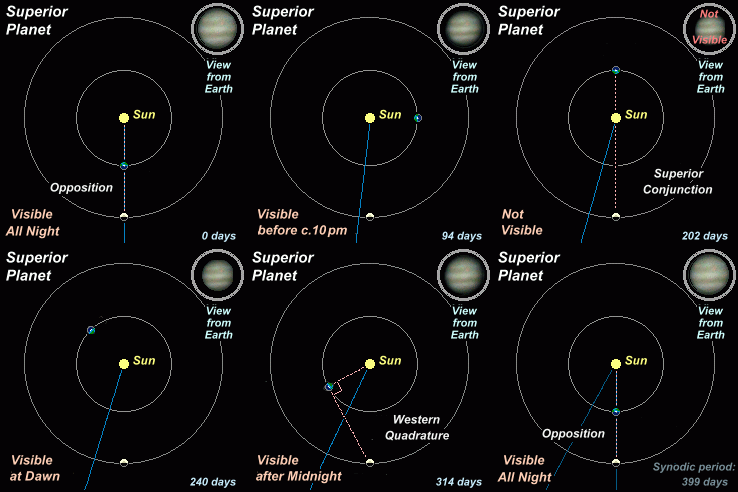
times. Venus passes between the earth
and the sun every 584-days or 5 times in 8 years.
Venus, in astronomical terms, completes five
synodic periods in 8 years, or 5 evening and morning
star circuits. The synodic interval is the
time between two successive conjunctions of a planet (Venus)
with the sun. Each observable synodic
period lasts about 1.6 Earth years or
584-days. Mesoamerican Calendars
meticulously track five Venus cycles of 584-days
each over 8 Haab-solar-year multiples of 365-days.
The true orbit of Venus around the sun is
225-days and should not be confused with Venus’
heliacal rising and observable behavior. Mayans
watched Venus progress in this manner 13
times, which culminates with one 104-Year
Venus Round. Observations involving planet Venus
allow deeper inspection of the records seen in chapter 5 of Genesis.
Early Israelite history mixes with content
drawn from celestial deities. Our Holy Bible draws
a line connecting astronomy, astrology and
calendar systems. The sun, moon, planets and
stars are natural timekeepers of the cosmos.
The Mayan version of Seth establishes
that a 104-Year Venus Round multiplies by a 365
day-Haab-solar-year to attain 37,960-days
in the Venus Round. Mesopotamian
cultures altered these figures slightly. Seth in
Egyptian mythology is a male god similar
to the Old Testament Baals. Biblical
Astarte or Astaroth is the female
fertility consort to Babylonian Baal. Standing
stones symbolized Baal or Bel, and his
alias names: Baalat, Molech or Marduk. A bull
frequently represents Baal/Seth. Ishtar
is the proper Babylonian name for the Canaanite
goddessAstarte, Asherah or Astaroth. Ishtar
was associated with planet Venus as the bright
morning star. Her Sumerian name is Inanna.
Later the Greeks would call her Aphrodite
and the Romans by the common name of today, Venus.
She equates with Greek Europa and Isis, the female
fertility goddess and consort to Osiris in
Egyptian mythology.
Venus was the bright morning star
throughout the ancient world. In Mesoamerica,
Venus was a powerful male deity.
Kukulatin or Quetzalcoatl dominated the Mesoamerican
pantheon. Mesopotamian religion,
throughout all stages and phases,
usually worshiped planet Venus in the feminine
gender. Lunar relationships between 19-year
or 20-year lunar/solar cycles likely shifted
patronage of the archetypal figure from masculine
to feminine. Transference to the female
goddess occurs for couples supplanting the male
godhead or vise versa. Ishtar/Inanna
shared Baal time control over 105-days
of Solar-Side
time split for any 20-year lunar/solar cycle.
Hence, 105-years of Solar-Side
time split followed suit for any 400-Year
Baktun Cycle. The Mayan & Egyptian
version 104-Year Venus Round naturally
substantiates theJewish
version 105-Years of Solar-Side
time split when we engage the resurrection
story. Ishtar/Baal, Isis/Seth and the
other examples are contingent upon the heliacal
risings of Venus. The Antediluvian
Calendar, an artifact initiated from naked-eye
human observation, stretches onward for hundreds
and thousands of years.
We must remember those preserving precious
knowledge down through history. Intrepid
copyists traversed desert and mountain alongside
brethren in the clan. Librarians at Nineveh
compiled and saved many cuneiform tablets.
Artists at ceremonial centers painstakingly carved
the legacy into stone for all to see. Tireless
monks working in dimly lit medieval rooms
spent their entire lives translating and revising
their interpretations of sacred scripture.
Everyone agreed that to permit any errors would
profane the sacred message they sought to protect.
Modern printing presses and computers are the medium
of exchange today.
Most attempts at past world chronology
backtrack in order to date the ancient past.
Since advances by the Roman Empire, the
secular western world and most of Christendom
use a solar calendar. Only in the last 50-years
or so, have archeologists in Central and South America been
able to decipher relevant calendar inscriptions.
A calendar system
that arose in Mesopotamia at least 5,000
years ago transfers to the new world by
seafaring travelers. The Moon, Sun, Sirius,
Venus and even Jupiter were all key
celestial players in this Antediluvian
Calendar system. The Antediluvian Calendar
was lunar/solar based and specific time cycles
included 210-days of lunar/solar separation time
during every 19-year or 20-year cycle.
Ancients graduated lunar/solar reckoning to
reach 400-years by squaring 20-years. The Mayan
Calendar asserts multiple 400-Year Baktun
Cycles were chronicled. Early astronomers
found that planet Venus adheres to a visible
104-Year Venus Round cycle.
Numerical matching of X-days with X-years stems
from a 364-day calendar year having Ethiopian
and Egyptian roots. A 364-day calendar year
was easier to implement, leaving one day every
year open for numerically matching the
phrase X Days & Years. Lunar/solar
separation time became 210-years for
every 400-Year Baktun Cycle. Time
splitting divides 210-years in two equal halves
and attributes 105-years to the lunar-side and
105-years to the solar-side. The Mayan
104-Year Venus Round increments by matching X
Days & Years in a single term. Mayan
104-Year Venus Rounds adapt from an earlier Mesopotamian 105
Day & Year Venus Round system. Seth’s 105-Year
Venus RoundPrimary Age
begets Enos to answer a 105-Year Solar-Side time split
and the Venus issue simultaneously. Going
further, two 400-Year Baktun Cycles add
together to produce a repeating 800-Year
Generation Cycle.
We need to recognize this material
was the ancient religion. Ideas and fixations
worshiped eons ago give us broader historical
appreciation. Countless people lived to
uphold paramount holidays prescribed by their
calendar. The Jewish Calendar still
appoints feasts and festivals in modern times.
Mesoamerican celebrations carry heritage that
teaches visitors the ancient spirituality. Babylonian
astrology and astronomy give us an early view of
scientific disciplines. Egyptology continues
to amaze everyone with spectacular finds.
Finally, the impact of the Holy Bible is far and ranging upon
modern society. Scholars and theologians have
scoured these scriptures and written volumes.
There are more questions than answers.
Modern views of very old Antediluvian Patriarch
ages appear in a different light. Perspectives
offered by lunar/solar calendars impart new
interpretations. Some help comes from published
Mesoamerican Calendar information. Other pieces
come from alternative sacred texts such as the
Book of Enoch and Book of Jubilees. Time
Emits strives to maintain accepted terminology
where applicable. Keeping geographical lore and
religious principles in mind, we are able to
employ lunar/solar calendars that penetrate to
the past extreme. The Antediluvian
Patriarchs provide historians with a calendar
sequence lasting literally thousands of years.
Our task is to understand the system they once
used.
Please be aware of the
forces that you are about to deal with!
Holy_of_Holies written content and illustrations
have undergone multiple revisions since first release. HoH_Readme
details a primer, top-down perspective regarding cyclic
flow for the Antediluvian pattern. Advancements
in defining lunar/solar terminology, appropriate
color coded text and abbreviations employed are
discussed. Basic classical Mayan Calendar
descriptions contributed greatly to building hyphenated
phrases in the Ages_of_Adam prequel.
Holy_of_Holies
Readme
Holy_of_Holies is
about the technical nature of multiple
ancient lunar/solar
calendar
systems. Section
links
within the book are listed in the Table of
Contents. Links to
individual mobile
articles can
sometimes help to clarify a topic. Resource
links may show in the Table
of Contents, Table
of Figures, or a more> link to
additional information.
Previous Ages_of_Adam
articles have been
updated. New
books assembled from work collection often have
redundancy. Sometimes a
point may need to be
reinforced or clarified.
Images may require touch-up,
resize or
improved
placement.
Whole paragraphs
or sentences can be
inadvertently
duplicated. Manuscript
proof reading and
revisions are continual.
New
SVG images for improved mobility are about 85% complete.
The as-is status of Holy_of_Holies
should not preclude
anyone from buying
the new release in pdf
format from
Paypal-payloadz. Purchasers
will automatically
enroll in a Focus
Group and be
entitled to obtain
new versions of
the book about once
a month. Cost
estimates for the
finished book price are
$34.95 when the PDF
version is
formally submitted to
Amazon POD. The Preliminary Edition Kindle
version and auto
downloads from
Payloadz will be
available. Payloadz
Pre-Order
download price is now
set at $34.95 per
book. Authorized
purchasers can get
monthly updated full
copies through all of
2017. HTML files
are about 10 mb and PDF
files 5 mb. Both file
types are visible on all
screen sizes, although
standard desktop or
laptop best renders
text with graphics. PDF
355 pages
are printable A4 size
and 11 pt. type.
Fallback display images
are present for most
screen sizes. The book
is not specifically
formatted for printing.
Holy_of_Holies is
expected to generate
significant interest. Focus
Group members are
encouraged to ask
questions and
comment. Year
2017 is a trial
period while people
absorb this Calendar
Research material.
Preliminary Editions are assigned a Password. Instant download links will come with the Password required to open the protected PDF document. Monthly updated PDF versions will need a new
Password and the new download link will be sent to your email address upon purchase. Copyright and ISBN
provisions
apply to Holy_of_Holies
since it is
considered a
derivative
work of the original
Ages_of_Adam.
Password
Protect decreases
the
opportunity
for potential
hacks, cracks
and
infringements.
Editing
usually take
place on the Holies_of_Holies
homepage.
Visit Table
of Contents
to see present
and pending
section
labels.
The first 90%
of the book is
currently
stable.
Remaining
sections will
be imported
soon. Future
updates can be
seen here
prior to
downloading a
fresh copy. We
are seeking Ministry Affiliates and Focus
Group
participantsto
share in social media distribution. Original Calendars_of_Creation
covers are available too.
Antediluvian
Patriarchs Adam through Enoch alternate Primary
Ages between Lunar/Solar
260-Year Tzolken-Sacred-Cycle 1
and Solar-Side 260-Year
Tzolken-Sacred-Cycle 1-2. The whole lineage of Genesis
5 progresses in a ladder-like order. Lunar/Solar 260-Year
Tzolken-Sacred-Cycle 1 begins with Adam.
His son, Seth starts Solar-Side 260-Year
Tzolken-Sacred-Cycle 1. Flow returns to Lunar/Solar 260-Year
Tzolken-Sacred-Cycle 1 when Seth
fathers Enos. Enos begets Cainan and the
calendar alternates back to Solar-Side
260-Year Tzolken-Sacred-Cycle 1. Cainan
fathers Mahalaleel to begin Solar-Side 260-Year
Tzolken-Sacred-Cycle 2. Mahalaleel
alternates the flow to complete Lunar/Solar 260-Year
Tzolken-Sacred-Cycle 1. Mahalaleel
sires Jared to accomplish intersections on both
sides. Jared finishes Lunar/Solar
260-Year Tzolken-Sacred-Cycle 2 and
simultaneously fulfills Solar-Side
260-Year Tzolken-Sacred-Cycle 3. Seventh
Patriarch Enoch sums the Lunar/Solar
group by opening Lunar/Solar
260-Year Tzolken-Sacred-Cycle 3 and his
heavenly translation.
The Mesopotamian term, 360
day-midpoint-year was originally adopted in Ages_of_Adam.
Earliest lunar/solar calendars chose a
central 360-day midpoint position between a
lunar-side lasting 12-lunations and the
solar-side having 365-days. Ancient biblical
time is always cyclic. The first course of time is
laid to become the foundation layer for the next
course of time. A series of numbered repetitions are
the key. Longer times are then successively measured
by multiples courses. All lunar/solar
calendars carry a natural tendency to measure
necessary lunar/solar separation time. The Jewish
Calendar distributes about 209-days of lunar/solar
separation time by inserting 7-months
over a 19-year lunar/solar cycle. Mayan
and Egyptian versions approximated 210-days
of lunar/solar separation time over 20-year
lunar/solar cycles. Time rendering
concepts include squaring specific cycles to
obtain a numbered multiple. Mayan and
Egyptian l/s calendars multiplied a Katun
20-year l/s cycle by itself. The 400-Year
Baktun Cycle result creates a stepped l/s
calendar able to count vast epochs.
Genesis 5 scripture is re-written as a
mathematical expression for Antediluvian
Patriarchs: Adam, Seth, Enos, Cainan, Mahalaleel,
Jared and Enoch. All Primary Age Category
entries extend until each character "begat" his
next named son. Primary Age is the
first of two numbered ages describing his lifetime.
Secondary Age is the second numbered age
lasting until the character ends. Adam Primary 130-Year Age
is the concise example applied to Genesis 5:3.
Mayan & Egyptian and Jewish are the two
general classifications for Holy_of_Holies
calendar material. Mayan & Egyptian is
the main source for terminology, codified as
necessary and drawn from classical Mayan
Calendar study. Jewish refers to Holy
Bible scripture taken from the Old
Testament. Lunar/Solar calendars
involve an exceptional kind of arithmetic. Phrases
and terms are inherently limited to simple
operations: addition, subtraction, multiplication
and division. The key to understanding the math used
in this body of work is to grasp the basics. Anyone
must start reading a good book from the beginning. Mayan &
Egyptian and Jewish lunar/solar calendars
have many commonalities. Most formulas define the
character name in bold black, followed by
numerical quantity and the specific term. Adam Primary 130-Tun-Year Age
indicates the Adam
personage. Primary is
Adam's first quoted age he begat
his listed son, Seth. The quantity is 130. Tun is a Mayan
Calendar term meaning a 360 day length
of year. Age
captures the period ... an hundred and
thirty years. Green text and graphics below
signify Adam is a Lunar/Solar name. Mayan
52-Year Calendar Rounds culminate a dual
system for tracking multiple years. The Mayan
Tzolken embodies sacred, ritualistic types of
year. Each Tzolken-sacred-year has 260-days.
The hyphenated phrase 260
day-Tzolken-sacred-year summarily operates in
conjunction with 360 day-Tun-years to
accomplish every 52-Year Calendar Round. The
52-Year Calendar Round counts 18,980-days.
Ordinary 365 day-solar-years are used to
compute 52-Year Calendar Rounds.
There are 73-Tzolken-sacred-years per each 52-Year
Calendar Round.
Antediluvian Patriarchs Adam through
Enoch adhere their respective Primary Ages
to either the Lunar/Solar
260-Year Tzolken-Sacred-Cycle or the Solar-Side 260-Year
Tzolken-Sacred-Cycle. Adam, Enos and
Mahalaleel together add to create the first Lunar/Solar 260-Year
Tzolken-Sacred-Cycle 1. Enoch begins
the first quarter of Lunar/Solar
260-Year Tzolken-Sacred-Cycle 2. Green text and graphics
are used for Lunar/Solar
Adam, Enos and Mahalaleel Primary Age Category
members.
Adam Primary 130-Tun-Year
Age establishes the Holy_of_Holies convention
for paraphrasing Genesis
5:3 above. Adam in black text
indicates the first Patriarch's name and
general information. Adam is the first Lunar/Solar
character of the Primary Age Category. Green text and applicable
graphics denote Adam
had 130-Tun-Years
marking his Primary Age
until his son, Seth was born. Mayan 360
day-Tun-years universally refers to prior Mesopotamian
360 day-midpoint-years and computations
involving Lunar/Solar
260-Year Tzolken-Sacred-Cycle 1. Adam through Jared have Secondary Age Category
elements that continue from fatherhood until
the Patriarch's death. Adam Secondary
800-Year Generation Cycle 1 Age immediately
follows Adam Primary
130-Year Age per scripture. The Secondary
Age Category numbers 400-Year Baktun
Cycles 1-13. Adam spans two sequential
400-Year Baktun Cycles 1-2 to initiate Adam
Secondary 800-Year Generation Cycle 1 Age. Adam
400-Year Baktun Cycle 1
plus Adam
400-Year Baktun Cycle 2
combine the first two Baktun 400 year l/s-cycles.
Adam Secondary 800-Year Generation Cycle 1 Age
is the root template for Antediluvian
characters through Jared.
Genesis 5:4
“And
the days of Adam after he had begotten Seth were
eight hundred years: and he begat sons and
daughters:”
Adam Secondary 800-Year Generation Cycle 1 Agemore>
Adam 400-Year Baktun Cycle
1 identifies active green text that
generates Adam Primary 130-Year Age.
Adam
400-Year Baktun Cycle 2 identifies
the inactive
blue text second half of Adam
Secondary 800-Year Generation Cycle 1 Age. Inactive blue text and
graphics increment the
cumulative Secondary Age Category total when
Adam
400-Year Baktun Cycle 2 is
considered. Lunar/Solar
260-Year Tzolken-Sacred-Cycle 1
regards Adam, Enos and Mahalaleel Primary
Ages.
Active red text and
graphics describe Solar-Side Seth,
Cainan and Jared Primary Age
Category members. Seth and Cainan
make the first Solar-Side 260-Year
Tzolken-Sacred-Cycle 1. Seth and Cainan
combine again in reverse order to implement Solar-Side 260-Year
Tzolken-Sacred-Cycle 2. Two episodes of Cainan
Primary
70-Tzolken-sacred-year Age and Jared
Primary 162-Ethiopic-Year
Age finish Solar-Side
260-Year Tzolken-Sacred-Cycle 3.
Secondary Age Category 400-Year
Baktun Cycles 1-13 generate
respectively numbered Venus Round 1-13.
Mayan and Egyptian versions modify 210-days
of lunar/solar separation time over Katun
20year lunar/solar cycles
to become 210-years of lunar/solar separation
time over Baktun 400 year
l/s-cycles. Only the Solar-Side 104-Year
or 105-Year half is counted in developing Solar-Side
260-Year Tzolken-Sacred-Cycles. Seth
is the first Solar-Side
time split Antediluvian Patriarch. There are two
types of Venus Rounds: Jewish
105-Year Venus Rounds allude to the biblical
Seth Primary Age example value.
Special Solar-Side
holiday consideration must be given to the last
5-days following a 360 day-Tun-year. The
ancient Jewish 364 day-Ethiopic-year
includes 4-holidays that add with every 360
day-Tun-year. The final, last 365th-day is
not counted in regular, 365 day-solar-year
computations according to sacred texts.
Solar-Side
260-Year Tzolken-Sacred-Cycles
are criterion that express an overarching paradigm.
Seth, Venus and a host
of related topics hinge upon 104-Year /
105-Year Venus Rounds. Venus
Rounds hold the key to Day & Year numerical
matching. Holy One
acknowledgement and Sabbath observance
ascend to a whole new level. Mayan
& Egyptian 52-Year Calendar Rounds
occur five times in every Solar-Side
260-Year Tzolken-Sacred-Cycle,
making it evenly divisible. Two and one half Venus
Rounds every 260-Years contrast with
the Jewish
system.Five
Jewish 50-Ethiopic-year
Jubilee Cycles
provide the alternative using 364-day-Ethiopic-years.
Jewish Solar-Side
260-Year
Tzolken-Sacred-Cycles
need to be counted twice for even Venus
Round division. The Holy Bible
embraces this Solar-Side
method to accomplish unity
Day & Year numerical matching.
Ancient thesis counts Seth
twice to get Cainan's
Ages, and Cainan
twice to get Jared's
Ages. The plan is unbelievably
old.
"And Seth lived an
hundred and five years, and begat Enos:"
Jewish Seth Solar Primary 105-Ethiopic-year
Venus Round 3 Age
sample abbreviation: Jewish Seth S 105-Y
VR 3, with Patriarch Names
and VR numbering to suit Mayan
& Egyptian Seth Solar Primary 104-Year Venus
Round 3 Agemore> sample
abbreviation: Mayan
& EgyptianSeth S 104-Y VR 3,
with Patriarch Names and VR
numbering to suit
Two main Venus Round variations involving Seth
and Cainan are in play for Solar-Side 260-Year
Tzolken-Sacred-Cycles 1-2. Jewish Seth Solar Primary 105-Ethiopic-year
Venus Round 3 Age specifies a Holy_of_Holies
descriptor having multiple attributes. Adopting this
convention enables later character descriptions to
follow similar nomenclature. Attributes include:
1. Jewish methodology stems from original
scripture.
2. Seth is the Patriarch's name.
3. Active red bold text
is chosen for Solar-Side
entries or some using Solar.
4. Primary Age serves
to differentiate Seth's first listed age
from his Secondary Age.
5. 105-Ethiopic-years
identifies 364 day-Ethopic-years used for Solar-Side
calculations. Day & Year numerical
matching also plays a role.
6. Venus Round
is a term derived from Seth Primary 105-Ethiopic-year Venus Round 3
Age.
7. Number 3 is the Venus Round
count generated by Seth 400-Year Baktun Cycle 3.
8. The Jewish l/s
calendar system slightly modifies the Mayan & Egyptian
l/s calendar system.
Mayan
& Egyptian Seth Solar Primary 104-Year Venus
Round 3 Agespecifies
a Holy_of_Holies descriptor having multiple
attributes. Adopting this convention enables later
character descriptions to follow similar
nomenclature. Attributes include:
1. Mayan
& Egyptian uses
typical Mayan
52-solar-year Calendar Rounds.
2. Seth is the Patriarch's name.
3. Red bold text
is chosen for Solar-Side
entries or some using Solar.
4. Primary Age serves
to differentiate Seth's first listed age
from his Secondary Age.
5. 104-Year is
a way to precise identify the 365-day-solar-year
used for Solar-Side
calculations.
6. Venus Round
is s term that adds two 52-solar-year Calendar
Rounds in order to make the 104-Year Venus Round.
7. Number 3 is
the Venus Round
count generated by Seth 400-Year
Baktun Cycle 3.
Genesis 5:7
"And Seth lived after he begat Enos
eight hundred and seven years, and begat sons
and daughters:"
Seth Secondary 807-Year Generation Cycle 2
Age expresses Seth's age after he
fathers Enos. Seth 400-Year Baktun Cycle 3
identifies active red text
that generates
Jewish Seth
Solar Primary
105-Ethiopic-year Venus Round 3 Age
or Mayan
& Egyptian Seth Solar Primary 104-Year Venus
Round 3 Age
during the first half of Seth 800-Year
Generation Cycle 2.Seth 400-Year
Baktun Cycle 4 employs inactive blue
text to
distinguish the latter half of 800-Years. Jewish Seth
finds a special holiday
5-Ethiopic-year tag
that enables tracking of multiple Solar 105-Ethiopic-year
Venus Rounds.
Holy_of_Holies
separately numbers Solar
105-Ethiopic-year Venus Rounds
according the Patriarch. AlternatingLunar/Solar with Solar-Side
Patriarch Names governs their placement
within proper Lunar/Solar or Solar-Side
260-Year
Tzolken-Sacred-Cycles.
Seth Secondary
807-year Generation Cycle 2 Age more>
Lunar/Solar Enos
alternates generational flow from the Solar-Side to
accomplish the third quarter of Lunar/Solar 260-Year
Tzolken-Sacred-Cycle 1. Notice also biblical
time units change from 360 day-Tun-years
to 260 day-Tzolken-sacred-years to correctly
exchange between Adam and Mahalaleel. Enos
Primary
90-Tzolken-sacred-year Age is the
reported age, which equals the converted
answer Enos Primary 65-Tun-Year Age.
Enos 400-Year Baktun Cycle
5 generatesactive green Enos
Primary
90-Tzolken-sacred-year Age. Inactive blue Enos
400-Year Baktun Cycle 6
occurs during the second Baktun 400 Year
l/s-cycle half of Enos Secondary 815-Year
Generation Cycle 3 Age. Three separate holiday
5-Ethiopic-year tags include one for Seth's
Primary Age, the second after Seth 400-Year Baktun Cycle 4,
and a third representing Enos 400-Year Baktun Cycle 5.
The baseline 800-Year Generation Cycle
repeats a third time for Enos, plus 15-Ethiopic-years
conclude Enos Secondary 815-Year Generation
Cycle 3 Age.
"And Enos lived after he begat Cainan
eight hundred and fifteen years, and begat sons and
daughters:"
Enos Secondary 815-year
Generation Cycle 3 Age more>
Partitions in the Antediluvian
Calendar year lay the groundwork for
establishing two different types of cycles. Mayan
260 day-Tzolken-sacred-years and 360
day-Tun-years exist simultaneously to support
a complex calendar arrangement. A standard 365
day-solar-year divides according to the 260
day-Tzolken-sacred-year, and 100-days
later, a 360 day-Tun-year. Five-days
remain at the end of every 365 day-solar-year.
The Jewish 364day-Ethiopic-calendar-year
variation includes a 4-day Solar-Side component
marked by four principal archangel, royal stars
directing four 91-day quarters. Ethiopic
364 day-years reserve the final day
for numerically matching X-Days &
X-Years. Each Primary Age occurs when
the next son is born.
Solar-Side
Cainan returns the process to Solar-Side
260-Year Tzolken-Sacred-Cycle 1.
Cainan is the third generation
following Adam and fixes Cainan Primary 70-Tzolken-sacred-year
Age as the second time split
of Solar-Side
260-Year Tzolken-Sacred-Cycle 1. The Jewish
version of Solar-Side
260-Ethiopic-year Tzolken-Sacred-Cycle 1
includes twice Jewish Seth Solar Primary 105-Ethiopic-year
Venus Round 3 Age. Seth's Primary 105-Ethiopic-years
add with Seth's second 105-Ethiopic-years obtained
after inactive blue
Seth 400-Year Baktun Cycle
4 changes color. Seth
400-Year Baktun Cycle 4
becomes active red
beyond Midpoint in the Secondary Age
Category. Jewish
Solar-Side
260-Ethiopic-year Tzolken-Sacred-Cycle 1
brackets
210-Ethiopic-years plus Cainan Primary 70-Tzolken-sacred-year
Age. Like Enos, conversion
takes place to fully realize the subject Solar-Side
260-Ethiopic-year Tzolken-Sacred-Cycle. Cainan
Primary
70-Tzolken-sacred-year Age
converts to 50-Ethiopic-years using 364
day-Ethiopic-years. Solar-Side
260-Ethiopic-year Tzolken-Sacred-Cycle 1
finishes once converted Cainan Primary 50-Ethiopic-year
Age
generates.
Genesis 5:12
"And Cainan lived
seventy years, and begat Mahalaleel:"
Cainan Primary 70-Tzolken-sacred-year
Age =
Cainan Primary
50-Ethiopic-year Age
Jewish Cainan
Solar Primary 70-Tzolken-sacred-year
Age more> Jewish Cainan
Solar Primary
50-Ethiopic-year Jubilee Cycle Age Mayan
& Egyptian Cainan Solar Primary 73-Tzolken-sacred-year
Age more> Mayan
& Egyptian Cainan Solar
Primary 52-Year Calendar Round Age Genesis 5:13
"And Cainan lived
after he begat Mahalaleel eight hundred and forty
years, and begat sons and daughters:"
Cainan
Secondary 840-Year
Generation Cycle 4 Age more>
Cainan
Secondary 840-Year
Generation Cycle 4 Age recognizes three
individual components. Cainan 400-Year Baktun Cycle 7
provides the first half of Cainan 800-Year
Generation Cycle 4 following the previous
Secondary Age Category template
style. Solar-SideCainan
400-Year Baktun
Cycle 7 with active red text generates
both Cainan
Primary 70-Tzolken-sacred-year
Age
or Cainan Primary
50-Ethiopic-Year Age variations.
Canonical Jewish Cainan Primary
70-Tzolken-sacred-year Age
revises to accommodate Solar-Side
260-Ethiopic-year Tzolken-Sacred-Cycles 1-2.
The ladder
structure above is an effective math
statement whereby the
Lunar/Solar
left rail equals the Solar-Side
right rail. Solar-SideCainan
400-Year Baktun
Cycle 7
ends at his Secondary Age
Midpoint l/s position
halfway through 800-Years.
Cainan Midpoint completes Primary Age
Category Solar-Side
260-Ethiopic-year Tzolken-Sacred-Cycle 1.
Solar-SideCainan
400-Year Baktun
Cycle 8
is shown inactive blue text
prior to Cainan
Primary 70-Tzolken-sacred-year
Age
finishing. Following Cainan
Midpoint, Cainan
400-Year Baktun
Cycle 8 switches
color to active
red Cainan
400-Year Baktun Cycle
8. Solar-Side 260-Ethiopic-year
Tzolken-Sacred-Cycle 1
counts 2 x Jewish
Seth Solar Primary
105-Ethiopic-year Venus Round 3 Age (S
105-Y VR 3 in later Figures),
plus Cainan Primary 50-Ethiopic-Year
Age to get 260-Ethiopic-years.
Cainan 400-Year
Baktun Cycle 8past Midpoint,
reverses the procedure to keep Solar-Side Primary Ages
on track with Lunar/Solar Primary Ages.
Solar-Side
260-Ethiopic-year
Tzolken-Sacred-Cycle 2 starts by
counting Cainan
70-Tzolken-sacred-years(or Cainan
50-Ethiopic-Years)a second time. Cainan's
50-Ethiopic-Year
descriptor
substitutes for the
authentic Primary Age during
Cainan
400-Year Baktun Cycle 8. Solar-Side260-Ethiopic-year
Tzolken-Sacred-Cycle
2
must admit
equivalency to
attain 2 x Jewish
Seth Solar
Primary
105-Ethiopic-year
Venus Round 3
Age. Solar-Side
260-Ethiopic-year
Tzolken-Sacred-Cycle
2
finalizes in
preparation
for changing
flow back to
the Lunar/Solar
left hand
rail.
Cainan
completes four
Solar-Side
5-Ethiopic-year tags to end his Cainan
Primary 70-Tzolken-sacred-year
Age(or Cainan
Primary
50-Ethiopic-Year
Age).Cainan
70-Tzolken-sacred-years,
obtained during red activeCainan
400-year Baktun Cycle 8, doubles
20-Ethiopic-years to arrive at 40-Ethiopic-years.Cainan
Secondary 840-Year
Generation Cycle 4 Age includes
the repetitive, standard 800-Tun-year Generation
Cycle portion plus
the last 40-Ethiopic-years.
Mixing 800-Tun-years
and 40-Ethiopic-years
is necessary to account for all eight
(8) 105-Ethiopic-year Venus Round
segments.
Distant Judaism projects at least three
scenarios for evaluating Solar-Side
49-Year and/or 50-Year Jubilee Cycles. The
most logical is a 50-Ethiopic-year Jubilee Cycle
since whole number integer results were
always sought. Cainan
Primary 70-Tzolken-sacred-year
Age
precisely equals converted
Cainan
Primary
50-Ethiopic-Year
Age.
Sabbatical sanctity observes according to multiples
of 7. In this second case, 7-day-weeks, 7-intercalary-months,
7-year-weeks, and finally 49 Day &
Year enumerations pertain to Exodus
Jubilee Cycles. A third possibility defers
further l/s intercalation until the 50th
lunar-year or 365 day-solar-year.
Removed Figure 7 Invert Cainan
VR8
Mayan & Egyptian
versions of the Antediluvian Calendar
defined here naturally reckon in 52-solar-year
Calendar Rounds. Archaeologists have
reported up to twenty different methods of
counting the last 5-days every
year. Vast Mesoamerican culture had
no common, specific way to count beyond 360
day-Tun-years. Some tribal evidence does
support a stylized 364 day-Ethiopic-year
with ambiguous reference to preserving the final
365th-day as holy. Sun, Moon
and Venus were profoundly Mesoamerican
and Egyptian celestial timekeepers.
Comparable Mayan & Egyptian
study assigns two Mayan &
Egyptian 52-Year Calendar Rounds for
every Solar-Side
104-Year Venus Round.
Acclaimed Seth in Egyptology and Venus
share many deified roles with Mesoamerican
beliefs. Mayan & Egyptian Seth Solar Primary 104-Year Venus
Round 3 Age (S 104-Y VR 3 in later
Figures) slightly alters perceptions
regarding Solar-Side
characters Seth, Cainan and Jarad.
Solar-Side
260-Year Tzolken-Sacred-Cycles
1-2 replaces
Jewish
105-Ethiopic-year Venus Rounds
with Mayan
& Egyptian 104-solar-year Venus
Rounds.
Twice Mayan & Egyptian Seth Solar Primary 104-Year Venus
Round 3 Age amounts to 208-solar-years. Mayan
& Egyptian Cainan Solar Primary 52-Year Calendar
Round Age remains to complete chain
diagrams involving Solar-Side
260-Year Tzolken-Sacred-Cycles 1-2.
Genesis 5:15
"And Mahalaleel lived sixty and
five years, and begat Jared:"
"And
Mahalaleel lived after he begat Jared eight
hundred and thirty years,and begat sons and
daughters:"
Mahalaleel Secondary 830-year
Generation Cycle 5 Age more>
Mahalaleel Primary
65-Tun-year Age adds the fourth
and final quarter to Lunar/Solar
260-Year Tzolken-sacred-cycle 1. Mahalaleel
alternates the
time stream in
two different
ways. Another
transition
to Lunar/Solar
260-Year
Tzolken-Sacred-Cycle
1 from Solar-Side
260-Ethiopic-year
Tzolken-Sacred-Cycle
2 has
occurred. Primary
Age units
also change
from Enos Primary
90-Tzolken-sacred-year
Age,
using 260
day-Tzolken-sacred-years, to Mahalaleel Primary
65-Tun-year
Age, which uses 360 day-Tun-years. Secondary Age Category
Mahalaleel 400-Year Baktun Cycle 9generates Mahalaleel Primary
65-Tun-year
Age during his first Baktun 400year
l/s-cycle
half
of Mahalaleel Secondary 830-Year Generation Cycle 5 Age. Mahalaleel 400-Year Baktun
Cycle 10
indicates the
inactive
blue, second Baktun
400year l/s-cycle
half of Mahalaleel Secondary 830-Year Generation Cycle 5 Age. Finally, three separate 5-Ethiopic-year tags
accumulated by
Enos
Secondary
815-year
Generation Cycle
3 Age
double to give
Mahalaleel
six full5-Ethiopic-year
tags or
30-Ethiopic-year
in his
Secondary
830-Year
Generation
Cycle 5 Age.
Genesis 5:18
"And Jared lived an hundred sixty and two years,
and he begat Enoch:"
Jared is the only Convergent Point in
the Antediluvian hierarchy. Jared
Primary 162-Year Age unites Lunar/Solar and Solar-Side
branches of the Primary Age Category.
On the Solar-Side
of the calendar ladder, moving down
from Cainan skips over Lunar/Solar Mahalaleel
to sequence Solar-Side
Jared. Lunar/Solar continuity
finishes Lunar/Solar 260-Year
Tzolken-Sacred-Cycle 1
after the Solar-Side
measures 8 Venus Rounds
at Cainan's
end.Jared
has two Primary Ages that
show the Convergent
Point
for Lunar/Solar
and Solar-Side
260 Day & Year
Tzolken-Sacred-Cycles.
Lunar/Solar
Adam(130-Tun-Years),
Enos
(90-Tzolken-sacred-years equal to
65-Tun-Years)
and Mahalaleel
(65-Tun-Years)
form Lunar/Solar
260-Year Tzolken-Sacred-Cycle
1.
Converted Enos Primary
65-Tun-Year Age
and Mahalaleel Primary 65-Tun-Year Age are quarters of
Lunar/Solar 260-Year Tzolken-Sacred-Cycle 1. Lunar/Solar
260-Year
Tzolken-Sacred-Cycle
2 divides into 8
parts to begin. Lunar/Solar reset
is exactly what
happens for Jared.
Since
the Solar-Side numerically matches 8-solar-years per
5-point Venus
Star, Jared next
restarts Solar-Side
counting
for all
8 Venus Rounds. Jared,
the sixth Antediluvian
Patriarch,
also restartsLunar/Solar
260 Day & Year
Tzolken-Sacred-Cycle
2
in the Primary Age
Category.
Upon reaching 8 Venus Rounds,
Jared finishes Solar-Side
260 Day & Year
Tzolken-Sacred-Cycle 3.
Jared Primary
162-Year Age merges both sides of the
lunar/solar calendar ladder. There are two
Primary Age Category descriptors
for Jared.
1. Jared Primary
162-Tun-year Age in Lunar/Solar 260 Day
& Year Tzolken-Sacred-Cycle
2 and 2. Jared Primary 162-Tun-year Age in Solar-Side 260
Day & Year Tzolken-Sacred-Cycle
3.
Genesis 5:19
"And Jared lived after he begat
Enoch eight hundred years, and begat sons and
daughters:"
Jared Secondary 800-Year
Generation Cycle 6 Age duplicates Adam
800-Year Generation Cycle 1 to renew Lunar/Solar 260Day & Year Tzolken-Sacred-Cycle 2
in the Primary Age Category. Lunar/Solar 260
Day & Year Tzolken-Sacred-Cycle 1 divides
by 2 Venus Rounds for Adam, then 4
Venus Rounds for Enos and 4 Venus
Rounds again for Mahalaleel. The Secondary Age Category assigns Mahalaleel 400-Year Baktuns 9-10, with active green Mahalaleel 400-Year Baktun Cycle 9 generating Jewish 105-Year Venus Round 9 (Mahalaleel S
105-Y VR 9). MahalaleelPrimary
65-Tun-Year Agefourth
quarter entry inserts between Solar-Side
separations by Cainan and Jared. Lunar/Solar Jared's
given Primary
162-Tun-Year Age specifies 360
day-Tun-years that convert to 224-Tzolken-sacred-years.
Jared Primary 162-Tun-Year
Age adjusts Lunar/Solar
260Day & Year
Tzolken-Sacred-Cycle 2 corresponding to
8 Venus Rounds. Imitating Adam’s Primary 130-Tun-Years
partially fulfills Jared’s given Primary 162-Tun-year Age.
Solar-Side Cainan to
Jared operation divides Lunar/Solar 260 Day &
Year Tzolken-Sacred-Cycle 2 according
to 8 Venus Rounds. JaredPrimary 162-Tun-year Age
adds 130-Tun-years
and the rounded 1/8 part
of 260-Tun-Years, 32-Tun-years. Jared
restarts Lunar/Solar
260Day & Year
Tzolken-Sacred-Cycleas number 2,
repeating AdamPrimary
130-Tun-year Age coincident with his
Secondary 800-Year Generation Cycle 1 Age. Adam
800-Year Generation Cycle 1 Age and Jared 800-Year
Generation Cycle 6 Age together reset
for Lunar/Solar 260Day & Year Tzolken-Sacred-Cycle 2.
Solar-Side Jared Primary
162-Tun-year Agefinishes Solar-Side 260 Day
& Year Tzolken-Sacred-Cycle 3.
Jared marks the active
red third Solar-Side
time split following Seth and Cainan
in the Primary Age Category. Solar-Side
separations held by Seth and Cainan
complete Solar-Side
260 Day & Year Tzolken-Sacred-Cycle 1.
Cainan and Seth repeat Solar-Side
separations for a second time, shown in
reverse order, to fulfill Solar-Side 260
Day & Year Tzolken-Sacred-Cycle 2.
Every Solar-Side
action occurring in relation to Cainan 400-Year Baktun Cycle 7before Midpoint, must happen a second
time for Cainan 400-Year
Baktun Cycle 8 after
Midpoint. CainanPrimary
70-Tzolken-sacred-year Age
generates during his 400-Year
Baktun Cycle 7 to finish Solar-Side 260-Day
& Year Tzolken-Sacred-Cycle
1. Cainan400-Year
Baktun Cycle 8 then generates
another 70-Tzolken-sacred-year segment to begin Solar-Side
260 Day & Year Tzolken-Sacred-Cycle 2. Solar-Side Cainan
to Seth illustration inverts the lower
diagram (Figures 3-4) solely to
distinguish differences between Solar-Side 260
Day & Year Tzolken-Sacred-Cycle 1
and Solar-Side 260
Day & Year Tzolken-Sacred-Cycle 2.
Solar-Side
260 Day & Year Tzolken-Sacred-Cycles 1-2
are valid for 260-Ethiopic-years that use 364
day-Ethiopic-years or 364-Ethiopic-years
that use 260 day-Tzolken-sacred-years. Solar-Side 260 Day
& Year Tzolken-Sacred-Cycle 1 includes twice
Seth Primary
105-Ethiopic-year Venus Round 3 Ageor
210-Ethiopic-years.
Jewish
Seth 105-Ethiopic-year Venus Round 3,
plus Jewish
Seth 105-Ethiopic-year Venus Round 4,
add with CainanPrimary
70-Tzolken-sacred-year Age. Conversion to Jewish
Cainan Primary
50-Ethiopic-year Age entirely
finishes Solar-Side
260 Day & Year Tzolken-Sacred-Cycle 1 (Figure
3). Seth to Cainan Venus Round flow
leaves Cainan 1/2 VR
7 remaining on the bottom of Figure
3. Solar-Side
260 Day & Year Tzolken-Sacred-Cycle 2
inverts, or reverses to compute Cainan to
Seth flow in Figure 4. Twice counting
Seth's Primary Age again
leaves Cainan 1/2 VR 8, either as Jewish
Cainan Primary
50-Ethiopic-year Age or CainanPrimary
70-Tzolken-sacred-year Age.
Figures 3-4 measure Solar-Side
260 Day & Year Tzolken-Sacred-Cycles 1-2 to
provide twice Cainan's Primary
Age. Cainan 1/2 VR 7 plus Cainan
1/2 VR 8 express two
converted Cainan
50-Ethiopic-year periods or
100-Ethiopic-years together.
The same is true for two Cainan
70-Tzolken-sacred-year Primary Ages that total 140-Tzolken-sacred-years of Solar-Side time split.
Still on the Solar-Side of the Patriarchal
ladder, Jared Primary 162-Tun-year Age
starts Solar-Side
260 Day & Year Tzolken-Sacred-Cycle 3. Twice
Cainan's Primary Age
results in 100-Ethiopic-years
carried forward to begin Solar-Side 260 Day
& Year Tzolken-Sacred-Cycle 3. The
canonical equivalent 140-Tzolken-sacred-years likewise
registers part of Solar-Side364 Tzolken-sacred-year cycle 3. CainanPrimary
70-Tzolken-sacred-year Age doubles,
then subtracts 140-Tzolken-sacred-years
from the equivalent Solar-Side 364
Tzolken-sacred-year cycle 3.
Subtracting 140-Tzolken-sacred-years,
224-Tzolken-sacred-years remain to verify Jared’s
third Solar-Side
time split. Jared
Primary 162-Tun-year Age calculates
nearly equal to 224-Tzolken-sacred-years or
58,240-days. The other way subtracts 100-Ethiopic-years
directly from Solar-Side 260 Day & Year
Tzolken-Sacred-Cycle 3
to give close approximation, 160-Ethiopic-year
for Jared's
Primary Age.
Substitute Jewish
Solar-Side 49-Ethiopic-year Jubilee
Cycles preserve Sabbath continuity on
a grander scale. Some Jewish Sects
seem to have mixed Jubilee Cycle kinds,
while others sought to mark every l/s calendar
interval with multiples of seven. In
this case, twice Cainan's Primary Age
amounts to 98-Ethiopic-years.
Subtracting 98-Ethiopic-years from Solar-Side 260 Day & Year
Tzolken-Sacred-Cycle 3
lands
exactly on Jared Primary
162-Ethiopic-year Age. The Antediluvian
Calendar
Solar-Side chain driven by Seth,
Cainan and Jared uses either 49-Ethiopic-year
or 50-Ethiopic-year
Jubilee Cycles and dates from before the Exodus.
Seth’s Primary Age doubles to
reach Cainan’s Primary Age, and
Cainan’s Primary Agedoubles
again to reach Jared’s Primary Age.
Jared's Convergent Point between Lunar/Solar and Solar-Side Patriarchal
Ages stands at Jared Primary 162-Year Age.
Lunar/SolarJared Primary
162-Tun-year Age classifies 360
day-Tun-Years in the
fashion of Adam, Enos and Mahalaleel. Once Mahalaleel finalizes Lunar/Solar 260 Day &
Year Tzolken-Sacred-Cycle 1, the next expected
Lunar/Solar
character is Enoch. Previous alternating
patterns dictate Lunar/Solar flow extending from Mahalaleel to skip over Solar-Side
Jared. Jared
Secondary 800-Year Generation Cycle 6 Age presents an
inflection. Jared duplicates
Adam Secondary
800-Year Generation Cycle 1 Age after Lunar/Solar 260
Day & Year Tzolken-Sacred-Cycle 1 ends. Adam
Primary 130-Tun-Year Age
also repeats in the Primary Age Category.
Resetting the Lunar/Solar 260 Day & Year
Tzolken-Sacred-Cycle a second
time addresses completing 8 Solar-Side Venus
Rounds. Logic adds 130-Tun-Years and 1/8 of the next Lunar/Solar 260 Day &
Year Tzolken-Sacred-Cycle, or 32.5-Tun-years.Jared Primary
162.5-Tun-year Age is the precise calculated answer for
Jared to ?? begin
?? Lunar/Solar
260 Day & Year Tzolken-Sacred-Cycle 2. Ancient
calendar makers rounded down values to the next
whole number integer.
Solar-Side Jared
Primary
162-Ethiopic-year Age affirms Jewish penchant for Sabbath multiples of seven. Solar-Side
260 Day & Year Tzolken-Sacred-Cycles 1-2
measure 8
Solar-Side 105-Ethiopic-year
Venus Rounds. Every 364
day-Ethiopic-year includes 52-seven-day-weeks
and the inherent principle of Day&
Year numerical matching. Projecting Solar-Side364
year-Ethiopic-cycles alongside Solar-Side
260 Day & Year Tzolken-Sacred-Cycles allows
364 Tzolken-sacred-years to perform a unity
function. Two passes of 364
Tzolken-sacred-years twice calculate Cainan Primary
70-Tzolken-sacred-year Age.
Solar-Side
260 Day & Year
Tzolken-Sacred-Cycle 3 begins
by subtracting the combined 140-Tzolken-sacred-years
during Jared's
third Solar-Side time split. Jared Primary
162-Ethiopic-year Age recognizes
49-Ethiopic-year Jubilee
Cycles, whereas 50-Ethiopic-year
Jubilee Cycles are
acceptable for Seth and
Cainan's Solar-Side Primary
Ages.
Jared's Convergent Point has two Primary
Age Category descriptors:
1. Jared Primary
162-Tun-year Age in Lunar/Solar 260 Day &
Year Tzolken-Sacred-Cycle 2 and
2. Jared Primary
162-Ethiopic-year Age in Solar-Side 260 Day &
Year Tzolken-Sacred-Cycle 3.
Genesis 5:21
"And Enoch lived
sixty and five years, and begat Methuselah:"
Enoch is the seventh Antediuvian Patriarch
in the lineage of Adam. A largely unknown Jewish
Ethiopian Sect is accredited with preserving 364
day-Ethiopic-year records through various sacred
texts. The original Antediluvian Calendar
seems to have been a shared resource between Egypt
and Ethiopia. The devout lunar phase, 7-day
Creative week appears somewhere in nearly
everyone's cultural history. Night/Day periods
count up to 13 intervals when we start from
zero in the week. Judaism always
reckons Creation evening first, or when "the
stars come out." Mesoamericans tend to chose daytime
first to start the week. Each Day/Night combination
is deified in some respect. Polytheism
treats seven gods individually, where monotheism
perceives only one. Our modern calendar
follows suit with Sunday, Monday for moon-day, etc.;
and mainly derives weekday names from
European sources.
Hallmark traces of lunar/solar calendar
elements are scattered throughout mythology. Osirian
lore attests to 72 parts of the moon and 72
bodily pieces. The 73rd
Tzolken-sacred-year, visible in Mesoamerican
Calendars, is undoubtedly deemed special in 52-Year
Calendar Rounds. In Asia, there is faint
mythology describing 72 emperors living on
mountain tops or in clouds. The world-wide lunar/solar
base stems a preponderance of archaic
evidence. Every time period has an earthly quality
for mortals below as well as its heavenly
spirit above. Egyptian mythology best
captures this duality of nature by showing animal
heads on human form and vice-versa. Mesopotamia
and Mesoamerica almost universally adopt the
same artistic practice. Half man, half god
is a very ancient religious philosophy keenly
enacted by story characters long ago. Lunar/Solar Enoch
surpasses his mortal, fleshly era: Primary 65-Tun-year Age
to achieve the righteous status of Metatron.
Grandiose visions tell tales of angelic imagery and
heavenly calendar observation beyond
reproach. He acquires the essence of Egyptian
"Ra" solar worship (Ray) attempting to
dominate lunar/solar endowments. Genesis
5:23 demonstrates emerging New Kingdom
monotheism by never dying like former Patriarchs.
Enoch summarizes thirteen holiday Solar-Side
5-Ethiopic-year tags with his Primary Age.
Enoch Primary 65 Tun-year Age
or Enoch Primary
65 Ethiopic-year Age descriptors
are determined by context. Enoch Primary 65 Tun-year Age begins a new
quarter for Lunar/Solar 260 Day &
Year Tzolken-Sacred-Cycle 3.
Enoch Primary 65 Ethiopic-year Age
is a more precise adaptation compelled by Solar-Side reckoning
and numerical matching constraints. Jared 400-Year
Baktun Cycle
12
accumulates 12
x 5
Ethiopic-year
tags
at the end of his third
Solar-Side time split.
Enoch 400-Year Baktun Cycle 13
is the catalyst for implementing a thirteenth 5
Ethiopic-year
tag. Therefore, 13 x 5
Ethiopic-year
tags answer 65 Ethiopic-years.
All 400-Year Baktun Cycles 1-13 are
accounted for in the Primary Age Category
and 5200 l/s-years are accounted for in the
Secondary Age Category. Enoch
addresses an entire 365
Year-Ethiopic-Cycle
by adding Enoch
Primary
65
Ethiopic-year
Age
and Enoch Secondary 300 Ethiopic-Year
Age. Useful
definitions of 360
Tun-years and
364
day-Ethiopic-years
for Enoch
are subjects for our convenience.
"And Enoch walked
with God after he begat Methuselah three hundred
years, and begat sons and daughters:"
Lunar/Solar Enoch Primary
65 Tun-year Age meets active green
criteria by re-establishing quarterly division
in the Primary Age Category. Similar to
the cases of Enos and Mahaleel, quartering
Lunar/Solar 260
Day & Year Tzolken-Sacred-Cycle 3 occurs
to capstone the entire Antediluvian
pattern. Enoch begins a new Lunar/Solar 260 Day
& Year Tzolken-Sacred-Cycle 3 relevant
to Enoch 400-Year
Baktun Cycle 13. Enoch Primary 65 Tun-year Agegenerates from Enoch 400-Year Baktun Cycle 13.
Enoch 400-Year Baktun
Cycle 13 adds the last
400-l/s-year step to the cumulative Secondary
Age Category total. The Mayan &
Egyptian 5200-Year Great Cycle describes 5200
l/s-years in the Secondary Age Category.
Jared Secondary 800-Year Generation Cycle 6 Age
returns Lunar/Solar
260 Day & Year Tzolken-Sacred-Cycle 2 to
begin a third cycle for Enoch. A
second condition outlined for Enoch makes
105-Ethiopic-year Venus Round 13
substitutable with Enoch 400-Year Baktun Cycle 13.
Either 13 different 400-Year Baktun Cycles
or 13 different 105-Ethiopic-year Venus Rounds
can describe the entire lineage from Adam
through Enoch.
Enoch Secondary 400-Year
Baktun Cycle 13 Age causes two
interesting lunar/solar time divisions. Enoch
Primary 65-Tun-year Age
corresponds with the first 100 l/s-years
of Enoch 400-Year
Baktun Cycle 13. Enoch Primary 65-Tun-year Age
likewise accounts for only the first
65-Tun-year age in the Lunar/Solar 260 Day
& Year Tzolken-Sacred-Cycle 2. Three
quarters of Lunar/Solar 260 Day &
Year Tzolken-Sacred-Cycle 2 remain to equal
195-Tun-years.
Three-quarters of Enoch Secondary 400-Year Baktun
Cycle 13 Age likewise remain
outstanding. Enoch Secondary
300-Tun-year Age accounts for the
remaining three-quarters of Enoch Secondary 400-Year Baktun
Cycle 13 Age. The final answer for
Enoch extends the secondary category total
by 300-Tun-years. Enoch 400-Year Baktun Cycle 13
adds 400-Tun-years to Jared's
cumulative 4800 l/s-yearSecondary Age
Category total. Enoch concludes the
5200 l/s-yearSecondary Age Category
when Enoch Secondary
400-year Baktun Cycle 13 ends. All
phases of the Mayan 5200-Tun-year Great Cycle
are accounted for by a sequence of seven
Antediluvian Patriarchs.
"And
all the days of Enoch were three hundred sixty and
five years:"
Enoch
Primary 65 Tun-year Age
or Enoch Primary 65 Ethiopic-year Age
descriptors are determined by context. Enoch Primary 65 Tun-year Age begins a new
first quarter
for Lunar/Solar 260 Day &
Year Tzolken-Sacred-Cycle 3.
Enoch Primary 65 Ethiopic-year Age
is a more precise adaptation compelled by Solar-Side
reckoning and numerical matching
constraints. Jared
400-Year
Baktun Cycle
12
accumulates 12 x 5 Ethiopic-year tags
at the end of his
third Solar-Side
time split.
Enoch 400-Year Baktun Cycle 13
is the catalyst for implementing a thirteenth 5 Ethiopic-year tag. Therefore, 13 x 5 Ethiopic-year tags answer 65
Ethiopic-years.
All 400-Year Baktun Cycles 1-13 are
accounted for in the Primary Age Category
and 5200-l/s-years are accounted for in
the Secondary Age Category. Enoch
addresses an
entire 365
Year-Ethiopic-Cycle
by adding Enoch Primary
65
Ethiopic-year
Age
and Enoch Secondary 300
Ethiopic-Year Age.
Useful definitions of 360 Tun-years and 364
day-Ethiopic-years
for Enoch
are subjects for our convenience.
Generations of Adam portray
the Genesis Calendar treasures known to Adam
and the Antediluvian Patriarchs. Color
illustrations and descriptions bring ancient
humanity closer to us. Jewish, Egyptian
and Mayan Calendars provide numbers in a
universal language. Old Testament
scripture in Genesis 5 preserves lunar/solar
traces found in Mesoamerican 800-Year
Generation Cycles and the 5200-Year
Great Cycle.
Bible calendar treasures recorded
for Adam and the Antediluvian Patriarchs
show lunar/solar calendar use by ancient humanity. Three
major calendars deliver heavenly wisdom
from Genesis. Jewish, Egyptian and Mayan
Calendars provide insight about numbered ages.
Holy Bible text carries original
lunar/solar calendar meanings forward to us
today. We can now restore that lost
historical education. Creative resources
begin with profound knowledge. Jesus Christ
alludes to an Old Testament scripture in Psalms
when he talks about a rejected cornerstone in the New
Testament. Time and calendars are holy
property of God. The calendar domain marks
the Alpha and the Omega.
Psalms 118:22
"The stone which the builders
refused is become the head stone of the corner."
Three major calendars known to civilization
in the extreme past provide modern science
with enough information to place their starting
dates at: 3,761 BCE for the Jewish Calendar,
between 4,236 BCE and 4,241 BCE for the Egyptian
Calendar and 3,114 BCE for the Mayan or
sister Mesoamerican Calendars. A triple means
of calendar analysis allows a hybrid
approach to the oldest trunk line of calendar
science and lifestyles of the earliest
people. Understood and revered to be the voice
and Holy Word of God, the Bible
chronicles precise ages for the eras of the
ancestral line of Adam. Practical
application of basic mathematics used with
the world’s oldest calendars systematically
unveils answers to the intricate riddle of all time.
The halving, doubling and dividing of time
involving the calendar records of Adam
permit reconstruction of their oldest, written
meanings. Masculine and feminine duality
channeled humankind down through the listed eras. Patriarchal
order deifies in the afterlife,
whereupon a ruler aligned himself with the angelic
host. Succeeding offspring measure time
according to their linear life span, having a Primary
Age until fathering their next named son
and ending life after the Secondary Age. The
Solar-Side
half of lunar/solar separation time employs
specific Primary Age durations that once
existed for a king or leader, his city-state
of rule and those inhabitants thereof. Woven into
the lunar/solar calendar was primitive
theology concerning the standing stone or sacred
pillar of the leader’s male image. Vertical
stone monoliths were a consistent standard to
mark solar, daytime positions on the
horizon, while the feminine lunar side
of time happened at night. Lunar phases
divide observable light and shadow or darkness seen
for the moon.
Time within Katun 20 year lunar/solar-cycles
and 400-Year Batun Cycles principally
belonged to demigod leaders. In life and death,
citizens were subordinate to the ruler’s
ancestral line. Significant multiples of Katun
20 year lunar/solar-cycles are manifest by
repetitive 360 day-Tun-years. Katun
steps are 20 times greater or 20-Tun-years
of 360-days each. Lunar/solar separation
time substitutes 210-days per Katun 20
year l/s-cycle. The 400-Year Baktun Cycle
is the next building block step to lunar/solar
progression. Substitution assigns 210-years
of l/s separation time to stand for one 400-Year
Baktun Cycle. Calendar Tools such as
the time split, divide for 105-years of Solar-Side reckoning
per 400-Year Baktun Cycle. The authority of
sacred text enables Mayan 400-Year Baktun
Cycles to combine with Jewish Calendar
study.
“And the PRINCE OF THE SEVENTH
HEAVEN, when he sees
THE SEVENTY- TWO PRINCES OF KINGDOMS,
he removes the crown of glory from his head and
falls on his face.”
Chapter XVIII; Verse (2):
3 Enoch or The Hebrew Book of Enoch
A Mayan 260
day-Tzolken-sacred-year is fundamental to Adam’s
biblical genealogy. Tzolken is
the Mayan name that describes sacred
number 260 Day & Year periods within the
calendar divinatory cycle. The above excerpt from
the Hebrew Book of Enoch is a reflective Jewish
metaphor that alludes to 72-Tzolken-sacred-years
within the Mayan 52-Year Calendar Round. A
final 260 day-Tzolken-sacred-year sums the Solar-Side 5-day
Wayeb for 52-Years. Wayeb or
nameless days, mark the year ending
based on the difference between 360
day-Tun-years and 365 day-haab-solar-years.
Mayan Calendar terminology aids the nature of
our study. Work at timeemits uses illustrations,
textual color coding and hyphenated phrases
to improve reading clarity. Two examples are the 360
day-Tun-year that contrasts with an ordinary 365
day-haab-solar-year. Against this backdrop of
ancient sacred texts and accepted calendar
information, we are able to reassemble the oldest
possible calendar system.
Days & Years pair together in a
consistent single term throughout the
lineage of Adam. The words: “And all the
days of .... were .... years,” show
measurement of the same thing, time.
Adhering to the remote lunar/solar calendar
system, a Mesoamerican 260
day-Tzolken-sacred-year divides in half to
arrive at 130-days (Eqn. 1). Parallel
treatment of the 260 day-Tzolken-sacred-year
and 260-Year Tzolken-Sacred-Cycle delineates
Adam Primary 130-Tun-Year
Age. Adam Primary
130-Tun-Year Age is color coded active green to
mathematically paraphrase his Primary Age
when son, Seth is born (Genesis
5:3). Similar to dividing the 260
day-Tzolken-sacred-year in half, the 260-Year
Tzolken-Sacred-Cycle divides in half to get 130-years
(Eqn. 2). Concepts of numerically matching
X-number of days to X-number of years source
from the 364 day-calendar-year observed by Enoch.
Jewish sectarians following Patriarch
Enoch show considerable evidence for citing a
special purpose 364 day-calendar-year. The 364
day-Ethiopic-year is a variant along the same
mathematical theme and clearly more widespread.
Principles of cascaded time numerically match
a 260 day-Tzolken-sacred-year with a 260-Year
Tzolken-Sacred-Cycle. Subtraction in both
cases from a 365 day-solar-year yields 105-days
and for the latter, 365 year-solar-cycle the
answer is 105-years (Eqn. 3-4). The
capitalized remaining time is 105 Days &
Years, respectively. Numerical matching
results in a cascading 105 Days & Years
single term.
Generations_of_Adam
Equations 1 - 4
130 days 1. 260 day-Tzolken-sacred-year ÷ 2 Time Split (divide) = 130 days or one-half of 260 day-Tzolken-sacred-year
130 years 2. 260-Year Tzolken-Sacred-Cycle ÷ 2 Time Split (divide) = 130 years or one-half of 260-Year Tzolken-Sacred-Cycle
105 days 3. 365 day-solar-year - 260 day-Tzolken-sacred-year = 105 days
105 years 4. 365 year-solar-cycle - 260-Year Tzolken-Sacred-Cycle = 105 years
The Antediluvian Calendar generically supports the literal Hebrew meaning of man. Biblical ages given for Adam and the Antediluvian Patriarchs following, include Primary and Secondary Age Categories. The father’s age when begetting his next named son belongs to the Primary Age Category. Primary Ages list seven lunar/solar divisions through Enoch. Seven Secondary Ages measure time from fatherhood until death. These men share their names with certain calendar eras.
All Primary Ages form a Category relevant to the Secondary Age Category. Secondary Ages include 800-Year Generation Cycles 1-6. Secondary 800-Year Generation Cycles 1-6 Ages repeat 800 Tun-Years throughout the ancestry of Adam, Seth, Enos, Cainan, Mahalaleel and Jared. “Generation” is a translated word having two meanings. From the Hebrew toledah, Generation can mean a long, indefinite time span or a firm number of years. Usage of Generation depends on the surrounding context. In the case of Abraham, the fourth generation was 400-years and the man’s age when his first son was born (Genesis 15:13, 16). The Jewish Calendar has always been a lunar/solar calendar.
Placement of all seven Antediluvian Patriarchs
determine two pathways. Lunar/Solar
active green text and graphics
identify Primary Ages for Adam, Enos,
Mahalaleel and Enoch. Solar-Side active red text and
graphics identify Primary Ages
for Seth, Cainan and Jared.
Tzolken-sacred years of 260-days and
alternative 360 day-Tun-years describe Lunar/Solar
intersections with halves and quarters of Lunar/Solar 260-Year
Tzolken-Sacred-Cycle 1. Adam Primary 130-Tun-Year Age
leads to Enos Primary
90-Tzolken-sacred-year Age. Lunar/Solar Mahalaleel
and Enoch have Primary
65-Tun-Year Ages. Antediluvian
Calendar time stream flow alternates Lunar/Solar and Solar-Side paths.
Seth signals the first Solar-Side time
split with Seth Primary
105-Year Age. Solar-Side Seth rests
between Lunar/Solar
Adam and Enos. Solar-Side
Cainan is between Lunar/Solar
Enos and Mahalaleel. Lunar/Solar
Primary Age year types also change from Adam,
Mahalaleel and Enoch logging 360
day-Tun-years and Enos counting 260
day-Tzolken-sacred-years. Solar-Side Primary Age
year lengths adjust according to Jewish
364 day-Ethiopic-years or the comparable Mayan
& Egyptian series using 365
day-solar-years. Two slightly different Solar-Side
arrangements exemplify an ingrained 8-solar-year
Venus Cycle.
This work will use the term 800-Year Generation
Cycle to mean two sequential 400-Year
Baktun Cycles added together. Multiple
800-Year Generation Cycles 1-6 are paramount
to the Secondary Age Category in the lineage
of Adam. Generation Cycles having 800-Years
held place value through all characters. The 800-Year
Generation Cycle is the root part of six Secondary
Ages. Notion from the seed of Abraham
ties directly to Mesoamerican 400-Year Baktun
Cycles. Doubling the 400-Year Baktun Cycle
answers multiple 800-Year Generation Cycles 1-6
seen in the Secondary Age Category.
Understanding ancient Jewry
rationale for the lunar/solar 800-Tun-Year
Generation Cycle further serves to excavate gemstones
from Bible knowledge.
The early Antediluvian lunar/solar calendar
describes eras for Adam, Seth, Enos,
Cainan, Mahalaleel, Jared and
Enoch. Two 400-Year Baktun Cycles add
to make each 800-Year Generation Cycle 1-6.
The 5200-Year Great Cycle pattern proves
mutual traits with Mesoamerican Calendars. A
Mayan 5200-Year Great Cycle adds 13
different 400-Year Baktun Cycles. The Secondary
Age Category represents 400-Year Baktun
Cycle pairs for each character
in serial order through Jared. Enoch
adds the last 400-Year Baktun Cycle 13 to
finish the 5200-Year Great Cycle.
Primary Ages of
Adam and Seth connects the Mayan Calendar
with the earliest Bible calendar and
listed ages for Adam and Seth. Adam
and Seth begin the list of Antediluvian
Patriarchs in Genesis. Ancient calendars in
the Holy Bible
had lunar/solar calendar origins. Calendar
Tools are developed from the three oldest
known lunar/solar calendars: Jewish, Mayan
and Egyptian. The “begat” family
of Adam measured time with a lunar/solar
calendar similar to the Mayan Calendar.
Original lunar/solar
calendar systems discover the oldest
trunk line of time reckoning and recording.
The three oldest major calendars give us
hybrid insight about early civilization.
There are several accepted Bible
chronologies. Most chronologies place the Deluge
before 2,000 BCE and the Exodus
between 1,470 BCE and 1,460 BCE. This work
emphasizes the use of lunar/solar
calendars rather than revising those
existing chronologies. The Antediluvian
Patriarchs knew astronomy, mathematics
and entwined early theology with time. As a
floatingking-list chronology,
beginning or ending dates are ambiguous
according to Gregorian Calendar
reckoning. Lunar/solar calendar
design applies to Mesoamerican
calendars. One should
remember that strict Judaism often
refers to Before Common Era with B.C.E
initials regarding the Jewish
Calendar. Most articles omit the "."
following letter initials. Any dates
relevant to the Gregorian Calendar
are recognized as B.C., for Before
Christ. The traditional Jewish
Calendar counts forward in linear
order from the Creation year 1.
Linear ages of the Antediluvian
Patriarchs, plus progression through
the life of Noah, amount 2,105
years at the Deluge. Another 1,656
years add to reach the first year of the Julian
Calendar, thus 3,761 BCE is the Jewish
Calendar date for Creation.
Modifications to the Roman Julian
Calendar reach the After
Divinity, AD Gregorian Calendar of
today. The Jewish Calendar places
the Deluge of Noah at 2,105 BCE.
and estimates Creation to have
occurred 5,777 years ago
in 2,016 AD. Rabbi
Hillel II introduced the present
standardized version of the Jewish
Calendar during Common Era
359 CE to 360 CE. The spread of Christianity
throughout the Roman Empire
brought persecution to many Jewish
believers. Romans established Christianity
alongside the Julian Calendar. Primary 130-Year Age
of Adam is gained directly from
the words of the Holy Bible.
Primary Ages span from the onset
of each biblical character until
the age he begat the next
named Patriarch. Primary 130-Year Age
of Adam confirms a 130-year
period until Seth. From Genesis 5:3
onward, these characters were the
ancestors of humanity. In every Holy Bible
that we can pick up and read, these
numbers are always the same. Adam's
era started recording the
calendar.
Genesis 5:3
"And Adam lived an
hundred and thirty years, and begat a son in his
own likeness, after his image;
and called his name Seth:"
Holy_of_Holies
advancements in defining lunar/solar
terminology, appropriate color coded
text and abbreviations are Calendar
Tools. Basic classical Mayan
Calendar descriptions contribute to
building hyphenated phrases. Antediluvian
Patriarchs: Adam, Seth, Enos, Cainan,
Mahalaleel, Jared and Enoch form the
group called the Primary Age Category.
All Primary Age Category entries
extend until each character "begat" his
next named son. Primary Age is
the first of two numbered ages
describing his lifetime. Genesis 5
scripture is written as a mathematical
expression that names the particular
character. Adam Primary
130-year Age is the concise
example applied to Genesis 5:3.
Secondary Age
is the second numbered age lasting until each
character ends. All listed
Antediluvian Patriarchs: Adam, Seth, Enos,
Cainan, Mahalaleel, Jared and Enoch include their second
numbered age. Taken together, Secondary
Ages form the Secondary Age Category.
Seven Antediluvian Patriarchs provide seven
Primary Age members of the Primary Age
Category and seven Secondary Ages
in the Secondary Age Category.
Phrases joined together with hyphens permit descriptors
to be composed for the different Patriarchs. Adam
Primary 130-Year Age is a general,
black textdescriptor
that includes his name and relevant Primary
Age. Context is
important to defining useful descriptors.
Color coding is added to facilitateillustrations and other artwork
info graphics. Green, blueand
red text
apply to areas within the pictures.
Genesis 5 embeds a very ancient
lunar/solar calendar system. God's
Word alludes to an entire religious
structure of gods and mythology stemming
from eyewitness accounts. Ancient
people articulated their vast calendar
in the process of worshiping god(s),
including both monotheism and polytheism. Sun,
Moon, Stars and Planets were objects of
devotion. To understand their remote mindset,
realize idolatry pertains to the physical,
celestial study of astronomy today. Primal
religious lore involves the time(s)
governed by these cosmic
entities. Night sky observation
was the faith mounted science and
esoteric province for ancestral spirits.
Humanity's purpose was meant to satisfy those
above.
Adam Primary 130-Year Age
is the foremost bridge joining the Ages of
Adam to the Mayan 260-year
Tzolken-Sacred-Cycle. Other parallels
exist between the biblical genealogy
of Adam through Noah and the numerical
time computations of the ancient Mesoamerican
Calendars (formerly Sun Kingdoms). Clear
patterns demonstrate lunar/solar
relationships between Genesis chronology and the Mesoamerican
Calendars. Parallel trends numerically
match Days & Years in a single
term for the generations of Adam.
Day & Year
single terms
provide the main Antediluvian
style. Three-way
numbering found
with the 365 day-solar-year includes
two identical periods of 130-days each
and the remaining 105-days. Triune
Father-Son components
involving 365-years stem from numerical
matching properties.
One 365 year-solar-cycle includes two
identical periods of 130-years each
and the remaining 105-years. A 365
Day & Year solar single term
encapsulates the first two generations of the
Antediluvian Calendar. EarlyJewish 364
day-Ethiopic-years further
underscore common numerical
matching practices. Ancient 260
day-Tzolken-sacred-years so often seen
in the carvings and idioms of Mesoamerica
directly embellish use of the 260-Year
Tzolken-Sacred-Cycle. Time splitting
after 130-days cleaves the 260
day-Tzolken-sacred-year into equal
halves. Numerically matched, the 260-Year
Tzolken-Sacred-Cycle separates for equal
halves after 130-years. Calendar
recording thousands of years ago employed
complex mathematics and astronomy.
Establishing the prototype divisions of
bisecting 260 day-Tzolken-sacred-years
and 260-Year Tzolken-Sacred-Cycles
using intervals directly exemplifies lunar/solar
separation times. Mayan 360
day-Tun-years differentiate from
260 day-Tzolken-sacred-years.
Genesis 5:6
"And Seth lived an hundred and five
years, and begat Enos:"
Genesis 5:6
quotes the Primary
105-Year Age of Seth
verbatim. Layers of numerical matching
took place for Seth. The 365
day-solar-year admits a leftover
period after one 260
day-Tzolken-sacred-year. Mayan
Katun 20 year-l/s-cycles produce 105-days
of solar-side
time split by multiplying 5.25-days
following every 360 day-Tun-year
(Eqn. 3). The single 105
Day & Year numerical term
introduces SethPrimary 105-Year Age.
Seth is the first recorded character
after Adam in the lineage. Seth
Primary 105-Year Age is the general
black, coined descriptor. Interesting
auxiliary scriptures omit famed Abel and
Cain from the calendar records. Cain killed
Abel, the first-born son (Genesis 4:8).
Seth was the appointed seed
to replace Abel. Seth would have
been heir to all rights and
responsibilities of the first-born son.
Significant calendar times assigned
specific eras to monarchy and deities. Adam Primary 130-Year Age
begins the first Lunar/Solar260-Year Tzolken-Sacred-Cycle. Numerical
Day & Year matching expands the Mayan
Calendar 260 day-Tzolken-sacred-year
to construct the 260-Year Tzolken Sacred
Cycle in the Primary Age Category.
The Tzolken divinatory pattern
expresses every year of the Lunar/Solar
260-Year Tzolken-Sacred-Cycle in
360 day-Tun-years. Tun-years using 360-days are
sometimes specified by Adam's
descriptor. Lunar/Solar green textotherwise infers
360-day-Tun-Years are being used.Adam Primary 130-Tun-Year
Age is generated from
the Secondary Age Category, which
increments in 400-Year Baktun Cycles.
The end of the first Adam Primary 130-year Age
coincides with the end of the first Secondary
Age 400-Year Baktun Cycle 1. Adam
400-Year Baktun
Cycle 1 descriptor
marks the 400 l/s-year Midpoint Age
Level between two successive Secondary
Age 400-year Baktun Cycles 1-2. The
second 130-year period for Adam
matches the first Adam Primary 130-Year Age
to complete Adam's 260-Year
Tzolken-Sacred-Cycle. Adam 400-Year
Baktun Cycle 2 adds the latter half
that completes the first, Adam 800-Year
Generation Cycle 1 in the Secondary
Age Category. Adam 800-Year
Generation Cycle 1 ends at 800l/s-years in the Secondary
Age Category. Color coding
text and images serves to organize the
"Begat" genealogy list of Antediluvian
Patriarchs. Separate Lunar/Solar
and Solar-Side
260-Year Tzolken-Sacred-Cycles
encompass the entire family from Adam to
Enoch. Green
text and graphics identify
the Lunar/Solar
side while red
text and graphics
mark Solar-Side
characters. Adam Primary 130-year Age puts forwardlunar/solar
methodology that restores misplaced
chronology. Ancients reckoned cyclic
time with emphasis upon recording
grander cycles as named Patriarchal eras.
Sequential 400-Year Baktun Cycle
steps each generate corresponding Venus
Rounds. Lunar/Solar
characters include Adam,
Enos, Mahalaleel and Enoch.
The Antediluvian time stream
alternates
individuals from the Lunar/Solar group with Solar-Side
members Seth, Cainan and Jared.
Far more than historical
record is archived in Genesis 5.
Segments
describe time when night meets day, one year
ends and the next begins, and cycles end to
begin the next. There are gaps, seams
and separations to every calendar
system. Striving to quantify time
using precise cycles inherently causes
ambiguity. Daylight and nighttime
differ according to seasons. Lunar
months need to averaged while crescent
moons appear independently from any
other celestial schedule. Annual 365
day-solar-years were stable and
counted, yet synchronizing lunar/solar
calendar years requires an
intercalary process. Culture decides
how to implement these intercalations.
Social elite like kings and priests
were once tasked with preserving sacred
almanacs and administering planting
and harvesting times. A time void
forms between calendar lunar and solar
sides. Bible
historians perceive a pre-Creation
period called Chaos existing
before day and night were
separated. God came
between day and night to
organize time.His
Will continues
between lunar and
solar sides of the calendar.
Acts of God align supernatural
events with time divisions. He
decides how and when divine intervention
manifests. When is the subject
matter determined by the only existing lunar/solar
calendar system
then available. Spirit
chose natural rhythms of lunar/solar
time to interact with people. His
pattern choice soon developed. Ancient clergy
noticed mysterious phenomenon
happening in association with an ever
widening intercalary gap. They were
renown, wise men of old, and gifted
Prophets. Humanity describes what
to document and assigns the calendar
date label. Calendar numbers
always convey a most important spiritual
nature.
The Lunar/Solar 260-Year
Tzolken-Sacred-Cycle
and Solar-Side 260-Year
Tzolken-Sacred-Cyclebuild Primary
Ages using a ladder-like
structure. Adam
Primary
130-Year Age begins the extensive
chain for Lunar/Solar 260-Year
Tzolken-Sacred-Cycle 1.
Adam 400-Year
Baktun Cycle 1
generates Adam
Primary
130-Year Ageactive
green.
Adam
Primary
130-Year Age counts 360
day-Tun-years. Adam
Primary
130-Tun-year Age marks the first half
of Lunar/Solar 260-Year
Tzolken-Sacred-Cycle 1.
Adam 400-Year Baktun
Cycle 1
is followed by inactive
blue Adam 400-Year Baktun Cycle 2.
Only the recorded, green
activeAdam
Primary
130-Tun-year Age descriptor
becomes the first half
measure of Lunar/Solar 260-Year
Tzolken-Sacred-Cycle 1.
The end of Adam Primary
130-Year Age
commences Solar-Side 260-Year
Tzolken-Sacred-Cycle 1. A
corresponding Adam 130-Tun-year
Age
is generated during Adam 400-Year Baktun Cycle 2, however since the Bible disregards anything
beyond Adam
Primary
130-Year Age,
only active
Lunar/Solar Primary Age
Category components
are included.
Solar-Side 260-Year
Tzolken-Sacred-Cycle 1 tracks the special
5-holiday period following 360
day-Tun-years within every solar year.
There are two versions of Solar-Side 260-Year
Tzolken-Sacred-Cycle 1. Jewish
version follows canonical numbering
from scripture. Mayan & Egyptian
versionpertains to Mayan
52-Year Calendar Round precepts. Mayanterms
collectively refer to an array of Mesoamerican
culture all using the lunar/solar
calendar base. Egyptian
defines a Mesopotamian term that
broadly approaches prehistory
up to and well into the Old Kingdom.
Permutations involving architecture,
writing and religious mythology reveal
that Venus worship and subsequent
observation was once a global practice. Multiple Holy_of_Holies
topics relate to counting the Solar-Side
5-holiday period beyond 360-days
every year. Jewish 364
day-Ethiopic-years are the fundamental
instrument in figuring SethPrimary 105-Year
Age. Shifting from 105-days
of Solar-Side
time split per 20 year-l/s-cycle
to Day & Year numerical
matching elevates the math to 105-years
of Solar-Side time
split per 400 year-l/s-cycle. From previous
work, the last 365th-day is Not Counted
during regular solar-years. The Secondary
Age Category continues from Lunar/Solar Adam
400-year Baktun
Cycle 2. Switching over to
the Solar-Side,
Seth 400-Year
Baktun Cycle 3 generates Jewish
Seth Solar Primary 105-Ethiopic-Year
Venus Round 3 Age. The word Ethiopic is
included with Seth's Primary Age
descriptor to help keep the units
straight. Red text
and graphics indicate Solar-Side
entries. Later character descriptors follow
similar nomenclature. Mayan
& Egyptian presents a sister
version of the Antediluvian
Calendar. Mayan
& Egyptian names a second
type of Venus Round. Original
Jewish 364 day-Ethiopic-years are
replaced with ordinary 365
day-solar-years for comparison. Two
52-year Calendar Rounds produces Mayan
& Egyptian Seth Solar Primary
104-Year Venus Round 3 Age.
Solar-Side
Patriarchs Seth and grandson
Cainan establish the Solar-Side
260-Year Tzolken-Sacred-Cycle 1-2
chain computation. Jewish lineage
evaluates a pattern that duplicates in the Mayan
& Egyptian version with
minor alterations.
Seth
completes the first 365 year-solar-cycle
by adding Solar-Side
105-Ethiopic-years to Adam’s first
Lunar/Solar
260-Tun-year Tzolken-Sacred-Cycle. Adam
Primary
130-Tun-year Age
corresponds with Adam
400-Year
Baktun Cycle 1.
Inactive blueAdam 400-Year
Baktun Cycle 2 completes Adam
260-Year Tzolken-Sacred-Cycle and
finishes Adam 800-year Generation Cycle
1. Jewish Seth Solar Primary 105-Ethiopic-Year
Venus Round 3 Age calculates
during Seth 400-Year
Baktun Cycle 3 in the Secondary
Age Category. Seth’s Midpoint Age
Level happens at 1200 l/s-years
through the overall 5200-Year Great
Cycle. Seth 400-Year
Baktun Cycle 4 is marked inactive blue
until Seth 400-Year
Baktun Cycle 3
completes at Midpoint.Seth 400-Year Baktun Cycle 4
changes from inactive blue to active red, Seth
400-Year Baktun
Cycle 4 once pastSeth
Midpoint Age Level. Seth 400-Year Baktun Cycle
4 provides his
endpoint age at 1,600l/s-years.
Jewish Seth Solar Primary 105-Ethiopic-Year
Venus Round 3 Age adds with
another episode of Solar-Side 105-Ethiopic-years
when Seth Secondary 807-Year Generation
Cycle 2 Age finishes. Primary Ages
of Adam and Seth together account for
an entire 365 year-solar-cycle made
by combining Lunar/Solar
and Solar-Side
elements. Antediluvian
Calendar beginning and ending times
have no fixed date in terms of modern Gregorian
Calendar reckoning. Early Patriarchs
conform to calendar techniques set forth by
the prevailing system. Ancient people were
observing and calculating time based upon
star and planetary definitions. Religious
persuasions most assuredly had bearings upon
history. Mesoamerican 400-Year Baktun
Cycles likely transferred already
intact to the Yucatan Peninsula. Mesoamerican
chronology before about 900 BCE is presently
unsupported. However, there are other ways
to ascertain history and scientists should
leave room for error. Any supposition can
vary by several hundred years either way.
Stelae, stepped pyramids and lunar/solar
calendar parallels all indicate some cultural
transference took place. The variance
is similar to that used for tree ring
dating of petrified remains. Measured by
cross-sectional viewing, tree rings add
seasonal years outward from the center of
the trunk by layers. Archaeology
determines the estimated boundaries
employed for start and finish times, while
tree ring analysis provides additional
information regarding climatic conditions
during a more precise time span. Biblical
chronology regarding the pre-Deluge
ancestors is more accurate by
adjusting the vast floating period within
the framework of primitive agriculture and
ending with the flooding stages of Mesopotamia.
During Antediluvian Calendar eras,
seven-day weeks were set by lunar
phases and rounded 30-day months
provided formative lunar calendars.
Early religious philosophies and calendar
use document a theme in the Book of
Genesis. Generations in the
lineage of Adam correlate with ancient
l/s calendar methods leading up to
the Great Flood.
Consider the
posture of Adam's calendar age
among the many theological doctrines that
are now at our service. Two significant
topics are open for further discussion and
inquiry. In the first viewpoint, the same
almighty God that created Adam
disseminated calendar information as
ordained principle. Secondly, conjecture
rationalizes that Adam, defined
as the generic man, developed
the complex calendar order on his
own merit. Most provoking is the latent
question we are forced to grapple with --
how long did it take to adopt an accurate
calendar of this magnitude and array?
Arbitration includes that time keeping
by lunar/solar recording process
held paramount importance with farming
disciplines. Albeit a
conservative estimate, we must accept that
ingrained 800-Year Generation Cycles,
along with required astronomy, formidable
mathematics and communication skills were
necessary to transfer such astonishing
information down through the society.
Any time scale of these epic proportions
surely must expound a people with remarkable
abilities and far in excess of present
agreement for prehistoric humans.
Ages recorded for Adam and his
descendants underline a culture that we can
barely begin to fathom. Early people in the
broadest sense of civilization had amazing
understanding. Citizens were far beyond what
evolution of the species seems to suggest.
Intelligence is an adaptive process rather
than a gradual production. Greek
writings that regress the 1,461-year
Sothic Cycle three times are the basis
for Egyptian chronology that
begins between 4,241 BCE. and 4,236 BCE.
Dates for the Exodus and Ramses II
are subject to debate. Egyptologists are certain Sirius star
worship had a solar-side
and lunar-side. The Egyptian
solar calendar and Ethiopic 364
day-calendar-year might be far older.
Introduction of Mesoamerican Calendar
patterns is a novel approach to chronology.
260
day-Sacred-Year matches with
260-Year Tzolken-Sacred-Cycle
Primary Ages of
Adam and Seth Figure 5
Genesis 5:3
"And Adam lived
an hundred and thirty years, and begat a son
in his own likeness, after his
image; and called his name Seth:"
Adam Primary 130-Year Age
Matches 130-Year Half of a 260-Year
Tzolken-Sacred-Cycle
Genesis
5:6
"And Seth lived
an hundred and five years, and begat Enos:"
260
day-Tzolken-Sacred-Year matches half of a
260-Year Tzolken-Sacred-Cycle
105 Days per
Year matches 105 Years
And all the
Days that …. were …. Years supports Day
& Year Numerical Matching(Genesis 5:5) X Number of
Days Match X Number of Years
Three
ancient calendars braid together
to strongly encourage biblical
history. Those that wrote this
knowledge down, so that it appears in
our Bibles
today, were smart enough to prove a
quite articulate calendar system was
already in place at the onset of Adam Primary
130-Tun-year Age.
Furthermore, they may have explored
and exposed themselves to other
possibilities of time and
spirituality that we have not
yet realized. Treat these items of
calendar research with caution and
respect since the overall impact
on religion or science cannot be fully
determined. The blunt interpretation
is “if it looks like a duck, quacks
like duck, and walks like a duck…it
probably is a duck.” The calendar
numbers written are about time in the
common vocabulary and understanding of
ancient people. They thought of time
as cyclic, recurrent phenomena.
Threads of time symbolically link
birth, life and death coincidental
with archaic calendar observation.
Supernatural attributes of
calendar study may lend new future
uses. Consensus testimony then decides
the social profit.
Figure
7 above describes the 365
day-solar-year and the numerical
match that has a 365
year-solar-cycle. An ordinary 365
day-solar-year separates into
the 260 day-Tzolken-sacred-year
component and the 105-day
portion. Likewise, a 365
year-solar-cycle has both the 260-Year
Tzolken-Sacred-Cycle and
105-year components. The 260
day-Tzolken-sacred-year divides
for two halves, each with 130-days.
The 260-Year Tzolken-Sacred-Cycle
also divides for two identical
130-year portions. Regarding the
365 day-solar-year, 105-days
remain and for the 365
year-solar-cycle, 105-years
remain (Eqn. 1 and 2). The upper right
pie subdivision of figure 1 represents
the 130-day and 130-year dual
units of time. An opposite 130-day
and 130-year left side half is
shaded to mature the entire 260
day-Tzolken-sacred-year. The
figure shows a 260-Year
Tzolken-Sacred-Cycle in similar
fashion. The whole 365
day-solar-year subtracts one
260 day-Tzolken-sacred-year.
The complete 365 year-solar-cycle
subtracts a 260-Year
Tzolken-Sacred-Cycle under the
circle diagram. At the bottom of the
graph, 105-days and the matched
105-year elements, finalize the
solar 365 Day & Year
durations, respectively.
Equations
1-13
365 day-solar-year parts 1. 365 day-solar-year
- 260 day-Tzolken-sacred-year
= 105 days
365 year-solar-cycle parts 2. 365 year-solar-cycle - 260
year Tzolken-Sacred-Cycle
= 105 years
Dividing 260-days
3. 260 day-Tzolken-sacred-year
÷ 2 divide by
two time split tool
= 130 day half numerical match
with Adam Primary
130-Tun-year Age
Dividing
260-years 4
260 year-Tzolken-sacred-cycle
÷ 2 divide by
two time split tool = 130
year half is Adam Primary
130-Tun-year Age
Figure 7
shows the divided relationship of the
independent 260
day-Tzolken-sacred-year. Numerical
matching permits the 130 Days &
Years single term to describe Adam
Primary
130-Tun-Year Age.
The left half represents the active green
portion of 130 Days & Years single
term assigned to Adam within the
260 day-Tzolken-sacred-year and
260-year Tzolken-Sacred-Cycle. Adam
Primary
130-Tun-Year Age is
generated active green during
Adam 400-Year Baktun Cycle 1. Contrasting
Adam Primary
130-Tun-year Age
is the blue
inactive130-Tun-year
portion on the right of Figure
2. Adam 400-Year Baktun Cycle 2generates
the second 400
l/s-year step in the the
Secondary
Age Category. Only greenactive Adam Primary
130-Tun-Year Age
counts
toward Lunar/Solar
260-Year
Tzolken-Sacred-Cycle
1 in
the Primary
Age Category.
Next
generation Seth
is born after
Adam
Primary
130-Tun-Year
Age to
begin Solar-Side
260-Year Tzolken-Sacred-Cycle 1.Like the
260 day Tzolken-sacred-year,
two halves of 130-years
together specify Adam's
exclusive 260-Year
Tzolken-Sacred-Cycle. The “divide
by two” time split Calendar Tool
accomplishes the results in
equations 3 and 4. Later sequences
based upon Lunar/Solar
separation times bisect time
measurements for the values of a 260
Days & Years single term.
Primary
Age Category divisions are defined
by 400 l/s-year steps in the Secondary
Age Category. The Secondary
Age Category is a sequence numbering
1 to 13 increments of 400-Year
Baktun-Cycles. Two consecutive
400-Year Baktun-Cycles count 800-Tun-Years
for each Generation Cycle. Adam
multiplies the Katun 20 Tun-year
l/s-cycle by itself to obtain a 400
Tun-year l/s-cycle. Adam’s
first 400-year l/s-cycle is
designated Adam 400-Year Baktun
Cycle 1 in the Secondary
Age Category. Active green text
and graphics emphasize Adam
400-Year
Baktun Cycle 1
generates Adam Primary
130-Tun-Year Age in the Primary
Age Category. Adam Primary 130-Tun-Year
Age is Adam’s age
when his son, Seth is born.
The second 130-Tun-Year
Age opposite to Adam
is inactive
blue to reserve the second
half of Lunar/Solar
260-Year Tzolken-Sacred-Cycle 1.
A corresponding second, Adam 400-Year
Baktun-Cycle 2 adds to
complete the first, Adam 800-Year
Generation Cycle 1 in the Secondary
Age Category. Inactive blue
text and graphics are
the character descriptor color for the
second numbered 400-Year Baktun
Cycle of two during every
numbered 800-Year Generation Cycle.
Adam 400-Year Baktun
Cycle 1
5. 20 Years per Lunar/Solar Cycle is a
Katun
x 20 multiples squares time in the
Secondary Age Category
= 400-Year Baktun-Cycle of the Mayan
Calendar
Result is the first, Adam 400-Year Baktun
Cycle 1 Adam 800-Year Generation Cycle 1
6. Adam 400-Year
Baktun Cycle 1 + Adam 400-Year
Baktun-Cycle 2 = Adam 800-Year Generation Cycle 1
Adam Primary
130 Tun-Year Age half of Lunar/Solar
260-Year Tzolken-Sacred-Cycle 1 Figure 6
Adam 800-Year Generation
Cycle 1 in the Secondary Age Category
also identifies 800
l/s-years in Holy_of_Holies: Antediluvian_Calendar_Table_Figure_13
We have added five powerful
calendar tools: •
The Antediluvian Calendar listed in
Genesis 5 uses time procedures of the
Mesoamerican Calendars. •
The 260-Year Tzolken-Sacred-Cycle
numerically matches Mesoamerican 260
day-Tzolken-sacred-years. •
Adam Primary
130-Tun-Year Age lasts until his
son, Seth is born. •
The scriptural 800-Year Generation term
links with Mesoamerican 400-Year Baktun
Cycles 1-2. •
Adam 800-year
Generation Cycle 1 adds
Adam 400-Year
Baktun Cycle 1 +
Adam 400-Year
Baktun Cycle 2.
Generations
of Adam, Seth, Enos, Cainan,
Mahalaleel and Jared repeat
the standard Secondary 800-Year
Generation Cycle Age.
The calendar strata pattern
concludes with Enoch's
progression to translation
during the last,Lunar/Solar
Enoch
400-Year
Baktun Cycle 13. Mayan
52-Year Calendar Rounds
count 52 haab-solar-years
x 365 day-solar-years. A 360
day-Tun-year was the chosen
Midpoint between
approximate 355-day-lunar-years
and 365-day-solar-years. Mayans
multiplied 52-Tun-years having
360-days each to result in
18,720-days (Eqn. 5). Solar-Side
time splits are
the 5-holidays
leftover following a 360
Tun-year in every 365
day-solar-year (Eqn. 6).
Every 52-Year Calendar Round finishes
when 52-solar-years
multiply by the last 5 holiday
solar-side time split. One final
260 day-Tzolken-sacred-year
is added (Eqn. 7). The entire 52-year
Calendar Round has
18,980-days (Eqn. 8). To figure in
Tzolken-sacred-years, the
same 18,720-days are equal to 72-Tzolken-sacred-years
(Eqn. 9). The last 260
day-Tzolken-sacred-year adds
to end the 52-Year Calendar
Round with 73-Tzolken-years
(Eqn. 10). A 52-Year Calendar
Round equals 73-Tzolken-sacred-years
or culminates with 18,980-days
(Eqn. 11). A Phrase_Glossary
of terminology and Synopsis_for_the_Ages_of_Adam_and_Seth
are provided. 52-Year
Calendar Round
7. 52 x
360-day-Tun-year = 18,720-days
8.
365-day-solar-year -
360-day-Tun-year = 5-days of
holiday-solar-side time split, then
Add
9. 52 x 5-days of
solar-side time split =
260-day-Tzolken-sacred-year 10.
18,720-days
+ 260-day-Tzolken-sacred-year =
18,980-days
73-Tzolken-sacred-year Calendar
Round
11. 72 x
260-day-Tzolken-sacred-year =
18,720-days
12. 18720-days +
260-day-Tzolken-sacred-year =
18,980-days
13. 52-Year Calendar
Round = 73-Tzolken-sacred-years =
18,980-days
Calendar Toolbox: Adam
and Seth details ancient lunar/solar Calendar
Tools in summary form. Color text
and graphics extend Antediluvian Patriarchs
Lunar/Solar
Adam and Solar-Side
Seth Ages using a bullet
list and descriptor
keyword terms. Tzolken 260 and Tun 360
hyphenated phrases emphasize Genesis
words and numbers with equations.
Calendar Toolbox: Adam and Seth
is a handy recap for ancient concepts
involving time reckoning and recording.
Bullet lists
are subtitled with previous material from
above. Calendar
arithmetic simply adds, subtracts,
multiplies and divides. The key is
understanding fundamentals of the
lunar/solar system. Ages_of_Adam
first introduced the Calendar Toolbox
for Adam and Seth in summary form. Calendar
Tools in the Holy_of_Holies
build the repertoire to further extend the Antediluvian
Calendar. Patriarch characters are
classified either Lunar/Solar
and identified with green text and
graphics, or Solar-Side
and identified with red text and
graphics. Hyphenated-phrases
daisy chain certain meanings. For
example, Adam
400-Year Baktun
Cycle 1 generates Adam Primary 130 Tun-Year
Age
explains pertinent details about Adam
in descriptor
format. Bold lettering and colors
emphasize
important words
and numbers.
Lunar/Solar Adam
belongs to the green
Lunar/Solar
rail of the Antediluvian Calendar ladder in Lunar/Solar & Solar-Side
260-Year
Cycles Figure
4.
Adam 400-Year Baktun Cycle 1
specifies Mesoamerican 400-Year
Baktun Cycle 1 of 13
gets assigned to Adam.
Adam Primary 130
Tun-Year Age starts the lineage Primary
Age Category using 360 day-Tun-years. Solar-Side
Seth Primary
Age
alternates the
lunar/solar
calendar
order over to
the Solar-Side.
Seth descriptors
show red
text and
graphics
and concentrate upon Venus
Round
variations.
Origins of the Antediluvian
Calendar are lunar phases and the
seven-day-week.
The Antediluvian
Calendar
sustains days and years as
different unit measurements of
time.
Integrity of calendar duration
and distant religious eschatology
are preserved.
Biblical mention of the famed
ages of Adam in chapter 5 of
Genesis was deeply rooted in the
ancient lunar/solar calendar
system.
The
Antediluvian Calendar
listed in Genesis 5
uses time procedures
of the Mesoamerican
Calendars.
The 260-Year
Tzolken-Sacred-Cycle
numerically matches
Mesoamerican 260
day-Tzolken-sacred-years.
Adam Primary
130-Tun-Year Age
lasts until his son,
Seth is born.
Primary Age
of Adam begins the Lunar/Solar 260-Year
Tzolken-Sacred-Cycle
Primary
Age of Seth
begins the Solar-Side
260-Year
Tzolken-Sacred-Cycle
Squaring
Mesoamerican Katun
20
year l/s-cycles
results in 400-Year
Baktun Cycles.
The scriptural
800-Year Generation
Cycle term links with
Mesoamerican 400-Year
Baktun Cycles 1-2.
Adam
800-year Generation Cycle 1
adds: Adam 400-Year
Baktun Cycle 1 + Adam 400-Year Baktun
Cycle 2.
Primary
Age divisions intersect with Secondary Age
steps. The Secondary Age Category
is a sequence numbering 1 to 13
increments of the 400-Year Baktun
Cycle. One pair of 400-Year
Baktun Cycles
count 800-Years for each 800-Year
Generation Cycle. Generations
of Seth, Enos, Cainan, Mahalaleel and
Jared repeat the standard Secondary
800-Year Generation
Cycle Age. The calendar
strata pattern concludes with Enoch's
progression to translation during
the last thirteenth,Lunar/Solar Enoch
400-Year Baktun
Cycle 13. Consider the 52-Year
Calendar Round that begins with 52-haab-solar-years
x 365 day-solar-years. A 360
day-Tun-year was the chosen Midpoint
between approximate 355
day-lunar-years and 365
day-solar-years. Mayans multiplied
52-Tun-years having 360-days
each to result in 18,720-days (Eqn. 5).
The Solar-Side
time split was 5-holidays
leftover following the 360
day-Tun-year for every 365
day-solar-year (Eqn. 6). To finish
the 52-Year Calendar Round, 52-solar-years
multiply by the last 5-holiday Solar-Side
time split to add the last 260
day-Tzolken-sacred-year (Eqn. 7).
The entire 52-Year Calendar Round
has 18,980-days (Eqn. 8). In 260
day-Tzolken-sacred-years, the same
18,720-days figure equal to 72-Tzolken-sacred-years
(Eqn. 9). The last 260
day-Tzolken-sacred-year adds to end
the 52-Year Calendar Round with 73-Tzolken-years
(Eqn. 10). The entire 52-Year Calendar
Round equaling 73-Tzolken-sacred-years
culminates with 18,980-days (Eqn.
11). A Phrase_Glossary
of terminology and Synopsis_for_the_Ages_of_Adam_and_Seth
are provided.
Equations 5-11
52-Year Calendar Round
5. 52-Years x 360
day-Tun-year = 18,720-days
6. 365-day-solar-year
- 360-day-Tun-year = 5-holidays of Solar-Side time split,
then Add
7. 52-Years x 5-holidays of Solar-Side
time split = 260 day-Tzolken-sacred-year
8. 18,720-days + 260day-Tzolken-sacred-year =
18,980-days
73-Tzolken-sacred-year Calendar Round
9. 72-Tzolken-sacred-year
x 260 day-Tzolken-sacred-year = 18,720-days
10. 18,720-days + 260day-Tzolken-sacred-year
= 18,980-days
11. 52-Year
Calendar Round = 73-Tzolken-sacred-years
= 18,980-days
Primary 105-Year
Age of Seth Legend combines ancient Egyptian
mythology surrounding Seth and
Enoch with principles found in the Holy
Bible. Layered Antediluvian
Calendar chronology begins with
relevant lunar/solar time. Supernatural
access within Judaism,
examples and modern interpretations lead
readers toward the Holy_of_Holies.
"And Seth
lived an hundred and five years, and begat
Enos:"
Seth
Primary 105-Year Age easily adds
to the Lunar/Solar
260-Year Tzolken-Sacred-Cycle to
complete one 365
year-solar-cycle pattern. Seth
is Adam's third born replacement
son and stands to inherit his
father's legacy (Genesis 4:25).
Jewish lunar/solar calendars
once held constant two fundamental
objectives: a 360-day middlepoint
position between lunar-years
and solar-years, and
concepts associated with Day
& Year numerical
matching. Like analogous 360-degree
wavelengths, l/s time has 360-day,
or 360 day-Tun-year
waves. Tun 360-year
waves were the longer
middle point echo between squared
lunar-years and solar-years.
Equal footing offered by the Lunar/Solar
260-Year
Tzolken-Sacred-Cycle
versus the Lunar/Solar 360
year-Tun-cycle still
require modification to
accurately represent natural 365
day-solar-years. Unity 365year-solar-cycles,
in graduated format, must also
carry a similar modification. Katun
20year
l/s-cycles inherently
provide a Solar-Side
105-day component
for every 20 year l/s span.
Baktun 400 year
l/s-cycles are the squared
result which provide the
selfsame Solar-Side
105-year component.
Seth Primary
105-Year Age is
the candid short form descriptor
that switches the Patriarchal
ladder time stream over
to Solar-Side
flow. Seth
Primary 105-Year Age becomes active
red to
indicate Solar-Side operation.
Seth (Egyptian
Seti) was 105 years old
at the time of fathering Enos,
the next "begat"
descendant of Adam.
Figure 1 (Primary Ages
of Adam and Seth) shows how
365 day-solar-years numerically
match with 365
year-solar-cycles. Standard 365
day-solar-years and 365
year-solar-cycles bind
together Lunar/Solar
Adam with Solar-Side
Seth. Lunar/Solar
Adam 400-Year
Baktun Cycle 1
generates Adam Primary
130-Tun-Year Age
when he fathers Seth. Adam 400-Year
Baktun Cycle 2
continues Adam's lifetime
until Adam 800-Year Generation
Cycle 1 ends. Seth 400-Year Baktun Cycle
3 is the next 400 year
l/s-cycle counted
on the Solar-Side
of the order. Seth 400-Year Baktun
Cycle 3 generates Seth
Primary 105-Year
Age
during the first
400-year
half of his
Secondary Age.
Character Seth has multiple
attributes best viewed from different
angles. Biblical Jewish Seth obeys
limited scope within strict teaching
guidelines. A wider appreciated vision for
Seth transfers his namesake
to grasp a host of similitude
meanings. Across the board, prehistorical
monotheism prior to Moses,
existed as the essence of Judaism.
There is but one Creator, and all
stars including the planetary are His
alone. Old Kingdom Egypt was in
contrast, awash with polytheism. Lunar/solar
calendars all incorporated Sun
and Moon to be sure. Planet
Venus secures the next exaggerated
calendar stature. Too many cultures and
subcultures to count idolized Venus as
a deity with overwhelming supernatural
powers. Against a starry
backdrop maintained by numerous gods
and goddesses, Venus
moves in a unique way. Native
Americans and principally those we
call Mayan situated Venus
renamed as the utmost figurehead
in their pantheon.
Two
slightly different types of Solar-Side Venus
Rounds are discussed
for precise comparison. Jewish Solar-Side 105-Year Venus
Rounds
are used to compute quoted
biblical ages. Preeminent
364
day-Ethiopic-years
are the paramount Solar-Side
calendar
instruments used to figure ages for Seth, Cainan and
Jared.
Core beliefs surrounding ancient Jewish mysticism
portrays Enoch
among others, in association with angelic spirits.
A seemingly different heavenly host
subjugated the mythologies of
Egypt and Mesoamerica.
Mayan &
Egyptian
is the comparatively named Solar-Side 104-Year
Venus Round. Mayan
& Egyptian Solar-Side 104-Year
Venus Rounds
simply add two Mayan 52-Year
Calendar Rounds.
Every Mayan
& Egyptian 365
day-solar-year includes Tzolken
260-day as well as Tun
360-day counterparts. On the other
hand, Jewish 364
day-Ethiopic-years
fostered numerical
matching ideas
underpinning more canonical
Solar-Side 105-Year Venus Rounds.
Full Seth Primary Age
descriptors stipulate Mayan &
Egyptian 104-Year Venus Rounds
or Jewish105-Year Venus
Rounds
are current to the prevailing material.
Egyptian legend and Mesoamerican art
forms share the religious icon
called Venus.
Solar-Side
Seth Primary
105-Year Venus Round 3 Age numerically matches a 105 Days
& Years single term within a 365
Day & Years solar single term.
The 260-Year Tzolken-Sacred-Cycle
and its equivalent 360 year-Tun-cycle
count the same number of days.
Specifically, 100 Days & Years
is a proportional annual value requiring
exact days per year unit be
assigned to understand character Seth.The 100-years of difference
between a 260-Year
Tzolken-Sacred-Cycle that uses 360
day-Tun-years, and a 360-year-Tun-cycle
that uses 260 day-Tzolken-sacred-years
are applicable to Lunar/Solar and
Solar-Side
content. Seth Primary 105-Year Venus
Round 3 Age parallels a
related number of 105 Days & Years.
Seth Primary Age has two separate
parts. Seth Primary Age includes
an isolated 100 Days & Years
portion, plus 5 Days & Years.
A special 5 holiday feast period
appends to the original 360
day-Tun-Year. Solar-Side
representation is reinforced by treating
the holiday 5 Day & Year
portion as an individual unit. Holiday
traits follow suit with an exclusive 5
holy-years that also affix to
360 year-Tun-cycles. Seth
emphasizes 105 in numbered Solar-Side association
regarding the 105 Days & Years
single term and connects two
intervals in the extreme past. "And
all the days of .... were .... years"
excerpts agreement between archaic Jewish
and Egyptian calendars. Jewish
Calendar years for the Antediluvian
Patriarchs harmonize numerical
context, Days & Years single terms
and Egyptian Sothic Cycle
patterns.
The personified Seth of the Bible
illustrates certain elements of an Egyptian
mythological deity. Seth ties the
Primary Age Category of the listed
Patriarchs to Sothic Calendar
dating. Seth is the founder of lunar/solar
time keeping methods. The Abydos
triad consists of Osiris,
his sister and consort goddess Isis
and their son Horus. Seth
was the brother of the fertility
god, Osiris. Much of the known
mythology survives from papyrus texts
following Pre-Dynastic Egypt,
which ends about 3,100 BCE. Chronographers
rely upon significant cross-references for
Old
Testament dating. Mesoamerican
Calendars superimpose patterns over
ancient legends.
Seth
of Egyptian lore murdered Osiris.
A bitter rivalry ensued between Seth
and Horus over inheritance. Seth
fought to control his birthright Upper
Egypt of the Old Kingdom. Horus
was the first-born son of Osiris
and claimed to be heir apparent. Horus,
often identified with King Menes,
ultimately defeated Seth and
united Upper and Lower Egypt. Some
versions of the story say that Horus
avenged his father’s death by killing Seth.
Seth and Horus finally reconcile in
other versions. Semitic Baal
weighs against Seth for Egyptians
and his female counterpart, Nephthys
is a variant of the goddess, Astarte
or Astaroth. Osiris becomes
the star-god named after Sirius
(Sothis), who presides in judgment
before sin confessions of the dead.
Horus rules as a benevolent
god for the living. Horus in
the role of first-born son and
rightful heir symbolically addresses
the story of Cain and Abel (Genesis 4).
Brotherly conflict evidences part of the scripture
calendar. Osiris is the son
of earth-god Geb and sky-goddess
Nut. Egyptian mythology
resurrects Osiris from 14
parts to teach agricultural skills.
Nut has a lover named Thoth.
In a game, Thoth wins 1/72 of
the moon every day from her. Thoth
combines the 72 lunar-parts
into 5-holidays and adds
them to the original Egyptian360
day-Tun-year.
Nighttime, underworld relationship of Osiris
with the moon is indisputable.
Measuring 14 lunar-parts in two weeks
reveals waning lunar
visibility. Osiris returns
to hear cries from the hereafter
once again. Lunar months measure
annual growing and harvest times.
Egyptian and Mesoamerican
Calendars reiterate Thoth’s
lunar collections. Both Egyptian
and Mayan Calendars commonly include
5 holidays of feasting. Mayan 52
Year Calendar Rounds consist of 73
Tzolken-sacred-years. One final
260 day-Tzolken-sacred-year results
after 72 sacred-years from the
difference between 360 day-Tun-years
and 365 day-Haab-solar-years. Mayan
Calendar vocabulary such as Tzolken
for 260-days or 260-years exchanges
time units having Ethiopian and
Egyptian Calendar roots. Tun
extends via numerical matching to
include the 360 year-Tun-cycle. A
special 5-Ethiopic-year
period completes the 365 year
combination that includes both Primary
Ages of Adam and Seth. According to
Eidemann's
Commentary on the Bible, we
note mention taken from the Exegesis
that written information was literally on the columns of Seth.
The 360-day Midpoint length
of year was a standard that fell midway
between 12 month-lunar-years and 365
day-solar-years. Tun stands
for the 360-day Midpoint
between 354 day-lunar-years and 365
day-solar-years. Five
special holidays add to
360-days to make the Solar-Side
list. Seth, Cainan
and Jared Solar-Side
Primary Ages all record Jewish
364 day-Ethiopic-years. Seth Primary 100
Ethiopic-year Age adds
another 5
Ethiopic-years that bear
special place-value significance.
Seth Primary
105 Ethiopic-year Venus Round 3 Age
is the formal, full named
descriptor chain assigned active red
for later Venus Round
discussion. Solar-Side
Ethiopic-Years
follow the same reasoning. Seth
Primary 100
Ethiopic-year Age adds to
the Solar-Side
260 Ethiopic-Year Tzolken-Sacred-Cycle
in order to achieve the numerically
matched 360 Ethiopic-year-Tun-cycle.
Seth Primary
105 Ethiopic-year Venus Round 3 Age
can then add to the Solar-Side 260 Ethiopic-Year
Tzolken-Sacred-Cycle.Longer,
full descriptors assemble entire
meanings. Solar-Side
precision involves meticulously
defining unit values.
Lunar/Solar
Adam, Enos and Mahalaleel
develop the Lunar/Solar
Tun
360 Day
& Year unity cycle. Solar-Side Seth, Cainan
and Jared alternate in
opposition to build the Solar-Side version of the
unity cycle. Two Jewish
364 Day & Year
cycles are created by progressing
their three Solar-Side Primary
Ages using 364 day-Ethiopic-years.
Two comparative Mayan
& Egyptian 365
Day & Year solar unity
cycles are obtained in similar
fashion. The Jewish biblical
system counts 49-Year or
50-Year Jubilee Cycles, whereas
substitute Mayan
& Egyptian
52-Year
Calendar Rounds utilize 365
day-solar-years. Seventh
Patriarch Enoch finalizes
the Antediluvian Calendar
with his lifetime 365-year age.
Enoch achieves the Secondary
Age Mayan
5200-Year Great Cycle total.
Enoch completes
one-quarter of the
Egyptian 1,461-Year
Sothic Cycle with his angelic ascension.
Pyramids depicted in relevant
pictures show the all-seeing eye
associated with Osiris and the
1,461-Year Sothic Cycle. The all-seeing
eye is symbolically the detached
pyramid eye on the back
of a United States one-dollar bill.
Our founding fathers realized
the importance of Egyptian
mythology. Gregorian
Calendar changes to the older Roman
Julian Calendar in 1,582 AD left
colonists with mixed religious
feelings. Constitutional
directives called for the freedom
of religion and the separation
of church and state. Any
changes to the 365 day-solar-year
calendar can reverberate through
time for literally hundreds of
years.
The above example shows the gravity
of profound calendar change. Historians
usually indicate the Sothic Cycle
lasting 1,460-years. According
to Wikipedia today, compelling
evidence moves the 1,461-Year
Sothic Cycle dating forward to
2,781 BCE. Note the entire Sothic
Cycle difference here modifies
earlier work and moreover, increments
the Sothic Cycle from 1,460-years
to 1,461-years. Adjustment
renders cyclic history as
opposed to revisionist history. Work
by Time Emits has prompted
many authors to cite the Sothic
Cycle extending 1,461-years.
After King Djoser in the third
dynasty, Egyptologists are
sure 5-holidays were included
following the 360-day midpoint,
Tun-year of classical Mesoamerican
Calendars. They adhere to lunar/solar
calendars predating the infamous
solar calendar widely accepted
as instrumental to the 1,461-Year
Sothic Cycle.
Numerical significance
regarding 364 day-Ethiopic-years
conveys greater influence predicating
accepted history. Often called curious
in scholarly, twentieth century
compositions, counting 364-days
per year always seems odd. Writers
were keen to disregard its
importance. Scripture
validates Egyptians and Ethiopians
sharing cultural ties. The reason
behind listing 364-days as
opposed to 365-days per solar
year is the simple 1-Day to
1-Year concept of numerical
matching. The Mayan Calendar
provides background l/s calendar
information to aid our study.
Lunar/solar separation times are
crucial to our ancient past.
Primary
105-Year Age of Seth Baktuns
extends Mayan and
Mesoamerican calendar
math to far greater time
cycles. Antediluvian
Calendar practices
include numerical
matching, squaring time and
time splits. Baktuns
are introduced to signal
400-year steps and the
process of multiplying Katun
20-year lunar/solar cycles
by themselves.
Lunar/solar
Calendar Tools prove useful in
evaluating the Seth Primary 105-year
Venus Round 3 Age.
Precious knowledge garnered from Mesoamerican
Calendars opens new
validity via the time split tool
and numerical matching. The time
split tool divides a 260-Year
Tzolken-Sacred-Cycle in half (See
Primary_Ages_of_Adam_and_Seth,
Figures 1 and 2). Adam Primary
130-Tun-Year Age begins
reconstructing Lunar/Solar
elements for the Antediluvian
Calendar. Numerically
matching Days & Years is the
Calendar Tool that helps define
Ages for Adam and his son,
Seth. From the time of Adam's
beginning to the age that he "begat"
Seth, we have 130-days and
130-years in the designated Adam
Primary
130-Year Age. MesoamericanTzolken components include the
number 260 within a 260
day-Tzolken-sacred-year and 260-Year
Tzolken-Sacred-Cycle. Tzolken
characterizes the sacred
astrological number 260 in
hyphenated phrases. Colored
graphic pie subdivisions represent the
parallel theme of 130 Days
& Years dual units of
time. Pie graphs indicate three
intervals that complete 365 Days
& Years in a single
term. Primary Ages for Adam
and Seth utilize 365-days
that confirm the 260
day-Tzolken-sacred-year. In the
same manner, 365-years are a numerical
model using the 260-Year
Tzolken-Sacred-Cycle. Seth's
final 105-years finish a
365 year-solar-cycle following
the 260-Year Tzolken-Sacred-Cycle.
The Splitting of Time
Calendar Tool continues with the
next layer of calendar progression. Numerical
matching is again evident. A Katun
20 year l/s-cycle is the source
that yields 210-days of
lunar/solar separation time. The
time split tool divides 210-days
of the Katun 20 year l/s-cycle into
105-day halves. Lunar-side
and solar-side time splits are
105-days each. The Katun
20 year l/s-cycle appoints 105-days
following 260-days with Seth's
105-day solar-side time split. Seth
Primary
105-Year Venus Round 3 Age reiterates
105 Days & Years with a single
term. Seth's Baktun 400
year l/s-cycle 3
squared value reinforces 105-years
following 260-years with Seth's
105-year solar-side time split.
Seth 400-Year
Baktun Cycle 3
therefore generates Seth Primary 105-Year
Venus Round 3 Age. An
analogy of tossing a stone into a
quiet pond may describe concentric
cycles of time. Ancients viewed
time as ever widening circles. Adam
Primary
130-Year Age is the
center point where the stone strikes
the pond. Waves radiate outward
exactly as time expands for a
lunar/solar calendar.
Significant waves are the month,
year, Katun 20 year l/s-cycle and
Baktun 400 year l/s-cycle.
Reasoning follows that
similar time split treatments
apply when the lunar/solar
calendar expands. A Mayan
Baktun encompasses 400-years
in a greater lunar/solar cycle.
The derived 210-Year Time Split
for 400-Years Figure 1 shown
below discovers the next time
split level of calendar strata.
Mesoamerican Calendars
employed 400 Year Baktun Cycles
to record separation times. Every Katun
20 year l/s-cycle extends
for 20 multiples to
make the Baktun 400 year
l/s-cycle (Eqn. 1). Figure
1 depicts a single Mayan
400-Year Baktun Cycle
centered upon a 360-Year Midpoint.
The right-hand side shows the 105-year
solar-side time split and the lunar-side
for each 400-Year Baktun Cycle
period appears on the left. Repeating
360 Day & Year Midpoint
lengths, 20 times 20-years
attains 210-years of lunar/solar
separation time. Lunar-side
and solar-side time splits amount
105 Days & Years each (Eqn.
2 and 3). The same rules for figuring
lunar/solar separation time
apply after squaring Katun 20 year
l/s-cycles. Seth Primary 105-Year
Venus Round 3 Age
reinforces 105 Days & Years.
- 6
Years
+ 5 Years or 4 (Enoch) Lunar-Side Time Split
Solar-Side Time Split 400-Year Baktun Cycle
400-Year Baktun Cycle - 105 Years Lunar-Side / + 105 Years Solar-Side
210 Years of Lunar/Solar Time Split in 400-Year Baktun Cycle ±105-Years L/S Time Split for a 400-Year Baktun Cycle 400-Year Baktun Cycle x 2
= 800-Year Generation Cycle 2 in Secondary Age of Seth
210-Year Time Split for 400-Years Figure 8
Figure 10 details how
the 360-Year Midpoint of a 400-Year Baktun
Cycle specifieslunar/solar
separation time. Lunar/solar
separation returns 210-years to be
time split in half. A 105-Year
Solar-Side time split is on the
right-hand side. Previous Ages_of_Adam
charts defined solar-side as having masculine
nature and the lunar-side of lunar/solar
calendars as feminine. The above
summary assigns 105-Years Solar-Side
reckoning to the masculine half of lunar/solar
separation time (Eqn. 2). The left-hand 105-Years
assign to the feminine half of lunar/solar
separation (Eqn. 3). Multiple 400 Year
Baktun Cycles are instrumental to the Secondary
Age Category. By this token, 360-years
are the Midpoint between 354.75-years of lunar-side
time and 365.25-years of solar-side
time. Figure 10 rounds to the whole
numbers: 354-lunar-years and 365-solar-years
for consistency.
Equations 1-3
400-Year Baktun Cycle of Mesoamerican
Calendars 1. 20 Multiples
x 20-Year Lunar/Solar Calendar Cycle
= 400-Year Baktun Cycle of Mesoamerican
Calendars
105 Years of Solar-Side Time Split
2. 210 Years of Lunar/Solar Separation per 400-Year
Baktun Cycle
÷ 2 Time Split
= 105 Years and Half of Lunar/Solar
Separation is Solar-Side, or Masculine
Gender per 400-Years
105 Years of Lunar-Side Time Split
3. 210 Years of Lunar/Solar
Separation per 400-Year Baktun Cycle
÷ 2 Time Split
= 105 Years and Half of Lunar/Solar
Separation is Lunar-Side, or Feminine
Gender per 400-Years
Seth to
Enoch Analogy follows a fictitious young
man duty bound to write ancient
observations throughout his lifetime and
pass Holy Writings down within his
family. Dynasties evidence deities, gods
and kings have all portrayed calendar
roles for Egyptology and Judaism. A 364-day
calendar year applies for Seth,
Cainan, Jared and Enoch.
Suppose you are one of the
people recording sky events. Modern
chronology puts the date at 4,000 BCE. Since you
are making the first Antediluvian Calendar,
you have no previous information to go by. There
is no technology. There are no fancy computers
to make calculations or store anything.
There are no watches or telescopes to
make your job any easier. You are busy trying to
eek out a living from the soil. Your
family needs to know when to plant
seeds for crops, expect the rainy
season and when to harvest. Your
family is fortunate enough to raise a few
cows and some sheep. Science tells us the
life expectancy for people back then was
maybe 35 years old.
About the age of fifteen, your father hands you
the Book of the Holy Writings.
He tells you to watch carefully the
positions of the sun, moon and stars
and to write them down. Every night you
watch the moon change with the lunar
phases. You record the moon’s course
against a starry background. You cannot
get much sleep because in the daytime
you are watching exactly where the sun rises
and sets on the horizon. Day after day,
year after year, you write down the rising
and setting directions. You document the
transit of the sun and note star positions.
You have noticed the sun returning
approximately to the same beginning
place every year. The whole process
seems to repeat. Your family is making
the first genuine calendar and your real
age is unknown. You hand down the holy
writings to your son when he turns adult.
For the next twenty years, your son watches
the sky and writes the same information.
He in turn passes the log onto his son
to do exactly the same thing. Your family
keeps track of these records for twenty
generations. After 400-years, one
of your great-grandchildren, ad infinitum,
notices the sun comes back to its original
position, less a fraction of a degree.
Knowledge of the stars and constellations
generates religion in nearby
villages. Word of the holy writings
begins to spread and your family
achieves royal status. Actual
observation of the heavens is the only way
to make your lunar/solar calendar.
A family or dynasty living in Egypt
requires meticulous observation over 73
generations to make just one 1,461-Year
Sothic Cycle calendar. Traditional
chronology credits King Djoser of the
third dynasty with introducing the 365
day-solar-year about 2650 BCE. Djoser
(Netjerykhet ) ruled between 2668-2649 BCE and
built the first stone Step Pyramid at
Saqqara. Your family has
been observing heavenly motions
for some 3,000 years and continues to improve
the calendar system. Anyone in
this example only had one opportunity to relay
the information accurately down to
his or her heirs.
Ptolemy III, (280-221 BCE) officially
included leap day calculations. His Canopus
decree in 238 BCE adds one day every
four years to correct the gradual drift of
winter feasts through the year. Leap Day
adds a single day every four years to
the existing winter solstice 5-holiday Feast
of the Walking Stick. Feast of the
Walking Stick celebrates the end of the 360
day-Tun-year. Romans would
later rename the feast to Saturnalia. Roman
scholars are also accountable for
retroactively dating the presumed Founding
of Rome AUC (ab urbe condita) starting
point as 753 BCE. A relative method for
dating Egyptian history with respect to
Roman chronology has emanated most Christian
Era, AD convention.
There are some housekeeping issues to think
about before going further. We must honor the attitudes
and opinions of many people. Heritage
and legacy esteems ancestry regardless of
whoever they may be, past or present. There is
more at stake than what meets the eye. Until
now, these calendar numbers; tools,
numerical matching, and lunar/solar side time
splits are merely fragments of calendar
patterns. They are all notes of the same
song, time. We have recognized Almighty God
while extracting calendar information
from diverse cultural and religious platforms. Deities,
gods and kings have played differing roles
in l/s calendar development. Beliefs in
the afterlife and resurrection of the righteous
dead affect world religion.
The Holy Bible
mentions polytheism and adverse spirituality.
Negative connotations surround characters such
as Seth and Enoch. Delving into the
distant past exposes both beneficial and
malevolent tendencies. The favor of God bestows
blessings. His wrath is a
curse to endure. Many layers of time have
passed to soften and diffuse supernatural
works showcased by the Exodus. Miracles
told in the New
Testament significantly changed Greek
and Roman perceptions. Calendar
research excavates deeply about basal
social structure.
The concept of professional ethics is
mandatory. Safety and security for
everyone are prime concerns in conjunction with
sheer calendar numbers. Calendar
science accesses intangible resources from
the time stream that may touch other
lives. The subjective nature of time
makes possible the grandiose and sublime. Grace
empowers us to know morally right from wrong.
Our quest directly seeks divine
spirit from the Holy Bible. Existing theology is
always an asset that strives to preserve basic human
rights and justice for all. Ultimate social
profit is the desired end.
Jewish 49-Year and 50-Year Jubilee Cycles
share affinity with the Egyptian 1,461-Year
Sothic Cycle. Jubilee Cycles
likely involved a mixture of 364 day and
365 day calendar years. Sothic Cycles
relied upon a forerunner 364 day calendar
year prior to 365 day calendar
year adjustments made in the New
Kingdom era. Within ancient Judaism,
both lunar and solar schools are
evident. Judaism tended to follow lunar
reckoning in contrast to the Egyptians
using solar reckoning. Monotheism
vs. Polytheism clearly defines events
leading to the Exodus. Mosaic Law
substantiates a rebuke of multiple deities in
favor of singular worship observing 7 Day
& Year weeks. Pharaoh Akhenaten
(18th dynasty) introduced monotheistic solar
worship centered upon Aten, an
aspect of Sun-god Ra for practical
purposes. Egyptian capital cities
establish fixed locations that promote solar
365 Day & Year
calendars. Mobile Jewish people
integrated lunar/solar observance with
their Ethiopic 364 Day & Year numerical
matching structure. Egyptians
gradually abandoned 364 Day & Year
units, leaving vague Sothic Cycle
remnants for study. Mesoamerican
Calendar branches stem from remote Mesopotamian
lunar/solar calendars. One cannot totally
abandon existing chronology. At this point, we
must surpass existing chronology. We are
moving into pre-history to study the
calendar of the Antediluvian Patriarchs
in more detail.
New Year (Rosh Hashanah) in the ancient
Jubilee calendar year begins at sunset
near the vernal equinox, about March 21.
Unlike the modern version, sunset on March 22 is
the first day of the seventh month in the Torah
Jubilee Year (Lev. 23:24-27). On the tenth day
of the same month, the Day of Atonement
is the most solemn of Jewish holidays.
The modern Jewish Calendar observes Rosh
Hashanah close to the autumnal equinox.
Jubilee calendar
years incorporate 10-days of l/s
separation time. The difference between a
354 day-lunar-year and a 364
day-Ethiopic-year is 10-days. An
explicit 365 day-solar-year results in 11-days
of l/s separation. Consistent notions
regarding cascaded time are imperative
to the ancient Jubilee year. The time
stream, natural and supernatural, flows
between lunar and solar calendar
sides. Supreme religious philosophy has
guarded and preserved the spiritual realm
for eternity.
Four cardinal points of the
year wield authority over the entire solar-side
of the calendar. Two equinoxes and two
solstices exhibit the viewpoint of having
different Jewish new years. The minimum
and maximum daylight periods during the year’s
regular course represent the beginning of four
seasons. The 364 day calendar year
of Enoch likewise divides into four
equal 91-day quarters. Four major
stars command the heavenly circuit and
luminaries. They represent individual
cascaded control for a single day
presiding over three 30-day months
per quarter. Enoch, in
heavenly visions, describes the “secret
year.” All principalities, heaven
and earth, are subject to 364
year-Ethiopic-cycles, which constitute numerical
matching with 364 day-Ethiopic-years.
One final day each year accumulates to
empower the capstone 364 day Ethiopic
calendar year by Enoch.
The lineage of Adam is a Judeo-Christian
core belief. To introduce lunar/solar
calendar tools boldly amends accepted
chronology and the greater impact upon humanity.
Lost civilizations sought vigorously to record
and preserve sacred calendar information.
Some manuscripts are the product of
recopied information many times over. The written
knowledge may be far older than the
document’s physical age. Ancient texts
have value by virtue of their antiquity. Supreme
intent will accommodate the differing skill mix
and faith eschatology of multiple cultures.
Chronology established for the Antediluvian
Patriarchs modifies traditional BCE
dating methods with lunar/solar
application. Prehistory before
Abraham and supernatural influences are
two effects borne from Seth’s position
in ancient lore. Venus Round antiquity
confirms traces found in the Bible and
mythology.
Genesis
lists the Antediluvian Patriarchs in
sequential order. Established modern
chronologies transfix a linear,
solar-year number line format to ages
recorded for Adam and his offspring.
Application of lunar/solar calendars
extracts calendar fragments in the original
ancient style. There are two theological
issues at stake. Accepted BCE dating
chronology is only written electronically or on
paper. As new finds come to bear, historical
corrections become necessary.
Introducing lunar/solar computations
asserts a far wider time range than traditional
Gregorian BCE dating methods. The advent
of lunar/solar facility dramatically
effects modern views of prehistory
before Abraham. Primary
105-Year Venus Round Ages inaugurate
deeply rooted spiritual
principles.
A unified theory of lunar/solar
comparisons accesses supernatural influences.
This material tightly focuses upon the seams and
joints of time. Religious experiences and
revelation fill the Holy Bible. Nearly every shred of testimony
and miraculous deed combines an eternal
presence of God
with the calendar. The will of God and the
time stream follow natural lunar
and solar banks. The calendar is an intangible
aspect of spiritual writing.
Knowledge of the Word,
in conjunction with calendar deployment
elevates our personal hopes, dreams and prayers.
Accelerating thought and words are
reader benefits. Ageless worship techniques
from the masters ensure others receive requested blessings.
Fervent prayer (James 5:16) stimulates
the concussion of heaven. The best practical
approach elicits humility of oneself with heart
felt sincerity. Genuine emotion and
concrete visualization strengthen a
truthful purpose.
Venus traces
a five-pointed star around the zodiac
ecliptic every 8-solar-years. The pentagram
symbol can be found dating back as far as
3,000 BCE in Mesopotamian writings.
Discovery in ancient Mesopotamia of the
Venus Star persists in tradition. Pentagrams
are considered occult symbols in western
culture. Christianity often aligns the
pentagram with paganism and in some
cases, blatant Satanism. Certain mystical
branches within Judaism such as kabbalah
recognize esoteric influence from Venus.
Islamic symbolism often includes a crescent
moon and star together.
The diagram outer circle lists the
common 12 astrological signs where Venus
appears in the morning sky. Venus rises as a
morning star every 584-days according
to schedule. The first inner circle counts the five
584-day events with red
numbers 1 - 5 during every 8-years.
Black dots indicate counter-clockwise monthly
transitions every year. Beginning at reset position 5-0,
Venus moves to number
1 between Libra and Scorpio.
Position 2 is
next between Taurus and Gemini. Another 584-day
segment moves Venus to position 3 and Capricorn.
Near Leo is position
4 and 5
returns Venus back to 0
shortly after Pisces.
Babylonian astronomy
launched spirituality associated with astrology.
The Venus Star became anchored synonymously
with pentagrams. Pentagram stars are
often emblematic for masculine bravery and war.
Many national flags bear the hallmark sign.
A circumscribed pentagram seen at the
innermost circle is the most widely recognized occult
symbol. Some believe the pentagram
once stood for all five known wandering
stars: Mercury, Venus, Mars, Jupiter and Saturn.
Many different cultures and groups have identified
with Venus Star pentagrams.
Abstract traces in ancient mythology
supplement the anthropology of past culture.
Clever screening of stories retold and rewritten
give historians the opportunity to discern the more
important pieces that still survive. Architecture
and other physical relics discovered are
studied elements of bygone days. Customs and
folklore secure clearer understanding of
former society. In libraries and museums, our
appreciation preserves distant heritage and
hopefully the future will conserve those
days and things shared today.
Jewish, Egyptian and
Mesoamerican Calendars all adjusted
neutral 360 day-Tun-years with intercalary
days. Ancient Jewry perpetuated seven-day
weeks in unceasing Sabbatical Cycles
to accomplish intercalation. Jubilee Cycles
count Sabbath 7-year-weeks. Each Jubilee
culminated 7 cycles of 7-year-weeks for
49-Years. Seth Primary
105-Year Venus Round 3 Age twice
repeats the Jubilee Cycle. Some writers
feel the last 50th-Year of the Jubilee Cycle
implies intercalation. Seth in other sacred
writings lists two 49-Year
Jubilee Cycles that make 98-years,
plus one additional 7-year-week. Either
case numerically matches Days & Years
with repetitive multiples to dominate l/s
calendar development. Religious
consciousness was insistent upon calendar
mathematics of the empire.
A 260
day-Tzolken-sacred-year period
comprised the Mesoamerican
agricultural sacred year that
began and ended on the same dates during
any standard 365 day-solar-year.
Mesoamerican
Calendars adapt a Mayan
Katun 20-year lunar/solar
cycle akin
to Jewish
Calendar Metonic 19-year lunar/solar cycles. Approximately
105-dayssignify
the remaining solar-side
time split
every year. Solar-side
time splits serve
to reinforce 105-years in later
multiples of years. Numerically
matching 105-days with 105-years
is similar to Jewish 7-day weeks
matching 7-year weeks. Lunar/solar
is abbreviated l/s in bold, keyword
hyphenated phrases for
consistency.
Both Egyptian and Mesoamerican calendars
emphasized repetitive multiples. Mesoamerican
calendars used the Katun 20 year
l/s-cycle exclusively. These calendars
multiplied the Katun 20year
l/s-cycle again by 20-years
to obtain 20-years of 20-years, or 400
years of years. Ancients had no way to
express 400 years of years, so they simply
called them “400-years.” Multiplying
the Katun 20 year l/s-cycle
by itself has the meaning of squaring
time. A Katun 20 year l/s-cycle
of the MesoamericanCalendar
attributes 105-days to the solar-side
and 105-days to the lunar-side of the
calendar. Mayan Baktun 400 year l/s-cycles
are written as 400-Year Baktun Cycles
and numbered in accompanying illustrations.
A Katun 20 year l/s-cycle that results
in 210-days of lunar/solar separation time
squares to build 210-years of l/s separation
time for any given 400-Year Baktun
Cycle. Lunar/solar separation
time numerically matches 210-days with
210-years. Time splits 210-l/s-years
into halves for the masculine,
solar-side and feminine, lunar-side
time genders. Substitution replaces 210-years
of l/s separation with 400-Year Baktun
Cycles. Venus Rounds and 400-YearBaktun Cycles form part of the
Dresden Codex.
Bold text and hyphenated
phrases highlight important keywords.
Mayan terminology couples with textual
color code meanings to improve clarity. Illustrations
use the same color coding pattern. Holy_of_Holies
adopts a learning curve approach to impart the Antediluvian
Calendar. Scripture provides the Patriarch's
Age with words. A mathematical
expression revises the wording to include
a number-unit meaning. For example, the
Primary Age of Adam was 130-years old at the
time of fathering Seth. The statement
revises to Adam Primary 130-Year Age. Adam
Primary 130-Year Age is a buzzword
phrase that concisely describes Adam,
his first listed Primary Age, number
130, and finally year units. Descriptor
is the term used to build the entire phrase.
Mayan vocabulary often mixes descriptors
with set meanings. Tzolken is the sacred
number 260 with either day, year or
both Day & Year units attached. Adam
Primary 130-Year Age doubles to complete
Adam's260-Year Tzolken-Sacred-Cycle.
The Bible matches Days & Years
so that 130-days double to complete a Mesoamerican
260 day-Tzolken-sacred-year. Adam
Primary 130-Year Age echos this
relationship in the 260-Year
Tzolken-Sacred-Cycle. Seth's
remaining Primary 105 Day & Year Age
compose a matched single term that
serves to reinforce impression of 365
day-solar-years and 365
year-solar-cycles. Seth
Solar-Side Primary 105-Year Age occurs at
the time of fathering Enos.
Color pictures provide a way to visualize
time segments within a circle. Adam
Primary 130-Year Age modifies for Adam
Primary 130-Year Age
using active green
text and graphics. Green and blue areas show Lunar/SolarPatriarchs
Adam, Enos, Mahalaleel
and Enoch in the same format. Names
and descriptors use black to
signify general information
consistently. Solar-Side
characters Seth, Cainan and Jared are
designated by active
red text and graphics. Adam Primary 130-Year Age
divides the first, Lunar/Solar260-Year
Tzolken-Sacred-Cycle 1 that
parallels a 260 day-Tzolken-sacred-year.
Seth Primary
105-Year Venus Round 3 Age
carries significant numerical traits
developed from Calendar Tools. Solar-Side Seth's
first 105-day
time splitadds with 260-days
to complete an ordinary 365 day-solar-year.
After Lunar/Solar Adam 400-Year
Baktun Cycles 1-2, or Adam 800-Year
Generation Cycle 1 in the Secondary
Age Category, two
105-Year periods add to reach 210-Years of Solar-Side
separation time. Solar-Side
Seth 400-Year
Baktun Cycle 3 then generates
Seth Primary
105-Year Venus Round 3 Age. On
the Solar-Side of the
ladder, Seth
halves 210-Years of
Solar-Side separation time to
mark the first 105-Year
Solar-Side
time split in the Primary Age Category.
Seth's matched 105-Years
add with Adam's 260-Year
Tzolken-Sacred-Cycle to complete the 365
year-solar-cycle.
The archaic
Jewish Jubilee calendar was
similar in concept to an Enochian
Sect Calendar Tool that uses 364-days.
Ethiopian and Egyptian ties point
to a more universal 364
day-Ethiopic-year. The role of a single
last 365th-day every year
evidences the common idea of numerical
matching in ancient custom. Jewish
Ethiopian literature within
provenance embraces the caveat that sets
aside the final day as extremely
holy. In fact, people are advised
not to count the last
day in regular annual
computations. Cascaded notion of 105
Days & 105 Years together
support a numerical single
term. Solar-Side
time split is the determining
factor for the 105 Day & Year
single term.
Seth
is the first generation
following Adam in the
genealogy of Genesis,
Chapter 5. Seth
means founder or originator in literal
Hebrew. Sethrepresents
baseline heir for the paternal
chronology of Adam. Solar-Side
Seth Primary
105-Year Venus Round 3 Age
invokes the first active red Solar-Side
time split following Adam's
Lunar/Solar
era. Seth fathers Enos
to subtract his first 105-Years
from Solar-Side 260-Year
Tzolken-Sacred-Cycle 1
with pretense of division;
to separate and to make holy those
times to follow. Halves and
quarters of Lunar/Solar260-Year
Tzolken-Sacred-Cycle 1
began and terminated with Solar-Side
time split intersections
by Seth and Cainan.
Ancient eyes saw lunar/solar
calendar patterns advance
by watching and recording
heavenly motion. The Primary
Age Category marking the halving,
doubling and dividing of time
continues to Enos in the
Holy_of_Holies.
Antediluvian Patriarch 800-Year Generation
Cycles form the bulk of the lunar/solar
Secondary Age Category. Adam
lives 800-Years after he "begat"
Seth. Mesoamerican Calendars
double 400-Year Baktun Cycles for each 800-Year
Generation Cycle 1-6. Secondary Ages
for Adam through Jared include 800-Year
Generation Cycles. Antediluvian
Calendar Table below lists the sequence of
thirteen 400-Year Baktun Cycles.
Mesoamerican
Calendars of the Aztec, Inca and Maya
cultures inclusively are labeled Mesoamerican
Calendars for technical purposes by timeemits.
South and Central American people also
include many other subgroups such as Olmec,
Mixtec, Toltec and Izzapan. Individual gods
and names varied widely across the Mesoamerican
pantheon. Operations of the calendar tended to
stay consistent throughout. A 360
day-Tun-year and a 260
day-Tzolken-year were the main time
keeping instruments. Mesoamerican Calendars
expand with prolific adaptation of 360
year-Tun-cycles and 260-Year
Tzolken-Sacred-Cycles. Antediluvian
Calendar patterns recorded in Genesis 5
apply this reckoning to the Primary Age
Category. Each character listing
in the lunar/solar calendar chain has Primary
Age time until he fathers his son.
Primary Ages note the first
age recorded for each Patriarch.
All Primary Ages taken together form the
Primary Age Category. For example, Genesis 5:3
tells us Adam lives 130-years
until his son, Seth is born. Adam
becomes the first entry in the Antediluvian
Calendar Table Figure 13. Earlier Ages_of_Adam
material identifying Sun Kingdoms’ Calendars is
appropriately updated in the Holy_of_Holies.
The "begat" genealogy following Adam
lists a Secondary Age from the time of fathering
the son, until the character’s death.
Adam lives 800-Years after the
birth of Seth. Secondary Age
Category is total lunar/solar
time, denoted here “l/s” to include
all seven Patriarchs in successive
order. Mayan terminology employs the
prefx “Ka” in the word Katun that
describes one Katun 20 year l/s-cycle. Metonic
19 year l/s-cycles of the Jewish
Calendar modify to become Katun 20
year l/s-cycles regarding Mesoamerican
Calendars. Every year in the Katun 20
year l/s-cycle was a 360 day-Tun-year.
TwentyKatun 20 year
l/s-cycles permit the Mayan
prefix “Bak” to describe a 400-Year
Baktun Cycle. Increments of 400-Year
Baktun Cycles count Secondary Ages
for all characters in the Antediluvian
Calendar.
The next
logical step to recording time was to double
the 400-Year Baktun Cycle. Abraham's
covenant with the Lord
relates to a 400-year span in Genesis
15:13-16, with literal Hebrew
definitions arising from the presence of
ancestry. The next age bracket advances
the l/s calendar to the 800-Year
era. Twice the 400-Year
Baktun Cycle measures an 800-Year
Generation Cycle. Calendar
references for the "begat"
genealogy following Adam
affix 800-Year Generation Cycles
to each named character’s Secondary
Age Category. Actions of halving
and doubling time are Calendar
Tools discovered to yield a
repeating order. The procedure of God
coming between and dividing
time continues further lunar/solar
separations.
"And
the days of Adam after he had begotten Seth were
eight hundred years: and he begat sons and
daughters:"
Adam lives for 800-Years in the
first full Generation Cycle following the
birth of Seth. Adam Secondary
800-Year Generation Cycle 1 Age
is the descriptor arising from two
successive, 400-Year
Baktun Cycles 1-2 of the ancient Mesoamerican
Calendar. The 400-Year Baktun Cycle
holds the most significant position of the Mayan
Long Count Initial Series or 5200-Year
Great Cycle. Mesoamerican dating
usually depends upon the Great Cycle with
13 different 400-Year Baktun Cycles. The Secondary
Age Category adds 400-YearBaktun
Cycles 1-13 increments for each major l/s
event. This work applies the 800-Year
Generation Cycle to describe the time after
the birth of Seth until the death
of Adam. Adam Secondary 800-Year Generation
Cycle 1 Age is the first of six
numbered Generation Cycles.
Critical
points in the Primary Age Category coincide
with 400-Year Baktun Cycle transitions. Secondary
Age 400-Year Baktun Cycles 1-13
appoint a progressive system of color coding
for all character names, Adam through
Enoch. Adam counts first in Lunar/Solar 260-Year
Tzolken-Sacred-Cycle 1 to chronicle his Adam
Primary 130-Year Age
half. Adam Primary
130-Tun-Year Age is sometimes the necessary descriptor to
emphasize 360
day-Tun-years are Lunar/Solar operators.
Active greenAdam
Primary 130-Year Age generates during Adam 400-Year
Baktun Cycle 1. Adam 400-Year
Baktun Cycle 1 is the first half of Secondary
Age Adam 800-Year
Generation Cycle 1. At this Primary Age
Category Midpoint, or the birth of
Seth, the Secondary Age Category changes from
Adam 400-Year Baktun
Cycle 1 to inactive
blue Adam 400-Year Baktun Cycle 2. Adam 400-Year Baktun Cycle 2 is the second half of Adam 800-Year Generation
Cycle 1.
Adam's Secondary 800-Year
Generation 1 Ageis the
repeating template 800-Year Generation
Cycle applied for the first six
Antediluvian Patriarchs.
Named and numbered 400-Year Baktun
Cycles increase the Secondary Age Category
total and synchronize Primary Ages.
Corresponding Primary Age Category elements
of Lunar/Solar 260-Year
Tzolken-Sacred-Cycle 1 interleave with
Solar-Side 260-Year
Tzolken-Sacred-Cycle 1. Secondary
Age 800-Year Generation Cycles 1-6
repeat for each Patriarch. Adam,
Seth, Enos, Cainan,
Mahalaleel and Jared
all include the repeating Secondary Age
800-Year Generation Cycle. Each 400-Year
Baktun Cycle 1-13 adds to the Secondary
Age Category “L/S” year total.
Adam
and Seth
are listed Patriarch Names in the
first column of the Antediluvian
Calendar Table Figure 2 below.
Their Primary Ages from birth
to fathering their next named son
are shown in the second column.Adam, Enos, Mahalaleel and Enoch are Lunar/Solar characters that utilize 360
day-Tun-years.
A 360-day length of (Tun)
year had universal origins. Holy_of_Holies
adapts popular Mayan Calendar
vocabulary to label AdamPrimary
130-Tun-year Age. AdamPrimary
180-Tzolken-sacred-year
Age
in the third column measures his equivalent
260 day-Tzolken-sacred-year age. Generation
Cycles lasting 800-Years
form the Secondary Age Category,
numbering from
1 to 7in
the fourth column. Adam
Secondary 800-Year Generation Cycle 1
Age begins at the onset of Adam400-Year
Baktun Cycle 1 and
extends through Adam400-Year Baktun
Cycle 2 until death.
Holy_of_Holies
descriptions use l/s
to signify cumulative 400-Year
Baktun Cycle steps
through lineage
progression.
Adam Secondary 800-Year Generation
Cycle 1 Age includes Lunar/Solar
Adam 400-Year Baktun Cycles
1-2. Color 400-Year
Baktun Cycles are assigned numbers
1 to 13 in the fifth
column of Antediluvian
Calendar Table Figure 2. All 400-Year
Baktun Cycles 1-13
utilize 360 day-Tun-years. Lunar/Solar
Adam, Enos, Mahalaleel and Enoch
have numbered Secondary Age400 l/s-year
Baktun Cycles
written in active green text;
Adam 400-Year
Baktun Cycle 1. Adam
400-Year
Baktun Cycle 1 begins
counting 13 colorized 400-Year
steps in
column six. Adam 400-Year
Baktun Cycle 1 measures
400 l/s-years in the running
totallast
column Secondary
Age Category L/S Years.Adam
400-Year
Baktun Cycle 2 or Adam400
l/s-year Baktun Cycle 2
shows inactive
blue to measure his
second 400 l/s-year
step. Secondary
Age Category L/S Years
last column totals
800 l/s-years. Each 800-Year
Generation Cycle 1 to 6
represents combining two sequential
400-Year Baktun Cycles. Adam
through Jared amount 4800
l/s-years after 6 x 800-Year
Generation Cycles. Solar-SideSeth and later characters Cainan and Jared follow
a similar pattern.Enoch
adds 300-Tun-years
to finish the Secondary
Age Categoryduring
his Enoch 400-Year Baktun
Cycle 13 entry in
column six.
Adam’s first half of Lunar/Solar 260-Year
Tzolken-Sacred-Cycle 1 is
followed by Solar-Side Seth’s
first Solar-Side
time split. Each Secondary Age 800-year
Generation Cycle 1-6 consecutively adds two
numbered 400-Year Baktun Cycles.
Additions that lengthen the l/s calendar
required changing the masculine Solar-Side
of lunar/solar separation time. Simply
doubling Adam Primary
130-Year Age results in Adam
accepting the original 260-Year
Tzolken-Sacred-Cycle. A different method needs
to record the next layer of the calendar. Scriptures
chose to show the next Solar-Side time
projection using Seth. Seth
400-Year Baktun Cycle 3
generates 210-years l/s separation
time. Seth’s
distinctive 105-Year Solar-Side
time split is half of these 210-years.
Seth Primary 105-Year Age
lasts from birth until fathering Enos.
Jewish 364 day-Ethiopic-years reserve the
last day for Day & Year numerical matching.
Numerical matching coins 105-days and
105-years in a special Primary Age
105 Days & Years
single term for Seth.
Adam
and Seth
are listed Patriarch Names in the
first column of the Antediluvian
Calendar Table Figure 2 below.
Their Primary Ages from birth
to fathering their next named son
are shown in the second column.Adam, Enos, Mahalaleel and Enoch are Lunar/Solar
characters
that utilize 360
day-Tun-years.
A 360-day length of (Tun)
year had universal origins. Holy_of_Holies
adapts popular Mayan Calendar
vocabulary to label AdamPrimary
130-Tun-year Age. AdamPrimary
180-Tzolken-sacred-year
Age
in the third column measures his equivalent
260 day-Tzolken-sacred-year age. Generation
Cycles lasting 800-Years
form the Secondary Age Category,
numbering from
1 to 7in
the fourth column. Adam
Secondary 800-Year Generation Cycle 1
Age begins at the onset of Adam400-Year
Baktun Cycle 1 and
extends through Adam400-Year Baktun
Cycle 2 until death.
Holy_of_Holies
descriptions use l/s
to signify cumulative 400-Year
Baktun Cycle steps
through lineage
progression.
Adam Secondary 800-Year Generation
Cycle 1 Age includes Lunar/Solar
Adam 400-Year Baktun Cycles
1-2. Color 400-Year
Baktun Cycles are assigned numbers
1 to 13 in the fifth
column of Antediluvian
Calendar Table Figure 2. All 400-Year
Baktun Cycles 1-13
utilize 360 day-Tun-years. Lunar/Solar
Adam, Enos, Mahalaleel and
Enoch
have numbered Secondary Age400-l/s-year
Baktun Cycles
written in active green text;Adam
400-Year
Baktun Cycle 1. Adam
400-Year
Baktun Cycle 1 begins
counting 13 colorized 400-Year
steps in
column six. Adam 400-Year
Baktun Cycle 1 measures
400-l/s-years in the running
totallast
column Secondary
Age Category L/S Years.Adam
400-Year
Baktun Cycle 2 or Adam400-l/s-year
Baktun Cycle 2
shows inactive
blue to measure his
second 400-l/s-year
step. Secondary
Age Category L/S Years
last column totals
800-l/s-years. Each 800-Year
Generation Cycle 1 to 6
represents combining two sequential
400-Year Baktun Cycles. Adam
through Jared amount 4800-l/s-years
after 6 x 800-Year Generation Cycles.
Solar-SideSeth and later characters Cainan
and Jared follow a similar
pattern.Enoch
adds 300-Tun-years
to finish the Secondary
Age Categoryduring
his Enoch 400-Year Baktun
Cycle 13 entry in
column six.
Adam’s first half of Lunar/Solar 260-Year
Tzolken-Sacred-Cycle 1 is
followed by Solar-Side Seth’s
first Solar-Side
time split. Each Secondary Age 800-year
Generation Cycle 1-6 consecutively adds two
numbered 400-Year Baktun Cycles.
Additions that lengthen the l/s calendar
required changing the masculine Solar-Side
of lunar/solar separation time. Simply
doubling Adam Primary
130-Year Age results in Adam
accepting the original 260-Year
Tzolken-Sacred-Cycle. A different method needs
to record the next layer of the calendar. Scriptures
chose to show the next Solar-Side time
projection using Seth. Seth
400-Year Baktun Cycle 3
generates 210-years l/s separation
time. Seth’s
distinctive 105-Year Solar-Side
time split is half of these 210-years.
Seth Primary 105-Year Age
lasts from birth until fathering Enos.
Jewish 364 day-Ethiopic-years reserve the
last day for Day & Year numerical matching.
Numerical matching coins 105-days and
105-years in a special Primary Age
105 Days & Years
single termfor Seth.
Six
800-Year Generation Cycles dominate the
lineage aligned from Adam. Lunar/Solar AdamSecondary
800-Year Generation Cycle 1 Age enables
changing the time stream flow to Solar-Side SethPrimary 105-Year Age. Seth 800-Year
Generation Cycle 2 adds two more Secondary
Age Cat L/S members to continue the pattern.
Through the genealogy following Adam,
i.e. Seth, Enos, Cainan,
Mahalaleel and Jared, Secondary
Ages incorporate numbered 800-Year
Generation Cycles. Based on actual
heavenly observation, this time had to pass to
properly record later lunar/solar time splits
found in the Holy
Bible.
Ideas
of God
dividing and coming between lunar and
solar separation times
transfer to people with other ordained
principles. The mirror image of God
was man. Pharaohs and kingly leaders
of the ancient world mediate between the heavenly
realm in the afterlife
and mortal humanity below. God
and man together conform to notions of masculine,
sun-side reckoning for lunar/solar
time. Sky-father concepts carry
forth by assigning lesser deity
rule to past monarchs. Personal
pronoun names and generic literal meanings
combine to explain characters such as Adam.
Early theology substitutes monarchs,
deities and other character roles
for specific allotted times. In
literal Hebrew and English, the name of Adam
applies in two ways. The generic man
exists in the mortal sense. Adam
also recognizes the personal pronoun name
for a deified king Patriarch type
of character. Along these lines,
synchronism between two types of years
had to be developed. First, there was the
agricultural 260day-Tzolken-sacred
year. Secondly, a midpoint 360
day-Tun-year exists halfway
between lunar and solar years. The
360 day-Tun-year measured
the time of God coming between
and separating greater differences
involving lunar/solar calendars.
The
oldest written calendar information in
the world penetrates into the past extreme. We
are using the ancient Jewish, Egyptian and
Mesoamerican Calendars in braided
fashion to develop the oldest trunk line of calendar
science ever known. To put this material
in better perspective, we should pause for a
moment to grasp the magnitude of this discovery.
About 5,000 years ago or 3,000 BCE, early Egyptians
were experimenting with step pyramid
building. Djoser’s step pyramid at Saqqara
and Ziggurats have resemblance to later Mesoamerican
step pyramids. Subsequent ruling dynasties
would modify their architecture to the sloped
pyramid. The Great Pyramid of Cheops
is the most famous sloped pyramid and a
wonder of the ancient world. Wooden or
reed sailing vessels may have served passage for
people to carry the calendar to the Americas
and settle near the Yucatan Peninsula.
Many are the Mayan ruins and others that
support a link across the ocean so long ago. Pyramid
facades and temple entrances show evidence
of similar decoration. Stelae, standing
stones and sacred pillars often mentioned
in the Old
Testament indicate religious and social
connections. Customs of carving stone
pillars for writing, glyph pictures and
preserving calendar records were common
throughout Central and South America.
Sacred writings tend to mix calendar
recognition with the afterlife. Life
after death is a cultural belief practiced since
the ancient world through modern times.
Proper respect for the dead is a religious
behavior imperative. Abel’s blood crying
out from the ground is our first scriptural
evidence of burial having spiritual ties (Genesis 4:10).
Eternal spirits in the heavenly
realm are detached from calendar time
restraints.
We know the story about Moses and the Exodus
by the Israelites from Egyptian bondage. Moses
grew up in the house of Pharaoh and
certainly had access to past Egyptian
calendar information (Exodus 2:9-10).
Egyptian temple initiates trained
in the secret operations of the calendar.
Priestly neophytes participated in special
rituals. Both Hebrew and Egyptian
religions monitored exactly who knew what
regarding the deeper mysteries of the
calendar. Mesoamerican lore preserves an
abundance of calendar ceremonial rites. Leviticus
tells the story of the revelation at Mt.
Sinai, Jubilee Years and instructions for
keeping sacred feasts and festivals. The
Jewish Ordo de Secretis Intercalationis
endorses the secret order of calendar
intercalations. Given the sanctity of keeping Sabbath
and other holidays as holy, calendar
information is sacred.
Enoch
achieves the status of Metatron
following his transfiguration mentioned in Genesis 5: 24
and Hebrews
11:5. Perception of the spirit
world combines bits and pieces of calendar
data with dual philosophies toward heaven
and hell. Enoch 3 encapsulates angelology
with imagery. The significant number 72
connects angels and heavenly princes. Raphatiel
is the prince appointed over the constellations
and accompanied by 72 great and honored
angels (Ch. XVII:6-7). There are also 72
princes in the kingdoms of the world (Ch.
XXX). Other references point to the righteous Metatron’s
72 wings. Subordinate to the Holy One,
vast numbers measure 354 thousand (parasangs)
for the moon and 365,000 (myriads of)
ministering angels for the sun (Ch.
XVII:5-7). Numerical relationships written into
the angelology of Enoch appear as
metaphors, exactly like Egyptian
mythology. Ending the Secondary Age
brought death for all other Patriarchs.
Death launches the afterlife continuity
for humans and gods.
Majesty in the heavens is complete at the
four heads of four fiery rivers. Ultimate Holy
One is seated upon the Throne of
Glory. His royal crown
holds 7 heavens and 49 costly stones
which shine the light of the sun
globe (Ch. 12:3). Two great princes
serve as keepers to write the book of the
living and the book of the dead. Enoch
3 is full of colorful metaphors that
predominately associate with continuous weekly
Sabbaths. The brilliance of Shekina
has 1,000 times the brilliance of the sun. A
dark cloud veils Shekina to shield
mortal people from the blinding light.
Enoch 2 and Enoch 3 define physical
astronomy rather than concentrating on relevant
heavenly visions. Jewish 364-day
Enochian year operation integrates closely
with Mesoamerican and Egyptian
calendar formats. Evangelical fire and
brimstone mimic Enoch 3. Sabbath
days and Sabbath year-weeks conform to
guidelines established by the Holy One.
Lunar months having 29-days or 30-days
expand to 29-years or 30-years in a month of
numerically matched years. Potential
exists to isolate Secondary Age 800-Year
Generation Cycles from within the total
given Secondary Age. Birth, death and Enoch’s
translation outline all three works of Enoch.
A lifetime 365 solar-year age suggests
factors that influenced early calendars.
The Enochian Sect was only one group of
Jewish monotheistic believers.
Geographically speaking, the 364
day-Ethiopic-year covered a larger area
and certainly included more people. According to
Dr. Aberra Molla, Ethiopian people were using
the 364-day Ethiopic Calendar perhaps as
early as 5493 Ethiopian BC. The 364
day-Ethiopic-year was the parent calendar
for the Jewish version and Mesoamerican
variations. Reconstructing the oldest Antediluvian
Calendar borrows terminology and
teaching from Mesoamerica. Enoch
cements solar 365 Day & Year single
terms to monotheistic doctrine. Holy
One is a solitary entity that spans all
time eternal. Any diminution of time
ranging between nanoseconds to millennia or lunar/solar
values fall subservient. Major religion
today verifies an omnipotent presence by
using a global solar calendar.
Seth
epitomizes two subjects of disdain according
to Bible fellowship. Venus
worship functions in polytheism
and idolatry on many levels. Adam’s
son, Seth has many identifying
surrogate names and purpose. He is
largely cast as an unimportant character;
a replacement son left to sow the seeds for
all Creationist humanity. Once
venerated in both male and female
genders, as an ancient Egyptian demigod
and Mesoamerican supreme commander
of the sacred Tzolken, this
personage formerly stood in high allegiance
with the Almighty. Enoch
imbues a single 364 or 365 Day &
Year solar calendar, Osiris
then a leap day with 4-year
solar system, and finally Venus
with five-point starsspaced 8
solar-years apart. All embellish lunar/stellar
astrology eons ago. Seth and Enoch
are among the oldest biblical references
to lunar/solar calendars.
Whole number integers were customary for
ancient calendar reckoning. Solar-SideSeth
Primary
105-Ethiopic-year Age figures 147-Tzolken-sacred-years
exactly. Numerically matching Solar-Side Seth
105 Days & Years
in a single term fosters Jewish
and Mesoamerican versions. Mayan &
Egyptian systems associate the Solar-Side 104-Year
Venus Round with the character we call Seth.
The Jewish version records Seth Primary 105-Ethiopic-Year
Venus Round 3 Age. Mayans
divided a 104-Year Venus Round into two
52-Year Calendar Rounds. The Jewish
Ethiopian divides a 105-Ethiopic-year
variant according to two 50-Year Jubilee
Cycles. The last 5-Ethiopic-years
having 364-days each equal 7
Tzolken-sacred-years or 1,820-days. Seven
Tzolken-sacred-years add to get Seth
Secondary 807-Year Generation Cycle 2 Age
using 364day-calendar-years.
Religious
attitudes toward agriculture derive from
the calendar. Feast, famine, planting and
harvesting depended upon the seasons. Movement
of celestial light and dark formed the
rungs of the calendar ladder. The Babylonian
Calendar compares with the Jewish
in early periods. Dual Jewish and Babylonian
monthly names are shared with the Metonic
19-year Jewish Calendar. The state of
agricultural products, special conditions,
weather and prevailing astronomical opinion
had impact upon the calendar.
Early ages in the dawn of civilization need definite
chronology or a presently known dating
system. Nomadic hunters and seed gatherers
began to develop culture, settling into small
communities. Some 20,000 years ago in lands east
of the Mediterranean Sea, the diversity
of culture was spreading. An agricultural
community arose in the Fertile Crescent
portion of the world. Social graduation to using
seasons for planting and harvesting is
historically comparable with the advent of
specialized labors. Rich soil of the locale and
the availability of a fresh water supply
permitted the land to be cultivated for
crops. The eastern Mediterranean
coastline supplemented human diet with an
easy harvest. Greek writers later knew
the fertile region between the rivers Tigris
and Euphrates as Mesopotamia. Literally,
the area was "between the rivers" to the Greeks.
Biblical geography has aided historical
science. Scripture reports lunar/solar
calendar eras with extraordinary language
and meaning adequate for classical science.
Mediterranean coastlands supported
agriculture. Mild winters, fertile soil and the
autumnal rainy season provided ideal growing
conditions. People lived near the exalted Garden
of Eden all year long. Maturation of the
societies blended the ability to share cumulative
knowledge gained, pass this resultant
knowledge down to their children and engage in
deductive reasoning. Variousgroups
acquired many skills. Humankind had satisfied basic
needs of food, clothing and shelter
to logically plan. Inhabitants gravitated into city-states
to aid one another and became dependent on
specialized vocations. Agricultural
economies developed into true city life,
complete with a variety of labor divisions.
These techniques of social grid work provided
mastery of increasingly complex skills. Civilization
was beginning to evolve.
Historians generally agree that agriculture
began roughly 10,000 BCE - 8,000 BCE in Mesopotamia.
Domesticated sheep and cattle were also present
during this time. Scriptures mention
that Abel kept sheep and Cain
was a tiller of the ground (Genesis 4:2).
Initial confirmation adheres to the need for an
accurate calendar in order to establish
planting and harvesting times during the
year. Three agricultural festivals that date
from the Exodus are the Festival of
Unleavened Bread (Passover), Feast
of Tabernacles (Sukkot) and the
Feast of First Fruits (Shavuot).
Optimizing crop production would be the
effective goal of a precise calendar.
The Jewish
Jubilee calendar year included two growing
seasons that ended in harvest celebrations. Five
days after the Day of Atonement, the
fifteenth day of Tishri celebrates a 7-day
festival called the Feast of
Tabernacles, or Sukkot (Leviticus 23:34,
Deuteronomy 16:13-16). Seven-days
commemorate the forty years that the children of
Israel wandered in the desert following the Exodus
from Egypt. The temporal nature of life
gives reason to erect temporary shelters,
wherein eating at least one meal per day in the
Sukkah honors God's provisions.
The whole family decorates the Sukkah booth
with fruits and vegetables. Partial
walls and roof admit sunlight and provide shaded
areas. Later observances converted this Festival
of Ingathering harvest celebration into a
historical festival. Also called the Feast
of Trumpets, Tabernacles was the
only feast with specific instructions to
rejoice. The lulav (branches of four species)
and the etrog (citron) are traditional wave
offerings. The Feast of Booths marks
thanksgiving for the fruit and grain harvest.
Grapes for wine, barley and wheat were the crops
gathered. Coming at completion of the entire
harvest, the shofar blast heralds the
second bounty in the modern calendar year.
Fifty
days after the Passover
anniversary celebrating the night of the Exodus
is the Feast of First Fruits (Numbers 28:26).
Known as the springtime feast holiday
Shavuot, the festival occurs during the Jewish
month of Sivan (Esther 8:9). English translation
adapts the word sometimes to Shav'ot, Sabbouth
or Shabout. Seven weeks of seven days
determines the name Feast of Weeks for
same festival and the transition day
from the sixth to the seventh day in the
month of Sivan. Sivan is the third
month of the sacred festival year, and
the ninth month of the modern Jewish
Calendar year. The sixth of Sivan
honors Shavuot for a single day
only in Israel. Elsewhere, the sixth
and seventh days of Sivan observe Shavuot.
The 50-day lapse between the two
festivals represents the complete 50-Year
Jubilee Cycle lunar calendar of Moses.
God
ordained Shavuot to celebrate the
revelation at Mt. Sinai. This holiday
marks the anniversary of giving God's
teachings to Moses. God gave the
Hebrews the first Five Books of Moses,
which are called the Torah in Judaism or
the Greek Pentateuch.
The early agricultural society ended the
waiting period for the harvest. Most likely
predating the Exodus, Counting the
Sheaves for fifty days culminated with
the first fruits of spring. Farmers
brought the first fruits of the land to
the Temple. Rejoicing in the bounty of
the grain harvest marked the end of the 50-day
interval. Decorating with flowers, green
plants, fruits and vegetables are traditional
for the spring season. Shavuot
emphasizes the Torah with the use of
dairy products. Avoiding meat and the
use of leather goods reminds Jewish
people to preserve living things during Shavuot.
With the destruction of the Second Temple
in 70 BCE, the agricultural ritual of first
fruits became symbolic. The encounter at Mt.
Sinai became the focus of the festival.
The
Old Testament l/s calendar
system used differences between the lunar
year provided by 12-months of new
moons and solar years measured against
the stars. The Great Flood sealed
evidence of a vast floating chronology.
Traditions and folklore of Mesopotamia
deeply embed the l/s calendar system
based on the sun, moon and stars
as natural timekeepers. Sometime
prior to about 3,000 BCE this calendar
centers geographically near the ancient
city of Byblos. Trees likely
held lunar month carvings that later
transferred to vertical stone columns.
Stationary markers enabled
heavenly movements to be sited and recorded
for later generations. Popular concept is
that a small pocket of civilization evolved
ahead of surrounding cultures, probably from
Sumerian roots and moved southward
into the Sinai Peninsula and Egypt.
Before Abraham led the Hebrews
away from Ur and King Menes united
the two lands of Egypt, the Genesis
lunar/solar calendar reveals
several thousand years. Antediluvian
Patriarchs from Adam through
Enoch distinctly record two
timekeeping categories. The Primary
Age Category references Lunar/Solar and Solar-Side 260-Year
Tzolken-Sacred-Cycles. Lunar/Solar 260-Year
Tzolken-Sacred-Cycle 1 denotes
time until the character fathers his
next named son using halves and
quarters. Solar-Side
260-Year
Tzolken-Sacred-Cycles 1-2 present a
unity series for alternating Primary Age
Category members. Jewish Ethiopic
364 Day & Year sequences reflect biblical
Primary and Secondary Ages. Mayan
& Egyptian comparisons adjust Solar-Side 260-Year
Tzolken-Sacred-Cycles 1-2 for solar
365 Day & Year unity. A
Secondary Age Category extracts
successive 400-Year Batun Cycles. Baktun
Cycles count from 1 to 13 in
multiples of two sequential 400-Year
Baktun Cycles per 800-Year
Generation Cycle. The Antediluvian
Calendar extends for 800-Year
Generation Cycles 1-6. Enoch's last
400-Year Baktun Cycle 13
signals the end of a 5200-Year Great
Cycle. Enoch’s transfiguration of
300-Years in the Secondary Age
Category culminates the Great
Cycle with 13 x 400-Year Baktun
Cycles. The final 365 solar-year
age of Enoch shows a pronounced
transition from 12-month lunar years to
365 day-solar-years. An identical l/s
pattern carries forward to Mesoamerican
Calendars.
Adam 800-Year Generation Cycle
1 Age begins the Secondary
Age Category. Holy Bible
Antediluvian Patriarchsuse lunar/solar
calendar
math origins from the three oldest
sources: Jewish, Egyptian and Mesoamerican
Calendars. The
Secondary Age Category includes 400-Year
Baktun Cycles 1-13 in Mayan
Calendar vernacular. Appended
images and color coded text end Adam 400-Year Baktun Cycle 2
to complete the first, Adam 800-Year
Generation Cycle 1. The Antediluvian
Calendar system applies 13 steps of
400-Year Baktun Cycles to describe the 5200-Year
Great Cycle from Adam to Enoch.
Secondary
800-Year Generation Cycle is the Calendar
Tool we need to resolve the genealogy
from Adam. Genesis
scripture quotes Primary and
Secondary Ages for each listed
character from Adam to Enoch.
Collectively known as the Antediluvian
Patriarchs, they have a Primary Age
until fathering the next named character. Secondary
Ages measure time from fatherhood until
death. Genesis
5:4 informs us that Adam
lives for 800-Years following the
birth of his son, Seth. Primary
Ages group to form the Primary Age
Category. The Secondary Age Category
starts with the first, Adam 800-Year Generation
Cycle 1 Age.
All Secondary
Ages
group together in the Secondary
Age Category.Secondary
Age Category measures total
lunar/solar time, denoted here l/s,
and includes all seven Antediluvian
Patriarchs in consecutive order. Generation
Cycles lasting 800-Tun-Years illustrate
the wisdom of ancient minds.
The Secondary
Age Category entails thirteen 400-Year
Baktun Cycles in the vernacular of
the Mayan Calendar. The first
of two 400-Year Baktun Cycles
achieves the halfway, midpoint
position
for the Patriarch’s entire800-Year
Generation Cycle. Adam400-Year Baktun Cycle
1 in the Secondary Age
Category also identifies with Adam
Primary
130-Tun-year Age in the Primary
Age Category. The end of Adam400-Year
Baktun Cycle 2 completes
the first 800-Year
Generation Cycle 1 in
the Secondary Age
Category. Color green text
indicates active
periods relevant to Lunar/Solar
260-Year Tzolken-Sacred-Cycle
1. Blue text
indicates inactive
periods for the same Lunar/Solar
260-Year Tzolken-Sacred-Cycle
1 in the descriptions below.
Genesis 5:4
“And the days of Adam
after he had begotten Seth were eight hundred
years: and he begat sons and daughters:”
Segments of
800-Years increment the Secondary
Age Category for every named
character. Extending the ancient recordings
expresses by repeating Adam
800-Year Generation Cycle 1 Agefor Seth and
remaining characters. Repeating 800-Year
Generation Cycles are part of later
descendant Patriarch Secondary
Ages. Characters Seth through
Mahalaleel utilize 800-Year
Generation Cycles as the first part of
their respective Secondary Ages. Adam
and Jared have separate
baseline 800-Year
Generation Cycle
numbers 1
and 6.Six
different 800-Year Generation Cycles
1-6 are single units of time that add
two consecutive 400-Year Baktun Cycles.
Lunar/Solar Calendar Toolsassemble the advanced 800-Year
Generation Cycle.
The begat
genealogy following Adam lists
Secondary Ages from fathering
each named son,
until the character’s death.
Original Jewish Calendar 19 year
l/s-cycles modify to become Mesoamerican
Calendar Katun 20 year l/s-cycles. Multiples
of 20 year l/s-cycles form the Secondary
Age Category. Mayan
& Egyptian 400-Year Baktun
Cycles constitute 20
multiples of 20 year
l/s-cycles.
Each year
during a 20 year l/s-cycle was a 360
day-Tun-year. Mayan terminology
employs the prefix “Ka” in the word Katun
that describes one Katun
20 year l/s-cycle. Twenty
multiples of Katun 20
year l/s-cycles permit the Mayan
prefix “Bak” to label l/s
400-Year Baktun Cycles. Stepped
increments of400-Year
Baktun Cycles count Secondary
Ages for all characters in the Antediluvian
Calendar.
Lunar/Solar Adam
Secondary
800-Year Generation
Cycle 1 Age Figure
15
below begins the Secondary
Age Category. Adam
Secondary 800-Year Generation Cycle
1 Age
below shows division for two Secondary
Age 400-Year
Baktun Cycles. Adam
names 400-Year
Baktun Cycle 1
in green text
and 400-Year
Baktun Cycle 2
in blue text.
Two types of Venus
Rounds (VR) underneath
correspond as VR 1
in green text
and VR 2
in blue text.
Capital S
stands for Solar-Side
reckoning of a Lunar/Solar
400-Y Baktun
Cycletime
split.
Adam 400-Y Baktun Cycle 1 + Adam 400-Y Baktun Cycle 2
Lunar/Solar Adam
400-Year Baktun Cycles 1-2 Figure 12
Lunar/Solar Adam
Secondary 800-Year Generation
Cycle 1 Age Figure 15 shows division for two
400-Y Baktun Cycles. Both are named after
Adam, and labeled 400-Year
Baktun Cycle 1 in green text and 400-Year Baktun Cycle 2
in blue text.
There are two types of Venus Rounds (VR)
that correspond as VR
1 in green
text and VR
2 in blue
text. Blue
text and graphics represent the inactive blue
latter half of Adam Secondary 800-Year
Generation Cycle 1 Age. Capital S
stands for Solar-Side reckoning
involving a lunar/solar 400-Year Baktun
Cycle time split. Mayan & Egyptian
version S 104-Y VR 1
employs active green Solar-Side
104-Year Venus Round 1 and the Jewish
version S 105-Y VR 1
identifies a similar Solar-Side
105-Year Venus Round 1. Mayan
& Egyptian version S 104-Y VR 1
essentially adds two Mayan 52-Year Calendar
Rounds together. An identical Lunar-Side,
L 104-Year is shown to demonstrate the dividing
l/s time split concept. Only the Solar-Side
time split half becomes significant
for Primary Age character calculations.
All Secondary Age 800-Year Generation Cycles
1 to 6 are comprised of two sequential
400-Year Baktun Cycles numbered from 1 to 13.
Corresponding Mayan & Egyptian 104-Y or
Jewish 105-Y Venus Rounds are likewise numbered
from 1 to 13.
Imagine two different rolls of green tape: Adam
400-Year Baktun Cycle 1
and Adam Solar
104-Year Venus Round 1, or Adam
S 104-Y VR 1. Both rolls
of tape start at the same time. The tape
called Adam 400-Year
Baktun Cycle 1 is wider and has 400
wraps of 360 day-Tun-years around the
spool. Adam Solar
104-Year Venus Round 1, or Adam
S 104-Y VR 1 tape is
narrower to about half the width of the other. Jewish
S 105-Y VR tape rolls are a variation on
the theme and simply measure Venus Round
lengths according to 364 day-Ethiopic-years.
Adam
S 104-Y VR 1 tape here
represents Adam'sgreen
active Solar-Side
half of 208-years lunar/solar separation time
during Adam 400-Year
Baktun Cycle 1.
Both rolls of tape end at the same time,
at the close of Adam
400-Year Baktun Cycle 1. Mayan & Egyptian Adam
S 104-Y VR 1 compares to a similar Jewish S 105-Y
VR 1
tape representing Adam's green active Solar-Side
half of 210-years lunar/solar
separation time per Adam 400-Year
Baktun Cycle 1.
Mayan &
Egyptian Adam S
104-Y VR 1 actively
determines Adam Primary
130-Year Age during Adam 400-Year
Baktun Cycle 1 of his Secondary
Age 800-Tun-Year Generation
Cycle 1. Jewish Adam S
105-Y VR 1 alternatively adjusts Adam's Solar-Side
Venus
Round 1
using
replacement 105-Ethiopic-years
instead of the
Mayan &
Egyptian
result. Secondary
Age Category
still adds Adam 400-Year Baktun Cycle 1
and Adam 400-Year
Baktun Cycle 2.
The
second half of Adam 800-Year
Generation Cycle 1, Adam
400-Year Baktun
Cycle 2 can be thought as two
more rolls of inactive
blue tape.
Adam Solar 104-Year Venus Round 2,
or Adam S 104-Y VR 2
tape again begins and ends simultaneously
with Adam 400-Year Baktun Cycle 2.
Another Jewish S 105-Y VR 2
version operates exactly the same way,
beginning and ending alongside Adam
400-Year Baktun
Cycle 2. Inactive
blueAdam
S 104-Y VR 2 is
the mirror for Adam
S 104-Y VR 1, and does not affect Adam Primary
130-Year Age. The second
130Tun-Year
half of Lunar/Solar260-Year
Tzolken-Sacred-Cycle
1 transpires next with Lunar/Solar
Enos.
Judeo-Christian
history began with lunar/solar
time reckoning concepts. Archaic
evidence reveals that 800-Year
Generation Cycles were
entrenched during the era of Adam
and Eve. The time line
establishes earliest Bible
followers held acquired skills in
astronomy, mathematics and
communications. Actual
observation through ancient eyes
taught astronomers the 20-year
lunar/solar cycle repeated the
same heavenly sun, moon and star
positions. The rational key to this
calendar system accounts for precise
fractions of degrees to the horizon,
the phase of moon and gradual star
locations. Lunar/solar time keeping
order warrants a calendar system that
later transferred to Mesoamerica
either intact or in pieces. Located
near Byblos and Ur, a small
pocket of culture preserved the
historical log in Genesis.
The calendar
numbers found
in the Holy
Bible
is, was, and
ever shall be
-- everlasting.
The eternal
domain belongs
to God.
Beginning with
Adam
(generic man)
and Eve
(sunset,
Ĕrēve), the
calendar is
the human way
to measure
time and our
precious
treasure from
the Bible.
Message skills
developed to
permit
transfer of
the sacred
calendar
knowledge. The
Word
is the
sanctuary for
calendar
material that
began over
10,000 years
ago. Genesis
5 holds
the 800-Year
Generation
Cycle
legacy of the
ancient past.
Calendar science highlights
more awareness and esteem for early people
than what is currently agreed. Primeval
humanity wrote this calendar material in the
familiar style common to their culture.
Countless languages and interpretations
preserve the sacred calendar numbers.
From original Hebrew and Greek,
through Old English and modern, we
have the astonishing knowledge of distant
past history. Beyond the sheer numbers and
impressive calendar math, this Bible
study describes absolute time reckoning in
the sense prevalent back then. Our modern
task is to adapt present understanding
to reflect a people with extraordinary
abilities.
Generation Cycles allow
modern society to examine early scriptures
based on original content meanings.
Numeric remnants of the calendar and names
attached to it constitute basic
ingredients found with the Jewish,
Egyptian and Mesoamerican Calendars
of the Western Hemisphere. Manifest in
mythology and religion, proto-historic
gods and deities aided formulation of the
calendar. The Antediluvian Calendar
uses an agricultural 260
day-Tzolken-sacred-year within every
365 day-solar-year and extends by
repeating 800-Year Generation Cycles.
Three different calendars combine for a
hybrid understanding of extremely remote
bonds in history. All three above were major
calendars of the ancient world
and commence between 4,241 BCE. and 3,113
BCE years. Entwined with the Egyptian
mythology and Israelite folklore, Mesoamericans
add their beliefs regarding this advanced
form of the calendar. A pattern
sequence emerges to span nearly
8,000-years of history prior to the Great
Flood of Noah. Adam
400-Year Baktun
Cycle 1 begins
the Secondary Age Category. Mayan
Calendar architects integrated their
base 20 numbering system for
both Days & Years.
Mere Katun 20year
l/s- cycles brought the heavens to a
very close arrangement
compared to the original state. Katun
20 year l/s-cycles required further
calendar refinement for celestial time
extension. The 400-Year Baktun Cycle
enhances lunar/solar timekeeping
over 20 multiples of 20 year
l/s-cycles. Time squares
from multiplying 20 year l/s-cycles by
20 year l/s-cycles. Every 400-Years
again resets the grand wheels of
heaven. Katun 20 year l/s-cycles
result in 210-days of l/s separation
time. The expanded 400-Year
Baktun Cycle is a traceable product
of the Mayan Calendar and the
comprehensive period to indicate 210-years
of l/s separation time. X Day
& Year numerical matching is the
dominant theme. The 400-Year Baktun
Cycle doubles to get Secondary
Age Adam 800-Year Generation Cycle 1. Adam
Secondary Age 400-Year
Baktun Cycle 2 completes Adam 800-Year
Generation Cycle 1. Later
descendants of Adam continue to
add 800-Year Generation Cycle
spans. Bold, color text follows
convention used for supplementary Mayan &
Egyptian, and Jewish
Antediluvian Calendar
formats.
Mesoamerican Calendars
employ a 52-Year
Calendar Round that uses both the 260
day-Tzolken-sacred-year and 360
day-Tun-year. Working like meshed
gears, 52 Haab-solar-years of 365-days
each and 73 Tzolken-sacred-years
having 260-days each pinpoint any
calendar date. The 52-Year
Calendar Round is renown to
academia, repeating after 18,980-days.
An intense ideology focused upon the Calendar
Round preserved religious and social
customs. The 52-Year Calendar Round is a
fragment presence descending from the original
l/s calendar of Adam.
A Mayan Calendar 5200-Year Great Cycle
expands the 52-Year Calendar Round a
hundredfold. Concentric time shifts the
reference between Days & Years via
numerical matching. The scale multiple
is exactly 100 times greater in the
5200-Year Great Cycle versus the 52-Year
Calendar Round. The Long Count
Initial Series and the Great Cycle
are variations along the same line. The Long
Count was a popular way to synthesize
calendar meanings in the mid-twentieth
century. Mesoamerican chronologists
point to the cyclic nature of Mayan
Calendar time. A Great Cycle
consisting of 5200 Haab-solar-years
follows the same sequence of 13
different 400-Year Baktun Cycles
as the Long Count.
Twelve consecutive 400-Year Baktun
Cycles give rise to the presumed Mayan
Creation date of 13.0.0.0.0.Mayan
Baktun numbers range from 1 to 13
in the Long Count Initial Series
rather than 0 to 12. The Long
Count is a number line, linear
format developed for convenience.
On the other hand, the Great Cycle
presumes 12 Baktuns have already
elapsed prior to 13.0.0.0.0.
The Great Cycle repeats after 5200
Haab-solar-years or 7300
Tzolken-sacred-years, whereas the Long
Count happens once.
Adam
and his descendants accentuate a culture
with outstanding perception and reasoning. Adam
first identifies a Primary
130-Year Age, which is
half of Lunar/Solar
260-Year Tzolken-Sacred-Cycle 1. Seth is
the first masculine, Solar-Side time
split written for two continuing Mesoamerican
400-Year Baktun Cycles 3-4. The next Lunar/Solar
time split in the Primary Age
Category quarters Lunar/Solar
260-Year Tzolken-Sacred-Cycle 1 to
derive the Primary
90-Tzolken-sacred-year Age of
Enos.
At the end of Enos Primary
90-Tzolken-sacred-year Age,
Cainan
is born. The l/s calendar system of
halving, doubling and dividing time
predicates most history.
Ancient
time
reckoningtheory
divides the 260
day-Tzolken-sacred-year
and the 260-Year
Tzolken-Sacred-Cycle in half with a masterDays &
Years single
term. The
calendar
applies numerical
matching
to simultaneously
obtain
130 Days
& Years.
Single
terms
such as 130
Days &
Years uniquely
capture
the essence of
numerical
matching.
Division of 210-days
l/s separation
time for a
Katun 20
year l/s-cycle
results in 105-days
of
Solar-Side
time split.
The l/s
calendar
squares
20-years by
multiplying a
Katun 20 year
l/s-cycle
by itself. The
circumscribed
400-Year
Baktun Cycle
delivers 210-years
of l/s
separation
time which
in turn, generate 105-Years
of Solar-Side
time split.
Significant
steps in the Secondary
Age Category
occur for each
numbered
400-Year
Baktun Cycle 1
to 13.
Lunar/Solar260-Year
Tzolken-Sacred-Cycle 1 in the Primary Age Category
halves to get
Adam Primary 130-Year Age
at the
completion of
Adam 400-Year Baktun Cycle 1.
All Lunar/Solar references use active
green text and
graphics.
Midpoint
Age Levels
in the Secondary
Age Category
are
characterized
by odd
numbered 400-Year
Baktun Cycles.
Adam's
total Secondary
Age Category
time is
400 l/s-years
that coincide
with the end
of Adam
Primary 130-Year Age.
Midpoint
Age Levels
mark halfway
points in
the Secondary
Age Category.
Adam
Midpoint Age
Level
occurs halfway
through,
between Adam
400-Year
Baktun Cycle 1
ending 400
l/s-years
and Adam 400-Year Baktun Cycle 2 ending 800
l/s-years.
Adam 400-Year Baktun Cycle 2 increments the Secondary
Age Category
column
total.
Adam 800-Year
Generation
Cycle 1
equals Adam 400-Year Baktun Cycle 1 + Adam 400-Year Baktun Cycle 2.
Total Secondary
Age Categor
time is
800 l/s-years
and Adam Lunar/Solar 260-Year Tzolken-Sacred-Cycle
1 is half
finished. The
second half of
Adam
Lunar/Solar
260 Year
Tzolken-Sacred-Cycle
1 defers
until active green Lunar/Solar Enos takes over.
Antediluvian
Calendar Table Figure 14 above lists
each character name, his given
Primary Age and his equivalent Primary
Age in 260 day-Tzolken-Sacred-Years.
Columns 2 and 3 detail active green Lunar/Solar
Primary Ages for Adam,
Enos, Mahalaleel and Enoch.
Active red
Solar-Side Primary Ages
differentiate Seth, Cainan
and initially Jared. Generation
Cycles number from 1 to 7 in the
fourth column, followed by his corresponding
400-Year
Baktun Cycle 1-13. Each 800-Year
Generation Cycle 1 to 6 includes two
sequential 400-Year Baktun Cycle numbers.
Secondary Age Category entries in
column 6 specify Lunar/Solar
400-Year Baktun Cycle steps as green active
or blue inactive
in accordance with Primary Age Category
members. Secondary Age Category Solar-Side active red
400-Year Baktun Cycle steps indicate Solar-Side
Primary Age Category members. Secondary
Age Category L/S Years registers the
cumulative, running total summary in
column 7.
Adam and Seth are Antediluvian
Patriarch names in the first column of
Table Figure 14. Adam Primary 130-Tun-Year Age
until fathering Seth shows in Lunar/Solar active green
360 day-Tun-years. Ages_of_Adam
and later the Holy_of_Holies adapt
popular Mayan Calendar vocabulary to
label Adam Primary
130-Year Age using 360
day-Tun-years. The 360-day length
of year had universal origins.
Equivalent Adam Primary
180 Tzolken-sacred-years
follows in column 3. Adam Secondary
800-Tun-Year Generation Cycle 1 Age
(col. 4) includes Adam 400-Year Baktun
Cycles 1-2 (col. 5). Baktun 400
Year Cycles are assigned numbers 1
to 13 in column 6. Adam Secondary
800-Year Generation Cycle 1 Age begins
at the onset of Adam 400-Year Baktun Cycle 1
and extends through Adam 400-Year Baktun Cycle 2
until death.
Odd numbered 400-Year Baktun Cycle
multiples signal halfway, Midpoint
Age transitions that determine changes
in the Primary Age Category. For
example, Adam 400-Year
Baktun Cycle 1 ending is the
halfway division of Primary Age Lunar/Solar
260-Year Tzolken-Sacred-Cycle 1. In
the Secondary Age Category, Adam
400-Year Baktun
Cycle 1 determines 400
l/s-years that end at Adam
Midpoint Age Level. Adam 400-Year Baktun Cycle 2
then finishes the first baseline Adam
800-Year Generation Cycle 1 Age. Secondary
Adam 800-Year Generation Cycle 1 Age
fulfills the Secondary Age Category
for Adam after successive Adam 400-Year Baktun Cycle 1
and Adam 400-Year
Baktun Cycle 2 end.
Inactive blue text
and graphics refer to the second
half, Adam 400-Year
Baktun Cycle 2 that achieves
800 l/s-years. Total Secondary
Age Category time is 800 l/s-years
and one-half of the initial Lunar/Solar
260-Year Tzolken-Sacred-Cycle 1 is
complete. Solar-Side
references identify with active red text and
graphics. Seth 400-Year Baktun Cycle 3
equally halves 210-years of lunar/solar
separation to get 105-Years of Solar-Side
time split. Seth Secondary Age
Category stands at 1200 l/s-year
Midpoint Age Level to end Seth Primary 105-Year Age.
Seth 400-Year
Baktun Cycle 4 is inactive blue
until after Seth Midpoint Age Level 1200
l/s-years. Seth Midpoint Age Level
1200 l/s-years changes Seth 400-Year Baktun Cycle 4
from inactive blue
to active red.
Seth 400-Year
Baktun Cycle 4 adds the fourth
400 l/s-year segment to the Secondary
Age Category. Note the delta; red active ∆ midpt
entry marks this color change
below Seth’s Name in column 1.
Seth Secondary Age Category total
concludes 1600 l/s-years.
Adam Primary
130-Tun-Year Age and Adam Secondary 400-Y Baktun
Cycle 1
Adam Secondary 400-Y Baktun Cycle 2 Lunar/Solar
Adam 800-Year Generation Cycle 1
Template Figure 13
Primary_130-Tun-Year_Age_of_Adam_Figure
8 previously shows Adam
Primary
130-Tun-Year Ageusing
bold green
text. A similar image: Adam
800-Year Generation Cycle 1 Template
Figure 15with active greenandinactive
blue semicircles
follows the same color code with
regard to the Secondary Age Category.
Adam 400-Y
Baktun Cycle 1 labels the
green
left side area with green text.
In Primary Age discussion. Adam
fathers his listed son, Seth
after 130-years (Genesis 5:3)
to indicate the active green
Adam Primary
130-Year Age. Adam Primary 130-Year Age
corresponds with the first half of
Adam Secondary 800-Year Generation
Cycle 1 Age. Adam 400-Year Baktun
Cycle 2 to the right
diagrams the second half of Adam
Secondary 800-Year Generation Cycle 1
Age. Secondary Adam 400-Year Baktun
Cycle 2 represents the inactive blue
right side to reflect Lunar/Solar
Adam Secondary 800-Year Generation
Cycle 1 Age Figure 15. Adam 400-Y Baktun Cycle 1
+ Adam 400-Y
Baktun Cycle 2
establishes the Secondary
800-Tun-Year Generation Cycle
color scheme for remaining Lunar/Solar
Patriarchs Enos, Mahalaleel
and Enoch. Adam’s Secondary
800-Year Generation Cycle 1 Age
sets the precedent template for
later Patriarch Secondary 800-Year
Generation Cycles.
Mayan
& Egyptian
version Lunar/Solar Adam Solar
104-Year Venus Round 1
identifies
with AdamS 104-Y VR 1.Jewish
version
employs Adam 105-Ethiopic-year
Venus Round 1
by default,
which
abbreviates to
Adam S
105-Y VR 1.
Only Adam's green activeSolar-Side time split half is significant for Lunar/Solar Primary Age calculations. An
identical lunar-side: L
104-Year
is shown to
illustrate the
dividing
time split
concept. All
Secondary
Age 800-Year
Generation
Cycles 1 to 6
are comprised
of two
consecutive
400-year
Baktun Cycles
numbered from
1 to 13. Corresponding 104-Y
or 105-Y Venus
Rounds are
likewise colored
andnumbered
from 1 to 13.
The first, Adam 400-year Baktun Cycle
1
of Adam
800-year
Generation
Cycle 1
adheres to the
active green Primary Age
color entry
for Adam
and other Lunar/Solar characters. Two semicircle
halves from Adam
Primary
130-Tun-Year
Age
Figure 9
obey the same
active green convention on the left side, and
inactive blue designation on the right.The
second half
of 800-Years
above isAdam
400-year
Baktun Cycle
2.
An inactive blue
mirror image is
standard for Adam
and other
named Primary
Ages.
The
first, Adam
400-Year
Baktun Cycle 1 of Adam
800-year
Generation Cycle 1 produces
the active green Primary Age entry for
Adam
and later
named Lunar/SolarPrimary
Ages.
Lunar/Solar Enos,
Mahalaleel and Enoch all
follow the same active
green color suit. The
second, Adam
400-Year
Baktun Cycle 2 provides
an inactive
blue mirror image
not included with the Primary
Age Category. Solar-Side Seth
104-Y or 105-Y
Venus Rounds
are important Solar-Side 260-Year
Tzolken-Sacred-Cycle 1
variants.
Adam Secondary 800-Year Generation Cycle 1
Age, Genesis 5:4 Black: general description with name and
number Ex. 800-Year Generation Cycle 1 to 7 Active
Green
S
or Active Red S with numbered Solar-Side
Venus Round Black
L notes Lunar-side Mayan
& Egyptian
and
Jewish
400-Year
Baktun Cycles
1-13
derive Venus
Rounds 1-13. Adam
400-Year
Baktun Cycles
1-2 each
divide into Lunar/Solar
sides. Adam,
Enos and
Mahalaleel
form Primary
Age Lunar/Solar
260-Year
Tzolken-Sacred-Cycle
1.
Seth
and Cainan
form
Primary Age Solar-Side 260-Year Tzolken-Sacred-Cycles 1-2.
Lunar/Solar
Adam 800-Year Generation Cycle
1: Adam 400-Year
Baktun Cycle 1
is active. Adam 400-Year
Baktun Cycle 2
is inactive.
Mayan
& Egyptian Adam
400-Year
Baktun Cycle 1
generates active green Adam
Solar
104-Y Venus
Round 1 or Adam S 104-Y VR 1 Adam
400-Year
Baktun Cycle 2
generates inactive blue Adam
Solar
104-Y Venus
Round 2 or Adam
S
104-Y VR 2
Jewish Adam
400-Year
Baktun Cycle 1
generates active green Adam Solar 105-Y Venus
Round 1 or Adam S 105-Y VR 1 Adam 400-Year
Baktun Cycle 2 generates inactive
blue Adam Solar
105-Year Venus
Round 2 or Adam S
105-Y VR 2
Jewish Solar 105-Ethiopic-year Venus
Round (S 105-Y VR)
is a variation of the Mayan
& Egyptian Solar 104-Year Venus Round (S 104-Y VR).
Two Mayan & Egyptian 52-Year Calendar
Rounds are replaced with either of two
49-Year Jubilee Cycles or two 50-Year
Jublilee Cycles (Exodus 25:10). The
364 day-Ethiopic-year sets aside the last
365th-day of any 365 day-solar-year
for X Days & Years numerical
matchingsingle
term.
Mayan & Egyptian S 104-Y VR
x 365 day-solar-year
= 37,960-days
Jewish S 105-Y VR
x 364 day-Ethiopic-year
= 38,220-days
Jewish 105-Y VR differs from Mayan
& Egyptian 104-Y VR by one 260
day-Tzolken-sacred-year.
Calendar
Toolbox: Adam Text Colors and Meanings Figure
14
The 364 day-calendar-year identifies
ancient religious attitudes toward the Antediluvian
Calendar in the Holy Bible. Jewish
Ethiopian 364 day-calendar-years and Mesoamerican
practices share mutual traits visible for the Patriarchal
Ages of Adam and Seth.
Jewish 50-Year Jubilee Cycles and Mayan
52-Year Calendar Rounds reference sacred
texts and spiritual angels in our distant
past.
The ages listed for the Holy
Bible Antediluvian Patriarchs
spawned 4 major calendar threads
or whole calendar systems in later
history. The Egyptian Calendar, Mesoamerican
Calendars and the Jewish
Calendar branched to share certain lunar/solar
Calendar Tools described in Holy_of_Holies.
Another variation on the solar
calendar theme occurs for the
364 day-calendar-year. The 364
day-calendar-year was the source for
Antediluvian Calendar ages and
likely, the original system ordained to Moses.
The 364 day-calendar-year or 364-day-Ethiopic-year
entails the Solar-Side
of the l/s calendar. The last 5-Ethiopic-yearsSeth Primary
105-Year Age equal 1,820-days
using 364 day-Ethiopic-years (Eqn.
1). Moreover, Seth’s last 7-Tzolken-sacred-years
in the Seth Secondary 807-Year Age
are equivalent to 1,820-days (Eqn.
2).
The 364 day-Ethiopic-year depends
upon measuring 10-days of l/s
separation time between the 354
day-lunar-year and 364
day-solar-year. Lunar
operations develop continuing Sabbath
7-day-weeks. Two schools of thought
exist in Judaism. A series of
weeks and on a greater scale, a series
of Sabbath 7-year-weeks build
through the canonical 50-Year Jubilee
Cycle (Leviticus 25:10). Time is
effectively multiplied upon itself or squared
to create 7-weeks of 7-year-weeks,
or 49-years. Matching X-number
of days with X-number of years was a
followed calendar practice in
antiquity. Jewish Calendar Jubilee
Cycles extending 50-Ethiopic-Years
were at the forefront of multiplying
7-years in weekly cycles by 7
times. The final Jubilee
fiftieth year was added with 49-years.
Solar-Side
calendar methods include the 364
day-calendar-year and the 365
day-solar-year. The terminal
365th day at the end of the year
is the impetus that gives rise to
recurrent ideas of numerical matching.
The 364 day-Ethiopic-year is the Solar-Side
counterpart to lunar based Jewish
calendar science. Persistent use of
364-days created perhaps the least
popular and most misunderstood branch of Judaism.
Analyses of Seth’s ages show whole
number, integer advantages
gained through reckoning. A definite 364-day
tie exists for the later Antediluvian
Patriarch character ages.
An
impressive list of religious texts
provide evidence the
364-day-Ethiopic-year combines
with more elaborate 49-year
Jubilee Cycles or 50-year
Jubilee Cycles. Leviticus
stands alone in counting a 50-year
Jubilee Cycles. The other
texts below count multiples of 49-year
Jubilee Cycles for Patriarch
ages. Sacred Jewish writing refers
to spiritual angels in heavenly
metaphors. We can trace the 364-day-Ethiopic-year
references to at least four ancient
manuscripts:
• Holy Bible,
Genesis 5:6-7 Seth Primary
105-Year Age Seth Secondary 807-Year Age
• Book of
Jubilees, Ch. 6:32
“And command thou the children of Israel
that they observe the years according to
this reckoning- three hundred and
sixty-four days, and (these) will
constitute a complete year, and they
will not disturb its time from its days
and from its feasts; …”
• Ethiopic Book of
Enoch I, Ch. 74:4
“And the harmony of the world becomes
complete every three hundred and
sixty-fourth state of it. … ”
• Dead Sea
Scrolls, 4Q321 (Mishmarot Ba)
Parchment fragment from Qumran Cave 4
and the archive catalog file number
assigned, or the alternative name:
Calendrical Document
Jubilee Cycles determine
reckoning in the less famous Testaments of
the Twelve Patriarchs book. Original
estimates place the writing after the second
century AD. This short work mixes Apocryphal
style regarding the Book of Jubilees
with the testimony manner seen for biblical
Abraham, Isaac and Jacob.
Hebrew customs encouraged giving a testimony
to children. Testaments of the Twelve
Patriarchs is the testimonies of Jacob's
twelve sons to their children. Discovery
of the Dead Sea Scrolls also found
fragments of this work. An older origin
combining the 364 day-Ethiopic-year and
49-Year or 50-Year Jubilee Cycle is
certain.
Equations 1-6
1. 365 year-solar-cycle
with 364 day-Ethiopic-years
5-Ethiopic-years
x 364 day-Ethiopic-Year
= 1,820-days extra in 5-Ethiopic-years
of 364-days
2. 5-Ethiopic-years
equal 7-Tzolken-sacred-years
7-Tzolken-sacred-years
x 260 day-Tzolken-sacred-year
= 1820-days extra in 7-Tzolken-sacred-years
of 260-days
3. Mayan unit for
counting 360 day-Tun-year
18 Uinals
x 20-days per Uinal
= 360 day-Tun-year
4. Zodiac circle that
describes one 360 day-Tun-year or
360-degrees 360 day-Tun-year
÷ 72 (divide)
= 5-days
6. Mayan &
Egyptian version of Seth Solar-Side 260-Year
Tzolken-Sacred-Cycle 1 ÷ 5 parts (divide) = 52 Year Calendar Round
Solar-Side 364
day-Ethiopic-years set apart the last
4-days beyond a regular 360 day
midpoint length of year. Both Egyptian
and Mayan Calendars celebrated a special
5-day feast period at the end of the
year. Exactly where and when the Jewish
Calendar branched with respect to 364-days
is unsure. Calculations for a 364
day-Ethiopic-year deeply trace remote
Antediluvian Calendar ages. Ethiopian
Enoch I may prove to be the necessary
bridge joining Egyptian and early
Jewish Calendar systems.
Enoch I perpetuates
cosmology views by dividing 10-days l/s
separation time between the 354
day-lunar-year and the 364
day-Ethiopic-year. The lunar-side
is less than 360-days. Enoch I
allocates 6-days to the 354
day-lunar-year for the lunar-side of
l/s operations. The Solar-Side
assigns 4-days to the sun and
stars beyond a midpoint 360-day
length of year. Nightly observers
divided the Zodiac into 72 parts,
with one Archangel, royal day-star
wielding influence over each of four
quarters. Quadrant partition themes suit
the Mayan Calendar combination of 18
Uinals multiplying by 20-days in the 360
day-Tun-year (Eqn. 3). Every 1/72 of
the Zodiac represents 5-days or
5-degrees in a 360-degree circle
(Eqn. 4). Day & Year numerical
matching presents the keystone Solar-Side
device. Every 360year-Tun-cycle
is equal to the 260-Year
Tzolken-Sacred-Cycle (Eqn 5). Lunar/Solar 260-Year
Tzolken-Sacred-Cycle 1 and Solar-Side 260-Year
Tzolken-Sacred-Cycle 1 are addressed
using mathematical substitution.
Advancements note the circular 360year-Tun-cycle Zodiac also
divides into five 72-Tzolken-sacred-year
portions. For the case of Seth, units
reverse, and Solar-Side 260-Year
Tzolken-Sacred-Cycle 1 divides into five
Solar-Side52-Year Calendar Rounds (Eqn. 6). Jewish
49-Year or 50-Year Jubilee Cycles compare
with Mayan version 52-Year
Calendar Rounds.
The Slavonic Book of Enoch II mixes lunar/solar
calendar references in a most unusual
way. The 19-year lunar/solar calendar
reveals the lunar course in chapter
16:8. Seven intercalary months of 30-days
each insert 210-days of l/s separation
time. Babylonian influence on Jewish
Calendar monthly names resulted in
adoption of 19 year l/s-cycles within
the framework of formal Metonic style 19
year l/s-cycle patterns. Another
reference in chapter 16:3 cites the 365
and one-quarter day solar year. A sense
of the later Roman Julian Calendar was
in effect. Most scholars label the
Slavonic Book of Enoch II as a product
of the second century BCE. The origins of Enoch
II are obscure. Such is the case with
many other ancient manuscripts.
Mayans may have implemented the 364
day-calendar-year with similar provision
as the Ethiopians. The Mayan
Calendar is principally a solar
calendar. After every 360
day-Tun-year, a special 5-holiday
Wayeb period completed the 365
day-Haab-solar-year. Four days
were spiritual Year-Bearers that held
significance for Mesoamerican culture
imbued with calendar worship. Their base
20 numbering system set aside 4-days
as windows to the New Year,
which universally divide everything into four
respective quadrants. One final
day landed on New Year’s Day to
increment the next 360 day-Tun-year.
Diverse Mesoamerican groups sometimes
treated the final day as a 0-day and
up to twenty yearly endings were
possible. Wayeb days rotated in single
file order that ultimately measure five
different 4 Tun-year-cycles. Like our
modern 4 Year Leap-Cycle results in 5
Leap-Days spanning 20-Years, the
Mayan method accounts for one Katun
20 year l/s-cycle without any fractions.
The prefix Ka attaches to the 360
day-Tun-year to indicate one Katun
20 year l/s-cycle. The 260
day-Tzolken-sacred-year shifts by 5-days
in a cycle of day-names. Angels
and gods were prominent calendar figures
in the Mesoamerican pantheon.
Most Mayan groups
place their New Year’s Day on the vernal
equinox in a pattern reminiscent of early
Ethiopian Judaism. However, there are at
least three different Year Bearer
sequences and possible variations approach
twenty. Different cultural groups follow
different 365 day-Haab-solar-year
placements so that New Year's Day
occurs at different times. Mayan 365
day-Haab-solar-years omit Leap Day
calculations. New Year's Day would
recess backward around the Gregorian
Calendar at the rate of one day
every four years. Mayan O Pop
was really the last day of an old 365
day-Haab-solar-year or the start day of
the new 365 day-Haab-solar-year and
always there were only 4 Year-Bearer-days.
The 364 day-Ethiopic-calendar-year
separately adds a 4 daySolar-Side
unit to 360-days.
Enoch I sums the 364
day-Ethiopic-year concisely.
Chapter
74:4
"And
the harmony of the world of the world becomes
complete every
three hundred and sixty-fourth state of
it. For the signs,"
Chapter
74:5
"The
seasons,"
Chapter
74:6
"The
years,"
Chapter
74:7
"And
the days, Uriel showed me; the angel whom the
Lord of Glory appointed over all the
luminaries."
One last day every year reserves the
practice that numerically matches X
Days & Years for Patriarch
Enoch and the Mayan Calendar. Enoch’s
lifetime age capped the Antediluvian
Calendar 5200-Year Great Cycle by
adding the final thirteenth, 400-YearBaktunCycle
13 to the Secondary Age Category
total. Enoch's lifetime 365
year-solar-cycle Age counts a 364
day-Ethiopic-year, to walk backward the last
365th-day through an entire circuit (Genesis 5:23).
Mayans went on to divide the 260
day-Tzolken-sacred-year into four
quadrant partitions having 65-days
each. Numerical matching follows suit
for the 260-Year Tzolken-Sacred-Cycle. Lunar/Solar Enoch
Primary 65-Tun-year Age
specifies one-quadrant of the Lunar/Solar 260-Year
Tzolken-Sacred-Cycle (Genesis
5:21). A remarkable system of 260
day-Tzolken-sacred-years, 360
day-Tun-years, and 365
day-Haab-solar-years enabled the Mayans
to project calculations some 52,000-Years
or more into the future.
Antediluvian
characterSeth has a given Solar-Side Primary
105-Year Age
in Genesis 5:6. Comparing a Jewish
Calendar 105-Year Venus Round with a
Mayan Calendar 104-Year Venus Round
exhibits numerical matching properties for the 364
day-Ethiopic-year and 364
year-Ethiopic-cycle. Planet Venus
survives Mayan, Greek, Egyptian, Babylonian,
Sumerian, Assyrian and African mythology
through observable behavior and time cycles
written into the Holy Bible.
The strongest pillar
connecting the Mayan Calendar system to the
aforementioned Antediluvian Calendar is the
transit pathway and surviving mythology surrounding
planet Venus. Repetitive legends and
astronomical principles were in place that associate five
helical risings of Venus every 8-years
in Mesoamerican religion with motions of Sirius.
The Dresden Codex Venus Table furnishes
critical planetary facts regarding Venus. Five
pages of the Dresden Codex record heliacal
risings for planet Venus (Figures 19-20).
The famous Aztec mythological figurehead, Quetzalcoatl
resurrects to assume his rightful place as the supreme
deity. He was the Feathered Serpent that
revived the dried bones of the old dead by sprinkling
his blood on them. Quetzalcoatl or Venus was
the morning star god of vegetation and fertility.
Life, light and visibility oppose death, darkness and
invisibility below the horizon.
Venus shared polytheism in remote Egyptology.
Pharaoh Kings customarily chose god-names
for themselves. Namesakes such as Ra and Seti
were borrowed and persisted in dynastic fashion. The Golden
Age of Pharaohs collectively asserts New
Kingdom dynasties of Ramses and Seti
were empowered, absolute rulers in both political and
religious matters. Ramses was considered the son
of sun-god Ra and Egypt's immortal living
god. His earthly son, Seti continued
tradition by claiming Seth from the Venus
god figure. Mythical Seth and mother
Isis were always drafted into Egyptian
cosmology. Early dynastic periods of Mesopotamia
indicate worshiping leaders grew fame by acknowledging
conquest and erecting temples.
Monotheism today has principally eradicated the
ancient deity role of Venus. The Holy Bible
vehemently opposes such pagan idol worship in
totality. Venus in both masculine or
feminine form commonly recollects Greco-Roman
polytheism. Once upon a time the fantasy world of myth
and legend was the learned scientific reality of
ancient people. Venus' prominent cultural
legacy has shifted to an object of astronomical
study. No more do we require Venus and
Sirius to coordinate the heavens and
punctuate the calendar. Faithful have since
departed from these erroneous ways. In doing so, a
richly steeped history has been abandoned. Every five-pointed
star, once a gift from heaven,
consequentially relegates to a modern pagan symbol.
Consider Venus part of God's will, a natural
timekeeper like the Sun and Moon.
Venus evokes relevant ties with masculine,
Solar-Side worship
from Egyptian and Mesoamerican roots.
Egyptian Seth and Quetzalcoatl (Aztec)
or Kukulcan (Mayan) have often been
compared by scholars. Indeed, the gods themselves
represent unique culture, diverse in many respects yet
similarities do exist. Venus motion widely
influenced their calendars to embellish religious
architecture and language style. Stepped
pyramids and carved stone stelae adorn
the ceremonial centers of two hemispheres. Venus
worship through all phases and stages was
significantly common. The underlying task
defines exactly what they saw and how they recorded
the information. The Dresden Codex is one
manuscript that has been studied for over a hundred
years. Called the Book of Mayan Astronomy,
this surviving work is an important original source of
information about Mayan culture. Decipherable
glyph translations in the document reveal that
it was mostly about astronomy, religion
and rituals. The present classical Mayan
Calendar with its 52-Year Calendar Round
relies upon the teamwork of dedicated historians. Ancient
sacred texts like Mayan Codices
alongside supplementary translations help identify
these people and their reverence for Venus.
Ancient observers noticed the
relative positions of Earth, Venus and
the Sun recur according to a schedule. Venus
orbits the Sun 13 times in 8-years during the
period in which Earth orbits the Sun 8
times. Venus passes between the Earth
and Sun 5 times in 8-years. Venus, in
astronomical terms, completes five synodic periods
in 8-years or 5 complete evening and morning
star circuits. The synodic interval is
the time between two successive conjunctions of a planet
(Venus) with the Sun. Each synodic
period lasts about 1.6 Earth years or 584-days.
Mesoamerican Calendars meticulously track five
Venus cycles of 584-days each over 8
Haab-solar-year multiples of 365 days.
The true orbit of Venus around the sun
is 225-days and should not be confused
with Venus’ heliacal rising and observable
behavior.
The visible path of Venus simplifies below in
Heliacal Risings of Venus Figure 21. Venus
moves counter clockwise in the drawing around the Sun
with the Earth at the bottom. The Earth
is spinning on its axis while the orbit is stationary
in this diagram. Venus appears on the left
side of the Sun as an evening star,
between points A and B. On the right side of the Sun,
Venus is a morning star between points
C and D.
A Mayan priest observer first notices Venus
at point A in the west as an evening star. The sunset
heliacal rising occurs slightly before sunset and
represents the birth of Venus. Heliacal
rising occurs on the fourth day of each
synodic period of the planet. Like the sun god
Ra of Egypt at dawn, Quetzalcoatl begins
to grow up. The moving planet spectacle grows
brighter and brighter between superior and
inferior conjunctions, averaging 263-days as an
evening star in the west. Venus attains maximum
brightness in the prime of Quetzalcoatl’s life.
Venus moves rapidly near the earth at point B,
which seemingly causes Quetzalcoatl to die. Venus
travels between the Earth and the Sun to
obtain inferior conjunction with the Sun, and
for a brief time Venus cannot be seen because of
the brightness of the Sun. Quetzalcoatl
dwells behind the sun in the underworld for 4-days.
Another 4-days pass before point C, during which
time legend claims the god was bony and weak. Quetzalcoatl
returns to the living when Venus
miraculously reappears on the right side as a morning
star after 8-days. Quetzalcoatl resurrects
full strength at point C as the rising bright morning
star. He wanes in brightness until
superior conjunction starts at D. The evening star
that vanishes from the western sky at inferior
conjunction resurfaces in the eastern sky as a morning
star before sunrise. Returning gods arise from
death with heavenly honors after spending time in
the underworld.
The
god’s journey continues 263-days more
until again he disappears on the far side of the sun
in the morning light. The last 50-days are
spent behind the sun prior to his reemerging once
again in the evening at A. From D to A is the
superior conjunction 50-day interval of
invisibility for Venus. Venus spends
an average of about 263-days as an evening and
morning star. The feathered serpentine
god disappears on the near side of the sun for
8-days and on the far side for 50-days.
The entire synodic cycle of Venus is 584-days.
The ancient Greek term, octaeteris means the
period of 8 solar-years for Venus after which the
next lunar phase occurs on the same day of the year. An
octaeteris consists of about 2,920-days
that equal 8Haab-solar-years
having 365-days each (Eqn. 1). Five Venusian
visibility cycles or synodic periods synchronize
with 13 revolutions around the Sun. An Egyptian
1,461 Day & Year single term of Sirius
measures exactly half of the matched 2,920
Day & Year single term discovered for 8Haab-solar-years (or five synodic periods
of Venus). Eight 365day-solar-years
equal five Venus synodic periods of 584-days
each. Sirius and Venus have meshed heliacal
risings known to ancient astronomers. Leap
Day calculations impart greater precision. The 2:1
ratio proportionally compares 2,922-days in Venus’
8 solar-year Greek octaeteris with the accurate 1,461-day
Leap Day cycle for Sirius.
The 104-Year Venus Round is the nucleus of the Mayan
Calendar. Two Mayan 52-Year Calendar
Rounds include 13 different Greek octaeteris 8
Haab-solar-year periods that multiply to get the Mayan
104-Year Venus Round (Eqn. 2). Aztec god Quetzalcoatl
is Kukulcan in Maya land. The Dresden
Codex Venus Table in Figures 1 and 2
depends upon two 52-Year Calendar Rounds
having 52 Haab-solar years of 365 days
each. Each table completes its total Venus Round
interval of 104 Haab-solar-years for 37,960-days
(Eqn. 3). Two turns of the Venus Table are
equivalent to one 208-year cycle with four different
52-Year Calendar Rounds.
Equations 1-6
Greek Octaeteris Cycle
1. 8 Haab-solar-years
x 365 day-solar-years = 2,920-days in 5 Venus synodic periods
Mayan Seth Primary 104-Year Venus Round Age
3. 104 Haab-solar-years
x 365 day-Haab-solar-year = 37,960-days in Mayan Seth Primary
104-Year Venus Round Age
Jewish Seth Primary 105-Year Venus Round Age
4. 105 Ethiopic-years
x 364 day-Ethiopic-years = 38,220-days in Jewish Seth Primary 105-Year Venus
Round Age Jewish – Mayan Venus Round Difference
5. 38,220-days in Jewish Seth Primary 105-Year Venus
Round Age
- 37,960-days in Mayan Seth Primary 104-Year Venus
Round Age
= 260 day-Tzolken-sacred-year Jewish – Mayan Venus
Round Difference
also applies to Mayan & Egyptian 104-Year
Venus Round
Jewish 105-Year Venus Round greater than Mayan
104-Year Venus Round
6. 38,220-days in Jewish Seth Primary 105-Year Venus
Round Age
> 37,960-days in Mayan Seth Primary 104-Year Venus
Round Age by one 260 day-Tzolken-sacred-year
Holy_of_Holies broadens traditional boundaries by
assigning the Mayan & Egyptian label. Mayan
& Egyptian is emblematic for descriptor
terms involving 52-Year Calendar Rounds
and equivalent 73-Tzolken-sacred-year measures.
Complete descriptors include the Patriarch's name,
one of two classifications: Mayan & Egyptian or
Jewish, and either Primary or Secondary Age
counts. Descriptor terms are further organized
by color coding associated text. Each Patriarch
beginning with Adam belongs to either a Lunar/Solar 260-Year
Tzolken-Sacred-Cycle or a Solar-Side 260-Year
Tzolken-Sacred-Cycle. The Primary Age Category
alternates Patriarch entries as Lunar/Solar or Solar-Side members. Lunar/Solar names
use Primary Age green text
and graphics. Solar-Side
names use Primary Age red
text and graphics.
Adam Primary 130-Tun-year Age
means Adam is a Lunar/Solar
character and represents the first half in green text of
Lunar/Solar 260-Year
Tzolken-Sacred-Cycle 1. All 360 day-Tun-year
Patriarchs form a series in the Lunar/Solar 260-Year
Tzolken-Sacred-Cycle. Adam has a son named
Seth listed by Genesis 5:3. Seth
incorporates two slightly different descriptors.
Mayan & Egyptian Seth Solar
Primary 104-Year Venus Round 3 Age (Seth
S 104-Y VR 3)
mentions Mayan & Egyptian Venus Round
time flow, character Seth, whether Seth
is a Solar-Side
member and finally his Primary
104-Year Age when he fathers son Enos.
Mayan & Egyptian version tells us 365
day-solar-years are being used for Seth. Venus
Rounds are numbered 1-13 and parallel with 400-Year
Baktun Cycles 1-13. Venus
Round 3 starts counting Solar-Side 260-Year
Tzolken-Sacred-Cycle 1. Color text and
illustrations specify abbreviations for descriptor
terms. Seth S 104-Y VR
3 follows the above example with S standing for Solar-Side. Mayan
& Egyptian is indicated by default 104-Y. Venus Round 3
shortens to VR 3.Mayan
& Egyptian Seth Solar
Primary 104-Year Venus Round 3 Age
provides a comprehensive comparison for Seth
outside of the canonical Jewish version.
The Antediluvian Calendar measures Solar-Side time
according to archaic use of the 364
day-Ethiopic-year. Jewish Seth Solar Primary
105-Year Venus Round 3 Age(Seth S 105-Y VR 3) arises due
to numerically matching 364-Days and
364-Years in a single term. The 364
Day & Year single term adds a special 4
Holiday & Year Solar-Side
component to every Tun 360 Day & Year
single term. Lunar/Solar
formats associate with nighttime, lunar-side
and starlight calendar operations. Solar-Side annual
sequence extends 360 day-Tun-years by
adding 4-holidays. One final 365th-day
is set aside to preserve the entire 364
day-Ethiopic-year. Solar-Side
360 year-Tun-cycles likewise add 4
Ethiopic-years made of 364 day-Ethiopic-years.
Ancients admonished against counting the last, 365th-day
in the regular computation of the year. Echoing
this doctrine, the final 365th-year was
uncounted within the 364-Ethiopic-year
cycle as well. The Holy One Day & Year
reserves for numerically matching all other X
Day & Year single terms. Day & Year
numerical matching permits extensive lunar/solar
tracking for X-number of years. Sabbath
7-day-weeks and 7-year-weeks always fell
on integer, whole number multiples. Jewish
Ethiopians in prehistory began archiving Solar-Side 105-Year
Venus Rounds in Genesis 5.
Solar-Side
characters in the Antediluvian Calendar include
Seth, Cainan and Jared. Every Mayan
& Egyptian Katun 20 year l/s-cycle generates 210-days
of lunar/solar separation time. Day & Year
numerical matching takes effect when a Katun
20 l/s-year cycle is squared or multiplies
by itself. Baktun 400 Year l/s-cycles
then generate a respective Jewish Solar-Side 105-Ethiopic-year
Venus Round. Solar-Side
describes extending 360 day-Tun-years in order
to get 364 day-Ethiopic-years. Solar-Side provides an
elevated platform to differentiate Lunar/Solar 360
year-Tun-cycles from Solar-Side
364 year-Ethiopic-cycles. Direct mathematical
conversions create the Lunar/Solar
260-Year Tzolken-Sacred-Cycle (in green) and Solar-Side 260-Year
Tzolken-Sacred-Cycle (in red).
Mesoamerican Calendars exhibit similar practices
according to comparative Solar-Side
104-Year Venus Rounds. The Antediluvian
Calendar cultivated spirituality of the planetary
and star deities found woven into the oldest Mesopotamian
cultures.
Genesis 5:6
"And Seth lived an hundred and five years, and begat
Enos:"
The ancient Jewish 364-day Ethiopian calendar year
escalates a Jewish 105-Year Venus Round to
accomplish Seth Solar Primary
105-Ethiopic-year Venus Round 3 Age (Seth S
105-Y VR3). Cascaded time
operations of a 364 day-Ethiopic-year reflect numerically
matching 1 Day & Year in order to
increment the annual 7-year-week count. Seth’s
Primary 105-Ethiopic-year Venus
Round 3 Age multiplies by 364
day-Ethiopic-years to get 38,220-days
(Eqn. 4). Solar-Side red text identifies related
information and illustration. Every 360 day-Tun-year
was situated midway between 355
day-lunar-years and 365 day-solar-years.
The last 5-days following 360-days were
incremented separately. Four of 5-days belong to
the Sun and Stars. The final 365th-day
is “not counted in the regular computation of the
year” according to Enoch. Mayan &
Egyptian and Jewish versions of 360
day-Tun-years demonstrate nearly identical
treatment. Five extra Wayeb, or nameless
days in the Mayan Calendar, compare with five
epagomenal days in the Egyptian Calendar.
Subtracting 37,960-days from 38,220-days answers
one Mayan 260 day-Tzolken-sacred-year
(Eqn. 5). Seth Solar Primary
105-Ethiopic-year Venus Round 3 Age is one
Mayan 260 day-Tzolken-sacred-year greater
than a comparable Mayan & Egyptian Seth
Primary 104-Year Venus Round 3
Age(Eqn. 6). Successive Venus
Round multiples coordinate with later l/s 400-Year
Baktun Cycles through numerical matching.
Mesopotamian Jewish versions of the Antediluvian
Calendar indirectly substitute two Jewish
49-Year or 50-Year Jubilee Cycles in
place of two Mayan & Egyptian 52-Year
Calendar Rounds.
The Mayan 260 day-Tzolken-sacred-year, 365
day-Haab-solar-year and 104-Year Venus Round
all synchronize at the end of every 104
Haab-solar-years. The Venus Round
including Tzolken, Haab and 8
solar-year Venus cycles completes when the
intervals synchronize on the senior emergence day-sign,
the Sacred Day of Venus, 1 Ahau. The
beginning of the Long Count, or 5200 Tun-year Great
Cycle was over 5,000-years ago. Regulus is
the leader over four royal archangel stars.
Descriptions in the Ethiopian Book of Enoch I
and elsewhere add these 4 day-stars to 360-days
every year to create the 364 day-Ethiopic-year.
Star Regulus announces the 104-Year Venus
Round. The Mayan & Egyptian 104-Year
Venus Round equals two 52-Year
Calendar Rounds as shown by the illustrations. Regulus
also figures prominently in Egyptology
associated with Nile river flooding.
Mayan & Egyptian
vs. Jewish Venus Rounds Figure 19
The traditional interpretation
establishes that a Mayan 104-Year Venus Round
multiplies by a 365 day-Haab-solar-year to
attain 37,960-days in the Venus Round.
Mesopotamian cultures alter these figures
slightly to obtain 38,220-days per Jewish
105-Ethiopic-year Venus Round. Seth
in Egyptian mythology is a male god
similar to the Old Testament Baals. Biblical
Astarte or Astaroth is the female fertility
consort to the Babylonian Baal. Standing
stones symbolized Baal or Bel, and his
alias names: Baalat, Molech or Marduk. A bull
frequently represents Baal/Seth. Ishtar
is the proper Babylonian name for the
Canaanite goddess Astarte, Asherah or
Astaroth. Ishtar associates with planet
Venus as the bright morning star. Her
Sumerian name is Inanna. Later the Greeks
would call her Aphrodite and the Romans
by the common name of today, Venus. She
equates with Egyptian Isis, consort to Osiris
and Greek female fertility goddess Europa.
Masculine Osiris and feminine Isis reinforce
supreme duality in the Egyptian cosmos by
expressing Sothic Cycle characteristics
alongside Venusian motion.
Planet Venus was the bright morning star
throughout the ancient world. In Mesoamerica,
Venus was a powerful male deity. Kukulcan or Quetzecoatl
dominated the Mesoamerican pantheon. Mesopotamian
religion, through all stages and phases, usually
worshiped planet Venus in the feminine gender.
Lunar relationships between 19-year or
20-year lunar/solar cycles likely shifted
patronage of the archetypal figure from masculine
to feminine. Transference to the female goddess
occurs for couples supplanting the godheads.
Ishtar/Inanna shared Baal time control
over 105-days of Solar-Side
time split for any 20 year l/s-cycle.
Hence, 105-years of Solar-Side time split
follows suit for any 400-Year Baktun Cycle.
The Mayan 104-Year Venus Round naturally
substantiates 105-years of Solar-Side
time split when we engage the resurrection
story. Ishtar/Baal, Isis/Seth
and the other examples are contingent upon heliacal
risings of Venus. Babylonians
knew the path of Venus by 1,600 BCE and the
African Maasai people refer to Venus as the
disappearing star, Kileken. Venus translates
as the Light Bearer from Latin Lucifer
or heosphoros from Greek as the morning
star (Isaiah
14:12).
Resurrection allowed celestial deities
to have immortal distinction. The gods Osiris
and Quetzalcoatl were thought to die
when they disappeared from naked eye view. Egyptian
Sun god Ra died at sundown. Ra returned
to the living as a child, growing brighter
and stronger as the day progresses. The story of
Sirius, the Dog Star in Canis Major
epitomizes Ra with 70-days of invisibility
every year prior to returning. Annual
heliacal risings coincided with the Nile
river overflowing.
Sin was the moon-god in Sumer,
Babylonia and Assyria. Religious lore
dating since 2,800 BCE mentions the lunar deity
in Mesopotamia before the time of Abraham.
Astral theology associates the moon and
planetary female goddess Ishtar with Venus.
Governing authorities used cylinder seals with Ishtar
depicted. Official documents bore the stamp by rolling
the cylinder seal over a soft clay tablet. Assyrian
and Babylonian myths portray Ishtar/Iananna
descending into Hades. She removes clothing and
jewelry as she passes through seven gates
until entirely naked. She exchanges places with her
counterpart lover god to rejoin the living.
The wide array of pan-Babylonian history has
accepted inferences to the early scriptures in Genesis.
Our goal is to highlight traces that provide
relevant insight about biblical calendar times,
whether based in polytheism, on written
tablets or authentic interpretations.
Comparing mythical tales regarding astrology
with hard scientific facts learned from modern astronomy
enables better understanding of early culture. Sacred
calendar wisdom includes flamboyant access to supernatural
channels through magical numbers and
descriptions. We have to do our very best to see
things from the ancient perspective.
The Antediluvian Calendar presents a two-edged
spiritual sword of God.
On the left side of Judeo-Christianity are such
topics as astrology, mythology and the
broader terms concerning cosmology. A wide range
of interpretation exists from strictly puritan ideals to
liberal groups where just about anything goes. Divergent
views can invite extremism, cult worship and express
distortion of fundamental beliefs. Some religions
intentionally masquerade hidden character with
glistening perfection.
Toward the more conservative disciplines found within Judeo-Christianity,
bitter opposition effectively denounces worship
forms that suggest any connection with celestial
objects. Judaism is a collective way to
preserve historical knowledge and divest worship from
fixed representations of God. One eternal Creator stands
apart from anything else. He rules over man and
women, the animals and our abode called Earth. Natural
phenomena that serve as calendar instruments,
like the Sun, Moon and Venus
only glorify His amazing handiwork. Judaism
vehemently opposes any hint of idol worship, including
planets or stars. Any calendar enumerations are simply
another aspect of created things.
Calendars allow us to divide time into smaller
parcels that we can share and understand. No
matter how big the number of years gets, we cannot grasp
the concept of eternal, infinite time.
We accurately count days, years and
cycles to assign time stamps. Yet, time exists measurable
and quantifiable. Christian adherents
largely follow Jewish underpinnings with
realization focused upon the New Covenant
through Jesus Christ.
Gregorian chronology before the Roman solar
calendar is a slippery slope, fraught with
complication. Any discussion turns out to be an arduous
path. Extending Gregorian dating to an accepted
epoch between 8,000 BCE and 4,500 BCE. originates
Genesis near
Sumer.
Science is a third leg of the tripod that
ultimately features hero and victim. The information
explosion is a limitless frontier, unimpeded by either geographic
boundaries or sovereign countries.
Equipment and expertise continues to improve lives
the world over. Developments in one skill carry over to
different arenas. Breakthroughs in medicine and
electronics disseminate globally via the Internet.
Technical science has a reputation for
overlooking safety, security and the environment.
Adverse recollections abound that purport technology
gone awry. Various ethics and socially
acceptable customs favor the friendliest and
most beneficial advancements. Archeology rarely
is responsible for future technique. Calendars
and time are the next exception. Discovering supernatural
intervention is the challenge for the new
millennium. The fact remains that all calendars
need a framework dependent on stellar and planetary
motion. Calendar science is a compilation
that bridges accepted information with religious
interests. People benefit by knowing God:
past, present, and future.
Author Anthony Aveni has written numerous books
about ancient civilizations and their respective
calendar systems.In Empires of Time, he shifts our
attention from the traditional 225-day orbit of
Venus: “To know how it [584-day Venus cycle] was
envisioned by the Maya, we must divest ourselves
of the heliocentric posture we have acquired
since the Renaissance, and learn that the
584-day Venus cycle, as far as an earth-based
spectator is concerned, is really far removed
from the sun-centered Venus year of Western
astronomy” (1995, p. 225).
Seth, son of Adam
and heir, switches the Antediluvian Calendar
time stream from Lunar/Solar Adam to
Solar-Side.
Solar-Side Seth Primary 105-year Age starts counting at birth.
Every numbered 400-Year Baktun Cycleequally halves
210-years of lunar/solar separation
to get 105-years of Solar-Side
time split. Seth400-Year Baktun
Cycle 3 generates Seth Primary 105-Ethiopic-year
Venus Round 3 Age. Total Secondary Age
Category time is 1200-l/s-years to
mark the end of Seth Primary
105-year
Age.
Seth 400-year Baktun Cycle 4 adds to Seth Secondary
Age Category to conclude 1,600-years
l/s time. The end of odd 400-Year Baktun
Cycle multiples are the halfway point
transitions that determine changes in the Primary
Age Category. For example, Adam 400-Year Baktun Cycle 1
ending signals the halfway division of the Primary
Age Lunar/Solar
260-Year Tzolken-Sacred-Cycle. The end of
the Adam 400-Year Baktun Cycle 2 also ends the first Adam 800-Year Generation
Cycle 1.
The beginning of Seth Secondary Age Category
starts, or “begets” 105-years of Solar-Side time split
in Seth Primary Age Category. Seth 400-year Baktun Cycle 3 ends the first half of 210-years
l/s separation time, thus resulting in Seth's
first 105-year Solar-Side
time split. A pattern emerges to alternate
divisions of the Lunar/Solar
260-Year Tzolken-Sacred-Cycle with
later Solar-Side
time splits in the Primary Age
Category. The Solar-Side 260-Year Tzolken-Sacred-Cycle begins with Seth
Primary 105-year
Age. Given by Genesis 5:6,
Seth Primary
Age at the
time of fathering Enos is 105-years. Adam Secondary
800-Year Generation Cycle 1 Age finishes
the Secondary Age Category for Adam after
successive Adam
400-Year Baktun
Cycle 1
and Adam 400-Year
Baktun Cycle 2 end. Seth Secondary
807-Year Generation
Cycle 2 Ageuses
the same method. Seth repeats the 800-Year Generation
Cycle a second time. Seth Primary 105-year Age halves 210-years of
separation time. Sethbegins the Solar-Side 260-Year
Tzolken-Sacred-Cycle with 105-years of Primary Age Solar-Side time split. Divisions of the Lunar/Solar 260-Year Tzolken-Sacred-Cycle alternate with successive Solar-Side time splits by means of the Solar-Side 260-Year Tzolken-Sacred-Cycle.
Building 400-Year
Baktun Cycles 1-13 provides for Mayan & Egyptian
Solar 104-Year Venus Rounds 1-13, or Jewish 105-Year Venus
Rounds 1-13. Biblecalendar framework
isolates one 5-Ethiopic-year
holiday tag attachment as the last part
of every Jewish
105-Ethiopic-year Venus Round. Beginning with
Seth,
a 5-Ethiopic-year
tag presently ends S 105-Y
VR 3. Another An additional 7-Tzolken-sacred-years
or 1,820-days equal
the last
5-Ethiopic-year tag
in Solar-Side
Seth Primary
105-Ethiopic-year Age.
The 5-Ethiopic-year
tag attached to Seth Primary
Age divides by 260-days
to get 7-Tzolken-sacred
years.
Seven-Tzolken-sacred
years are
added to Seth
Secondary 800-Year
Generation Cycle 2 Age
to arrive at the mixed
unit value, Seth
Secondary 807-Year
Generation Cycle 2 Age.
Ethiopic
364 day-calendar-years
survive ancient religious aspects
regarding the Antediluvian
Calendar of the Holy Bible.
Jewish
50-year Jubilee Cycles and 52-year
Calendar Rounds reference sacred
texts and spiritual angels in
our distant past.
Converting
the Primary 130-Tun-Year Age of Adam to
180-Tzolken-Sacred-Years shows the
exchange between Mayan Calendar
260-day-Tzolken-sacred-years and
360-day-Tun-years. This step is essential
to progress the Antediluvian Calendar
beyond Adam and Seth in Genesis 5. Enos is
the third Antediluvian Patriarch in the
chain that quarters the 360 year-Tun-cycle
with a Primary 90-Tzolken-sacred-year age.
need?
Secondary
807-Year Age of Seth follows Seth
Primary 105-Year
Venus Round 3 Age using
lunar/solar math from the three oldest
sources: Jewish, Egyptian and
Mesoamerican Calendars. Ancient
calendars of the Holy Bible had lunar/solar
calendar origins. Timeemits
develops illustrated tools for each Antediluvian
Patriarch in the lineage to Enoch.
Moon versus Sun time reckoning was
once common to civilization. Each Antediluvian
Patriarch character in the lineage
to Enoch reports time reckoning
common to ancient civilizations.
"And
Seth lived after he begat Enos eight hundred and seven
years, and begat sons and daughters:"
Lunar/solar calendar
math from the three oldest sources: Jewish Calendar,
Egyptian Calendar and Mesoamerican Calendars
discovers embedded meanings for the ages of Seth.
Seth, after Cain and Abel,
progresses the genealogy following Adam
by recording the first Solar-Side
time split. Genesisadvances lunar/solar
calendar divisions using birth and death ages.
Each Antediluvian Patriarch in the lineage to Enoch
reports time reckoning in ancient
style. Timeemits
defines a Primary Age Category and a Secondary
Age Category in the lengthening Antediluvian
Calendar. A father's birth until his
named son are age elements in the Primary
Age Category. Adam and Seth begin to
recount vast spans of time. The Secondary Age
Category measures time by incremental Mayan
Calendar 400-Year Baktun Cycles. Secondary
Ages include the span from fatherhood
until death.
Mayans
call the 365 day-solar-year a Haab and
divide the 365 day-Haab-solar-year three
different ways. The first division decides a 260
day-Tzolken-sacred-year. Adding 100-days
arrives at the 360 day-Tun-year. The remaining 5-days
have significant religious implications. Some Mayans
subdivide the final 5-day Wayeb ominous period
into the last 4-days and overlap the New
Year by one final day. A Mayan
system that derives from Mesopotamia manifests
the 5-day Wayeb in high esteem. Sacred
ritual involving a number 0-day (O Pop),
plus the 364 day-calendar-year support the
belief structure. Mayans named them Year
Bearer days, which advance a 360 day-Tun-year
by 5 day-names every year. There can be five
groups of Year Bearers, and 4 Day
Lords per group. Given there are four separate Year
Bearers in a Katun 20 year l/s-cycle,
mythology correlates these last 4-days with four
directions and four sacred mountains. They are the
windows to the New Year and divide 260
day-Tzolken-sacred-years with four gates of
65-days each.
Mayan Katun 20 year
l/s-cycles encompass five different 4-yearcycles similar to our Leap Day
pattern. The prefix Ka is accepted vocabulary
for the Katun, which means 20-Tun-years
or one one Katun 20 year l/s-cycle. The 4-year
cycle of 5-day Wayeb, consecutively place
the next Year Bearer day on New Year’s day.
As mentioned, the prefix Bak squares the
Katun 20 year l/s-cycle to become one 400-Year
Baktun Cycle. The concept of numerically
matching X Days & Years commences with ancient
364 day-calendar-years. Tribal customs and
regional differences are responsible for year-ending
variations.
Seth
Secondary 807-Year Generation Cycle 2 Age
prescribes a second 800-Year Generation Cycle as
partial segment device within the whole period. The 800-Year
Generation Cycle repeats to hold place value in
the Secondary 807-Year Generation Cycle 2 Age
case of Seth. Seth 400-Year
Baktun Cycles 3-4 combine to make 800-Tun-Years
partial fulfillment for Seth Secondary 807-Year
Generation Cycle 2 Age. Seth Secondary
807-Year Generation Cycle 2 Age Figure 1
illustrates color Seth 400-Year
Baktun Cycles 3-4 and status in the Secondary
Age Category.
The starting 365
year-solar-cycle
fostered by Adam and Seth
has two components. Adam's Lunar/Solar 260-Year
Tzolken-Sacred-Cycle
is first halved by Adam Primary 130-Tun-Year Age.
Adam 400-Year Baktun Cycle 1
generates Adam S 104-Y VR 1
during the first active
green Solar-Side Venus Round 1 count. Inactive blueAdam 400-Year
Baktun Cycle 2 next
generates Adam S 104-Y VR
2 during Adam's secondSolar-Side half of his 800-Year Generation Cycle 1. Adam
Secondary 800-Year Generation Cycle 1 Age
generates two sequential, Mayan & Egyptian
104-Year Venus Rounds 1-2. Only Adam S 104-Y VR 1 accounts for
the active
green status of Adam Primary 130-Tun-Year Age.
Inactive blueAdam S 104-Y VR
2 is not added to
the Primary Age Category. Adam Secondary
800-Year Generation Cycle 1 Age is responsible for
208-Years of total Solar-Side time split
in Adam's Lunar/Solar 260-Year
Tzolken-Sacred-Cycle 1.
Seth provides the third, Solar-Side Venus Round 3
count required to finish a 365
year-solar-cycle.
Seth
switches the Antediluvian Calendar ladder
over to Solar-Side
260-Year
Tzolken-Sacred-Cycle 1.Seth Secondary
Age 807-Year Generation Cycle 2 Figure 1
shows Seth 400-Year Baktun Cycle 3 and Seth
Solar 104-Year or 105-Year Venus Round 3
with activered text.Adam's
baseline 800-Year Generation Cycle 1 is the template used to
compute Solar-Side 260-Year
Tzolken-Sacred-Cycle 1 subsequent divisions. Jewish
text and pictures refer to 105-Y VR
and Mayan
& Egyptian refer
to 104-Y VR.
Solar 104-Y or 105-Y Venus Rounds
were the ancient measurement tool used to
count 400-Year Baktun
Cycles. Mayan
& Egyptian 104-Yand Jewish 105-Y
Venus Round versions
both count 400-Year Baktun
Cycles.
The Mayan & Egyptian version
divides equally for 104-Years
of Lunar-side
(L 104-Y) and S
104-Years of Solar-Side time
split. The Jewishversion results in 105-Years
of Lunar-side and 105-years of Solar-Side time
split. Jewish
Venus Rounds
lasting 105-Years
are considered Seth'sSolar-Side 105-Year
Primary Age output
half resulting from Seth 400-Year Baktun Cycle 3.
SethSolar
104-Year Venus Round 3 Age (Seth S
104-Y VR 3) or SethSolar
105-Year
Venus Round 3 Age(Seth S 105-Y VR 3)
are colored
active
red text following
Adam 800-Year
Generation Cycle 1
in the Secondary Age
Category.Every
Solar-Side
104-Year Venus Round
generated
by Solar-Side
400-Year Baktun Cycles
associates with two
Lunar/Solar
400-Year
Baktun Cycles. Seth
provides the template for
establishing Solar-Side Primary Ages
for upcoming Cainan and Jared.
Lunar/Solar
and Solar-Side
260-Year Tzolken-Sacred-Cycles
are used to
discover later
Antediluvian
Calendar ages.
Seth Midpoint
1200-l/s-year Age Level
in the Secondary
Age Category
is the critical juncture that ends Seth
400-Year Baktun Cycle 3 and Seth S 104-Y VR 3
simultaneously.Adam's Lunar/Solar 260-Year Tzolken-Sacred-Cycle
is complete when Seth
Midpoint
1200-l/s-year
Age
is reached in his Secondary
Age.
The Secondary
Age Category
counts forward in Baktun
400
Year l/s-cycle
steps. The Primary
Age Category inserts Seth S 104-Y VR 3
between Lunar/Solar Adam S
104 VR 1
and Adam
S 104-Y VR 2.
Seth 400-Year Baktun
Cycle 4
remains inactive blue
until Seth Midpoint
1200-l/s-year
Age in the Secondary Age
Category
is reached. Seth 400-Year
Baktun Cycle 4
changes color to active
redSeth
400-Year
Baktun Cycle 4
after Seth
Midpoint 1200-l/s-year
Age
occurs. Seth 400-Year
Baktun Cycle 4
then proceeds to generate Mayan &
Egyptian Seth Solar
104-Y Venus Round 4
(SethS 104-Y VR 4)
following Midpoint
Age.
Adding Seth 400-Year
Baktun Cycle 4
to the Secondary
Age Category
total finishes Seth
Secondary 800-Year
Generation Cycle 2
for the Mayan
& Egyptian
version.
Seth
generates Solar-Side
Venus Rounds 3-4 having Mayan
& Egyptian 104-Years. Jewish
105-Year Venus Rounds follow suit in Seth
Secondary Age 807-Year Generation Cycle 2.
Seth Mayan & Egyptian Primary Age
is shown active
red Seth S
104-Y VR 3 in Solar-Side
drawings Figure 1 and Figure 2.
Seth 400-Year
Baktun Cycle 3 generates Mayan
& Egyptian Seth
Solar 104-Y Venus Round 3 (Seth
S 104-Y VR 3)
until Seth Midpoint 1200-l/s-year Age.
Seth 400-Year
Baktun Cycle 3 finishes at
his Midpoint Age, when Seth 400-Year Baktun Cycle 4
changes color from inactive blue
to active red
Seth 400-Year
Baktun Cycle 4.
Solar-Side
characters Seth, Cainan and Jared
all follow the same text and graphics color
coding plan. The first half of
their particular 800-Year Generation
Cycle is always rendered active red.
Solar-Side
numbered 400-Year
Baktun Cycles 3, 7 and 11
inclusively generate their
quoted Solar-Side
Primary
Ages. Solar-Side
Seth,
Cainan and Jared
Primary
Ages
have important Secondary
Age Midpoints. The second
half of their individual
800-Year Generation Cycle begins
inactive blue
which lasts until achieving their
respective Midpoint Age (Figure
23). The second of two
involved 400-Year Baktun Cycles changes
colorfrom inactive blue to active red as a Calendar
Tool in order to discriminate when
his Primary Age ends (Figure
24).
Seth
Secondary Age 807-Year
Generation Cycle 2 Figure 2
demonstrates Seth's post
Midpoint 1200 l/s-year Age
color change. Seth
400-Year
Baktun Cycle 3
is still marked active red,
continuing to generate either of two
distinct types of Venus Rounds.
Active red
Jewish Seth S 105-Y VR 3slightly
revises the pattern established by Mayan
& Egyptian Seth S 104-Y VR 3.
Active redJewish
Seth S
105-Y VR 4past Midpoint replicates Jewish
Seth S
105-Y VR 3
from his Primary
Age.
The Bible
only records the first Primary Age
Solar-Side
time split: Seth S 105-Y VR 3,
obtained during Seth 400-Year
Baktun Cycle 3.
Seth's
second Solar
105-Ethiopic-Year Age Venus
Round 4 Age
(Seth
S 105-Y VR
4)
is his companion Solar-Side Primary Age.
Seth’s
Secondary 807-Year Generation Cycle 2
Age replaces active green
with active
red following the same
pattern as Adam Secondary 800-Year
Generation Cycle 1 Age. Seth 400-Year Baktun
Cycle 3 is Seth’s
first half of his 800-Tun-Years
in the Secondary Age Category. Seth
400-Year Baktun
Cycle 3 ends
simultaneously with either Mayan
& Egyptian Seth Solar Primary
104-Year Venus Round 3 Age
(Seth S 104-Y
VR 3) or Jewish Seth
Solar Primary
105-Ethiopic-year Venus Round 3 Age
(Seth S 105-Y
VR 3). Seth Secondary 400-Year
Baktun Cycle 3 Age
remains consistent for both Mayan
& Egyptian or Jewish
lineage versions. Seth's first Solar-Side
time split occurs at his Midpoint
1200 l/s-year Secondary Age mark.
Seth 400-year
Baktun Cycle 4 stays inactive blue
until active
red Seth 400-Year Baktun
Cycle 3 terminates. Seth
400-Year Baktun
Cycle 4changes color
to active red
during the second half of Seth
Secondary 807-Year Generation Cycle 2
Age. Seth 400-Year Baktun
Cycle 4 finishes a
duplicate active
red Jewish 105-Ethiopic-year
segment in order to align Solar-Side
260-Year Tzolken-Sacred-Cycle 1
with its Lunar/Solar
counterpart. The fourth, Seth 400-Year
Baktun Cycle 4 adds to
the Secondary Age Category.
A final period lasting 7-Tzolken-sacred-years,
or about 1820-days, adds the last
Primary Age
5-Ethiopic-years
according to the mandatory 364
day-Ethiopic-year. Five Jewish
364 day-Ethiopic-years add exactly
7-Tzolken-sacred-years to get the
last 5-Ethiopic-years
in Seth Solar
Primary 105-Ethiopic-year Venus
Round 3 Age (Seth S 105-Y VR 3).
Later generations utilize similar 5-Ethiopic-year
tags in describing multiple Venus
Rounds. Solar-Side
260-Year Tzolken-Sacred-Cycles 1-2
show red text
and graphics for active Solar-Side
information. Blue
text and graphicschange
color to active
red after reaching the Secondary
Age Midpoint position.
Solar-Side 260-Year
Tzolken-Sacred-Cycle 1 for the Mayan &
Egyptian result must add Seth S 104-Y VR 3 and Seth
S 104-Y VR 4 to
finish the repeating 800-Year Generation Cycle
for Seth. Mayan & Egyptian version
Seth S 104-Y VR 3 has
acquired 104-Years of Solar-Side time split
or two whole 52-Year Calendar Rounds. Seth
S 104-Y VR 4 provides
another 104-Years of Solar-Side time split or two more
52-Year Calendar Rounds. After
becoming red active,
Seth
S 104-Y VR 4 sets up Lunar/Solar flow
to divide the next character, Enos. In
the Jewish system, Seth 400-Year Baktun Cycle 3
generates the corresponding active red Jewish Seth Solar 105-Year Venus Round 3
(Seth S 105-Y VR 3).
Beyond Seth Midpoint 1200-l/s-year Age, Seth
400-Year Baktun Cycle 4
changes color from inactive
blue to become Solar-Side active red.
Seth S 105-Y VR 4
adds with Seth S 105-Y VR 3
to make 210-Years of Primary Age Category
Solar-Side time split.
Seth Midpoint
1200 l/s-year Age Level
in the Secondary
Age Category
is the critical juncture that ends Seth
400-Year Baktun Cycle 3 and Seth S 104-Y VR 3
simultaneously.Adam's Lunar/Solar 260-Year Tzolken-Sacred-Cycle
is complete when Seth
Midpoint 1200
l/s-year Age
is reached in his Secondary
Age.
The Secondary
Age Category
counts forward in Baktun
400
Year l/s-cycle
steps. The Primary Age Category
separately counts Seth S 104-Y VR 3
after Lunar/Solar Adam S
104 VR 1
and before Adam
S 104-Y VR 2.
Seth 400-Year Baktun
Cycle 4
remains inactive blue
until Seth Midpoint 1200
l/s-year
Age in the Secondary Age
Category
is reached. Seth 400-Year
Baktun Cycle 4changes color to active
redSeth
400-Year
Baktun Cycle 4
after Seth
Midpoint 1200 l/s-year
Age
occurs. Seth 400-Year
Baktun Cycle 4
then proceeds to generate Mayan &
Egyptian Seth Solar
104-Y Venus Round 4
(SethS 104-Y VR 4)
following Midpoint
Age.
Adding Seth 400-Year
Baktun Cycle 4
to the Secondary
Age Category
total finishes Seth
Secondary 807-Year
Generation Cycle 2
for the Mayan
& Egyptian
version.
Mayan & Egyptian Seth
S 104-Y VR 3 Figure 26
shows how Lunar/Solar
Adam Primary 130-Year Age
interfaces with Solar-Side
Seth Primary S 104-Y VR 3 Age.
The Mayan & Egyptian version determines two
Solar-Side 52-Year
Calendar Rounds add together to bisect Adam’s
first pair of Lunar/Solar
52-Year Calendar Rounds from his second
pair of blue inactive
52-Year Calendar Rounds. Biblical
representations pursue a linear
father-to-son time arrangement, instead of
defining two interlocked, separate Lunar/Solar and Solar-Side columnar
patterns. Adam’s S 104-Y VR
1 and S 104-Y
VR 2 both belong to the Lunar/Solar order that
brackets Solar-Side
Seth Primary S 104-Y VR 3 Age.
Seth begins Solar-Side
260-Year Tzolken-Sacred-Cycle 1 with his Primary S 104-Y VR 3 Age.
Lunar/Solar and
then Solar-Side
characters alternate scriptural Primary Ages.
Primary Age Category is a general, collective
way to circumscribe all seven Patriarch members.
The
easy way to visualize Mayan
& Egyptian 104-Year Venus
Rounds simply adds two
traditional Mayan 52-Year Calendar Rounds. Each 52-Year
Calendar Round
employs Tun and Tzolken dual
kinds of years. Ancient
Egyptian mythology and
architecture evidences 73
Tzolken-sacred-year
Calendar Rounds
which count 260
day-Tzolken-sacred-years. Egyptians
tracked the
8-solar-year
Venus Cycle
with similar
precision as later
Mayan
astronomers.
Thirteen times an
8-solar-year Venus Cycle
enables numbered Mayan
& Egyptian 104-Year Venus Rounds to identify
successive lunar/solar
400-Year Baktun Cycles. The Genesis 5 narrative
positions Seth between Adam and grandson
Enos in the Primary Age Category.
The main adaptation to traditional teaching
separates the Antediluvian Calendar into
Lunar/Solar
and Solar-Side
characterizations for the seven Patriarchs.
Creation for Adam, and birth
for his named offspring
sequentially lists his begat lineage
according to segmented Primary Age
l/s calendar eras. Death ends
specific l/s periods that ultimately
affect the Secondary Age Category. To
show comparative Solar-Side
methodology, Mayan & Egyptian 104-Year
Venus Rounds using 365 day-solar-years
are shown first to divide Lunar/Solar
260-Year Tzolken-Sacred-Cycle 1. Seth’s
first Solar-Side 400-Y
Baktun Cycle 3 occurs after Adam
400-Y Baktun Cycle 1
and separates Adam S
104-Y VR 1 from Adam S 104-Y VR 2 in
the Primary Age Category. Mayan
& Egyptian Seth S
104-Y VR 3 Figure 26 depicts Seth’s
first two Solar-Side
52-Year Calendar Rounds between Adam
Primary 130 Day &
Year Age and Adam Primary 130 Day & Year
Age. The Solar-Side
146 Tzolken-sacred-yearequivalent to
Seth's 104 Solar
Year Venus Round
is necessary for later Solar-Side 260-Year
Tzolken-Sacred-Year 1-2
sections. Adam 400-Year Baktun Cycle 1
generates Adam S
104-Y VR 1, and Adam 400-Year Baktun Cycle 2
generates Adam S
104-Y VR 2, to reveal Solar-Side
intervention by Seth S 104-Y VR 3submits a 1.25
day per year multiplier for Adam.
Adam Primary 130 Day
& Year Age is a product
gleaned from original use of the 364
day-Ethiopic-year. Mayan &
Egyptian version is not an exact substitute
for the Jewish version. One can
clearly see how preserving the holiest
last day following the 364
day-Ethiopic-year renders division of Lunar/Solar
260-Year Tzolken-Sacred-Cycle 1 by two.
Treatment of the 364 day-Ethiopic-year
by the entirety of Mesoamerican culture
is somewhat ambiguous.
Authentically,
the Jewish Antediluvian Calendar
is counting 364 day-Ethiopic-years
in Sabbatical 7-year-weeks. Seven
Sabbatical 7-year-weeks achieve
each 49-Ethiopic-year Jubilee Cycle.
Two 49-Year Jubilee Cycles indeed
amount 98-Ethiopic-years. A
final 7-year-week adds with 98-Ethiopic-years
to complete 105-Ethiopic-years
in Seth Primary Solar
105-Ethiopic-Year Venus Round 3 Age
(Seth S 105-Y
VR 3). Katun 20 year
l/s-cycles have 105-days of Solar-Side
time split. Baktun 400 Year
l/s-cycles have 105-Ethiopic-years
of Solar-Side
time split. Solar-Side
260-Year Tzolken-Sacred-Cycle 1
provides the comprehensive part to
reasoning. Subtraction of 210-Ethiopic-years
from Solar-Side
260-Year Tzolken-Sacred-Cycle 1
prepares 50-Ethiopic-years for
the next Solar-Side
character, Cainan.
The Jewish 364
Day-Ethiopic-year version is used
to calculate 49-Year Jubilee Cycles
which replace Mayan & Egyptian
52-Year Calendar Rounds. Some Jewish
Sects undoubtedly counted 50-Year
Jubilee Cycles, mixing 365
day-solar-years with 364
day-Ethiopic-years. An obvious
overlap took place with early culture.
The ultimate goal establishes a
unity pattern for 360
day-Tun-years with 360
year-Tun-cycles regarding Lunar/Solar
260-Year Tzolken-Sacred-Cycle 1. Jewish
adherents extended the unity
combination to Solar-Side
reckoning 364 day-Ethiopic-years
and 364-year Ethiopic-cycles. A
single, last 365th-day, plus a quarter-day
leap fraction multiplies 1.25-days
by 104-Years per Venus Round. Judaism
predominately associates a numerical
matching theme, whereby Adam
is assigned 130
Days & Years in his green active
Primary Age. Seth’s Primary Age
increments from Mayan & Egyptian
104 Days &
Years to Jewish 105 Days & Years
by the same numerical matching
process.
Jubilee Cycles, whether counted
as 49-Year or 50-Year
periods, always marked a celebratory
time. A Sabbatical Year
distinguishes the end of 7-Ethiopic-years
or 7 x 52-weeks (Leviticus
25:1, 8–13). Jubilee Cycles
lasting 49-Years are designed to
preserve Sabbath continuity.
Nesting of 7-day-weeks takes
place by counting 49 weeks of 7-days
each. Notice the inclusive numbering
also used for the Feast of Weeks:
“From the day after the Sabbath, the
day you brought the sheaf of the wave
offering, count off seven full weeks.
Count off fifty days up to the day
after the seventh Sabbath, and then
present an offering ...” The starting
day is included in the total. It
means that the 50th-day is identical
to the 49th-day. Procedures to
reckon Jubilee Cycles and the Feast
of Weeks were alike. This inclusive
numbering pattern most likely
adheres to the 364 day-Ethiopic-year
also.
Proclamation
of liberty and joy surrounded Jubilee
festivals. Named after Jubal,
the father of all who play stringed
instruments and pipes, music and dance
often accompanied the Jubilee (Genesis
4:21). Planting and harvesting
during Sabbath and Jubilee
Years was avoided. Slaves were
given freedom, debts were cancelled
and land property was returned to
rightful owners. Leviticus
refers to a single 50th
Jubilee Year. If the Jubilee
was a separate year following the seventh
Sabbatical year, then there would
be two successive years of fallow
land and there is no indication of
this anywhere in Scripture.
Taking these considerations together
establishes the Jubilee Cycle as 49
years, and the Jubilee Year
was identical to the seventh
Sabbatical year.
Some chronologists may feel such an inclusive
numbering stipulation is akin to
splitting hairs. Inclusive numbering
attains imperative stature when one
starts stringing multiple Jubilee
Cycles together. Ancient language
style must be regarded as absolute
methodology prior to extracting
meaningful answers. In the exaggerated
sphere of vast multiple calendar
systems, frequent “off-by-one”
errors can have enormous repercussions.
Ordinary 365 day-solar-years are
candidly substituted too often for retroactive
dating. Scientists and
scholars hastily assign years to past
events without looking at predominate
Lunar/Solar
calendar ordering. Rules governing
49-Year Jubilee Cycles disperse
toward 50-Solar-Year Jubilee Cycles
to the extent of affecting Creationist
views. Too much fine work has been
accomplished using traditional dating. A
synthesis of ideas is prudent for latter
revisions. For the most part, modern
theism does not share the same archaic
page, nor even play in the same
ballpark.
Two
drawings (Figure 27 and Figure
28) below compare Jewish
variations for two 49-Year Jubilee
Cycles and two 50-Year Jubilee
Cycles involving Seth Primary Solar
105-Year Venus Round 3 Age (Seth S 105-Y VR 3).
Both cases are deemed canonical
and differentiate particular Jewish
Sect use of the 364
day-Ethiopic-year. Sabbath
continuity maintains 52 even weeks
in both cases. Sabbatical
7-year-weeks are counted using 7-multiples
to achieve 49-Years (Leviticus
25:10). The final 50th-Year
is usually interpreted to mean a typical
365 day-solar-year. A matter of
configuration construes 7-year-weeks
that amount to 49-Years with a 50th-Year
Jubilee Cycle cap. Other ancient Jewish
texts, such as The Book of
Jubilees or Book of Divisions, and
Testaments of the Twelve Patriarchs,
demonstrate 49-Year Jubilee Cycles
were added to accomplish later generations.
Definite Ethiopian ties were
present since adding two 49-Year
Jubilee Cycles with one final
7-year-week also finishes Seth
Primary Solar
105-Year Venus Round Age
(Seth S 105-Y
VR 3). Jewish Seth
S 105-Y VR 3
is equivalent to 147-Tzolken-sacred-years
and more thoroughly discussed in
later Solar-Solar 260-Year
Tzolken-Sacred-Year 1-2
sections.
Individual Jewish Sects
following Exodus naturally began
to scatter geographically through
neighboring lands. Apparently most
continued to associate a Solar-Side
time split lasting 105-Years
with every Solar-Side
400-Year Baktun Cycle. Jewish
Venus Round adaptation of the Mayan
& Egyptian 104-Year case
confirms Sabbath continuity
imperatives were practiced very
early in Old Testament history.
One final 7-year-week
adds with two complete 400-Year
Baktun Cycles to get Seth
Secondary 807-Year Generation Cycle 2
Age. Reasoning applies during the
post Exodus phase to
explain a gradual shift from the Egyptian
solar dominate calendar system
of fixed culture to more nomadic
lunar/solar 19-year or 20-year
methods. Mayan & Egyptian
lunar/stellar escalation of lunar/solar
parameters were preserved.
According to the Book of Jubilees,
Seth is born to Adam and Eve
during the third Jubilee
Cycle, after at least two 49-Year
Jubilee Cycles were done. The
excerpt below only agrees with the Holy
Bible if 49-Year Jubilee
Cycles were chronologically
present. The third Patriarchal
Jubilee Cycle begins at 98-years.
And Adam
and his wife mourned Abel four weeks of years (+
28-years); and in the fourth year of the fifth week (+
4-years) he became joyful and knew his wife again, and
she brought forth for him a son, and they called his
name Seth; for he said "The Lord has raised up
for us a second seed on the earth in the place of
Abel; for Cain slew him." Chapter IV v. 7, Book of
Jubilees
Adam's
total Primary Age
at the time of fathering Seth is 98-years +
28-years + 4-years, or
130-Years which agrees with the Genesis
5:3 account. Counting 50-Year Jubilee Cycles
increases Adam's age to 132-years.
Jewish Seth S 105-Y VR 3 Figure 26 Using 49-Year Jubilee Cycles
Seth S 104-Y VR 3 occurs between Adam 105-Y VR 1 and Adam S 104 VR 2 in the Primary Age Category Lunar/Solar 260-Year Tzolken Sacred Cycle 1.
Another
interesting point is brought forward by examining Seth's
Primary Age at the
time he fathers Enos. Four whole 49-Year
Jubilee Cycles had elapsed prior to introducing
Seth as father of Enos. Four times 49-years
equals 196-years to begin the fifth 49-Year
Jubilee Cycle.
And in the
fifth week (see above + 35-years) of this jubilee Seth
took Azura his sister to himself as wife, and in the
fourth (year of the sixth week, + 4-years) she brought
forth for him, Enos. Chapter IV v. 11, Book of
Jubilees
Jewish Seth S 105-Y VR 3 Figure 27 Using 50-Year Jubilee Cycles
Seth's Primary Age
calculates 196-years + 35-years + 4-years which
equal 235-years. The Book of
Jubilees reiterates Genesis; Adam130-yearsplus Seth105-Ethiopic-years.
Genesis
reports a 235-year total by adding Adam and Seth Primary Ages to obtain Seth's
Primary Age at
the time he fathers Enos. Important differences between 49-Year and 50-Year Jubilee Cycles show two distant chronologies and two
calendar methods, were at work in Torah. Divergent paths leading to Seth Primary Age
illustrates early 365 day-solar-year
encroachment upon original records. A third calendar
system borrowed from Egyptian eschatology broadens insight toward these pre-flood forefather Primary Ages.
Seth Secondary 807-Year Generation Cycle 2
Age
includes the second 800-Year Generation Cycle 2, plus
another 7 Tzolken-sacred-year component. The
ancients add seven Mayan 260
day-Tzolken-sacred-years to Seth Secondary
800-Year Generation Cycle 2 Age. Equation 1
multiplies 7-Tzolken-sacred-years by the 260
day-Tzolken-sacred-year to equal 1820-days.
Seth Secondary 800-Year
Generation Cycle 2 mixes 360
day-Tun-Year units with another 7-Tzolken-sacred-years
to describe the entire Seth Secondary
807-Year Generation Cycle 2 Age
(Eqn. 2). Remaining time following each numbered 800-Year
Generation Cycle always adds to the Patriarch’s
Secondary Age.
Secondary Ages
correspond with Primary Ages in a chain of
l/s progression from Adam through Enoch. Seth
Primary 105-Ethiopic-year
Venus Round 3 Age (S 105-Y VR 3) is
the first Solar-Side
time split listed for the ancestry. Twice
Adam Primary 130-Tun-Year Age
finishes Adam's numerically matchedLunar/Solar 260 Year
Tzolken-Sacred-Cycle 1. Seth Primary 105-Ethiopic-year
Venus Round 3 Age (S 105-Y VR 3)
couples with Adam to complete one 365
year-solar-cycle. Throughout the Antediluvian
Calendar ancestry, reversing conversions
between 260 day-Tzolken-sacred-years and 360
day-Tun-years took place.
The Ethiopic
364-day calendar year suits cascaded time
layers for Seth. A 100 Days &
Years single term continues with Seth's last
5-Ethiopic-years in
the Primary Age Category. An Ethiopic 364
day-calendar-year provides 105-days in
105-years using last day numerical matching. The last 5-Ethiopic-years of Seth
Primary 105-Ethiopic-year
Venus Round 3 Age (Seth
S 105-Y VR 3) multiply by 364
day-Ethiopic-years to equal 1820-days
(Eqn. 3). Exactly 1820-days are whole
number integers that secure Seth's last 7-Tzolken-sacred-years
in his Secondary Age Category. Both Seth’s
Primary Age last 5-Ethiopic-years and his Secondary Age last
7-Tzolken-sacred-years are congruent to 1820-days.
Placing the last 365th-day on New Year’s Day
calculates the 364-day-Ethiopic-year correctly
according to Enoch I, The Book of Jubilees
6:23-38 and the Dead Sea Scrolls 4Q321.
Seth, the
first generation after Adam, completes a
365 day-solar-year and 365
year-solar-cycle. Seth Primary 105-Ethiopic-year
Venus Round 3 Age (S 105-Y VR 3)
adds with Adam's Lunar/Solar
260 Tun-year Tzolken-Sacred-Cycle 1
to make one 365 year-solar-cycle. Every
360 day-Tun-year is the midpoint length of
year that leaves 5-days of Solar-Side time split
unaccounted for at the end of a 365 day-solar-year.
Solar-Side
equations 1-3 present a contrasting 1820-day
surplus to the Lunar/Solar
arrangement using a 364 day-Ethiopic-year
base. Seth’s last 5-Ethiopic-year
tag counts 1820-days via numerical
matching to make the Solar-Side
Ethiopic 5 Day & Year
single term (Eqn.1). Seth’s equivalent Solar-Side last 7-Tzolken-sacred-years
produce the same 1820-days using 260
day-Tzolken-sacred-years (Eqn. 2). Seth
Secondary 807-Year Generation Cycle 2 Age sums
mixed units of 800-Tun-Years per Generation Cycle
plus Seth’s last 7-Tzolken-sacred-years
(Eqn. 3). Seth Secondary 807-Year Generation Cycle
2 Age repeats Adam Secondary 800-Year
Generation Cycle 1 Age with 1820-days
leftover.
Adam's Lunar/Solar 260
Tun-year Tzolken-Sacred-Cycle 1 measures 360
day-Tun-Years. A 360 day-Tun-year is
the Lunar/Solar
Midpoint length of year that leaves 5-holidays
of Solar-Side time
split remaining every year to fulfill the
typical 365 day-solar-year. Lunar/Solar Patriarchs
Adam, grandsons Enos, Mahalaleel
and Enoch all respect the equivalent 360
Tzolken-sacred-year-cycle throughout the Lunar/Solar chain.
Two viewpoints are possible with Lunar/Solar260-Year Tzolken-Sacred-Cycle 1 steadfast. The
first is a Lunar/Solar
360 year-Tun-cycle used in conjunction with 365
day-solar-years. A 5-day difference
exists between the 360 day-Tun-year and the 365
day-solar-year. The first Lunar/Solar minimum in equation
4 multiplies for 1800-days using a 360
year-Tun-cycle that has 365
day-solar-years. Seth’s Solar-Side 1820-holiday
total is greater than the minimum Lunar/Solar 1800-day
value using a 360 year-Tun-cycle that has 365
day-solar-years (Eqn. 4). The 365
year-solar-cycle delivers the alternate
method, likewise multiplying by 5-years
in the converse for the same 1800-day minimum.
Seth'sSolar-Side
5-holiday Wayeb period remains between
one 360 day-Tun-year and the 365
day-solar-year (Eqn. 5). Lastly, a 365
year-solar-cycle can multiply by 5-holidays
at solar-year end to provide the maximum 1825-days
comparison (Eqn. 6). Lunar/Solar minimum 1800-day
and maximum 1825-day answers are Lunar/Solar limits
related to Seth. Solar-Side
Ethiopic 364 Day & Year single terms are the
effective integer solution to explain Solar-Side 260-Year
Tzolken-Sacred-Cycles 1-2 applied for Patriarchs
Seth, Cainan and Jared.
Only 4-holidays
of 5-holidays count for the Jewish 364
day-Ethiopic-year. The remaining 1.25-days
per 365.25 day-solar-year multiply by a Mayan
& Egyptian 104-Year Venus Round.
Lunar/Solar Adam Primary 130-Day Agenumerically matches withAdam Primary 130-Year Age to substantiate Adam Primary
130 Day & Year Age.
Alternating Primary Age stages involved
for the hierarchy require a series of arithmetic
checks to ensure Lunar/Solar vs. Solar-Side positions
are accurate.
The Lunar/Solar
260-Tun-Year Tzolken-Sacred-Cycle and its
corollary, Lunar/Solar
360 year-Tun-cycle are fundamental to lunar/solar
calendar operations. Background 30-day
months coalesce to initiate 19-year or
20-year l/s-cycle calendars. Seven-month
intercalations lasting 209-days or
210-days are formulas to create sacred
Sabbaths, extending l/s calendars to
phenomenal lengths. Squaring Katun 20 yearl/s-cycles led to Baktun 400 Year
l/s-cycles and concepts behind Day &
Year numerical matching. Solar-Side
counting culminated in a lunar/stellar
calendar ascribed to planet Venus. Number
7 Sabbath permutations eventually produced a
host of enumeration plans. Egyptian
lunar/solar calendars held sway before monotheism
gained limited popularity in the New Kingdom
era. Older Egyptian gods of polytheism
sustained their Venus anchor. Judaism,
monotheistic in all respects, fractured to
observe according to the unique Ethiopian 364
Day & Year and later, pre-exilic 19
yearl/s-cycles. Mesoamericans
settled with 104 solar-year Venus Rounds
using 365 day-solar-years. Jewish Solar-Side Ethiopic 364
Day & Year unity cycles retained Sabbath
continuity. Annual 52 week-years set
aside one final day every year to
facilitate Sabbatical 7-year-weeks.
Solar-Side 364 year-Ethiopic-cycle summits
embody 364 day-Ethiopic-years.
The
complete descriptor: Jewish
Seth Solar-Side
Primary 105-Ethiopic-year
Venus Round 3 Age
(SethS 105-Y VR
3) marks Jewish
Seth as the first Solar-Side character
in Solar-Side
260-Year
Tzolken-Sacred-Cycle 1.
Counterpart to Lunar/Solar
260-Year
Tzolken-Sacred-Cycle 1,
Solar-Side
260-Year
Tzolken-Sacred-Cycle 1
keeps track of Solar-Side
reckoning furnished
by 364
day-Ethiopic-years.
The 5-Ethiopic-year
supplement to Solar-Side Seth's
Primary Age, and his
equivalent extra7-Tzolken-sacred-year
Secondary Age is
imperative to following
remaining Solar-Side
characters Cainan and Jared.
Every Solar-Side 400-Year
Baktun Cycle
generates a
corresponding Solar-Side 105-Ethiopic-year
Venus Round Age.
For example, Solar-Side
Seth 400-Year
Baktun Cycle 3
generates active
redSeth Primary
105-Ethiopic-year Venus
Round 3 Age (SethS
105-Y VR 3).
Seth's last 5-Ethiopic-years
become
a tagline to
indicate multiple 105-Ethiopic-year
Venus Rounds have
elapsed.
Each Patriarch name
carries forward the sum
total of 5-Ethiopic-year
tags which are included
with their respective Secondary
800-Year Generation Cycle Age.
Jewish
Seth Primary Solar
105-Ethiopic-Year Venus Round 3 Age
(Seth S 105-Y VR 3)
explicitly serves Solar-Side
260-Year Tzolken-Sacred-Cycle 1. Seth S 105-Y VR 3 is
actually a composite that includes three
distinct sub-periods. The first 100-Ethiopic-years
are between Solar-Side
260-Year Tzolken-Sacred-Cycle 1 and the equivalentSolar-Side 364 year-Ethiopic-cycle,
where each year is a 364 day-Ethiopic-year.
Two identical Solar-Side
49-Year Jubilee Cycles add with a final
Sabbatical 7-Ethiopic-year-week
to arrive at Seth Solar-Side
105-Ethiopic-year Venus Round 3 Age (Seth S
105-Y VR 3). Mesoamerican
protocol divides Solar-Side
260-Year Tzolken-Sacred-Cycle 1 into five 52-Year
Calendar Round sectors. Jewish version
last 5-Ethiopic-years
compute 7-Tzolken-sacred-years,
or 1820-days in Seth’s Secondary Age
Category. Two methods estimate 7-Tzolken-sacred-years
in equations 7-8 to compare closely with the 364
day-Ethiopic-year conclusions above.
Substituting
the more
familiar 365
day-solar-year
and the 365
year-solar-cycle into the
calculations shows
the incredible
accuracy of the
ancientAntediluvian
Calendar. Minimum
L/S to S-S difference is 1800-days and
maximum
L/S to S-S
difference is 1825-days
(Eqn. 4-5). A 365
year-solar-cycle substitutes in combination with a 365
day-solar-year
to result in 1,825-days
(Eqn. 6). Especially
note the 5
times Tun
(or 5 x
360)
synergy
developing the
Day &
Year single
term. The
last 5-Ethiopic-year tag in Seth Primary
105-Ethiopic-year
Venus Round 3
Age
(Seth S 105-Y VR 3) amounts
between 1800-days and 1825-days.
Where
the equations
are redundant,
either case
divides by a 260
day-Tzolken-sacred-year to find two values approximating 7-Tzolken-sacred-years.
For 1800-days,
dividing by 260
day-Tzolken-sacred-years equals 6.92-Tzolken-sacred-years (Eqn. 7).
In the case of
1825-days,
dividing by 260
day-Tzolken-sacred-years results in 7.02-Tzolken-sacred-years (Eqn.
8). Time
beyond Seth's
repeating 800-Tun-Year
Generation
Cycle 2
approximates
to
7-Tzolken-sacred-years
(Eqn.
7-8),
which add to
make Seth
Secondary
807-Year
Generation
Cycle 2 Age.
The 360
year-Tun-cycle
and complement
260-Year
Tzolken-Sacred-Cycle,
were
fundamental to
lunar/solar
calendar
operations.
Jewish Solar-Side 260-Year
Tzolken-Sacred-Cycle
1 measures
Solar-Side
260-Ethiopic-years
to sync with Lunar/Solar 260-Year Tzolken-Sacred-Cycle 1 that
uses 360-day-Tun-years.
Equations
1-8
Solar-Side Ethiopic 5 Day
& Year
single term
1.
5-Ethiopic-years
x 364
day-Ethiopic-year
= 1820-days
Solar-Side last 7-Tzolken-sacred-years 2.
7-Tzolken-sacred-years
x 260
day-Tzolken-sacred-year =
1820-days
7-Tzolken-sacred-years
estimate
1825-days
8. 1825-days
maximum L/S to S-S
difference ÷
260
day-Tzolken-sacred-years
=
7.02-Tzolken-sacred-years
approximate:
~
7-Tzolken-sacred-years
Numerical
matching
concepts
stemming from
The
Book of
Jubilees
reiterates
presence of 364
day-Ethiopic-years. One additional 7-year-week adds with 800-Years
involving Seth
Secondary
807-Year
Generation
Cycle 2 Age.
Primary age
discrepancies
existing with
104-Year
Venus Rounds
versus 105-Year
Venus Rounds
emphasize a
cardinal
philosophy to
accurately
track the path
of years. Sabbaths
and ordained
festivals
were precisely
computed by
adhering to 7-year-weeks
that
propagated 49-Year
Jubilee Cycles.
Including the
extra 7-year-week
as an isolated
unit amounts 807-Years
in Seth’sSecondary
Generation
Cycle 2 Age
and
underscores
refinement for
Lunar/Solar
reckoning.
Chapter
VI v. 28-29
proclaims:
"And all the
days of this
commandment
are fifty-two
sabbaths of
days, and the
whole year is
completed. 29.
Thus it is
engraved and
ordained in
the tablets of
heaven, and
there is no
transgression
from one year
to another.
And thou
command the
children of
Isral that
they should
observe the
years in this
number, three
hundred and
sixty-four
days, and the
year shall be
complete and
the fixed date
of their days
and their
festivals
shall not be
corrupted, for
every thing
transpires in
them according
to their
testimony, and
they (Israel)
shall not miss
day or corrupt
a festival."
Our Calendar
Tools
enable current
Bible
students to
explore the
most remote
thought
processes
ever. A final
revelation
point examines
the Leap
Day
inclusion we
are familiar
with today. Leap
Day
additions
every four
years in our
modern
calendar were
once vital to
the ancient Egyptian
Calendar.
The Egyptian
Calendar
sums the quarter-day
fraction
every year.
The last 365
day-solar-year
adds the summit
leap-year
to make the
entire Sothic
Cycle
1,461-Years
long. Leap
Day held
an important
role in remote
solar
calendars. Enoch,
seventh Antediluvian
Patriarch
from Adam,
links with the
Egyptian
Calendar.
An Ethiopian or Enochian
Sect
applied the 364
day-Ethiopic-year with the parallel theme of numerical matching.
Leap Days
exist rooted
in lunar/solar
400-Year
Baktun Cycles.
A repeating 400-Year
Leap Day pattern
appears in our
present
calendar.
The present Gregorian
Calendar
labels the
current 2017
calendar year.
Our calendar
embraces
fine-tuning.
Leap Day
is normally
included every
fourth year on
February 29.
Leap Day
adjustments
are required
to keep star
positions on
track over
successive
years. Pope
Gregory XIII
modified the Julian
Calendar
and associated
Leap Day
correction
rules in 1582
to maintain
proper Easter
calculations.
Easter
was slipping
farther into
summer. His
namesake
calendar
reform dropped
10-days
between
October 5 and
October 15 in
1582. Another
rule
excludes Leap
Day in centurial years not
evenly divisible by 400-Years.
Thus, the
years 1700,
1800 and 1900
excluded Leap
Day. Years
1600 and 2000
added Leap
Day in the
usual manner.
Solar-year
stability
needs only 97
Leap Day
insertions in
a 400-Year
Leap Day cycle.
Early
calendar
systems shared
phenomenal
accuracy
to rival our
modern Gregorian
Calendar.
Leap Day
adjustments
were
fundamental to
the religious
eschatology of
ancient
Egypt. Lunar/Solar cycles anchored four
cardinal
points in
the solar-year.
Two
solstices
and two
equinoxes
seemingly
imitated
directions on
a compass
rose. A winter
solstice
celebration
later called Saturnalia
helped
perpetuate the
Egyptian
Calendar.
The vernal, spring
equinox
once began Jewish
Jubilee
Calendar Years
and the New
Year of ancient
Greece.
Many cultures
note Seven
Sister Stars
forming the Pleiades
cluster
nearly align
with the spring
equinox. The
Book of Enoch
cites the summer
solstice
in the context
of heavenly
gates. Fall
harvest
festivals
such as the Feast
of Tabernacles
within the Jewish
Calendar
reference the
occipital,
fall
equinox. Leap
Day
calculations
in the Gregorian
Calendar
identify a 400-Year
Leap Day cycle
in a style
reminiscent of
Mayan
400-Year
Baktun Cycles.
Genesis
15:13-16
implies prior
knowledge
of a 400-Year
period. The
translated
word generation
has two kinds
of meanings.
From the Hebrew
toledah,
generation
can mean a
long,
indefinite
time span or a
firm number of
years. Usage
of generation
depends on the
surrounding
context.
In the case of
Abraham,
400-Years
and the fourth
generation
allude to his
age when
his first
son was
born. Calendar
Tools
include
strands
referenced
from sacred
literature
that weave
into our
modern view of
biblical
chronology.
A multiple of
two
successive
400-Year
Baktun Cycles
specify an advanced
800-Year
Generation
Cycle. Samaritans
also were
counting Jubilee
and Sabbatical
Cycles
according to
the Samaritan
Chronicle
Tolidah. Post-exilic
Sabbatical
Cycles
were clearly
interrupted,
alleging
contention
that a
possible 14th
century BCE
Exodus
occurred. Semitic
400-Year
Baktun Cycles
bridge to draw
upon Mesoamerican
history.
The Antediluvian
Calendar
detailing Adam's
lineage
exhibits numerical
matching.
In a single
term, 365
Day & Year
solar-cycles
occur
throughout the
text.
Conceptions of
Days &
Years
having the
same numerical
value
elaborate the
meaning for "and
all the days
of …. were ….
years."
Calendar study
further
secures the 105 Day & Year single term as a
Solar-Side component. The agricultural 260
day-Tzolken-sacred-year and the matched 260-Year
Tzolken-Sacred-Cycle
describe Tzolken
260 Day &
Year single
terms
also.
Lunar/Solar calendar
order of the Patriarchs
continues to
unfold in the
same manner.
Elements from
other l/s
calendar
systems
assemble to
drive advanced
Calendar
Tools.
Named
characters
from Adam to Enoch
list a Primary
Age Category
time that
alternates Lunar/Solar and Solar-Side260-Year
Tzolken-Sacred-Cycles.
Secondary
Age Category
includes six
repeating
800-Year
Generation
Cycles
that number
from 1 to
6.
Additional
time adds to Secondary
Age 800-Year
Generation
Cycles and
calculates in
either 260
day-Tzolken-sacred-years or 364 day-Ethiopic-years.
The Antediluvian
Patriarchs incorporate a
spiritual hierarchy. Birth,
life and death events mark strategic
points to illustrate lunar/solar
calendar reckoning. Natural
and explicit, recognized eras are mathematical
remnants left to us by highly
skilled society. Kings,
deities and the nature
of gods all played a role in ancient
cosmology. References to supernatural
beings and visions are most
noteworthy in writings attributable to Enoch.Enoch's
lifetime age, seventh Antediluvian
Patriarch from Adam, is 365-years.
More precisely, a 365
day-solar-year and the 365
year-solar-cycle combine in the solar
365 Day & Year single
term. The solar
calendar of Enoch
is
rooted in both Egyptian
mythology and Jewish
lore. "Enoch walked with
God"precludes himself
being God,
and exceeding
the
mortal sense of man (Genesis
5:24). Sacred Jewish
texts impart an Ethiopic 364
day-calendar-year that lends
new insight by reserving the last
365th-day of the solar-year
as holy. A final Day &
Year single term serves
again, numerical matching. Enoch
blends with parts of many
prophetic scriptures, such as
"... one day with the Lord
is as a thousand years, and a
thousand years as one day" (II
Peter 3:8). Ideas of an angelic,
heavenly host compare
with other sacred Jewish
writings that regard intangible,
supernatural entities. The Talmud, Dead
Sea Scrolls and The Book
of Jubilees are such examples.
Calendar information is serious
business.
dup verse?
Genesis
5:6
"And Seth lived an hundred
and five years, and begat Enos:"
The Ethiopian Book of Enoch (I)
advises the perfect calendar year has
364-days. A 364-day Jubilee
calendar year quite possibly
demonstrates the oldest mention of
cascaded time. Affiliations with
initial Egyptian Calendar
practices clarify 4-days assigned
to solar-side and 6-days
assigned to the lunar-side of
the calendar. The final summit day in
the 365 day-solar-year and four
controlling Archangel days, one
for each quarter of the year, were the
principal rulers of time.
4.
“And the harmony of the world
becomes complete every three hundred
and sixty-fourth state of it.
For the signs,”
5. “The seasons,”
6. “The years,”
CHAP. LXXIX; Verses
4-6: The Book of
Enoch (I), The Prophet
Synopsisfor the Ages of Adam and Seth
begins the Synopsis_List page that highlights key
points from Ages_of_Adam and
Holy_of_Holies material. Lunar/solar calendar
origins are evident for their famed ages in
Genesis 5. Antediluvian Calendar of the Patriarchs
includes Day & Year
numerical matching and related phrases.
The integrity of calendar duration and distant
religious eschatology is preserved. The calendar
maintains days and years as different unit
measurements of time.
Biblical mention of the famed ages of Adam
in Genesis 5 was deeply rooted in the
ancient lunar/solar calendar system.
Numerical matching is a basic lunar/solar
calendarconcept.
The 365 day-solar-year and the 365
year-solar-cycle numerically match in a 365
Day & Year single term.
The 260day-sacred-year and
the 260year-sacred-cycle
relate by numerical matching. The remaining 105-day
portion of a 365day-solar-year
and 105-year portion of a 365year-solar-cycle
relate by numerical content.
Mayan Calendar vocabulary assigns the word Tzolken
to describe 260 Days & Years in a pantheon
of many gods.
Middle Eastern lunar/solar calendars using
the 19-year lunar/solar cycle result in 209-days
of lunar/solar separation time. Mesoamerican
Calendars approximate lunar/solar separation
time to be 210-days during a 20-year
lunar/solar cycle. Shared intervals of
both calendar types prove the original Bible
calendar was the stem.
Holy_of_Holies pictures and bold text use colors
to help define meanings. Black text is used
for Patriarch names, scriptures and general
meanings. Green areas
and text denote active
lunar/solar time. Blue areas and text
denote inactive lunar/solar
time. Red areas and text
relate to active solar-side
time.
Holy_of_Holies work refers to 260
day-Tzolken-sacred-years or 260 Year
Tzolken-Sacred-Cycles in building the Genesis
5 Antediluvian Calendar of the Patriarchs.
For example, Adam has a Primary 130-Year
Age
when he begat Seth in Genesis 5:3. Mayan
Tun years have 360-days. Adam Primary 130-Tun-Year Age
divides Lunar/Solar
260-Year Tzolken-Sacred-Cycle 1
in half. Active
green text and graphics show Adam's
first age when he begat Seth.
Mayan Calendar vocabulary assigns the word Tun
for 360 Days & Years
regarding the ubiquitous midpoint 360-days between
lunar and solar years. Holy_of_Holies
refers to 360 day-Tun-years or 360 year-Tun-cycles
by emphasizing hyphenated phrases.
The Great Cycle and the Long Count
Initial Series of Mesoamerican Calendars
employ Mayan lunar/solar
400-Year
Baktun
Cycles. Holy_of_Holies describes 400-Year
Baktun Cycles 1-13 with similar Primary Age
color coded text. Adam 400-Year Baktun Cycle 1
is active green
during Adam Primary
130-Tun-Year Age.
The Great
Cycle includes 13 Mayan 400-YearBaktunCycles,
which amount to 5200-Tun-Years
of 360day-Tun-years.
Common adaptation refers to 5200-Haab-solar-years of 365
day-solar-years. Two 400-Year
Baktun Cycles add to make one
800-Year Generation
Cycle visible in the Secondary
Ages. Holy_of_Holies
numbers 800-Year
Generation Cycles from 1 to 6 for
each Antedilvian Patriarch: Adam,
Seth, Enos, Cainan,
Mahalaleel and Jared.
The Great Cycle equally expresses as 7300-Tzolken-sacred-years
of 260-days each in the Mesoamerican
dual calendar system.
All Primary Ages belong to
the Primary Age Category. Primary
Ages begin with the named
Antediluvian Patriarch’s birth and end with
the next named offspring son. Adam Primary 130-Tun-year Age is active green until he
fathers his
son, Seth.
All Secondary Ages belong to
the Secondary Age Category that
measures from fatherhood until death of the named
character. Secondary Ages
from Adam through Jared consist of one
800-Year Generation Cycle plus
additional Solar-Side
time as necessary.
The Secondary Age of Adam is
the first 800-Year Generation Cycle
1. An 800-Year Generation
Cycle adds two consecutive 400-YearBaktun Cycles such as Adam
400-Year Baktun Cycle 1 + Adam 400-Year Baktun Cycle 2.
Adam 400-Year
Baktun Cycle 2 is inactive blue since no
Primary Age is
generated. Adam 800-Year Generation Cycle 1
contains 800-Tun-years of 360
day-Tun-years.
The ultimate power of God and time inspired
the Creation. Survival meant the concerns of
raising food and nurturing the children. Lunar/solar
calendars are the natural way to measure
celestial events.
The effects of cascaded
time form an elementary pattern:
Seth in the Bible is called Jewish Seth
in Holy_of_Holies illustrations and text. Mayan
& Egyptian Seth relates to the mythical
Egyptian Seth and relevant Mayan Venus Round
calendar cycles. Parallel mythologies and
Venus counting techniques underscore shared
cultural resources. Fixed, sacred pillars
that held calendar records symbolized
Semitic Baals and Seth. Seth was the
first-generation founder of the Solar-Side
Patriarchal Age order.
The 19-year lunar/solar calendar cycle
measures 209-days of lunar/solar separation time.
The 20-year lunar/solar calendar cycle
approximates lunar/solar differences to be 210-days
of lunar/solar separation time. Where
applicable, a Mayan Katun adds the prefix
"Ka" to 360 day-Tun-years. Katuns are 20
annual multiples of 360 day-Tun-years,
hence the hyphenated phrase: Katun 20
year-l/s-cycle.
Patriarchal layers of cascading time begin
with Adam and Seth. The 260
day-Tzolken-sacred-year adds with 105-days
to figure a combined 365 day-solar-year.
The Solar-Side half of 210-days
lunar/solar separation time found with a Katun
20 year-lunar/solar-cycle is 105-days.
A 400-YearBaktun
lunar/solar-cycle results from 20 multiples
of Katun 20 year-lunar/solar-cycles. Prefix
"Bak" modifies 360 day-Tun-years to get
400 annual multiples. Equally, the Katun 20
year-lunar/solar-cycle squares for 20
multiples. The same 400-Year
Baktun Cycle divides 210-years of
lunar/solar separation time to get the Solar-Side 105-Year time
split half.
The 260-Year Tzolken-Sacred-Cycle
plus another Solar-Side 105-Year
time split half totals the combined 365
year-solar-cycle.
The 260 day-Tzolken-sacred-year adds 100-days
to compute a 360 day midpoint length of year.
The 360-day Tun length of year is the middle
position between lunar and solar calendar years
in early calendar systems. Numerical Day
& Year matching properties
dictate how a 260-Year Tzolken-Sacred-Cycle
adds 100-years to get a 360
year-Tun-cycle. Mainstay Jewish Solar-Side 364
day-Ethiopic-years, used in
conjunction with numerical matching,
particularly reveal integer values for later Cainan
and Jared Solar-Side
time split calculations.
The last 5 Day & Year single term in
every solar 365 Day & Year single term
were treated as a special holidays within a single
term. The last 5 Day & Year single term
adds consistent
units to the 100
Day & Year single term.
Two 400-Year Baktun Cycles
sequentially add for each Secondary Age
Category 800-Year
Generation Cycle 1-6. Seth 400-Year Baktun Cycle 3
provides active red
text and graphics to generate Jewish
Seth Primary 105-Year
Venus Round 3 Age. Seth 400-Year
Baktun Cycle 3
generates two kinds of Solar-Side
Primary Age Venus Rounds. Mayan &
Egyptian Seth Primary
104-solar-year
Venus Round 3 Age provides a learning
aid for comparison. Jewish Seth Primary 105-Ethiopic-Year Venus Round
3 Age is the first Solar-Side time split of the Antediluvian
Calendar.
SethPrimary
105-Ethiopic-year Venus Round 3 Age
includes the last 5 Day&
Year single term. Five 364
day-Ethiopic-years (or five 364day-calendar
years according to Enoch I) result in 1,820-days
exactly. In comparison, five 365day-solar-years
amount to 1,825-days. The whole number,
even integer quotient answer of 7-Tzolken-sacred-years
is only possible when 1,820-days convert to 260day-Tzolken-sacred-years.
Seth Secondary 807-Year
Generation Cycle 2 Age is the secondary 807-year
age of Seth from Genesis 5:7. Seth
807-Year Generation Cycle 2
repeats the 800-Year Generation
Cycle pattern a second time. An additional
7-Tzolken-sacred-years or 1,820-days,
equal the last 5-Ethiopic-years in Jewish
Seth Primary
105-Ethiopic-year Venus Round 3 Age.
Five additional 364 day-Ethiopic-years or 1,820
days, divide by 260-days for 7-Tzolken-sacred
years. Seth Secondary 807-Year
Generation Cycle 2 Age combines Seth
800-Year Generation Cycle 2
with 7-Tzolken-sacred years to arrive at 807-Years.
Core books of
the Holy Bible stem directly from original Septuagint
writings. Bible history and other sacred
texts provide a pool of work from which to draw calendar
information. Ethiopian Enoch and differing
Jubilee Cycles were circulating by the Exodus.
Antediluvian characters having alternative ages
sheds light upon how given time cycle components
were assembled.
The Holy
Bible commits the bulk of this Holy_of_Holies
to exploring given ages for the Antediluvian
Patriarchs from Enos to Enoch.Holy_of_Holies
harvests calendar information from several known
sources.The Jewish
Calendar, Egyptian Calendar and Mesoamerican Calendars
assist to discern fundamental requisites of lunar/solar
calendar operations.Enhancing our view of ancient time
recording, additional materials from the three
Book(s) of Enoch, the Book of Jubilees and
mythological inferences compile for better awareness
about ancient calendar systems.
Supplementary writings
serve our calendar interests.Original Septuagint texts
translate to compose most of the canonical Holy Bible.The Septuagint
is aptly noted LXX, for the legendary seventy or
so scholars involved.Ptolemy
II (285-247 BCE.) requested six translators from each of
the twelve tribes of Israel
to come to the library at Alexandria.They translated the
first five books of Moses, or the Torah.The Pentateuch
means the same name in Greek.Most scholars estimate the latter part
of the third century for scripture translations into
Greek.Noteworthy
resources embrace various stages of correspondence with
several collections attributed to be Septuagint.A survey of the
differences and similarities yields more specific
calendar information targeted toward resolving the ages
listed in chapter 5 of Genesis.
A striking difference
exists between the Antediluvian Septuagint
calendar ages and respective ages in the traditional Bible.The mainstream part
of the Septuagint copies the generational flow
from the character's age at fatherhood until the
characters death.The
Septuagint mentions Adam'sPrimary
Age to be 230-years when his son, Seth
is born in Genesis
5:3.A
stark 100-years of difference exists between the
Primary 230-Year Age of Adam,
as reputed by Septuagint text, and the accepted
Adam Primary 130 Tun-year Age
in canonical Holy
Bible versions.This
100-year difference causes one to visualize two
possible case scenarios.
Related text and graphics follow a color code in the Holy_of_Holies.
Green bold text and graphics
denote Patriarchs having a Lunar/Solar Primary Age
Category entry. Adam Primary
130 Tun-year Age defines his first
listed, Primary Age upon fathering his son, Seth.
Adam begins Lunar/Solar
260-Year Tzolken-Sacred-Cycle 1 by marking 130 Tun-years. Each Tun-year is a Mayan Calendar
term that counts 360
day-Tun-years.
Seth is the first Solar-Side Patriarch case
to begin Solar-Side
260-Year Tzolken-Sacred-Cycle 1. Seth Primary 105-Ethiopic-year Venus
Round 3 Age identifies Seth's Primary
Age when fathers his son, Enos. Red text and graphics
are used for Solar-Side
characters. Ethiopic 364-day calendar years determine
the last 4-days of 5-days every year are holidays,
and the final 365th-day is not counted
in regular computations.Ethiopic-years
are considered Solar-Side
since they extend beyond 360 day-Tun-years. Patriarch
Seth has attachments with planet Venus
time reckoning and Egyptian mythology. Septuagint writers share convention with Genesis
5 scripture. Lunar/Solar,
Solar-Side, Tun 360 Days
& Years and Tzolken 260 Days & Years
exemplify ancient calendar archetypes. Associated numerical
matching of X-days with X-years bolsters a
more comprehensive scheme that situates the difference
between the Solar-Side260-Year Tzolken-Sacred-Cycle and the 360
year-midpoint (Tun) length of cycle.By numerical
matching, the 260-Year Tzolken-Sacred-Cycle
and the 360-year-Tun-cycle suggest 100-years
are an isolated term.Less
emphasis is placed upon the tally from beginning to the
Primary Age ending at fatherhood.The Septuagint's
230-year Primary Age of Adam departs
from the chosen set of biblical l/s calendar terms.One must revert to
the older versions, as translated from Torah, to
give proper credit to the Holy Bible.Modern English
versions of the Holy
Bible better preserve original settings cast by
the Torah.The
Greek Septuagint did a more accurate job of
translating spiritual underpinnings as opposed to
precise numbers.
Adam Secondary
800-Year Generation Cycle 1 Age,
measured from fatherhood until Adam's
death, also mutates with regards to 700-years
in the Septuagint.The identical 100-year deviation
between the sacred texts affects the Secondary
Age Category by the same amount.Primary
and Secondary Ages of Adam offset 100-years
according to the Septuagint.Mesoamerican l/s
calendar ages are ideally fixed for both 130-Years,
as half of Lunar/Solar
260-Year Tzolken-Sacred-Cycle 1; and Adam 400-Year Baktun Cycle 1,
as half of the larger Adam 800-Year
Generation Cycle 1.Septuagint
authors add 100-years to the BiblePrimary Ages for the
first five characters: Adam, Seth, Enos (Enosh),
Cainan (Kenan), and Mahalaleel (Mahalalel). They
then subtracted 100-years from the Bible
Secondary Ages to preserve lifetime age
totals for the group.
Original Hebrew
texts maintained accuracy in keeping with Mesoamerican
Calendars.Specific
calendar units of measurement show the principal time
reckoning ingredients embedded as bits and pieces in
religious lore. The
difference lasting 100-years similarly carries
through the remaining Septuagint genealogy.Seth, for
example, is assigned 205-years in his
Primary Age before he fathers Enos.Seth'sSecondary 707-Year
Age indicates the same 100-year
shortfall versus the Holy Bible account.Adam and Seth
eventually sum their total lifetimes as 930-Years
for Adam and 912-Years for Seth,
respectively. Both summary lifespan ages
match those given by the Holy Bible. The second case
sets aside 100-years and underlines
practical attention for the 100 Days & Years
single term scenario.Important
considerations that select 100 Days & Years
graphically determine the difference between 260
day-Tzolken-sacred-years and 360
day-Tun-years to formulate the larger frames
of 260-Year Tzolken-Sacred-Cycles and 360
year-Tun-cycles.Closer scrutiny of the Bible'sSeth Primary 105-Ethiopic-year Venus Round 3 Age reinforces
notion that 100-years was most likely a 100 Day &
Year single termportion, and
the last
5-Ethiopic-Years share the very same
treatment referring to a holiday 5 Day &
Year single term.Ending the 360 day-Tun-year
with the special 5-Day Wayeb period agrees
with ending a 360 year-Tun-cycle with an
outstanding terminal 5-Year Wayab.
Septuagint
translators had access to Torah
scrolls and other manuscripts that modern
people may never know.The library at Alexandria
was partially destroyed by fire when Julius Caesar
laid siege to the city in 48 BCE.Stringent
rules for recopying Torah scrolls
have always been in
effect.Asserted
in Deuteronomy 4:2 and 31:24-26,
all scriptures are to be left unchanged.Stewardship of the
scriptures was granted to the Levite
priesthood.The
New Testament later affirms the "oracles
of God" are committed to the Jewish
people (Romans 3:2).
dups ? The earliest
scriptures tell how Levites protected the
sanctity and original meanings inherent to the Hebrew
Bible. Religious law determined
copy practices of the Levite priesthood.The Levites
were chosen to make new copies of the Bible
as older copies wore out.Meticulous
rules were developed for transcribing text.Every page
needs to be an exact duplicate, word for word, and
letter by letter.Numbers of words and/or letters per page
were counted and compared to the original text.Up to three
people eventually were required to make a copy.A copyist sat
in full Jewish dress, accompanied by at least two
others tasked with checking the manuscript for
errors.Safeguarding
the Sacred Text enable the acclaimed
"fence to the scriptures."Words and
letters were locked into position.A single
mistake caused the entire work to be destroyed and
the whole process started over.
TempleScriptures
were placed inside the Ark of the Covenant,
which was located in the Holy of Holies or Most
Holy Place.Levite
scribes continued to painstakingly duplicate and
distribute copies.The last Old Testament Prophet and scribe,
Ezra is said to have fixed the canon of the Old
Testament about 400 BCE.Masoretic
Text (MT) refers to later versions that date
between 500-1000 CE.The moral to this condensed story
is to realize due precautions have been observed
to ensure the highest degree of content and
meaning are conveyed by the new copy.
Our purpose here is to extract
pertinent fragmentary evidence offered by ancient
writings to facilitate reconstruction of calendar
systems.We
can rest assured diligent care was exercised by Septuagint
translators in creating Greek rendition(s) of the Bible.According to the
Letter of Aristeas, the Jerusalem high priest, Eleazar
was to appoint Jewish sages trained to ensure precise
translations were generated.
Examination of the 100
Day & Year single term unit precludes
simple editorial corruption concerning the frequency
and deliberate variations of the Antediluvian
Ages.The
100 Day & Year single terms take new
instrument meanings by separating two component 50-Year
Jubilee Cycle(s) in Leviticus.Periods of 7-weeks
having 50-days are celebrated by Jewish
Calendar festivals of Passover and Counting
the Omer that leads to Shav'ot. Modern King James Version
(KJV), New International Version (NIV),
and many other versions have corrected any errors to
reflect the original Hebrew.
The Hebrew alphabet is
language and numbering system.Translating
numbers into Latin, Greek and finally English tends to
lump together their numerical values and the units.Two passes
of the Jubilee 50 Day & Year single
term, rather than 100 Days & Years
combined, substantially alters our interpretation of
the Antediluvian Ages. Mesoamerican
Calendar earmarks are visible, where adding two
52-Year Calendar Rounds per 104-Year Venus Round
follows the same pattern.
The last 5 Day
& Year single term acquires a special
holiday unit regarding Jewish Solar 105-Ethiopic-year Venus Rounds.
For each numbered Solar-Side
Venus Round 1-13, an improved descriptive label
sets apart the 5-Ethiopic-year
tag. Jewish Seth Primary
Solar
105-Ethiopic-year Venus Round 3 Age(Seth S
105-Y VR 3) conveys the
first 5-Ethiopic-year
tag. Separately isolating 5-Ethiopic-year tag
packages supplement holiday Solar-Side
totals for continuity in the chain calculation.
Seth through Jared preserve additional holiday
summary beyond their respective 800-Year
Generation Cycles 2-6. Seth includes the
first holiday 5-Ethiopic-year
tag, which convert to 7-Tzolken-sacred-years,
in his Seth Secondary 807-Year Generation Cycle 2
Age. Enos, son of Seth, carries
15-Ethiopic-years
(or 3 x 5-Ethiopic-year
tag) extra in Enos Secondary 815-Year
Generation Cycle 3 Age. Cumulative Solar-Side5-Ethiopic-year
tags serve to track successive 105-Ethiopic-Year
Venus Rounds throughout the lineage until
Jared Secondary 800-Year
Generation Cycle 6 Age returns the chain
to the station of Adam Secondary
800-Year Generation Cycle 1 Age.
Composite Secondary Age Category
members trace different units.
Dead
Sea Scroll Fragment of
The Book of Jubilees Figure 29
The
Book of Jubilees or The Book of Divisions,
is another sacred piece introduced in Ages_of_Adam.Most likely
written in the 2nd century BCE, The Book
of Jubilees is a historical account from Creation
to Moses.The
narrative divides Jubilee Cycles into 49-Years
in a familiar story comparable to Genesis.The only complete
version of The Book of Jubilees is in
Ethiopian.Large
sections survive in Latin and Greek.
7
Ancient Texts refer to 364
day-Ethiopic-years or Jubilee Cycles:
Discovery
of Dead Sea Scroll fragments in 1947 verified
the integrity of shared meanings and script within the
body of sacred works. Jesus Christ is often
profiled as an Essene familiar with the Qumran
community and potentially their library. Barely a
day's journey from Jerusalem to the
northwestern shore of the Dead Sea indicates
travel on a regular basis was possible. Sabbaths,
monthly beginnings and festivals of the Dead Sea
sect are described by the Calendrical
Document from Cave 4 (4Q325). The Dead Sea
sect used a solar 364 day-Ethiopic-year in opposition
to Temple
leaders favoring more
popular lunar
years. Christ did not seem to
endorse either lunar-side or solar-side calendars
in the New Testament. He instead,
emphatically taught his disciples to follow original
Mosaic law and blatantly disagreed with contemporary
hypocrisy.
Matthew 23:1-3 (NIV)
1. Then Jesus said to the crowds and to his
disciples: 2. "The teachers of the law and the
Pharisees sit in Moses’ seat." 3. "So you must be careful to do everything they
tell you. But do not do what they do, for they do not
practice what they preach."
Essene adoption of a 7-year-week
was prevalent at Qumran. Jubilee
style 364 day-Ethiopic-years count the
final, last 365th-day separately from the regular
computation of the year. Jubilee Cycles
lasting 49-Years, or 7-cycles of 7-year-weeks,
were original observations during the Exodus.
This practice consistently maintains Sabbath
continuity over the course of 7-day-weeks
and 7-year-weeks. The Book of Jubilees and
The Testaments of the Twelve Patriarchs
reiterate customary 49-Year
Jubilee Cycles for the Antediluvian
family. Jewish Ethiopian is an authentic
resource digressing from widely accepted 365
day-solar-years. Egyptian prince Moses
visited Ethiopia prior to the Exodus.
He went under the pretense of a diplomatic mission
or to conquer. Numbers 12:1 reports Moses
married an Ethiopian woman, whom some say
was the daughter of a King. Growing up in Egyptian
aristocracy gave Moses unfettered
access to the most sacred writings concerning the
calendar. He may have merged very ancient records
with new content derived through his Ethiopian
wife. Moses rejected ancient Egyptian
polytheism to prefer the single omnipotent God.
He realized the Antediluvian Patriarch
legacy was guarded information and sought to include
the group with other Torah manuscripts.
Along with new livelihood for the people, he brought
valuable treasure and historical knowledge out of
Egypt. The archive was a crucial addition to
the Ark of the Covenant. The Septuagint is
the early Greek translation of Old Testament
dating to the third century BCE. Scholars have
sifted through canonical Septuagint versions
with regard to the Holy Bible and those
books considered Apocryphal and non-canonical.
Debate continues over just where and how The
Book of Enoch was marred with controversy. A
fascinating Bible study all its own, Enoch
has been a figure riddled with accusation. Apocrypha
derives from Latin roots that mean hidden or
secret. Spiritual fallen angels have
never enjoyed favoritism in Judaism, let
alone early Christian church fathers.
Reformers influencing the Old Testament Jewish
canon avoided placing at least 15 books with the
official 39 books. Christians assigned
pejorative connotations to Apocryphal works
and labeled them heretical. The Book of
Enoch was preserved by the Ethiopian
Church and inspired esoteric circles. James
Bruce discovered three such surviving Books of
Enoch in Ethiopia in 1773. In 1821,
Dr. Richard Laurence translated the first English
version. The Slavonic Enoch 2
was discovered in 1886 by professor Sokolov in the
archives of the Belgrade Public Library. The core of
the Slavonic Enoch 2, or The Book of the Secrets
of Enoch, reflects much of the Enoch I
relationship toward calendar loaded text.
Discovery of several Enochian fragments at
Qumran proves the material was known to the
Essene community. Awareness about such authenticity
has elevated the Antediluvian character
to his present stature. Certain para-phrasing in the
New Testament echoes much of the style and
meaning behind variations of the Book of Enoch I
and II. Some sages feel there is
abundant proof that Christ knew about and
approved of the Book of Enoch. Over a
hundred phrases in the New Testament are
represented in the Book of Enoch. Early Christian
church editors seem to have adjusted Enoch 2
to make the book more palpable. Suppression of Apocryphal
works was commonplace for over a thousand years. Hebrews
11:5 and Jude 1:14-15 illustrate that Enoch
held position among Septuagint authors. Heavenly
Watcher, King of Kings and Lord of Lords, and
many other partial allusions to Enoch
references appear in the New Testament. Including Septuagint
calendar references with Holy Bible
scripture discussion lends further historical
insight. Valid 364
day-Ethiopic-years justify original 49-Year
and 50-Year Jubilee Cycle functions. Given
that Moses departed Egypt with such
archival records and temple treasure, every
angle for discernment should be considered. Ancient
cultures sought to find whole number, integer
values for time cycles. Time cycle numbers
with a half remaining beyond the least
significant day or year integer are doubled
to make the next whole number. Quarter
fractions sustain the customary practice by quadrupling
age. Halves and quarter time cycles lead to
binary progression in order to achieve the next
significant integer multiple. Enoch 3 or The Hebrew
Book of Enoch quantifies multiple descriptions
with a single word translated as parasang. Parasang is borrowed from ancient
Persian vocabulary frequently
mentioned for Talmudic and biblical units
of linear measure. Hugo Odeberg's translation of Enoch
3 indicates numbered parasangs were
indispensable measures of numerically matched
time cycles. A myriad of 365 thousand
parasangs and occasionally, 354 thousand
parasangs throughout the book
preempts linear distances. The 1000-parasang
multiplier regarding 365 day-solar-years or 354
day-lunar-years attaches a long time
implication to the phrase. A given number oflong
times are assigned in a quest to detail
spirituality. Odeberg's page notes reflect
commentary where Enoch 3 shares key points
with alternative sources. Some 365,000 parasangs
seem almost interchangeable with another phrase: 365,000
myriads of ministering angels widely used in
rabbinic literature. A definite number of
angels dancing on the head of a pin is an
appropriate comparison. Exact numbers detail the
precision involved by numerically matching l/s
calendar 49-Year or 50-Year Jubilee Cycles.
The size of the pin, kind of steel used or how sharp
the point is irrelevant. Septuagint 49-Year
Jubilee Cycles using 364
day-Ethiopic-years provide a slightly
different interpretation of Antediluvian
Ages to complement literal 50-Year Jubilee
Cycles from Genesis 5.
Jewish Jubilee
Cyles measure Old Testament
history. Modern
chronology
counts similar49-Year
and 50-Year
Jubilee Cycles
as 7-cycles
of
7-year-weeks.
Historians are
prone to apply ordinary
365day-solar-years
and disregard the
ancient 364
day-Ethiopic-year.
Continuity of 7-day
weeks is
maintained with whole
number integer
results.
Jewish 49-Year and
50-Year Jubilee Cycles are similar in many
respects while representing two individual time
streams. Modern chronology typically
associates 49-Year and 50-Year Jubilee Cycles
with ordinary 365 day-solar-years.
Sabbath 7-day-weeks and Sabbath
7-year-weeks embody numerical matching
philosophy. Jubilee Cycles are sometimes
called Sabbatical Cycles to indicate 7-cycles
of 7-year-weeks are in effect. The 49-Year
Jubilee Sabbatical Cycle is long known. A last
transition year to the 50-Year Jubilee Cycle,
so widely construed, automatically emphasizes a Sabbatical
system that tries to accommodate 365
day-solar-years instead of 364 day-Ethiopic-years.
Substituting 364 day-Ethiopic-years impacts
how and whyPatriarch Seth utilizes
the Jewish version of the 105-Ethiopic-Year
Venus Round. Scriptures below outline
the original Jewish lunar/solar calendar
since the Exodus. Minor adjustments
have enabled current Metonic
19-year lunar/solar cycles.
Lawgiver Moses and Aaron
are instructed how to begin the
sacred festival calendar.
Exodus 12:2
This month shall be
unto you the beginning of months: it shall be the
first month of the year to you.
The first day of the
Hebrew Month Nisan begins the first
month of the modern calendar. Nisan
was considered the new year for counting year based
on the reigns of ancient kings in Israel. Nisan
also begins the new year that orders Jewish
holidays. Nisan usually occurs near
April in preparation for the Passover
celebration. Modernized years are
counted from the seventh month on Rosh HaShanah,
or the first of Tishri. The Hebrew Head
of the Year, Rosh HaShanah is observed
with schofar blasts and marks as the anniversary of
Creation. Adam, as the first man, was
fashioned on the first of Tishri and the sixth
day of the Creative Week. Rosh Hashanah
begins a 10-day period of somber reflection
and planning self-improvement in the upcoming new
year. The Day of Atonement, Yom Kippur
follows on the tenth day of Tishri from
scripture.
Numbers 29:1
And in the seventh
month, on the first day of the month, ye shall
have an holy convocation; ye shall do no
servile work: it is a day of blowing the
trumpets unto you.
Leviticus 23:27
Also on the tenth day
of this seventh month there shall be a day of
atonement: it shall be an holy
convocation unto you; and ye shall afflict your
souls,
and offer an offering made by fire unto the
Lord.
We can easily see lunar/solar
calendar formulation at this early juncture.
Remembering Judaism changes the day just
after sunset, these scriptures designate Rosh
HaShanah to be a one or two day holiday
according to Gregorian reckoning. The
autumnal festival is observed on the first and
second of Tishri. A 10-day period of
introspection begins with Rosh HaShanah
and lasts until Yom Kippur. These are called
the Days of Awe when plans are made to
correct past mistakes. Primary emphasis of the Jewish
Calendar is the lunar year. Lunar-side
years are either 353, 354 or 355-days.
Exceptions are based on the additions of the Second
Adar month and further refinements. Seven
times over a Metonic19-year lunar/solar cycle,
Second Adar inserts intercalary time to keep
the lunar-side on track with the 365 day-solar-year. Any lunar/solar
calendar requires some method of additional
intercalary months so that lunar and solar
years may track together. The contemporary 19
year l/s-cycle applies 29-day or
30-day Second Adar months every two or three
years, and they usually alternate lengths. Looking
back to the time of Moses, Leviticus
and other scriptures specify a 49-Year Jubilee
Cycle pattern. Preserving Sabbath
continuity has always been a major tenet of Judaism
at large.
Leviticus 25:8
And thou shalt number
seven sabbaths of years unto thee, seven times
seven years; and the space of the
seven sabbaths of years shall be unto thee forty
and nine years.
Conventional estimates for
Jewish chronology, particularly involving Old
Testament kings, associate both a 365
day-solar-year and relative Gregorian
Calendar reckoning with 50-Year Jubilee
Cycles. Historians have long dismissed Apocryphal
books citing multiple deterrents to their
validity. The style of writing, including tense and
spelling, tends to reinforce much later composition
toward the end of the first millennium BCE.
Spiritual allegiance seems questionable especially
whenever angelic or demonic influences are
described. Some works have parts that tie into
neighboring mythologies, too. Reservations
concerning false worship and external gods have
greatly distanced lesser texts from more reliable
sources.
Discoveries like the Qumran
fragments and related archeological evidence
has caused biblical enthusiasts to revisit a long
standing debate. After all the translations and
revisions have been accounted for, cognizant
scholars can detect grains of authenticity. More
etymology or word studies coupled with adjoining
science have proven a sense of respect for writings
previously ignored. Phrases and terminology
found in the Masoretic text, Septuagint
and other comprehensive documentation deemed
canonical have given rise to rethink certain
attitudes. Early Christian authors were
known to discard many texts based upon cooperation
with Jewish leaders. Texts were sometimes labeled
heretical or negatively assessed for value.
Differences between 49-Year and 50-Year Jubilee
Cycles are a single aspect of lost substance.
Egyptologists
reason the earliest calendar of the Pharaohs
was lunar/solar. Regional spirituality
gradually replaced the sacred religious
lunar/solar system with a traditional
civil 365 day-solar-calendar. Mythical
character Seth first cuts Osiris
into 14 parts and preserves the phallus. Osiris
is a masculine god of the dead and fertility. The
corpse is then placed in a special coffin by Seth
and 72 conspirators. The box is tossed into
the Nile, where upon Isis magically
discovers it at Byblus. Plutarch substitutes the Greek
name Typhon for Seth. His version purports Seth-Typhon
conspiring against Osiris with 73
others. Seth proceeds to dismember Osiris
into 14 pieces and scatter them throughout Egypt.
Isis reassembles Osiris and with the
aid of a wooden figurine to represent the phallus;
she conceives new king Horus.
Stories about Isis and Osiris
clearly link to lunar/solar calendars
emerging from foundational dynastic periods. Isis
symbolizes a lunar-side mother of rebirth by
rejoining 2-weeks in a lunar cycle. Light and
dark, sun and moon were the eyes of Horus. Seth's
conspiracy consisting of 72 participants
enumerates a pattern now distinguishable in Mesoamerican
Calendars. Comparing 5 Wayeb-days,
belonging to Mayan culture, is essentially
the same mathematically as 5 Epagomenal-days
once celebrated by Egypt's Feast of the Walking
Stick festival. Both systems include a special
5 holiday supplement beyond 360-days. The
esteemed Jewish holidays called Rosh HaShanah and Yom
Kippur were likewise positioned
around the 360-day midpoint between lunar and
solar years.
wooden figurine to
represent the phallus
wooden figurine
to represent the phallus
wooden figurine
to represent the phallus
wooden figurine
to represent the phallus
wooden figurine
to represent the phallus
Protodynastic Egypt
is divided into Naqada I, II and III periods, and
extends in principle from 4400 BCE up to about 3000
BCE. Indigenous people traded with Nubia to
the south, western desert dwellers and eastern
Mediterranean cultures. Old Kingdom
inhabitants were importing obsidian from Ethiopia
and ceder wood from Lebanon by the Early Bronze
Age, 2650 BCE. Old Kingdom kings of Egypt
were related in dynastic fashion. They
assumed the role of living gods in name and
sovereign control. Close association with Nubia,
Ethiopia and neighboring communities brought
new ideas. Nile river flooding and stable
farming conditions allowed the people to thrive in a
geographically fixed culture.
Geb, god of the Earth,
and Sky goddess Nut were the cosmic parents
of Sun-god Ra (Ray, or Re). First
references to Ra date from 2800 BCE and the
second dynasty. Ra represents the sun
dawning from primordial waters. Ra develops
in prominence with close ties to kingship and
the afterlife. The fifth dynasty (c. 2500 BCE)
saw Egyptian gods and their namesakes
begin to proliferate. At his rising Ra becomes Atum,
a variant that begins to acquire almost monotheistic
importance. Worship transpires to a sun disk
picture in dedicated hieroglyph drawings. Names of gods
merge with one another, in addition to names
of Pharaohs and their personal gods. Atum-Ra
and Amun-Ra in the New Kingdom
period attest to Creator and solar worship.
The 360-day midpoint
length of year is well established by the biblical
flood story and cross-cultural traces with Egyptian,
Babylonian, Chaldean and other
civilizations. During the Early Dynastic Period
a new civil 360-day calendar year developed
around three trimester seasons grouped into
four months each. Each month was
divided into three 10-day decades.
Lunar-side 354-day yearsneeded
intercalation to stay synchronized with solar-years.
Egyptians added an extra month to create a Great
Year of 384-days every 2 or 3 years. Meanings
for the Great Year may allude to further
calculations leading to precession of the
equinoxes and movement within the animal
zodiac.
Geb and Nut
eventually give birth to Osiris,
Horus, Seth, Isisand Nephtys
during an intercalary 5-day
period following 360-days. Osiris
was born on the first day, Horus the Elder
on the second, Seth on the third, Isis
on the fourth and Nephthys was the last born
on the fifth day. Isis becomes consort to Osiris,
and Seth is paired with Nephtys.
Finally, young Horus of the horizonpersonifies
Pharaoh on either the second or sometimes
last day in the line of 5 Epagomenal-days.
Pharaoh is referred to as the son of Ra
going forward. Contemporary to the Old Kingdom,
the name of Nubian Amun was Amani.
Solar calendar worship
helps define Ra, his Pharaonic sons
ruling the empire and the entirety of Egyptian
mysticism. Sun-god Ra transfers his
mythical qualities to his storied son, Osiris and a stellar-side
calendar superimposes over the older Solar-Side calendar.
Coincidental annual Nile floods and
heliacal, dawn risings of star Sirius in Canis
Major were Middle Kingdom (2000–1600
BCE) objectives. Sirius, the brightest star
in the night sky, reappeared in the sky after an
absence of 70-days and heralded the Nile
rising. The new year officially began on the first
new moon after the rising of Sirius. Ancient Egyptians
called the star Sopdet and Greeks
chose the name Sothis. The beginning or the
opening of the year about four thousand years
ago occurred near the summer solstice in
early July (modern June 21-22). Sirius
opened the way for the Nile flood to return
life and fertility back to the land of Egypt
following some 70-days of invisibility below the
horizon. Isis mourned and wept for
beloved husband, Osiris to provide vital Nile
flood waters.
Since European
scholars began to discover the antiquity
encompassed by Egyptian history in the 19th
century, nearly everyone has attempted to
impart a standard 365 day-solar-year upon
every conceivable chronology. All of these
calculations, including those dominating biblical
history and regnal alignments, are
dependent upon relative Gregorian dating.
Modern archeology and techniques certainly have
added a great deal to our body of archaic study. A
more difficult route follows the path of absolute
chronology, which exposes the originators'
actual meaning. Every gap in the flow of cultural
history cannot be filled, nor can anyone hope
to gather lengthy hindsight over centuries and
millennia, however obvious clues are often well
documented.
Jewish 49-Year
and 50-Year Jubilee Cycles
are written into the annals of Leviticus. Moses
vehemently opposed the entire Egyptian pantheon.
He did preserve the crown jewels of Egyptian
heritage: the Antediluvian Patriarchs. Moses
in Hebrew literally means, drawn from or drawn
out as a son.
Moses was the New Kingdom adopted
prince (son) of Pharaoh. Convention assigns
Moses to be the son of Ramses II or Ramses
III during the Ramessid Period from
1295-1186 BCE. Ramses was the son of Ra
during the 19th dynasty and variations surrounding
the names are evident. Notice how Moses
drops any affiliation with Sun-god Ra in his
name.
The calendar tree drawing
below (Figure 29) shows two separate 49-Year
Jubilee Cycles adding together to make 98-years.
There are 7-cycles of 7-year-weeks in each 49-Year
Jubilee Cycle. On the far right, a final
7-year-week called week 15 adds to
complete the Solar-Side
105-Year Venus Round 3 Age for Jewish
Seth. Identical patterns fit a profile for
both 364 day-Ethiopic-years or the more
common 365 day-solar-year. The building
pattern involved is the same and only the total day
count is subject to change. Fifteen cycles
of 7-year-weeks in two successive groups bring
the day count difference to 105-days
when a 364 day-Ethiopic-year marks multiple
years. A logical, numerical matching
process reveals the Solar-Side
105 Day & Year single term.
Solar-Side 2 x 49-Year Jubilee
Cycle + 7-Year-Week = S
105-Year Venus Round Figure 31
Character
Horus lends insight to the choice of Solar-Side 364
day-Ethiopic-year or 365 day-solar-year regarding
Jubilee Cycles. Two separate Horus
identities appear in Egyptian writings
with overlapping characteristics and provenance.
Horus the Elder definitely belonged to the
pre-dynastic era. He was one of the oldest gods in
this form representing a deity of light and husband of
goddess Hathor. Pharaoh was the
embodiment of Horus in life. Pharaoh
became Osiris in death. Pharaoh then
reunited with the rest of the gods. Horus as
Pharaoh was overshadowed by the concept of Pharaoh
as the son of Ra during the fifth dynasty.
Sister Isis,
daughter of Hather, had Venus connections
in Egypt and abroad under a variety of celestial
idols.
In a battle with Upper Egypt patron Seth
(Set), Lower Egypt patron Horus
succumbed to having his left eye (moon) gouged out. A
new all-seeing eye (Wedjat)was created by moon god Khonsu.
Oral traditions enable common folk to understand a
transition took place in the heavens without
specifically addressing any particular calendar.
Genuine calendar changes were dictated by Pharaoh's
court and high priesthood. Lunar and solar
calendars ran concurrently together and were
complete within themselves. Young Horus is the
New Kingdom vehicle elite personnel morphed to
explain changing intercalary time.
Elder Horus presents a metaphor that
describes lunar-side intercalations
with deity essence. His Wedjat
eye symbolizes a constantly changing
lunar-scape for the older lunar/solar
calendar. Storied ties to Isis and Osiris
expand the lunar/solar system
to a lunar/stellar calendar. Over a
thousand years later, Horus
continues to be a godly metaphor for time
divisions of Venus and Sirius. Solar-Side
105-days of lunar/solar separation time
are replicated as 105-years through
numerical matching acquired via 364
day-Ethiopic-years. Pharaoh Osiris
disappears from view, traverses the
netherworld for 70-days, and emerges
as Horus to signal a new year of
vitality for all.
Young Horus
fuses with Seth in the New
Kingdom following reunification. The
once external cultures of Ethiopia,
Nubia and Sumeria transplanted the
stellar based, 364 day-Ethiopic-year
to a religion founded upon the solar
worship of Ra. The last 5-days
are aligned with the proverbial favorites: Osiris,
Horus, Seth, Isis and
Nephtys. Horus seems to be an
afterthought, marking the second day,
(or 362th-day of 365-days) in a parade
bearing the next Nile flood during summer
solstice.
Amum was
the chief god in the Old Kingdom era
locally at Thebes. The god of air and wind
grew to achieve national recognition by 2100
BCE and was often referred to as king of
the gods. Amum and his altered
name Atum, were synonymous with Pharaoh
and Ra mergers. Hybrid names such as Amun-Ra-Atum
linked multiple gods with related
backgrounds. Female Pharaoh Hatshepsut
(1500 BCE) claimed to be daughter of Amum
incarnate as Thutmose
I, thus giving her
legitimacy to ascend the throne. Hatshepsut's
assertion rejuvenated much older god Amum
or Atum as Creator god. Auxiliary monotheism
resulted to elevate Amum above Ra
and the remaining deities. Where Judaism
worships a solitary God and forbids
any others, Egyptian worship at this
time accepted the whole group. Shortly after
Hatshepsut died, Moses
returned from exile to lead the Exodus
(Exodus 2:23). Leaders and laymen
alike agree that Egypt employed a 365
day-solar-year throughout history. Egyptian
priest-astronomers successfully joined
a multifaceted religious theology with the Venus
5 pointed star by counting 8
solar years. Sirius rising
according to the summer solstice
further cemented the roles of Isis and
Osiris by measuring a 4 solar year
pattern exactly like a modern leap day.
The 365 day-solar-year is
automatically assumed to be the only agent
possible to explain the 50-Year Jubilee
Cycle mentioned in Leviticus
25:10-12 and elsewhere. New reasoning
suggests 364 day-Ethiopic-years in
the original plan celebrated the fiftieth
year as intercalary point for the
entire 50-Year Jubilee Cycle.
Differences between Jewish 364
day-Ethiopic-years and Egyptian
civil 365day-solar-years
are best understood in the context written.
Continuity for the sacred number 7
is attributable for 7-day-weeks,
7-intercalary-months and 7-year-weeks
within the 49-Year Jubilee Cycle.
The Ethiopian version of 364-days
emphatically does not count the last,
365th-day in the regular computation
of the year. Labeling the last day as
0-day (zero)
is not entirely accurate either. Special
annual counting properties on the last day
allowed for sequential Day & Year
numerical matching. Consider the 365th-day
a special holiday, removed and apart
from the ordinary 365day-solar-year.
The definition for this day is largely a
matter of semantics which affected early Judaism
significantly.
The Egyptian civil 365 day-solar-year
is the account so well remembered by
history. Osiris,
Horus, Seth, Isis and Nephtys are said to have
birthdays during the 5
Epagomenal-days at year end. Akhenaten
(or Amenhotep IV sometimes) was Pharaoh
in the 17th dynasty, around 1335 BCE. He
favored abandoning traditional Egyptian
polytheism and introduced worship
centered on solar deity Aten. Aten
reiterates the original Ra
preoccupation, now described with monotheistic
overtones. For more than 150-years after Hatshepsut,
a trend within aristocracy waged
disagreement between sun and star
worship. Rituals honoring the god(s)
were more important than specifically how to
count the calendar. Moses departed
from Egypt to begin the Exodus
shortly after Hatshepsut's death.
Some authors feel she was endorsing Judaism.
Later rulers following ambiguous rights of
succession discredited Akhenaten
and slowly restored the polytheism Moses
sought to reject. Assigning star
worship to represent annual
quartering of the year following 360-days
left the 365th-day outstanding. Young
Horus merging with Seth during
these events omits a solitary day to
justify only 4 Epagomenal-days.
Horus-Seth links intercalary time to
planet Venus moving against fixed
stars.
Two schools of thought grew within Judaism
during the intervening years from the time
of the Tabernacle in the desert to
building the Holy Temple in Jerusalem.
The first group realized the importance of calendar
worship using sacred number 7. Units
of 7-day-weeks, 7-months of
lunar/solar separation time and
finally 7-year-weeks resonated in
their calendar. The Lord's resolve
to preserve Sabbath continuity
sanctions the practice today. The 364
day-Ethiopic-year was primarily
solar and finished 52-weeks.
Lingering traces of Egyptian Ra
and polytheism needed to be
eradicated. The only alternative choice was
the lunar/solar calendar
solution. Diaspora favored lunar-side
operations for a people always on the
go. A lack of fixed ceremonial sighting
stones precluded any reason to use
either Venus or Sirius as calendar
instruments. Moses concentrated God
like a powerful magnifying glass by
prohibiting all other gods. Lunar/solar
separation time
forms a dynamic channel
between the most primitive,
oldest elements of time.
Below the surface
of biblical history remains hidden
constructs of ancient Egypt. Antediluvian
Patriarchs are listed according to lunar/solar
strategy and furthermore, a far
grander lunar/stellar calendar system. Characters
are named
and
numberedaccording to specific time measurements.
Jewish 49-Year and 50-Year Jubilee Cycles
differ solely by an intercalated
amount.Adding two 49-Year
Jubilee Cycles makes 98-years (Figure
30).
Adding another 7-year-week makes 105-Years
to reach Seth Solar Primary 105-Ethiopic-year
Venus
Round 3 Age (Seth S 105-Y VR 3).
Seth Solar Primary 105-Ethiopic-year
Venus
Round 3 Age repeats as inactive blue
Seth Solar Primary 105-Ethiopic-year
Venus
Round 4 Age prior to
achieving Midpoint 1200 l/s-years Age in the Secondary Age Category.
During Seth 400-Year
Baktun Cycle 4, Seth Solar Primary 105-Ethiopic-year
Venus
Round 4 Age(Seth S 105-Y VR 4) activates red,
totaling theSolar-Side 210-Year Time Split in Figure 30. The Solar-Side of the Antediluvian
Calendar
ladder
accounts 210-Ethiopic-Years or 30
x 7-Ethiopic-Year-Weeks.
Extraneous sacred texts such as the Books
of Enoch I and II, Jubilees,
Dead Sea Scrolls, and The
Testaments of Twelve Patriarchs are
lasting examples that such a following
persisted. Recorded in the Septuagint,
more remnants of 49-Year Jubilee Cycles
mix patterns consisting of 364
day-Ethiopic-years and corollary 365
day-solar-years.
Solar-Side 4 x 49-Year
Jubilee Cycle + 14-Year-Week = S 210-Year Time Split
Figure 32
The Festival
of Sokar or Choiak during
the 18th dynasty was a 10-11
day agricultural festival
named for the rebirth of
Osiris after he had been
killed by Seth. Burying
seeds in the ground was a metaphor
for burial of the dead.
Farmers sowed seeds by pushing
them into the ground and planting
clay figurines of Osiris.
Sprouting seeds serve to symbolize
resurrection. Choiak and
Sokar are known since the
5th dynasty from the Old
Kingdom. At the end of the Nile
flood season and fourth
month of the Egyptian civil
calendar, Choiak
occurs in late October of the
modern calendar. Choiak
customarily is the first 6-day
half of a funerary ritual
devoted to all things Osiris.
In Pharoah Ninetjer's 2nd
dynasty (c. 2800 BCE) era, Choiak-Sokar's
festival was celebrated
every 6-years. On the
night of Choiak 25th/26th,
deceased are made divine through mummification
restoring vital powers to Sokar-Osiris.
Dismembered Sokar-Osiris
becomes solar Osiris for the
next 5-days. Sokar
ends in fertility rites associated
with Ptah, a creator god
linked with trees, grain and corn.
Raising the sacred djed-pillar
reenacts the phallic
representation of Osirian
lore.
Two
New Year's day festivals
show co-mingling of Egyptian
sacred and civil years. An
original lunar 360-day
calendar derives from
celebrating sacred
agricultural seasons and
harvests. Three seasons of
four months coupled with intercalary
29.5-day or 30-day months
tie the 11-day Festival of
Opet with a lunar-side
rendition. Little is known about
the festival prior to the 18th
dynasty. However, it became
significant by lengthening to 27-days
in the 20th dynasty. Festivals
and barque (barge) rituals
were often localized and cult
driven by the most popular gods. Pharaohs
and priests alike placed the
god's stone statue upon a sledge
or barge and procession ensued to
mimic the act of the god
traversing below the horizon.
Festivals were often obscure and
changed over time, merging with
other festivals or by changing the
gods or events they celebrated.
New Year's Day (Wep-renpet)
according to the later civil
year, was the first day of
the solar year and marked
rejuvenation and rebirth for
everyone. Feast of Wagy
was originally set according to lunar
basis and never was
totally discarded. A second
Wagy feast was later
established for the
18th-day of the first civil month.
Wep-renpet was also the
last month during the Middle
Kingdom. When the dawn
rising occurred during the last 11-days
of Wep-renpet, the
additional Greek month of Thoth
was added. Every 2-3 years, a
second Thoth month prevented
the 11-day festival from
landing into the first lunar
month of the next civil year.
Egyptians changed their
days at dawn, so the presence of
utilizing a 364
day-Ethiopic-year versus the
365 day-solar-year reserves
1-day for numerical
matching purposes. The first
new moon following the
reappearance of Sirius
after it disappeared under the
horizon for 70-days was
established as the first day
of the new year and the flood
period. Mummification
process for the Pharaoh
lasted about the same 70-day
duration. Popular
obsession with funerary practices
explain why Osiris is a god of
the dead.
Egypt's
perfect 360-day midpoint (Tun)
length
of year recognizes the
middle point between 354
or 355 day-lunar-years, and
364 or 365 day-solar-years.
Segmentation allows the remaining
Solar-Side
5-day Epagomenal separation
to include the first Osirian
day and possibly the second
day, named for
intercalary Horus. Consensus
agreeing with a 10 or 11-day
Sokar festival reveals both
are feasible. From studies
regarding Jewish Calendar
Metonic 19
year-lunar/solar-cycles and
later Mesoamerican Calendar
Katun 20 year-lunar/solar-cycles,
there are 209-days to 210-days
of lunar/solar separation time.
Solar-Side
separation time is half or
105-days in a familiar Egyptian
Calendar masculine pattern.
Counting 5 Epagomenal-days
per year, the product of 105-days
is realized for an Egyptian 21
year l/s-cycle. Leap
cycles potentially bring
into play 105-days of Solar-Side
time split per Egyptian
20 year l/s-cycle. Leap
Day insertions are weighed
conjecture prior to the official Canopus
Degree of 238 BCE. Jewish
364 day-Ethiopic-years may
link with Egyptian
omission of Osirian to Horus
2nd day intercalations.
Access to the Jewish
system is granted by following 7-year-weeks.
Here, 21-years are
expressed as 3 cycles of
7-year-weeks. Substituting 5
Epagomenal-days per year
shows 35 Epagomenal-days
per each 7-year-week. And
3 cycles of 7-year-weeks
amounts 3 times 35
Epagomenal-days in order to
reach the same 105-days of Solar-Side
time split over 21-years.
All three cultures employed the
same lunar/solar separation
time techniques.
Solar-Side 4 x 50 Ethiopic-Year Jubilee Cycle + 10 Ethiopic-Year = S 210 Ethiopic-Year Time Split Figure 33
Jewish 50-Year Jubilee Cycles (Figure 31)
subscribe to another group choosing to adhere to the
old ways. They likely supported 364
day-Ethiopic-years early on and later
substituted 365 day-solar-years into
calendar equations. They too distanced themselves
from anything Egyptian, maintained
Sabbath and observed sacred festivals
according to prescribed directives. Lunar-side
calendars were always a consistent standard
that never stood totally independent over long
annual multiples. Vernal, spring
equinoxeswere an original solar
calendar method for starting solar years
in Mesopotamia. Babylonian star charts
have enabled archeologists to gather evidence
supporting spring equinox solar year
beginnings. Estimates for dating the Pleiades
star cluster dawn rising on the vernal equinox range
around 2350 BCE. From Numbers 29:1, six
30-day months are 180-days, and Rosh
Hashanah falls on the first day of Tishri
or the seventh lunar month. Nisan-Abib is a compound name
made from Hebrew Nisan, Babylonian Nisanu and
Cannanite Abib or Aviv.
Adam
and Seth Time Streams compares Mayan
& Egyptian and Jewish Antediluvian versions
pictorially for Adam and Seth. Mayan
& Egyptian Adam and Seth Primary Agesare
represented by
four color
triangles. Adam
specifies an active
green Primary
130 Days and
Years
single term
for both
versions.
Active
red Seth
Primary
S 104-Y VR 3conveys
his Mayan
& Egyptian
Solar-Side
104-Year
Venus Round 3
Primary Age. Jewish
Seth S
105-Y VR 3 is shown in the second of two
Time Stream pictures.
Adam and Seth Primary Age Time
Streams shows graphical representations using
four color triangles. Lunar/SolarAdam Primary 130-Tun-Year
Age is first shown on the upper
left side (Figure 1). Green text notes the
Antediluvian character engages his numerically
matched 130 Days and Years
single term. Adam, Enos and Mahalaleel
designated Lunar/Solar Patriarchs base their Primary Ages on 360
day-Tun-Years
within Lunar/Solar 260-Year Tzolken-Sacred-Cycle
1. Secondary
Age Category Adam 400-Year
Baktun Cycle 1generates
the first, Mayan & EgyptianAdam
Solar 104-Year Venus
Round 1 (Adam S 104-Y VR 1)
also marked active
green. Approximate ordinary 365.25day-solar-years have four
individual parts. Each Tun-Year
unit spans 360-days, 4-holidays
more align with 90-day quarters, and
finally the last 365th-day
is set aside to numerically match
years. Leap day fractions are also
dealt with. Every4-solar-years,
one Leap day extra is summed.
About 0.25-days or 1/4-day
every year combines with the last
365th-day in the Mayan
& Egyptian system. Mayan
& Egyptian calculations here
reckon using a 1.25 day per year
multiplier. In
contrast, the Jewish system using 364
day-Ethiopic-years
has only 1 day per year as its
multiplier. The Mayan
& Egyptian multiplies 1.25
days per year by 104-Year Venus Rounds
to figure 130-days.
Similarly, 1.25 years per Venus Round
multiply by 104-Year
Venus Rounds to answer 130-years
for Adam. Adam's Primary
Age Half of Lunar/Solar 260-Year Tzolken-Sacred-Cycle
1 realizes half of a Tzolken 260 Day & Year single term is in effect. There are 4-holidays
after day 360 through day 364
yet unaccounted for in this squared
time, Mayan &
Egyptian version. Mayan & Egyptian
mathematics
are not a
perfect
substitute
meant to
replace authentic
Antediluvian
Ages.
Reasoning evaluates a 210
Day & Year single term
for
comprehensive
lunar/solar
separation
time over
Adam 400-Year Baktun Cycle 1
and Adam 400-Year Baktun Cycle 2.
Adam Primary 130
Day & Year Age is drawn on
the Lunar/Solar left rail of the
Antediluvian Calendar
ladder. The right hand includes
active
red Solar-Side
Seth. Adam is
slightly above active red Seth Primary Solar 104-Year Venus Round 1Age (Seth
S 104-Y
VR 3) to
illustrate Adam Primary
130-Tun-Year Age
ends to produce Seth's
Primary Age. Immediately
below Adam's 130 Days and
Years single term green
triangle begins Adam's second half
of Adam
800-Year Generation Cycle
1 Age (GC1). Blue
triangle Adam S 104-Y VR
2 marks his inactive
Venus Round period when no Primary
Age occurs. Adam's
130 Days and Years single term
is determined by Adam 400-Year
Baktun Cycle 2.
Seth S 104-Y
VR 3 starts
inserting the Solar-Side order
of Primary
Ages when Seth 400-Year
Baktun Cycle 3
starts. Seth's active
red triangle
shows an interlocking
sawtooth pattern joining Lunar/Solar
and Solar-Side
time streams. Active
red Seth Primary Solar 104-Year Venus Round
1Age (Seth
S
104-Y VR 3)
is the focal point that
compares the Mayan
& Egyptian version with the Jewish
version. Seth 400-Year Baktun
Cycle 3 generatesJewish Seth S 104-Y
VR 3 exactly
like Mayan
& Egyptian Seth
400-Year
Baktun Cycle 3
generatesSeth S 104-Y
VR 3. Seth
Secondary 807-Year
Generation Cycle 2 Age
(GC 2) adds Seth
400-Year
Baktun Cycle 3
with the blue
inactive
state of Seth
400-Year Baktun
Cycle 4 before reaching Seth Midpoint
1200 l/s-year Age level. Beyond Seth's
Midpoint Age, Seth 400-Year
Baktun Cycle 4
changes to red
to indicate the second
half of Seth
Secondary 807-Year
Generation Cycle 2 Age
(GC 2). Seth 400-Year
Baktun Cycle 4 (not
shown in red) also generates
(Seth S 104-Y VR 4), which is the second of twoSolar-Side
Venus Rounds
(VR
3-4)
for both
versions.
Antediluvian Calendar Jewish Primary Ages Time Stream Figure 35
Adam and Seth together
embody 4
Venus Rounds.
Adam
spans the first
two Venus
Rounds (VR 1 and VR 2).
His son, Seth
spans the second
two Venus
Rounds (VR 3 and VR 4).
All 4
Venus Rounds
must maintain
either the Mayan
& Egyptian
template 104-Y
VR, or all
4 Venus
Rounds are
Jewish
105-Y VR.
Adam
articulates
the first
half of Primary Age Category Lunar/Solar
260-Year
Tzolken-Sacred-Cycle
1. Seth
accounts the first
Solar-Side
time spit
of Primary Age Category Solar-Side260-Year
Tzolken-Sacred-Cycle
1 at his Midpoint
1200 l/s-year
Age. Mayan
& Egyptian
Seth
establishes 208-Years of Solar-Side separation time have occurred within
Solar-Side260-Year
Tzolken-Sacred-Cycle
1 at the
end of Seth
400-Year
Baktun Cycle 4.
One Mayan
& Egyptian
52-Year
Calendar Round
remains
outstanding
from Solar-Side260-Year Tzolken-Sacred-Cycle
1. Jewish
Seth
determines 210-Years
of Solar-Side separation time are part of Solar-Side260-Year
Tzolken-Sacred-Cycle
1. One Jewish 50-Year Jubilee
Cycle is
left for Patriarch
Cainan to
fulfill his Primary
Age. The
same reasoning
applies,
whether Mayan & Egyptian 365
day-solar-years
or Jewish 364
day-Ethiopic-years
are put into
practice. Four
separate
400-Year
Baktun Cycles
have elapsed:
Adam 400-Year Baktun Cycle 1, Adam 400-Year
Baktun Cycle 2, and Seth 400-Year Baktun Cycle 3, Seth 400-Year
Baktun Cycle 4 to finish 1600
l/s-years in the Secondary
Age Category. Lunar/Solar Enos next evaluates the third quarter of Lunar/Solar 260-Year
Tzolken-Sacred-Cycle
1. Roughly one-fifth
of Solar-Side260-Year
Tzolken-Sacred-Cycle
1 will
become the second
Solar-Side
time
Split attributable to Cainan.
Solar-Side
260-Year Tzolken Sacred Cycles 1-4 image sequences
include
three time streams. Mayan
& Egyptian Solar-Side
260-Year Tzolken-Sacred-Cycle 1 Figures 37 - 39 build five 52-Year Calendar
Rounds for
Seth first Solar-Side time split. Jewish Solar-Side 260-Year
Tzolken-Sacred-Cycle 1 Figures 42 - 44 similarly approximate
(~) five
50-Ethiopic-Year Jubilee Cycles. Cainan
second Solar-Side
time split
develops to express his equivalent
73-Tzolken-sacred-year Calendar Round in M
& E Solar-Side
260-Year Tzolken-Sacred-Cycle 1.
Holy_of_Holies Table of Contents continues the Solar-Side ordering with Mayan & Egyptian Solar-Side 260-Year
Tzolken-Sacred-Cycle 2 Figures 63-65. Jewish versions follow with Figures 66-68 showing 50-Year Jubilee Cycles plus holiday time. Cainan converts to a
Primary 70-Tzolken-sacred-year Jubilee
Cycle
for Seth to Cainan Solar-Side tracking.
Solar-Side
260-Year Tzolken Sacred Cycles 1-4 resolves multiple Venus Round Flows to a granular level. Mayan & Egyptian and Jewish are the two Venus Round Flow
versions
depicted by
pie charts.
Mayan &
Egyptian Solar-Side
104-Year Venus Rounds (S
104-Y VR) equal two 52-Year Calendar
Rounds,
where every
52-Year Calendar Round is an accepted Mayan Calendar term. Seth 400-Year
Baktun Cycle 3
in the Mayan
& Egyptian
version of
the Antediluvian
Calendar
generates Seth
S
104-Year VR 3
entirely
by counting
ordinary 365
day-solar-years. Jewish Solar-Side 105-Year Venus
Rounds
implement 50-Year and 49-Year Jubilee Cycle
time streams. Jubilee Cycles measure 364 day-Ethiopic-years while reserving the
final Holy One day for Day
& Year numerical matching. Mayan & Egyptian version of Solar-Side
260-Year Tzolken Sacred Cycle 1 Venus Round Flow is easiest to learn,
differing only slightly from the Jewish
version. Mayan & EgyptianSolar-Side 260-Year Tzolken
Sacred Cycle 1
divides into five 52-Year Calendar Rounds
(52-Y CR)
in
Figure 37. Two red active 52-Year
Calendar Round sectors make each M & E Solar-Side 104-Year Venus
Round.
Solar-Side Venus Round Flow diagrams are interim
portraits designed to emphasize 260-Year
Tzolken-Sacred-Cycles 1-4. Figure numbers in this
supplemental article refer directly to those appearing in Holy_of_Holies.
The
260
day-Tzolken-sacred-year and
Solar-Side
260-Year Tzolken-Sacred-Cycles follow Day & Year
numerical matching concepts.
Lunar/Solar halving and quartering Calendar
Tools
involve
360 day-Tun-year and 360 year-Tun-cycles with similar
provisions. Mayan and Egyptian 52-Year
Calendar Rounds fundamentally count
18,980-days. Conversion to 260
day-Tzolken-sacred-years is accomplished
through division and
73-Tzolken-sacred-years result. Traditional
lunar/solar
calendars
employed
209-days or 210-days of lunar/solar separation
time.
Early
Jewish 19 year-l/s-cycles with
209-days of l/s separation closely approximate
their
Mayan & Egyptian counterpart that has
210-days of l/s separation
per 20 year-l/s-cycle.
Mayan & Egyptian version
squares time by multiplying a 20 year-l/s-cycle by itself to
accomplish the 400 -Year Baktun Cycle.
Planet Venus
completes a circuit in 8-solar-years , mapping out a five pointed star against a starry
background. Ancient people counted this complete Venus motion 13 times
in regard to a 104-Year Venus Round. Mayan & Egyptian
version
sequentially numbers
400-Year Baktun Cycles 1-13
beginning with
Adam through
Enoch. Every numbered
Mayan & Egyptian 400-Year Baktun Cycle produces
208-years of lunar/solar separation time.
Half of 208-years becomes the
M & E Solar-Side 104-Year Venus Round (S
104-Y VR) and its opposite half,
Lunar/Solar 104-Year Venus Round (S
104-Y VR). Judaism once mixed
Mayan & Egyptian 400-Year Baktun Cycle traits with an
advanced system using 210-years of
lunar/solar separation time. The Jewish Solar-Side half
results in a likewise numbered
Jewish 105-Year Solar-Side
time split (S 105-Y VR).
Venus observation
was, and still is, a continuous process. Prehistorical
astronomy somehow, at some time, permitted someone
to synchronize 400-Year Baktun Cycles with their
appropriate M & E or Jewish version Venus
Round.
Eons of Venus watching
yields two kinds of
Venus Rounds demonstrated here
for
Seth's active red Primary
Age: M & E Seth
Solar 104-Y VR 3 ( Seth S 104-Y VR 3) and Jewish Seth Solar 105-Y VR 3 (Seth S 105-Y VR 3).
Venus Round Flow diagrams present a slightly
different perspective in evaluating
Solar-Side 260-Year
Tzolken-Sacred-Cycles 1-2.
The Mayan & Egyptian Solar-Side approach requires
looking at the Venus Round flow directly. Figure 37 segments
Solar-Side 260-Year
Tzolken-Sacred-Cycle 1
Venus Round flow into
five equal Mayan & Egyptian 52-Year Calendar
Rounds (52-Y CR).
Mayan & Egyptian Seth Primary Solar 104-Year Venus
Round 3 Age (Seth S 104-Y VR 3) maintains
active red color convention, dividing
into Seth 1/2 S 104-Y VR 3 and
Seth 2/2 S 104-Y
VR 3 while showing paired 52-Y CR episodes. Seth 400-Year Baktun Cycle 3 in the Mayan & Egyptian
version
of the
Antediluvian Calendar generates Seth S 104-Year VR 3 entirely by counting
ordinary
365 day-solar-years.
Seth 400-Year
Baktun Cycle 3
begins counting at the close of Adam Secondary
800-Year Generation Cycle 1 Age or
when Adam 400-Year
Baktun Cycle 2 ends at 800 l/s-years in the Secondary Age Category.
Seth 400-Year
Baktun Cycle 3
adds the next 400 l/s-year step to the Secondary Age Category
while
simultaneously generating Seth S 104-Y VR 3.
Seth 400-Year
Baktun Cycle 3,
along with
Seth S 104-Y VR 3, count until
reaching
Seth Midpoint Age 1200 l/s-years. Seth S 104-Y VR 4 is shown
inactive blue prior to
Seth Midpoint Age.
Solar-Side 260-Year
Tzolken-Sacred-Cycle 1 is a product
resulting from a series of observable Venus
Cycles.
Venus
Round Flow diagrams present five incremental parts
to form a
comparative perspective in evaluating
Solar-Side
260-Year Tzolken-Sacred-Cycles 1-4.
Mayan & Egyptian and Jewish methods share
1/2 and 2/2 symbology in
expressing full Venus Rounds. M & E Figures 37
-39 contain five 52-Year Calendar
Rounds.
M & E 104-Year Venus Rounds evenly divide by
two 52-Year Calendar Rounds.
Jewish Figures substitute
five 50-Year Jubilee Cycles in place of five M & E 52-Year
Calendar Rounds. Jewish 364 day-Ethiopic-years, along with
Day & Year numerical matching,
are used to figure
50-Year Jubilee Cycles, and subsequent
progression to 49-Year Jubilee
Cycle diagrams. Jewish 105-Year Venus
Rounds
include
2 x 50-Ethiopic-years, plus the isolated 5-Ethiopic-year
tagline
recorded for Seth.
Jewish 105-Year Venus Rounds, on the other hand,
require the approximation tilde ~ symbol.
M & E
Solar-Side 260-Year
Tzolken-Sacred-Cycles 1-3 provide comparisons
and should not be considered a substitute for
anything biblical. Jewish Solar-Side 260-Year
Tzolken-Sacred-Cycles 1-3 are products
resulting from a series of observable Venus
Cycles.
Figures 37-38 leave Cainan gray, holding a
place value 52-Y CR. Gray Cainan 1/2 S 104-Y VR 7 reserves the final 52-Y CR section of
Solar-Side 260-Year
Tzolken-Sacred-Cycle 1 until
Solar-Side
260-Year Tzolken-Sacred-Cycle 2 begins. The Solar-Side
path starts with Seth and moves forward to Cainan. Skipping
Lunar/Solar Enos
400-Year Baktun Cycle 5, plus Enos 400-Year Baktun Cycle 6, prepares for
drawing Solar-Side Cainan 400-Year Baktun Cycle 7 in Figure 39. Consistent 52-Year Calendar
Rounds
and/or
73-Tzolken-sacred-year Calendar Rounds require a specific Venus Round Flow to maintain the
proper Solar-Side sequence.
Solar-Side 260-Year Tzolken-Sacred-Cycle 1-3 Venus Round Flow charts below are listed in order beginning with the M & E Seth to Cainan series Figures 37 - 39. Jewish Solar-Side 260-Year Tzolken-Sacred-Cycle 1-3 Venus Round Flow charts continue with next set for Jewish Seth to Cainan Figures 42 - 44. Antediluvian Calendar order diverts to Lunar/Solar Enos, and upon returning to the Solar-Side order, M &E Solar-Side 260-Year Tzolken-Sacred-Cycle 2 shows the next generation Cainan to Jared series Figures 69 - 71. Last red active section Cainan 1/2 S 104-Y VR 7 is necessary to finish Solar-Side 260-Year Tzolken-Sacred-Cycle 1 for this presentation. However, Antediluvian Calendar makers used generational changes; ie: Solar-Side Seth to Cainan transition to start the new Solar-Side 260-Year Tzolken-Sacred-Cycle 2 . M & E Solar-Side 260-Year Tzolken-Sacred-Cycle 2 must repeat Cainan 1/2 S 104-Y VR 7 and follow with Cainan 2/2 S 104-Y VR 7 in Figure 42 to provide the next full Solar-Side 104-Year Venus Round, which is number 7. Cainan 1/2 S 104-Y VR 8 and Cainan 2/2 S 104-Y VR 8 are shown inactive blue in Figure 69, similar to Seth in Figure 37 above. Cainan S 104-Y VR 8 becomes active red beyond Cainan Midpoint Age 2800 l/s-years in Figure 70. Jewish Solar-Side 260-Year Tzolken-Sacred-Cycle 2 for the Cainan to Jared series Figures 72-74 reiterates most of the M & E example. Cainan S 105-Y VR 8 becomes active red beyond the same Cainan Midpoint Age 2800 l/s-years in Figure 73. M & E Jared 1/2 S 104-Y VR 11 (Figure 71) or Jewish Jared ~ 1/2 105-Y VR 11 adds the final lower red sector (Figure 74).
Venus Round Flow Active Seth S 104-Y VR 3 M & E Seth S 104-Y VR 3 - S 104-Y VR 4 800 - 1200
l/s-years Figure 36
After
Seth
Midpoint Age 1200 l/s-years occur in the Secondary Age Category, Seth S 104-Y VR 4 changes color to become
active red Seth S 104-Y VR 4. Seth 400-Year Baktun Cycle 4
generates Seth S 104-Y VR
4 with the next two
consecutive 52-Y CR.
Seth 1/2 S 104-Y
VR 4 and Seth 2/2 S 104-Y VR 4 add to complete
Seth S 104-Y VR 4
.
Seth 400-Year
Baktun Cycle 4
finishes the Secondary Age Category
at 1600 l/s-years.
Cainan 1/2 S 104-Y VR 7
remains gray while
generational flow
switches to
Lunar/Solar Enos
and counts from
1600 l/s-years
to 2400 l/s-years
in the Secondary Age Category. Lower gray pie
section
Cainan 52-Year Calendar Round (Cainan 52-Y CR)
reserves
Solar-Side position prior to commencing
Lunar/Solar Enos character.
The second half of
Cainan 400-Year
Baktun Cycle 7,
while generating second half
Cainan ~ S 104-Y
VR 7, is dividing
Cainan's 208-years of
Solar-Side time
split into four 52-Year Calendar Round parts.
M & E Active
Seth S 104-Y VR 3 + S 104-Y VR 4 800-1600 l/s-years Figure 37
Venus Round Flow Active Seth Four 52-Y CR M & E Seth S 104-Y VR 3 + S 104-Y VR 4 800-1600 l/s-years Figure 37
Solar-Side 260-Year Tzolken-Sacred-Cycle 1 Venus Round Flow series Figures 37 - 39 and Figures 42-44 (section top) can only represent unfinished Cainan VR 7. M & E Cainan 1/2 VR 7 is a single 52-Year Calendar Round in the lower part of Figure 39 below. Figure 40 starts the Jewish version of Solar-Side 260-Year Tzolken-Sacred-Cycle 1, featuring Seth VR 3 + Seth VR 4. All five M & E 52-Y CR parts are replaced with five comparable Jewish 50-Ethiopic-Year Jubilee Cycles. Where M & E S 104-Y VR evenly divides, Jewish S 105-Y VR must engage the approximation tilda ~ sign. Jewish Cainan ~ 1/2 S 105-Y 1/2 VR 7 depicts the notion of dividing two 50-Y JC, plus the holiday 5-Ethiopic-year tag per 105-Ethiopic-year Venus Round.
Cainan is Second Solar-Side Time Split
Cainan
400-Year Baktun Cycle 7
generates the whole unit, Cainan S 104-Y VR 7. The first 52-Y CR half of
Cainan S 104-Y VR 7 changes to active red Cainan 1/2 S 104-Y VR 7 to begin the Solar-Side Primary Age of
Cainan. Active
Cainan 1/2 S 104-Y VR 7 fulfills Solar-Side 260-Year
Tolken-Sacred-Cycle 1. Figure 39 divides Cainan S 104-Y VR 7 to show the front half
finishing Solar-Side
260-Year Tzolken-Sacred-Cycle 1
and the second half repeating, and
continuing per Solar-Side
260-Year Tzolken-Sacred-Cycle 2 in Figure 69
below. Cainan 400-Year Baktun Cycle 7
generates Cainan S
104-Y VR 7 as two 52-Y
Calendar Round halves to accomplish
the first
400 l/s-year half of
Cainan Secondary 840-Year Generation Cycle
4 Age.Seth S 104-Y VR 3 and Seth S 104-Y VR 4 combine to
produce the first Solar-Side
half of Cainan Solar
104-Year Venus Round 7, labeled Cainan 1/2 S 104-Y VR 7. M & E Solar-Side 260-Year
Tzolken-Sacred-Cycle 1 below evenly divides Cainan S 104-Y VR 7. Jewish Solar-Side
260-Year Tzolken-Sacred-Cycle 1 in contrast,
provides Cainan S 105-Y VR 7 with the requisite change
to 364
day-Ethiopic-years. Mayan &
Egyptian version is a schematic
representation for the Solar-Side Venus
Round Flow configuration. Jewish version more accurately
conveys the authentic biblical Solar-Side Venus Round Flow. Both versions employ similar
patterns leading from Seth VR 3 + VR 4. Jewish Cainan S 105-Y VR 7 does not evenly divide to render the two parts of Cainan ~ 1/2 S 105-Y VR 7 and Cainan ~ 2/2 S 105-Y VR 7. Instead, five approximate ~
50-Y JC notations divide Jewish Solar-Side
260-Year Tzolken-Sacred-Cycle 1.
Cainan
400-Year Baktun Cycle 7
generates Cainan S 104-Y VR 7 as
two 52-Y Calendar Rounds in order to
accomplish separate 400 l/s-year
steps during the first, and
second halves, of Cainan Secondary
840-Year Generation Cycle 4 Age. Seth S 104-Y VR 3 and Seth S 104-Y VR 4 combine to
produce the first Solar-Side half of Cainan Solar 104-Year Venus Round
7, labeled Cainan 1/2 S 104-Y VR 7. M & E Solar-Side
260-Year Tzolken-Sacred-Cycle 1 evenly divides Cainan S 104-Y VR 7. Jewish Solar-Side
260-Year Tzolken-Sacred-Cycle 1 in contrast,
provides Cainan S 105-Y
VR 7 with the
requisite change to 364
day-Ethiopic-years. Mayan &
Egyptian version is a schematic
representation for the Solar-Side Venus
Round Flow configuration. Jewish version more accurately
conveys the authentic, biblical Solar-Side Venus
Round Flow. Both versions employ similar
patterns leading forward from Seth VR 3 + VR 4. Jewish Cainan S 105-Y VR 7 does
not evenly divide to render the two 50-Y JC parts of Cainan ~ 1/2 S 105-Y VR 7 and Cainan ~ 2/2 S 105-Y VR 7. Instead, five approximate
~ 50-Y JC sectors assemble each Jewish Solar-Side
260-Year Tzolken-Sacred-Cycle 1-2. Jewish Solar-Side
260-Year Tzolken-Sacred-Cycle 2 starts the
second pass.
M & E Cainan 1/2 S 104-Y VR 7 begins when Lunar/Solar Enos 400-Year Baktun Cycle 6 ends at 2400 l/s-years in the Secondary Age Category. Cainan S 104-Y VR 7 derives from Cainan 400-Year Baktun Cycle 7 , which increments the Secondary Age Category to 2800 l/s-years. Cainan Midpoint 2800
l/s-year Age simultaneously marks the
end of Cainan S 104-Y VR 7 and Cainan 400-Year Baktun Cycle 7. Cainan 1/2 S 104-Y VR 7 is therefore synonymously
the halfway, 200 l/s-year point during Cainan 400-Year Baktun Cycle 7. Cainan 1/2 S 104-Y VR 7 only spans from 2400 l/s-years to 2600 l/s-years in the Secondary Age
Category. Cainan 1/2 S 104-Y VR 7 signals the first quarter division of M & E 208-solar-years Solar-Side
separation time. We can look to
Lunar/Solar Enos for the opposing
quarterly example concerning Lunar/Solar
260-Year Tzolken-Sacred-Cycle 1. Enos Primary
90-Tzolken-sacred-year Age quarters
360-Tzolken-sacred-years in the equivalent cycle. Cainan 52-Y CR equals Cainan 73-Tsy CR in the lower pie sector of
Figure 39. M & E Cainan 1/2 S 104-Y VR 7 differs remarkably from the
Jewish version Cainan ~ 1/2 S 105-Y VR 7 at this
comparison juncture in the Venus Round Flow sequence. On the
Solar-Side, Cainan Primary
73-Tzolken-sacred-year Age finishes Active Cainan 1/2 104-Y VR 7 using one M & E
Cainan 52-Y CR. Verbatim Jewish Cainan Primary
70-Tzolken-sacred-year Age addresses one Jewish 50-Y JC (Figure 42). The first of two
M &
E 52-Y CR effectively quarters the combination
Cainan
VR 7 + VR 8 series as shown
by Solar-Side 260-Year
Tzolken-Sacred-Cycle 2 Venus Round Flow
series Figure 63 - 68. Seth to Cainan 2400
l/s-years drawing below starts Cainan's Secondary
Age Category status.
Venus Round Flow Active Seth 800 -1600 l/s-years M & E Seth S 104-Y VR 3-4 + Active Cainan 1/2 S 104-Y VR 7 2400 - 2600 l/s years Figure 38
Mayan and Egyptian Calendar Tree Figures 40 -41 detail the Seth to Cainan Solar-Side transistion involving Solar-Side 260-Yeaar Tzolken-Sacred-Cycle 1. Seth S 104-Y VR 3, consisting of two 52-Y CR is active red from 800 l/s-years until Seth Midpoint 1200 l/s-years in Figure 40. On the right side, Seth S 104-Y VR 4 remains inactive blue prior to Midpoint. The fork below includes mention of active red 104 Day & Years joining the second Venus Round, provided by inactive blue 104 Day & Years. Solar-Side Seth Midpoint 1200 l/s-years signals Seth's Primary Age end and the crossover for Seth's Secondary Age to begin his second 400 l/s-year Baktun Cycle. Seth S 104-Y VR 3 feeds the lower red 104-Y summary, which equals 146-Tzolken-sacred-years. Deriving from Figure 39, this Mayan & Egyptian comparison adjusts Cainan 1/2 S 104-Y VR 7 using 73-Tzolken-sacred-years vs. the latter given Jewish 70-Tzolken-sacred-years. Seth S 104-Y VR 4 turns active red after Seth Midpoint 1200 l/s-year Age in Figure 41. Seth has accomplished 208-Years Solar-Side separation time, or 292-Tzolken-sacred-years through 400 l/s-year Baktun Cycles 3-4. Solar-Side 260-Year Tzolken-Sacred-Cycle 1 determines the lower Solar 52-Year Calendar Round for Cainan through subtraction. Cainan 52-Y CR relates the M & E example to the Jewish 50-Y JC by approximation.
Seth is the Son of Adam (Genesis 5:6), or Sun of Adam and first Solar-Side time split in the Antediluvian Calendar. Jewish Seth Primary Solar 105-Year Venus Round 3 Age (Seth S 105-Y VR 3) begins Solar-Side 260-Year Tzolken Sacred Cycle 1 Venus Round Flow Figures 42 - 44. Seth S 105-Y VR 3 is active red first in Figure 42. Inactive blue Seth S 105 VR 4 changes color to red active Seth S 105 VR 4 in Figure 43. M & E and Jewish Seth 400-Year Baktun Cycle 3 follow the same red active color pattern. Seth 400-Year Baktun Cycle 3 begins counting at the close of Adam Secondary 800-Year Generation Cycle 1 Age or when Adam 400-Year Baktun Cycle 2 ends at 800 l/s-years in the Secondary Age Category. Seth 400-Year Baktun Cycle 3 adds the next 400 l/s-year step while simultaneously generating Seth S 104-Y VR 3. Seth 400-Year Baktun Cycle 3, along with Seth S 104-Y VR 3, count until reaching Seth Midpoint Age 1200 l/s-years. M & E and Jewish Seth 400-Year Baktun Cycle 4 both change to active red after Seth Midpoint 1200 l/s-years is achieved in the Secondary Age Category. Synchronizing 400-Year Baktun Cycles with Solar-Side 105-Year Venus Rounds was an imperative for the Patriarch's later descendants; to create an accurate, extensive lunar/solar calendar. Their original 360-day based lunar/solar calendar grew into a lunar/stellar calendar. Equinoxes, solstices and lunar phases governed 360 Day & Year nighttime operations. Solar-Side timekeeping graduated to Venusian observable behavior. Venus, coupled with associated mythical beliefs, became nighttime Sun for calendar recording. Our Genesis 5 ages listing survives as remnant information today. The Antediluvian Calendar started by Adam is the archaic record of long ago.
Solar-Side separations by Seth and Cainan build Jewish Solar-Side 260-Year-Tzolken-Sacred-Cycle 1 independently of Lunar/Solar 260-Year Tzolken-Sacred-Cycle 1 started by Adam. Jewish Solar-Side 260-Year Tzolken-Sacred-Cycle 1 combining Seth and Cainan measures 364 day-Ethiopic-years (Figures 42 - 44). Seth and Cainan sum their equivalent 260 day-Tzolken-sacred-year units to make one 364 year-Ethiopic-cycle. Lunar/Solar 260-Year Tzolken-Sacred-Cycle 1 that includes Adam, Enos and Mahalaleel easily divides into halves and quarters since their equivalent 360 year-Tun-cycle is reminiscent of a 360-degree circle. Halves and quarters exchange in a straight forward manner, where Enos Primary 90-Tzolken-sacred-year Age quarters Lunar/Solar 360 year-Tun-cycle 1, which is made with 360-Tzolken-sacred-years. Converted Enos Primary 65-Tun-year Age likewise quarters Lunar/Solar 260-Year Tzolken-Sacred-Cycle 1. Seth and Cainan together fulfill an equivalent 364-Tzolken-sacred-years. The Solar-Side path starts with Seth and moves forward to Cainan. Figures 42 -43 again leave Cainan gray, holding a place value ~ 50-Ethiopic-year Jubilee Cycle. Gray Cainan 1/2 S 105-Y VR 7 reerves the final ~ 50-Y JC section of Jewish Solar-Side 260-Year Tzolken-Sacred-Cycle 1 Venus Round Flow until Jewish Solar-Side 260-Year Tzolken-Sacred-Cycle 2 Venus Round Flow begins. Jewish version also skips Lunar/Solar Enos 400-Year Baktun Cycle 5 and Enos 400-Year Baktun Cycle 6, to prepare for Solar-Side Cainan 400-Year Baktun Cycle 7 in Figure 44.
Jewish Venus Round Flow Figures 42 - 44 repeat most of the explanation from the above M & E Venus Round Flow illustrations. Jewish version 364 day-Ethiopic-years with final day numerical matching are in effect. Solar-Side 260-Year Tzolken-Sacred-Cycle 1 requires extending the Solar-Side Venus Round Flow to Solar-Side 260-Year Tzolken-Sacred-Cycle 2. Seth S 105-Y VR 3-4 follow identical patterns in the Jewish Figure set. Venus Round substitutions have been made for active Seth ~ 1/2 S 105-Y VR 3 and Seth ~ 2/2 S 105 VR 3. Seth ~ 1/2 S 105-Y VR 4 and Seth ~ 2/2 S 105 VR 4 are again inactive blue until Seth Midpoint 1200 l/s-year Age in Figure 42. Both approximate ~ halves: Seth ~ 1/2 S 105-Y VR 4 and Seth ~ 2/2 S 105 VR 4 turn active red post Midpoint 1200 l/s-year Age in Figure 43. Lower gray Cainan also reserves the last sector by approximating Cainan ~ 1/2 S 105-Y VR 7 in Jewish Solar-Side 260-Year Tzolken-Sacred-Cycle 1 (Figures 42 - 43). Finally, Cainan ~ 1/2 S 105-Y VR 7 turns active red to accomplish five approximate ~ 50-Y JC parts in Figure 44.
The Jewish version of Solar-Side 260-Year
Tzolken-Sacred-Cycle 1 shown below
emphasizes scriptural Cainan Primary
70-Tzolken-sacred-year Age. Solar-Side 260-Year
Tzolken-Sacred-Cycle 1 still divides
into
five equal parts. Jewish
50-Ethiopic-Year Jubilee Cycles are represented
again with five pie sectors. Instead of
assigning 73-Tzolken-sacred-years per 52-Year Calendar
Round,
364
day-Ethiopic-years convert each Jewish
50-Ethiopic-Year Jubilee Cycle to
70-Tzolken-sacred-years. A Jewish
50-Ethiopic-Year Jubilee Cycle multiplies by 364
day-Ethiopic-years to equal 18,200-days . In comparison,
Mayan
& Egyptian 52-Year Calendar Rounds have 18,980-days. The 780-day difference is
found through subtraction. Mayan &
Egyptian 52-Year Calendar Rounds having 18,980-days exceed 18,200-day Jewish
50-Year Jubilee Cycles by 780-days. Dividing 780-days by 260
day-Tzolken-sacred-years reveals a
meaningful difference between the two very different
periods. Three 260 day-Tzolken-sacred-years are required for
every
Jewish 50-Year Jubilee Cycle to reach one Mayan &
Egyptian 52-Year Calendar Round. Expanded
reasoning doubles these day counts for Venus Round comparison. Mayan &
Egyptian S 104-Y VR and Jewish S 105-Y VR enable closer
comparison for the two different types of Venus Rounds. Mayan &
Egyptian 104-Year Venus Rounds utilize 365
day-solar-years. Multiplying 104-solar-years x
365 day-solar-years equals 37,960-days per
104-year Venus Round. Total days per Mayan &
Egyptian 104-solar-year Venus Round likewise equals
146-Tzolken-sacred-years x 260
day-Tzolken-sacred-years. An entire Jewish
105-Ethiopic-year Venus Round on the other
hand, multiplies by 364
day-Ethiopic-years to get 38,220-days. Two Jewish
50-Ethiopic-year Jubilee Cycles are 100-Ethiopic-years, which multiply
by
364 day-Ethiopic-years to get 36,400-days. The last
5-Ethiopic-years multiply again
by
364 day-Ethiopic-years to equal 1820-days. A Jewish S 105-Year
VR
contains 147-Tzolken-sacred-years and the Mayan &
Egyptian S 104-Y VR contains
146-Tzolken-sacred-years. The day count
difference between a Mayan &
Egyptian S 104-Y VR and Jewish S 105-Y VR
can
be found by subtraction. Jewish 38,220-days
per 105-Ethiopic-year
Venus Round minus Mayan &
Egyptian 37,960-days per 104-solar-year
Venus Round is exactly one 260
day-Tzolken-sacred-year. Mathematical
relationships between a Solar-Side Jewish
S 105-Y VR and the Solar-Side Mayan
& Egyptian S 104-Y VR have great
bearing upon whole
Solar-Side 260-Year
Tzolken-Sacred-Cycles 1-3 and indeed,
supporting numerical matching concepts.
Further principles allow manipulation of these
time
periods and properties.
Jewish
Seth 105-Ethiopic-year
Venus Round 3 (Seth S 105-Y VR 3)
includes two red pie slices
containing
50-Ethiopic-years per Jubilee Cycle (Figure 42).
The original Jewish system converts 1820-holidays to approximate ~ the first Primary Age
5-Ethiopic-year tag. Seth S 105-Y VR 3 totals 100-Ethiopic-years together and one ~ 5-Ethiopic-year tag , or 7-Tzolken-sacred-years of year ending
holiday time. Following Seth Midpoint Age, Seth 105-Ethiopic-year Venus
Round 4 identically
totals for
100-Ethiopic-years in Seth S 105-Y VR 4 (Figure 43). Seth 100-Ethiopic-years approximates
another ~
5-Ethiopic-year tag . Seth 400-Year Baktun Cycle 4 adds the next 400 l/s-year step
to
the
Secondary Age Category, ending Seth Secondary 807-Year
Generation Cycle 2 Age
total at 1600-l/s-years for both Mayan &
Egyptian and Jewish cases. Solar-Side
Tzolken-Sacred-Cycle 1 combines four Primary Age 50-Ethiopic-year Jubilee
Cycles, plus 10-Ethiopic-years of Solar-Side time
split.
Jewish Seth to Cainan Primary Ages Seth is First Solar-Side Time Split
Venus Round Flow Active Seth S 105-Y VR 3 Jewish Seth S 105-Y VR 3 +
S 105-Y VR 4 800-1200 l/s-years
Figure 41
Jewish
Seth Midpoint
Age 1200
l/s-years
(Figure
42)
duplicates
the Mayan
& Egyptian
version
(Figure
39)
after
Seth
S
105-Y VR 4
becomes active
red.
Seth ~
1/2 S 105-Y VR
3
plus Seth ~
2/2 S 105-Y VR
3,
and Seth~
1/2 S 105-Y VR
4 plusSeth ~
1/2 S 105-Y VR
4,
combine
together by approximation
of four red ~ 50-Y JC parts.
The
last
5-Ethiopic-years
in VR 3 or VR 4
are
indivisible by
two. Total
Solar-Side
separation
time
measures 210-years,
with the Secondary
Age Category
marking 1600
l/s-years.
Generational
flow
switches to Lunar/Solar Enos
in the Primary
Age Category
while the next
Solar-Side Venus Round Flow
character is Solar-Side Cainan.
Venus Round Flow Seth Four Active 50-Y JC Jewish Seth S 105-Y VR 3 + S 105-Y VR 4 800-1600 l/s-years Figure 42
The bottom red active sector of Figure 44 shows Cainan's Primary Age equivalency
three ways. Cainan bears one Primary Age 50-Ethiopic-year Jubilee
Cycle. Cainan ~ 1/2
105-Y VR 7 approximates the
next partial half of 105-years after Lunar/Solar Enos S 105-Y VR 6. Solar-Side Cainan VR 7 includes two
50-Ethiopic-year Jubilee Cycles, plus his
additional 5-Ethiopic-year holiday segment. The last 5-Ethiopic-years of Cainan S 105-Y VR 7
cannot be evenly divided by two pertaining to
Solar-Side 260-Year
Tzolken-Sacred-Cycle 1. Solar-Side 260-Year
Tzolken-Sacred-Cycle 2 must continue Cainan ~ 2/2 105-Y VR 7 as the second half of
210-years. Like Lunar/Solar Enos Primary
90-Tzolken-sacred-year Age reverts to 260
day-Tzolken-sacred-years, Solar-Side Cainan Primary
70-Tzolken-sacred-year Age also reverts to
260
day-Tzolken-sacred-years. And, where converted Enos Primary 65-Tun-Year Age
quarters Lunar/Solar
260-Year Tzolken-Sacred-Cycle 1, converted Cainan Primary 50-Ethiopic-year
Age Jubilee Cycle quarters some
210-years of
Solar-Side time split with remainder. Cainan Primary
70-Tzolken-sacred-year Age in the original 260 day-Tzolken-sacred-year
format equates
to one
50-Ethiopic-year Jubilee Cycle. Solar-Side Venus Round Flow changes from Seth Primary 105-Ethiopic-year
Age to the next Solar-Side Cainan generation given in 260
day-Tzolken-sacred-years. Lunar/Solar Enos on the other
side, changed similarly when Enos Primary
90-Tzolken-sacred-year Age was implemented.
Figuring the
number of days per Jewish S 105-Y
Venus Round reviews a two-step
process in the full Jewish Solar-Side
260-Year Tzolken-Sacred-Cycle 1
pictured below. Seth S
105-Y VR 3 first admits 100-Ethiopic-years
for
36,400-days. The last
5-Ethiopic-year tag separately adds
1820-days
more to sum 38,220-days.
Seth S 105-Y VR 4
reiterates the same two-step
process by choosing to again
separately include 1820-days.
Simplifying multiplication into two-steps
conveniently isolates two holiday
5-Ethiopic-year tags or two
7-Tzolken-sacred-year periods. Cainan S 105-Y VR 7
cannot finish Solar-Side
260-Year Tzolken-Sacred-Cycle 1
until
Cainan 400-Y
Baktun-Cycle 7 is done.
Both
5-Ethiopic-years and
7-Tzolken-sacred-years are prime numbers,
regardless of units, and indivisible by two.
Hence,
Cainan ~ 1/2 S
105-Y VR 7 carries the tilde
approximation sign forward.
Lunar/Solar and Solar-Side Venus Round Flow diagrams that culminate 260-Year
Tzolken-Sacred-Year Cycles are for our
educational benefit. Legitimate ancient Venus Round observers started a new Lunar/Solar or Solar-Side Venus Round Flow 260-Year
Tzolken-Sacred-Cycle with each
succeeding generation. M & E and Jewish Enos Venus Round 5 requires both halves: 1/2 VR 5 and 2/2 VR 5 to start Lunar/Solar
260-Year Tzolken-Sacred-Year Cycle 2. M & E and Jewish Cainan Venus Round 7 begin Solar-Side 260-Year
Tzolken-Sacred-Year Cycle 2 Venus Round
Flow with his
second half, Cainan ~ 2/2 VR 7 also. Solar-Side M & E 52-Y
Calendar Rounds (or
73-Tzolken-sacred-year Calendar Rounds)
are drawn as 5-part Venus
Round Flow diagrams. Approximate Jewish ~ 50-Ethiopic-year
Jubilee Cycles (or 70-Tzolken-sacred-year
Jubilee Cycles) follow the identical
5-part Venus Round procedure.
Cainan Primary
70-Tzolken-sacred-year Age presents a significant
inflection point that bridges Solar-Side 260-Year
Tzolken-Sacred Cycle 1-2. Biblical Cainan Primary 70-Year Age (Genesis 5:12)
is reproduced in 260
day-Tzolken-sacred-year terms, with
emphasis on completing Solar-Side 260-Year Tzolken-Sacred
Cycle 1. Twice Seth Primary 105-Ethiopic-year
Age, plus converted Cainan Primary 50-Ethiopic-year
Jubilee Cycle finish Solar-Side
260-Ethiopic-year Tzolken-Sacred-Cycle 1 in the Primary Age
Category. Lunar/Solar
Enos S 105-Y VR 6 ends at 2400 l/s-years in the Secondary Age
Category, arranging the next 200 l/s-year increment by Cainan. Recall Cainan S 105-Y VR 7 is responsible
for adding 400 l/s-years to the Secondary Age total. First
half,
Cainan ~ 1/2 S 105-Y
VR 7 with Jubilee Cycle approximation,
limits a further increase to only 200 l/s-years. Cainan Secondary Age level stands at 2600 l/s-years at the end of Cainan ~ 1/2 S 105-Y VR 7, or Cainan Primary 70-Tzolken-sacred-year Age. Another 200 l/s-years are obtained in mirror fashion when Solar-Side 260-Year Tzolken-Sacred Cycle 2 begins.
Solar-Side 260-Year
Tzolken-Sacred-Cycle 1 completes in Venus Round Flow
Figure 44 below to parenthetically suggest the
first half Cainan ~ 1/2 S
105-Y VR 7 approximation
passing. Figure 44 identifies Venus Round Flow placements for
the
first pass, Solar-Side
260-Year Tzolken-Sacred-Cycle 1. Layered Solar-Side units change
from
Seth Primary
105-Ethiopic-Year Age to Cainan Primary
70-Tolken-sacred-year Age due to a new Solar-Side 260-Year
Tzolken-Sacred-Cycle 2 starting. Cainan's given Primary
70-Tzolken-sacred-year Age converts
to
his equivalent 50-Ethiopic-year counterpart. Cainan adds one 50-Ethiopic-year
Jubilee Cycle more to Seth's previous
210-Ethiopic-years of Solar-Side time
split in order to finish Solar-Side
260-Year Tzolken-Sacred-Cycle 1.
Venus Round Flow Active Seth 800 - 1600 l/s-years Jewish Seth S 105-Y VR 3-4 + Active Cainan ~ 1/2 S 105-Y VR 7 2400 - 2600 l/s years Figure 43
Cainan Primary 70-Tzolken-sacred-year Age in the original 260 day-Tzolken-sacred-year format equates to one 50-Ethiopic-year Jubilee Cycle. Solar-Side Venus Round Flow changes from Seth Primary 105-Ethiopic-year Age to the next Solar-Side Cainan generation given in 260 day-Tzolken-sacred-years. Lunar/Solar Enos on the other side, changed similarly when Enos Primary 90-Tzolken-sacred-year Age was implemented. Lunar/Solar and Solar-Side Venus Round Flow diagrams that culminate 260-Year Tzolken-Sacred-Cycles are for our educational benefit. Legitimate ancient Venus Round observers started a new Lunar/Solar or Solar-Side Venus Round Flow 260-Year Tzolken-Sacred-Cycle with each succeeding generation. M & E and Jewish Enos Venus Round 5 requires both halves: 1/2 VR 5 and 2/2 VR 5 to start Lunar/Solar 260-Year Tzolken-Sacred-Year Cycle 2. M & E and Jewish Cainan Venus Round 7 begin Solar-Side Venus Round Flow 260-Year Tzolken-Sacred Cycle 2 with the second of two halves. Solar-Side M & E 52-Y Calendar Rounds (or 73-Tzolken-sacred-year Calendar Rounds) are drawn as 5-part Venus Round Flow diagrams. Approximate Jewish ~ 50-Ethiopic-year Jubilee Cycles (or 70-Tzolken-sacred-year Jubilee Cycles) follow the identical 5-part Venus Round procedure.
Cainan Primary 70-Tzolken-sacred-year Age represents the converted 50-Ethiopic-year crux result that connects Solar-Side 260-Year Tzolken-Sacred Cycles 1-2. Biblical Cainan Primary 70-Year Age (Genesis 5:12) is reproduced in 260 day-Tzolken-sacred-year terms, with emphasis on completing Solar-Side 260-Year Tzolken-Sacred Cycle 1. Twice Seth Primary 105-Ethiopic-year Age, plus converted Cainan Primary 50-Ethiopic-year Jubilee Cycle finish Solar-Side 260-Ethiopic-year Tzolken-Sacred-Cycle 1 in the Primary Age Category. Figure 44 details Cainan 50-Y JC, followed by the approximate ~ 1/2 S 105-Y VR specification necessary to fulfill the biblical paraphrase. The lower red sector finishes Solar-Side 260-Year Tzolken-Sacred Cycle 1 with Cainan 70-Tsy JC. Cainan S 105-Y VR 7 is responsible for adding 400 l/s-years to culminate the Secondary Age Category total at 2800 l/s-years. Cainan ~ 1/2 S 105-Y VR 7 with Jubilee Cycle approximation, extends to Cainan ~ 2/2 S 105-Y VR 7 and second pass, Solar-Side 260-Year Tzolken-Sacred Cycle 2.
Converting Adam Primary 130-Tun-Year Age to 180-Tzolken-sacred-years is the first step and first halfway division of Lunar/Solar 260-Year Tzolken-Sacred-Cycle 1. Lunar/Solar Enos skips over Solar-Side Seth Primary 105-Year Venus Round 3 Age to add the third quarter 65-Tun-years in the Primary Age Category. Cainan Primary 70-Tzolken-sacred-year Age marks the second Solar-Side time split that divides Primary Ages of Enos and Mahalaleel. Lunar/Solar Mahalaleel completes the first Lunar/Solar 260-Year Tzolken-Sacred-Cycle 1 by adding the last 65-Tun-year quarter to the lineage of Antediluvian Patriarchs.
Jewish Cainan Primary 70-Tzolken-sacred year Age in Figure 45 compares with Mayan & Egyptian Cainan, where the same procedure acquires Cainan Primary 70-Tzolken-sacred-years Age. Two 105 Day & Year pieces join Seth S 105-Y VR 3 and Seth S 105-Y VR 4 together at the fork, making 210-Ethiopic-years. From 260-Ethiopic-years, 210-Ethiopic-years subtract to answer one Solar-Side 50-Ethiopic-Year Jubilee Cycle. Seth Secondary 807-Year Generation Cycle 2 Age divides into Seth 400-Year Baktun Cycle 7 and Seth 400-Year Baktun Cycle 8. Primary Age substitution permits Seth S 105-Y VR 3 and Seth S 105-Y VR 4 to suffice, leaving converted Cainan Primary 50-Ethiopic-year Age. Necessary conversion returns Cainan Primary 50-Ethiopic-year Age back to his given Cainan Primary 70-Tzolken-sacred-year Age. Jewish Solar-Side 260-Year Tzolken-Sacred-Cycle 1 is complete.
Biblical authenticity is not disparaged by suggesting Mayan & Egyptian 52-Year Calendar Rounds and Jewish 50-Year Jubilee Cycles share similar Venus Round roots. Hebrew Sabbath 7-year-weeks were indeed part of 105 Year-Venus Round arrangements, whether they advocate 105 Ethiopic-years or 105 solar-years. Cainan Midpoint Age assumes fulcrum for progressing the Antediluvian Calendar. An identical Solar-Side procedure as that used for Mayan & Egyptian 1/2 Cainan S 104-Y VR 7 begins the Venus Round Flow series of pie charts illustrating Jewish 1/2 Cainan S 104-Y VR 7. Jewish Venus Round Seth S 105-Y VR 3 applies two 50-Y JC segments plus the last 5-Ethiopic-year tag at the top of Figure 45. Seth S 105-Y VR 4 turns red active, adding 400 l/s-years more during Seth 400-Year Baktun Cycle 4 .
Jewish Seth VR 3 - VR 4 to ~ 1/2 Cainan S 105-Y VR 7 Calendar
Tree Figure 44 Before Seth
Midpoint 1200 l/s-years
Cainan is the second Solar-Side Patriarch, which in the Jewish version, answers for a single Primary Age 50-Ethiopic-Year Jubilee Cycle. Active red Seth 400-Year Baktun Cycle 3 and inactive blue Seth 400-Year Baktun Cycle 4 evidence Seth status prior to Seth Midpoint 1200 l/s-year Age level. Jewish 105-Ethiopic-year Venus Rounds stipulate two 50-Ethiopic-year Jubilee Cycles must both finish before the adjoining 5-Ethiopic-year tag, or its 7-Tzolken-sacred-year twin, can be included. Unlike Mayan & Egyptian 104-solar-year Venus Rounds that evenly divide by two, Jewish 105-Ethiopic-year Venus Rounds cannot divide evenly by two. The closest possible choice inserts an approximation symbol using a small tilde (~) sign. The approximation tilde below describes lower red ~ 1/2 Cainan S 105-Y VR 7. A final terminal 5-Ethiopic-year tag adds with two 50-Ethiopic-Year Jubilee Cycles to make the whole Jewish 105-Ethiopic-Year Venus Round. Figure 46 illustrates 210-Ethiopic-years culminating four different 50-Ethiopic-Year Jubilee Cycles, plus 10-Ethiopic-years attributable to Seth. The Jewish version of the Antediluvian Calendar altogether counts 210 Ethiopic-years of Solar-Side 260-Year Tzolken-Sacred-Cycle 1. Cainan Primary Age remains gray prior to initiating active red Seth 400-Year Baktun Cycle 4.
The Antediluvian Calendar
in Genesis 5 begins with Lunar/Solar Adam
Primary
130-Tun-Year Age. Adam
Primary 130-Tun-Year
Age is exactly half of Lunar/Solar260-Year Tzolken-Sacred-Cycle 1. Midpoint
360 day-Tun-year lengths arise
from the heavenly Zodiac
that has 360-degrees in a circle.
In the Mayan vernacular, every Tun-year
is 360-days long. Hyphenated-phrases
and bold color coded text refer to
branded meanings and various images.
Mayan 360 day-Tun-years are Lunar/Solar,
leaving the remaining 5-day Wayeb
period outstanding until finishing
the full 365 day-Haab-solar-year.
Four Year Bearer days within the 5-day
Wayeb complete a 364
day-Ethiopic-year. Similar to our
modern Leap Day cycle, five
different 4-Tun-yearcycles
make one Katun 20 year lunar/solar-cycle.
The Holy One final day ends a 365
day-Haab-solar-year, which reserves
the practice that numerically matches
X Days & Years. The
last 365th-day held some place
value 0-day significance
depending upon Mesoamerican
subculture.
Mayan
cosmology reflects early Jewish
philosophy regarding four special days
every year. Sacred Jewish
writing refers to spiritual angels
acting in heavenly metaphors. The lunar-side
measures less than 360-days. Enoch I
allocates 6-days to the moon
using 354 day-lunar-years for the lunar-side
of l/s operations. The Solar-Side
assigns 4-days to the sun and
stars beyond a midpoint 360-day
length of year. Ethiopian nightly
observers divided the Zodiac into 72
parts, with one Royal day-star
wielding influence over each of four
quarters. The main difference is that most
Mayan groups united these four
special days together prior to restarting
the New Year on the vernal equinox.
A 364 day-Ethiopic-year divides the year
into four equal quadrants having 91-days
according to four Royal stars. Concepts
of dividing time into four equal parts
transcend other cultural differences. Most
significant are four quarterly divisions
of the 260 day-Tzolken-sacred-year.
Four Year
Bearer days divide the 260
day-Tzolken-sacred-year into equal
quadrants having 65-days each. Numerical
matching and identical segmenting
techniques divide Lunar/Solar260-Year Tzolken-Sacred-Cycle 1 into four
quadrants having 65-Tun-years
each. The first division in the Antediluvian
Calendar is Adam Primary 130-Tun-Year Age.
Adam begins Lunar/Solar
260-Year Tzolken-Sacred-Cycle 1 with a green semi-circle
in Figure 37. Substituting a 360
year-Tun-cycle having 260
day-Tzolken-sacred-years provides
equivalent results. Adam Primary 180-Tzolken-sacred-year
Age has the same total number of
days.
Converting Adam
Primary 130-Tun-Year Age
to 180-Tzolken-sacred-years
involves finding the total number of days
for the two types of years. Comparisons for the
two types of cycles are exactly
twice Adam Primary 130-Tun-Year Age
in days. Lunar/Solar
260-Year Tzolken-Sacred-Cycle 1 multiplies
by 360 day-Tun-years for the greatest
common 93,600-days (Eqn. 1). Adam Primary 130-Tun-Year Age
that has 360 day-Tun-years is one-half
of Lunar/Solar 260-Year
Tzolken-Sacred-Cycle 1 or 46,800-days
(Eqn. 2). The equivalent 360 Tun-year-cycle
multiplies by 260 day-Tzolken-sacred-years
to get 93,600-days (Eqn. 3). Adam Primary 130-Tun-Year Age
converts to Adam Primary
180-Tzolken-sacred-year Age or
46,800-days (Eqn. 4). Equations 1 and 3 answer
93,600-days for both time cycles. Adam’s Primary Age is
the one-half value equal to 46,800-days
in equations 2 and 4. Adam's
equivalent180-Tzolken-sacred-years
of 260-days each are his converted Primary Ageanswer.
The special 5-day Wayeb holiday
period tracks separately.
Figure
37 shows the conversion process for Adam
Primary 130-Tun-Year Age.
Adam Primary
130-Tun-Year Age refers to 360
day-Tun-years. The left circle in
Converting Primary
130-Tun-Year and 180-Tzolken-Sacred-Year Ages
Figure 37 shows the greensemicircle
for Adam Primary
130-Tun-Year Age in 360
day-Tun-years. Conversion of 130-Tun-years
to 260 day-Tzolken-sacred-years finds
the total 46,800-days
for AdamPrimary 130-Tun-Year Age
(Eqn. 2).
Mayan terminology numerically matches
260 day-Tzolken-sacred-years with Lunar/Solar260-Year
Tzolken-Sacred-Cycle 1. An equivalent 360
year-Tun-cycle has 360-Tzolken-sacred-years
or 93,600-days (Eqn. 3). Conversion for Adam
finishes by dividing 260
day-Tzolken-sacred-years into his Primary 46,800-day Age.
The converted, equivalent Adam
Primary
180-Tzolken-sacred-year Age uses 260
day-Tzolken-sacred-years
(Eqn. 4). The right
side green
semicircle half of Figure 37
depicts the converted
Adam Primary
180-Tzolken-sacred-year Age.
130-Tun-Years is 1/2
of Lunar/Solar 260-Year Tzolken-Sacred-Cycle 1
180-Tzolken-Sacred-Years is1/2 of Lunar/Solar 360 Year-Tun-Cycle
And: 180-Tzolken-Sacred-Years
of 260-DaysConvert to: 130-Tun-Years of 360-Days
Converting Primary 130-Tun-Year and 180-Tzolken-Sacred-Year Ages
Figure 46
AntediluvianPatriarch Ages
operate in pairs. Elements of Lunar/Solar 260-Year
Tzolken-Sacred-Cycle 1 contrast with those
belonging to Solar-Side
260-Year Tzolken-Sacred-Cycle 1. Adam Primary 130-Tun-Year Age
reports in Lunar/Solar
360 day-Tun-years. SethPrimary 105-Ethiopic-year Venus
Round 3Age
counts 364 day-Ethiopic-years to acknowledge Solar-Side reckoning.
The third and fourth characters: Lunar/Solar
Enos and Solar-Side Cainan,
list their Primary Ages in 260
day-Tzolken-sacred-year format. Lunar/Solar Mahalaleel
and Solar-Side Jared are the fifth and sixth
characters making the next Primary Age pair. MahalaleelPrimary Age
switches back to basic Lunar/Solar
360 day-Tun-years. Jared signals the only Convergent Point between Lunar/Solar and Solar-Side
260-Year
Tzolken-Sacred-Cycles
in the Antediluvian Calendar. Jared
initially follows Cainan on the Solar-Side Primary Age
order. After Lunar/Solar
Mahalaleel completes Lunar/Solar
260-Year Tzolken-Sacred-Cycle 1, Jared Primary Age begins Lunar/Solar 260-Year
Tzolken-Sacred-Cycle 2. Jared Primary Age
carries the same age value forward to tie both Lunar/Solar and Solar-Sides together.
The 365 year-solar-cycle and 365 day-solar-year
have similar divisions influencing the Antediluvian
Calendar. A 260-Year Tzolken-Sacred-Cycle
is followed 100-years later by the 360
year-Tun-cycle. The last 5-years of the
365 year-solar-cycle includes both 4-year
and single year elements. Numerically
matchingX-number of days to X-number of
years was the recurring theme of the Antediluvian
Calendar.
Adam Primary 130-Tun-Year
Age using 360 day-Tun-yearsactively finishes
coincidental to Secondary Age Category Adam400-Year Baktun Cycle 1.
Secondary Age 400-Year Baktun Cycle steps increment to end the
respective Primary Age and Midpoint Age
levels for each named character.
Adam 400-Year
Baktun Cycle 2 in the Secondary Age
Category concludes the first, Adam Secondary
800-Year Generation Cycle 1 Age. Four 65-Tun-year
parts constitute one total Lunar/Solar
260-Year Tzolken Sacred-Cycle. Adam Primary 130-Tun-Year Agespans
two consecutive 65-Tun-year portions. Primary Age
Category Lunar/Solar
260-Year Tzolken-Sacred-Cycle 1 begins with Lunar/Solar Adam,
includes Lunar/Solar
Enos and completes
with Lunar/Solar Mahalaleel Primary
65-Tun-Year Age. Solar-Side time
splits by Seth, Cainan and Jared alternate
with Lunar/Solar Primary Ages to develop separate Primary Age Category Solar-Side 260-Year
Tzolken-Sacred-Cycles 1-2. Exchanges between 260
day-Tzolken-sacred-years and 360
day-Tun-years occur throughout the genealogy of
Antediluvian Patriarchs.
Equations 1-4
Lunar/Solar 260-Year Tzolken-Sacred-Cycle 1
with 360 day-Tun-years
1. 260-Year Tzolken-Sacred-Cycle 1
x 360 day-Tun-year
= 93,600-days in Lunar/Solar
260-Year Tzolken-Sacred-Cycle 1
Adam Primary 130-Tun-Year Age
is half of Lunar/Solar
260-Year Tzolken-Sacred-Cycle 1
2. 130-Tun-year Primary Age of Adam
x 360 day-Tun-year
= 46,800-days in Adam Primary
130-Tun-Year Age
Lunar/Solar 360
year-Tun-cycle with 260 day-Tzolken-sacred-years 3. 360-year-Tun-cycle
x 260 day-Tzolken-sacred-years
= 93,600-days in 360year-Tun-cycle Adam Primary 180-Tzolken-sacred-year Age
is half of 360 year-Tun-cycle
4. 180-Tzolken-sacred-years in Primary Age of Adam
x 260 day-Tzolken-sacred-years
= 46,800-days in Adam Primary 180-Tzolken-sacred-year Age
All Primary Age
situations are marked according to Secondary Age
400-Year Baktun Cycles, which number from 1
to 13. The first of two 400-Year Baktun
Cycles determines the Primary Age. Adam
400-Year Baktun Cycle 1
identifies his active green
Primary 130-Tun-Year Age. The Midpoint
Age l/s halfway position during
every 800-Year Generation Cycle ends the character’s
Primary Age. The Secondary Age Category
continues by adding the second 400-Year Baktun
Cycle to finish a named character's 800-Year
Generation Cycle. Adam400-Year Baktun Cycle 2
shows inactive blue type since no Primary Age is generated.The inactive bluesecond of two 400-Year Baktun Cyclesmerely
duplicates each character's Primary Age flow.
Secondary Age Category totals show l/s
progression by shifting between Lunar/Solar and Solar-SidePrimary Age
reckoning.
Six 800-Year Generation Cycles cumulatively add
l/s increments for each character in the Secondary
Age Category. Thirteen numbered400-Year Baktun Cycles 1 to 13 make up
the entire 5200-Year Great Cycle for the
genealogy.
Partitions
of the 365 day-solar-year and the
matched 365 year-solar-cycle
elaborate regular ancient l/s calendar
divisions. The 260 Day &
Year, 360 Day & Year,
plus four or 5 Day & Year single
terms fulfill isolated Solar-Side
segments. They are all separate
units. A Phrase Glossary is
included to supplement the Calendar
Toolbox list from Ages_of_Adam
and Holy_of_Holies.
Several
partitions in the year and
different types of cycles exist
simultaneously in a uniform pattern of calendar
eschatology. The 365 day-solar-year
divides according to a 260
day-Tzolken-sacred-year, and 100-days
later, a 360 day-Tun-year. Five
special Solar-Side holidays
ending the 365 day-solar-year include 4-days
that impart presiding day-star notions
for each 91-day quarter in the 364
day-Ethiopic-year. One final day
remains at the end of the year to numerically
match multiples of years.
260
day-Tzolken-sacred-year + 100 days 360 day-Tun-year + 4 Holidays assign to 4 Royal day-stars + 1day reserves to
Numerically Match days, years and cycles
365 day-solar-year
260-Year
Tzolken-Sacred-Cycle + 100years
360 year-Tun-cycle
+ 4-years assign to 4 Royal day-stars + 1-year reserves to Numerically Match days,
years and cycles
365 year-solar-cycle
365 day-Haab-solar-year has 365-days per
regular year
100 Days & Years is a matched numerical
term.
260 day-Tzolken-sacred-year uses a Mayan base
of 13 names x 20-kin-days
360 day-Tun-year is the Mayan midpoint length
of year between 354 day-lunar-years and 365
day-solar-years.
360 day-Tun-years consist of 18 Uinals x
20-days each.
260
Year Tzolken-Sacred-Cycle has
260-Tun-years of 360-days
each.
360 year-Tun-cycle is the Mayan midpoint length
of cycle between 354 lunar-years and 365
solar-years.
Each year of the 360 year-Tun-cycle is a 260
day-Tzolken-sacred-year.
360 year-Tun-cycle expresses as
360-Tzolken-sacred-years of 260-days each
Each year of the 260-Year
Tzolken-Sacred-Cycle is a 360
day-Tun-year.
Calendar Toolbox: 365 Day
& Year Partitions Figure 48
Lunar/solar
separation times bisect time measurements
for the 260 day-Tzolken-sacred-year and
the 260-Year Tzolken-Sacred-Cycle in the Antediluvian
sequence. A binary ladder ensues that
divides Primary Ages while doubling the Secondary
Age(s) span.
Mayan 260 day-Tzolken-sacred-years
differentiate from 360 day-Tun-years by 100-days.
The 100 Days & Years single term has a
bearing upon this relationship. The 260-Year
Tzolken-Sacred-Cycle and the 360
year-Tun-cycle are separate by 100-years.
Shared resources differentiate two major time
cycles within the Antediluvian Calendar
by 100 Days & Years in a matched single
term. Later calendar systems and essential
religious texts recognize the 100 Days
& Years single term
significance in alternative ways.
The Antediluvian
parent l/s calendar branched into four
major calendar systems. Mayan and Egyptian
Calendars
group the last 5 Days & Years single term
with chosen numerical matching
philosophies. The traditional Jewish Calendar
eventually settles with the Metonic
19-year lunar/solar cycle. Jewish Sect
Ethiopians enabled a fourth
system with comparable
364 day-Ethiopic-years. Characteristic
roles generate parallel use of a 364 year-Ethiopic-cycle
that highlights a single Day & Year
numerical identity. Documentation relating
to an Enochian Sect and mysterious Qumran
community may be traceable to much older
beginnings. The Book of Enoch and The Book of
Jubilees are included in the Ethiopian
Narrower Canon between Deuteronomy
and Joshua. The prominent Egyptian
1,461-Year Sothic Cycle underscores a
slightly altered branch of lunar/solar
calendar development.
AncientJewish
50-Year Jubilee Cycles and Mayan
52-Year Calendar Rounds have
similar religious and numerical
connotations. Two 50-Year Jubilee
Cycles make 100-years and
two 52-Year Calendar Rounds add
to detail 104-years. Every 364
day-Ethiopic-year sections the 360
day-Tun-year and saves the
remaining 4-holidays for later Solar-Side
evaluation. The final capstone day
proves the basis for numerically
matching X Days & Years. Four
quadrant divisions of a matched 360
year-Tun-cycle draw almost
universally from ancient theology.
Nearly every civilization, old or new,
recognizes two equinoxes and two
solstices with spiritual
affinity.
Building the Antediluvian series
requires marvelous command of astronomy and
mathematics. Accepted Mayan
Calendar practices overlay the oldest
and most prestigious calendar scale in
human history. Character Primary
and Secondary Ages seem like
chambers attached to a grand hallway.
Indeed, halls and corridors grace the
realms occupied by spirits. Genesis
is the great cathedral to God
under heavenly canopy and the refuge
accessible only through dreams and
visions, birth and death.
Enos Primary 90-Sacred-Year Age
defines partitions within the Antediluvian
Calendar using color images and text. Mayan
260 day-Tzolken-sacred-years and 360
day-Tun-years describe character Primary
Ages from Adam to Enoch in Genesis 5. Enos
is the third Antediluvian Patriarch in the
chain that quarters the 360 year-Tun-cycle
with a Primary
90-Tzolken-sacred-year Age.
Partitions
in the Antediluvian Calendar year lay the
groundwork for establishing two different types of
cycles. Mayan 260
day-Tzolken-sacred-years and 360
day-Tun-years exist simultaneously to support
a complex calendar arrangement. A standard 365
day-solar-year divides according to a 260
day-Tzolken-sacred-year, and 100-days
later, a 360 day-Tun-year. Five
holidays remain at the end of every 365
day-solar-year. The 364
day-Ethiopic-calendar-year variation includes
a 4-holiday Solar-Side
component marked by four principal
archangel, royal stars that
represent four 91-day quarters. Ethiopic
364 day-solar-years reserve the final
365th-day for numerically matching X-days
with multiples of X-years. Each Primary
Age occurs at the time the next
character is born. dup?
The 365
year-solar-cycle has similar divisions
influencing the Antediluvian Calendar.
A 260-Year Tzolken-Sacred-Cycle is
followed 100-years later by the 360
year-Tun-cycle. The last 5-years
of the 365 year-solar-cycle includes
both 4-year and single year
elements. Numerically matching X-number
of days with X-number of years is the
recurring theme. Single terms
containing X-number of Days & Years
present the waterfall order of cascaded
time. Single Day & Year terms
also express pertinent types of years
and cycles. The genealogy uses Tzolken
260 Day & Year single terms to
implement both Lunar/Solar
and Solar-Side
260-Year Tzolken-Sacred-Cycles. Tun
360 Day & Year single terms likewise
develop a 360 year-Tun-cycle. All
characters from Adam through Enoch
list their Genesis 5 Primary Age. Seven
Antediluvian Patriarchs record the Primary
Age Category. One Primary Age Lunar/Solar 260-Year
Tzolken-Sacred-Cycle concludes for Adam,
Enos and Mahalaleel. Active green Lunar/Solar
Primary Ages diagram members
of the Lunar/Solar 260-Year
Tzolken-Sacred-Cycle in the accompanying pie
drawings. Seth and Cainan active red Primary Age
sections constitute time
splits in the complementary Solar-Side260-Year
Tzolken-Sacred-Cycle. Antediluvian
Calendar procession reckons both Lunar/Solar
and Solar-Side
260-Year Tzolken-Sacred-Cycles.
Adam Primary 130-Tun-Year Age
halves Lunar/Solar
260-Year Tzolken-Sacred-Cycle
1 using green
text and graphics at the end of Adam
400-Year Baktun Cycle 1.
Lunar/Solar
characters in the genealogy record their listed
Primary Age as active green,
during and ending with their first
400-Year Baktun Cycle. Green text and graphics
signify that active
greenAdam Primary 130-Tun-Year Age
occurs during Adam 400-Year
Baktun Cycle 1.
Second of two, Adam 400-Year
Baktun Cycle 2 is inactive
and noted by blue text and
graphics. Adam 400-Year
Baktun Cycle 2does not generate a listed Primary Age segment for
Adam. Think of inactive
blue Adam 400-Year
Baktun Cycle 2 as holding an interim
place value step that mirrors Adam Primary 130-Tun-Year Age with
another 130-Tun-Year inactive period.Inactive
blue periods are equal to official active green Primary Ages
and enable useful intermediary steps in the
generational flow. First and second: Adam 400-Year Baktun Cycles 1-2
are counted as Secondary Age Category elements. Only
the first of two 400-Year Baktun Cycles is germane to the recorded Primary
Age.
Lunar/Solar 260-Year
Tzolken-Sacred-Cycle 1 is fundamental to the Antediluvian
Calendar. Adam and EnosPrimary Ages are halfway, Midpoint
Age denominations regarding the Tzolken 260 Days
& Years single term. Converting Adam Primary 130-Tun-Year Age to Adam
180-Tzolken-sacred-years
equally halves a 360 year-Tun-cycle that uses 260
day-Tzolken-sacred-years. Assessment involves finding
the total number of days per cycle for the two
types of years. Exactly twice the Primary Age of Adam in days
results in comparison for the two types of cycles. Lunar/Solar 260-Year
Tzolken-Sacred-Cycle 1 multiplies by 360
day-Tun-years for the greatest common 93,600-days
(Eqn. 1). Adam Primary
130-Tun-Year Age that counts 360
day-Tun-years is one-half of Lunar/Solar 260-Year
Tzolken-Sacred-Cycle 1 or 46,800-days (Eqn. 2). The
equivalent 360 Tun-year-cycle multiplies by 260
day-Tzolken-sacred-years to get 93,600-days (Eqn. 3).
Converting Adam Primary
130-Tun-Year Age to 260
day-Tzolken-sacred-years results in 46,800-days. The 260
day-Tzolken-sacred-year is a constant that multiplies
by converted Adam Primary
180-Tzolken-sacred-year Age to get Adam’s
same Primary Age total 46,800-days
(Eqn. 4). Adam Primary
130-Tun-Year Age converts to Adam Primary 180-Tzolken-sacred-year Age.
Equations 1 and 3 answer 93,600-days for both time
cycles. Adam Primary
130-Tun-Year Age is equal to one-half
or 46,800-days in equations 2 and 4. Adam's
equivalent180-Tzolken-sacred-years
of 260-days each are the converted Primary Age
answer for Adam. Converted Adam Primary
180-Tzolken-sacred-year Agedescriptor
using 260 day-Tzolken-sacred-years defines the end
of Adam 400-Year Baktun Cycle 1
and Midpoint Age of Adam Secondary Age 800-Year
Generation Cycle 1. Antediluvian Calendar Enos
Secondary Age pictures refer to Enos 815-Year
Generation Cycle 3. The special 5-day Wayeb
holiday period tracks separately. Adam
and Seth combine in a 365 year-solar-cycle.
Genesis 5:3 cites Adam Primary 130-Tun-Year Age in
360 day-Tun-years. Adam
Primary 130-Tun-Year Age
represents half of Lunar/Solar
260-Year Tzolken-Sacred-Cycle 1. Adam Primary
130-Tun-year Age gave human
context to the solar, masculine side of Lunar/Solar 260-Year
Tzolken-Sacred-Cycle 1. Twice Adam Primary
130-Tun-year Age comprises the entire Lunar/Solar260-Year
Tzolken-Sacred-Cycle 1.
Seth Primary
105-Ethiopic-year Venus Round 3 Age then
completes the 365 year-solar-cycle. Seth
adds 105-years of Solar-Side
time split to the Primary Age Category (Genesis 5:6). Adam
and Seth form a pair that counts four different, Mayan
400-Year Baktun Cycles 1-4. Antediluvian Calendar images refer to Adam 400-Year
Baktun Cycle 1, Adam 400-Year
Baktun Cycle 2 and the Seth pair
as Seth 400-Year
Baktun Cycle 3 and Seth 400-Year
Baktun Cycle 4. Adam and Seth
together span 1,600 l/s-years in the Secondary
Age Category.
A 365 year-solar-cycle is complete with the addition
of Seth Primary
105-Ethiopic-year Venus Round 3 Age. Seth Primary
105-Ethiopic-year Venus Round 3 Age
reiterates the masculine, Solar-Side of lunar/solar
separation time. Five 364 day-Ethiopic-years
conclude SethPrimary
105-Ethiopic-year Age externally to a Lunar/Solar 360 year-Tun-cycle.
The basic 360 year-Tun-cycle, plus the last 5-Ethiopic-years account for
the whole 365 year-solar-cycle. Each year of the Lunar/Solar
260-Year Tzolken-Sacred-Cycle is a 360 day-Tun-year, plus 5-holidays independent; and
each year of the 360 year-Tun-cycle is a 260
day-Tzolken-sacred-year. The last 5 Days &
Years single term determines
remaining time to end Seth Secondary
807-Year Generation Cycle 2 Age.
Solar-Side 260-Year
Tzolken-Sacred-Cycle 1 counts 364 day-Ethiopic-years
for Seth. Every 360 day-Tun-year holds 5-holidays
independent during 365 day-solar-years. The last 5
Days & Year single term determines remaining time
summed at end of Seth Secondary 807-Year Generation Cycle 2 Age. Mesoamerican Calendars
distinctively set aside the nameless 5-day Wayeb
every year as ominous holidays. The special
5-day period came after the 360 day-Tun-year to
complete the 365 day-solar-year. The first 4-days
of the 5-day Wayeb were Year Bearer days. Mayan
and Egyptian Calendars grouped the last 5-holidays
with chosen numerical matching philosophies. A single
term coining 5 Days & Years arises to
enumerate the Mayan 52-Year Calendar Round and
consistencies asserted in Egyptian mythology. A single
day-to-year numerical identity highlights the comparable
364 day-Ethiopic-year. Characteristic roles generate
parallel use of a 364 year-Ethiopic-cycle.
Documentation relating an Ethiopian - Enochian Sect
and the mysterious Qumran community may be traceable
to much older beginnings. The Egyptian 1,461-Year Sothic
Cycle and the 364 day-Ethiopic-year underscore
slightly altered branches of solar calendar
development. dups?
Enos Primary 90-Tzolken-sacred-year Age
archives the next layer of Lunar/Solar
260-Year Tzolken-Sacred-Cycle 1 progression
according to Genesis 5:9.
Both kinds of cycles total 93,600-days (Eqn 1 and Eqn.
2). Conversion techniques allow Primary Ages
to exchange between the two cycles: a 360
year-Tun-cycle consisting of 260
day-Tzolken-sacred-years and a 260-Year
Tzolken-Sacred-Cycle consisting of 360 day-Tun-years.
Tun-years having 360-days and 260
day-Tzolken-sacred-years are positioned with a specific
Primary Age sequence in the Antediluvian Patriarch
calendar. Two values are equal for Adam: 130-Tun-Years made with 360
day-Tun-years and 180-Tzolken-sacred-years
made with 260 day-Tzolken-sacred-years. Adam Primary 130-Tun-Year Age
computes the first half 130-Tun-Years
equal to 46,800-days (Eqn. 3). The next halfway division
of 180-Tzolken-sacred-years
occurs for Enos. The
180-Tzolken-sacred-year
period equal to Adam Primary 130-Tun-Year Age
(Genesis 5:3), divides
in half for EnosPrimary
90-Tzolken-sacred-year Age. Multiplying EnosPrimary 90-Tzolken-sacred-year Age
by 260 day-Tzolken-sacred-years equals 23,400-days
(Eqn. 5). Enos Primary 90-Tzolken-sacred-year Age converts to 360 day-Tun-years in reverse order
to detail his biblical Primary
Age. Enos Primary 90-Tzolken-sacred-year Age, which equals
23,400-days, is one-quarter of a 360
year-Tun-cycle. Similarly, one-quarter of Lunar/Solar 260-Year
Tzolken-Sacred-Cycle 1converts to Enos Primary 65-Tun-Year
Age. Summary equation 6 shows the final
23,400-day Primary Age of Enos
when his son, Cainan is born. Transitions from one
character to the next change Primary Age descriptors
from 360 day-Tun-years to 260
day-Tzolken-sacred-years or vice versa.
Figures 39-41
show three circle diagrams below. Figure 39 pictures
the interim state of Adam 130-Tun-Years on the left during Adam
400-Year Baktun Cycle 2. Adam
130-Tun-Years is the mirror image
of Adam
130-Tun-Years in the Step
representation. Step diagrams facilitate a series of breakdown
images that accommodate inactive
blue periods to render active
green Primary Ages. Refer to Figure 4
and Figure 9 to see how Adam 130-Tun-Years shifts from right to
the left side still acting within Lunar/Solar 260-Year
Tzolken-Sacred-Cycle 1. Step Figure 39 provides
a Lunar/Solar
look-ahead feature after Solar-Side
Seth is reconciled, and prior to adding Enos Primary 90-Tzolken-Sacred-Year Age to the Primary Age Category. Primary 90-Tzolken-Sacred-Year Age
of Enos Step Figure 39 shows intermediary Lunar/Solar 260-Year
Tzolken-Sacred-Cycle 1 with inactive
blue Adam 130-Tun-Years.
Adam is also the temporary inactive
blue left side, 180-Tzolken-sacred-years
in Lunar/Solar 360
year-Tun-cycle 1 of 260
day-Tzolken-sacred-years. Adam 400-Year Baktun Cycle 2 is the
second 400 l/s-year Step in the Secondary Age
Category, when Adam 130-Tun-Years
occurs. The equivalent Lunar/Solar 360
year-Tun-cycle 1 is likewise represented using
the same picture. Enos Primary
90-Tzolken-Sacred-Year Age Step Figure 39 helps
to visualize how Adam 400-Year
Baktun Cycle 2 affects the Primary Age
Category involving Lunar/Solar
260-Year Tzolken-Sacred-Cycle 1. Adam Primary 180-Tzolken-sacred-year
Age comprises half of 360-Tzolken-sacred-years.
Adam’s active green Primary Age generates during Adam 400-Year
Baktun Cycle 1. Adam 400-Year
Baktun Cycle 2 is inactive
blue and omitted from the biblicalLunar/Solar 260-Year
Tzolken-Sacred-Cycle 1. Adam and Enos active green Primary Ages are
presented together in Primary
90-Tzolken-Sacred-Year Age of Enos Step Figure 40.
Following Adam 400-Year Baktun
Cycle 1, Seth begins listing Primary
Age Category members to build Solar-Side
260-Year Tzolken-Sacred-Cycle 1. Primary Age Lunar/Solar and Solar-Side 260-Year
Tzolken-Sacred-Cycles are separate time streams
throughout Genesis 5, whereas Secondary Ages
consecutively add 400-Year Baktun Cycles 1-13.
Seth Primary and
Secondary Age values initiate the Solar-Side of the Antediluvian
Calendar. Seth 400-Year
Baktun Cycle 3 is marked by active red text and graphics.
Seth 400-Year Baktun Cycle 3
adds the third 400 l/s-year increment to the
cumulative Secondary Age Category, bringing the total
to 1200 l/s-years. Seth 400-Year
Baktun Cycle 4 begins inactive
blue and the Secondary Age Category
stands at 1600 l/s-years at the end of Seth
Secondary 807-Year Generation Cycle 2 Age.
Enos Primary 90-Tzolken-sacred-year
Age returns back to Lunar/Solar
360 Year-Tun-cycle 1 when Enos
400-Year Baktun Cycle 5
begins. Enos formally switches Primary Age
Category flow from Adam’s 360 day-Tun-years to
register Enos'Primary Age
in 260 day-Tzolken-sacred-years. The Secondary Age
Category increases to Enos' Midpoint 2000 l/s-year
Age level at the end of Enos 400-Year
Baktun Cycle 5. Enos Primary
90-Tzolken-sacred-year Age adds the green third quarter to Lunar/Solar 360 year-Tun-cycle 1.
By the same token, converted Enos Primary
65-Tun-Year Age adds an equivalent green third quarter to Lunar/Solar260-Year
Tzolken-Sacred-Cycle 1. Enos next starts to
count his inactive blue
Secondary Age Enos 400-Year Baktun
Cycle 6. The fourth 65-Tun-Year quarter is
shown inactive blue to future
reserve for Mahalaleel 400-Year Baktun Cycle 9 at the
end of interim Step Figure 40.
Enos quarters Lunar/Solar
360 year-Tun-cycle 1 that equals 360
Tzolken-sacred-years Enos
Primary Age third quarter
of Lunar/Solar 360
year-Tun-cycle 1
Adam inactive
blue left side half 130-Tun-Years
in
Lunar/Solar
260-Year Tzolken-Sacred-Cycle 1
Adam = 180-Tzolken-sacred-years
of
360-Tzolken-sacred-years or 360
year-Tun-cycle of
260 day-Tzolken-sacred-years
Enos active green third quarter
65-Tun-Years in
Lunar/Solar
260-Year Tzolken-Sacred-Cycle 1
Enos = 90-Tzolken-sacred-years
of
360-Tzolken-sacred-years or 360
year-Tun-cycle
Enos 400-Year Baktun Cycle 5
completes in
the Secondary Age Category to generate
Enos Primary
90-Tzolken-sacred-year Age Enos Baktun 400-Year
Cycle 6 is
inactive blue
fourth Quarter
Enos 400-Year Baktun Cycle 5 + Enos 400-Year Baktun Cycle 6
= Enos 800-Year Generation Cycle 3 Enos Primary 90-Tzolken-Sacred-Year Age
with 260
Day-Tzolken-Sacred Years Step 1 Figure 48
The third Enos
Primary 90-Tzolken-sacred-year
Age quarter
of Lunar/Solar 360
year-Tun-cycle 1 equals converted Enos Primary 65-Tun-Year Age.
The same 23,400-days equal one quarter of
360-Tzolken-sacred-years in a 360 year-Tun-cycle.
Enos marks the Midpoint opposite to converted
Adam Primary
180-Tzolken-sacred-year Age. Enos
subdivides the next 180-Tzolken-sacred-years with two
90-Tzolken-sacred-year quadrants. Four Mayan Year
Bearer days divide the 260 day-Tzolken-sacred-year
into four quarters. Identical numerical matching
divides Lunar/Solar260-Year Tzolken-Sacred-Cycle 1
into four quarters. EnosPrimary 90-Tzolken-sacred-year Age
equals Enos Primary 65-Tun-Year Age. The halving
and quartering of layered Primary Ages is definite.
Lunar/Solar360 year-Tun-cycle 1 separates into 180-Tzolken-sacred-years
twice to get the converted Primary
Age of Adam. A half of a half
is effectively the result for Enos Primary
90-Tzolken-sacred-year Age. Bible definitions
for using 260 day-Tzolken-sacred-years in
the Primary 90-Tzolken-year
Age of Enos are absent. The name of
Enos applies a literal definition for mortal man
that strengthens Adam’s literal generic man
meaning. Masculine traits implied for Old Testament vertical
sacred pillars consolidate early attitudes that bear
similes with solar rising and setting positions. Men
began to call upon the name of the Lord (Genesis 4:26). The 360
day-Tun-year embeds so distantly remote that it defies
chronology. The center line value between lunar years
and solar years dominates lunar/solar calendars.
Enos Primary 90-Tzolken-sacred-year Age
Step Figure 40 is the next interim picture to
substitute Adam Primary
130-Tun-Year Age standing opposite to two
adjacent 90-Tzolken-sacred-year quarters attributable
to Enos. Active green
left halfAdamPrimary
130-Tun-Year Age copies the basic Lunar/Solar 260-Year
Tzolken-Sacred-Cycle 1 from Figure 4. We can
also view converted Adam 180-Tzolken-sacred-years
within 360-Tzolken-sacred-years. Proper orientation
for Enos Primary
90-Tzolken-Sacred-Year Age fulfills the third
quadrant of Lunar/Solar
360 year-Tun-cycle 1. Since active
green Enos 400-Year Baktun
Cycle 5 generates Enos Primary
90-Tzolken-sacred-year Age, inactive blue Enos 400-Year Baktun Cycle 6 is
represented as the blue fourth
quarter of Step Figure 40. The Primary Age
Category omits the blue
inactive 90-Tzolken-sacred-year mirror of Enos
Primary 90-Tzolken-sacred-year Age.
The inactive blue fourth
quarter reserves placement for Mahalaleel in
the next iteration of Lunar/Solar
260-Year Tzolken-Sacred-Cycle 1. Enos 400-Year Baktun Cycle 5
increments the Secondary Age Category from 1600
l/s-years to Enos Midpoint Age 2000 l/s-years.
Primary
Age Lunar/Solar
260-Year Tzolken-Sacred-Cycle
1, which equals 360-Tzolken-sacred-years,
interrupts for Seth. Solar-SideSethchanges
Adam 130-Tun-Years from
blue inactive back to green active color for Enos.
Figure 40 continues the same interim step
numerical quantities for Adam as the active
green
left half
of Lunar/Solar 260-year
Tzolken-Sacred-Cycle 1 or the equivalent Lunar/Solar360
year-Tun-cycle 1. Enos 400-Year
Baktun Cycle 6 remains inactive
blue in quadrant four of Step
Figure 40. Enos
Primary
90-Tzolken-sacred-year Age
does not change status during Enos
400-Year
Baktun Cycle 6.
Enos
400-Year Baktun Cycle 6
further upsides his Secondary Age Category total to
2400 l/s-years at the end of Enos Secondary
815-Year Generation Cycle 3 Age. Converted
Enos Primary
65-Tun-Year Age still applies for Primary
Age Lunar/Solar 260-Year
Tzolken-Sacred-Cycle 1.
Instead of turning inactive blue Enos 400-Year Baktun Cycle 6 into
a green active
participant, we look ahead to reserve the gray
fourth quarter for Lunar/Solar
Mahalaeel. Primary 90-Tzolken-Sacred-Year Age of
Enos & Mahalaleel Figure 41 shows the character
pair combination Enos and Mahalaleel in the
360-Tzolken-sacred-year version of Lunar/Solar 260-Year
Tzolken-Sacred-Cycle 1. Enos Primary 90-Tzolken-sacred-year Age
is opposite to gray Mahalaleel in the second
half. Enos and Mahalaleel are divided
from one another by Solar-Side Cainan.
Cainan, like Seth previously, has Primary
and Secondary Ages that align with Solar-Side 260-Year
Tzolken-Sacred-Cycles. Cainan is omitted from
the Primary Age Lunar/Solar
260-Year Tzolken-Sacred-Cycle 1 of Adam, Enos
and Mahalaleel.
Enos Quarters the 360
year-Tun-cycle that equals
360-Tzolken-Sacred-Years
Enos Primary Age third quarter of
360-Tzolken-sacred-years or Lunar/Solar
360 year-Tun-cycle
EnosGHalf_GB_2Quarters.svg
Adam active green
left half 130-Tun-Years
in
Lunar/Solar
260-Year Tzolken-Sacred-Cycle 1
Adam = 180-Tzolken-sacred-years
of
360-Tzolken-sacred-years
or 360 year-Tun-cycle of 260 day-Tzolken-sacred-years
Enos active green
third quarter 65-Tun-Years
in
Lunar/Solar
260-year Tzolken-Sacred-Cycle 1
Enos =
90-Tzolken-sacred-years
of
360-Tzolken-sacred-years
or 360 year-Tun-cycle
Enos 400-year
Baktun Cycle 5
completes in
the Secondary Age Category to
generate
Enos Primary
90-Tzolken-sacred-year Age Enos 400-year Baktun
Cycle 6 is inactive blue fourth
quarter
Enos
400-Year
Baktun Cycle 5 + Enos 400-Year
Baktun Cycle 6 =
Enos 800-Year Generation Cycle 3 Primary
90-Tzolken-Sacred-Year Age
of Enos with
260 day-Tzolken-Sacred-Years
Step 2 Figure 49
Primary
Age Category
flow resorts
to counting Solar-Side Cainan once Enos 400-Year
Baktun Cycle 6
finishes at 2400
l/s-years.
Cainan 400-Year Baktun Cycle 7 indicates an active red Solar-Side entry to the Secondary
Age Category.
Cainan 400-Year Baktun Cycle 7 raises the Secondary
Age Category
from 2400
l/s-years
to Cainan
Midpoint Age
Level 2800
l/s-years.
Cainan Primary 70-Tzolken-sacred-year Age places the
second
named
Patriarch
of Primary
Age Solar-Side
260-Year
Tzolken-Sacred-Cycle
1. After Midpoint
2800
l/s-years,
Cainan 400-Year Baktun Cycle 8 shows
the next active red Solar-Side member of the Secondary
Age Category.
Cainan 400-Year Baktun Cycle 8 steps from the
cumulative Cainan
2800 l/s-year
Midpoint Age
up to 3200
l/s-years
in the Secondary
Age Category.
See Antediluvian_Calendar_Table_Figure_14,
page 84.
Primary
90-Tzolken-Sacred-Year
Age of Enos
&
Mahalaleel
Figure 41
modifies Lunar/Solar 360 year-Tun-cycle 1
by reserving
the gray
fourth quarter
for the next Lunar/Solar character, Mahalaleel.
The transition
from Enos
to Mahalaleel
skips over Cainan
in the Primary
Age Category
diagram of Figure
41.
Following Cainan
400-Year
Baktun Cycles
7-8,
Mahalaleel
adds the
ninth, 400-Year Baktun Cycle 9 to the Secondary
Age Category.
Genesis
5:15
reports Mahalaleel
has a given
65-year age
at the time of
his fathering
Jared.
Looking
ahead in
the scriptures
one learns Mahalaleel
Primary
65-Tun-Year
Age
perfectly
finishes the
original Primary
Age Lunar/Solar
260-Year
Tzolken-Sacred-Cycle
1. Mahaleel
400-Year
Baktun Cycle 9
generates active green, Mahalaleel Primary
65-Tun-Year
Age
to accomplish
the fourth
quarter.
Any year of 360-days
inherently
references the
oldest
technical lunar
reckoning
on earth.
Scores of
calendars have
approximated lunar
months to
30-days
each. Twelve
whole 30
day-lunar-months are basal to 360-degrees in a circle.
Associated
culture has
generated an
overwhelming
spectrum of
religious,
mathematical
and scientific
endeavors.
Events leading
to the Deluge
note the 360
day-calendar-year in archaic scriptures of Genesis
7:11.
Celebrated use
of 360
day-years
rightly
perpetuates
society.
Chinese,
Greek, Hindu
and many
subcultures
employed
variations of
360-days
and detached 5-days
remaining in
the solar
year. The
Egyptian
Coptic
calendar
is
representative
for most 365
day-solar-year
operations.
King Djoser
(2670 BCE) is
reputed to
have modified
the older 365-day
Egyptian year
to include one
leap day every
4-years. Every
fourth year,
5-epagomenal-days
at the end of
the year were
increased to 6-days
during leap
years. The
Canopus
Decree
followed in
238 BCE,
proclaiming leap
day for
everyone.
Today, modern
Coptic and
Ethiopic
calendars
follow
Gregorian
leap day
additions.
The mainstay calendar
length of year
measured whole
number
integers
for 12-months
of 30-days
each when
people began
to count
weeks. The
year of 360-days
and sacred
standing
stones
were joint
requirements
for the
earliest
worship.
Expanding
early theology
to 360
year-Tun-cycles
naturally
associates Zodiac
constellations
with deified
kings and
angelic
host. The
Tun style
of Lunar/Solar
360 Days &
Years
captures the
essence of 364
day-Ethiopic-year texts. Four or five holidays remain
outside the ordinary
computation of
the year.
Dominant Patriarchs
were special
mediators
between the spiritual
Lord
above and mortal
people
below. Heavenly
cosmology
includes saintly
lore and astronomy.
Kings,
leaders
and gods
enter the
assortment of
mythical
figures.
Some
characters in
the Antediluvian
Calendar
genealogy fit
the
distinguishing
scorn of fallen
angels
today. dup?
Numerical
matching
was especially
vital for
groups
adhering to
the 364
day-Ethiopic-year.
Extending 360-days
that bracket
together with
360-years
is a natural
outgrowth. Mayan
and related Mesoamerican
culture
observed Tun
360 Day &
Year single
terms with
the same
pretense. The
360
day-Tun-year
blends with
the 360
year-Tun-cycle
to accentuate
diverse
calendar
functions.
Everything in
time and space
belongs to
four main
quadrants.
Ceremonial
centers
ingrained
directions of
north, south,
east and west
through
architecture.
Sunlight
and shadow
displays
coincide with
equinoxes
and solstices.
Campuses and
buildings
specifically
highlight the
four
cardinal
points
annually. A Mayan
Tun that
has 360
Days & Years
is a single
term.
Especially
noteworthy are
four 65-day
quarterly
divisions of
the 260
day-Tzolken-sacred-year.
Lunar/Solar260-Year
Tzolken-Sacred-Cycle
1 divides
alike into four
equal
65-Tun-Year
quarterly
divisions.
Enos quarters the 360
year-Tun-cycle that equals
360-Tzolken-Sacred-Years
Mahalaleel Primary Age fourth
quarter of Lunar/Solar
260-Year-Tzolken-Sacred-Cycle 1
Figure 41 Prepares for
Mahalaleel to Finish Lunar/Solar
360 year-Tun-cycle
Adam
active
green left
half
130-Tun-Years
in
Lunar/Solar
260-Year
Tzolken-Sacred-Cycle
1
Adam = 180-Tzolken-sacred-years of
360-Tzolken-sacred-years
or
360-year-Tun-cycle
of
260
day-Tzolken-sacred-years
Enos active
green third
quarter
65-Tun-Years
Lunar/Solar
260-Year-Tzolken-Sacred-Cycle
1
Enos = 90-Tzolken-sacred-years of
360-Tzolken-sacred-years
or
360-year-Tun-cycle
Enos
400-Year
Baktun Cycle 5
completes in
the Secondary
Age Category
to generate
Enos Primary
90-Tzolken-sacred-year
Age
Enos 400-Year Baktun Cycle 6 reserves
as gray
fourth quarter
for Mahalaleel
Primary
65-Tun-Year
Age
Mahalaleel 400-Year Baktun Cycle 9 in the Secondary Age Category results an equivalent Mahalaleel Primary 90-Tzolken-Sacred-year Age in 360 year-Tun-cycle 1
Primary 90-Tzolken-Sacred-Year
Ages of Enos & Mahalaleel Figure 50
Antediluvian
Patriarch names: Adam,
Enos and Mahalaleel
carry diverse meaning
for different people.
Ancient calendar makers
provide understanding
from their viewpoint by
recording multiple ages
in Genesis 5.
Time cycles
measuring actual
observation over
literally thousands
of years enabled sacred
knowledge to be
written. Chosen
names were
attributed to heavenly
manifestations
which became garnered by
social leaders. The
practice of eponymy
served to derive ancestral
names based upon celestial
motion. Kings
and other powerful
officials
sometimes used their name
to designate years
of office. Cities
and tribes often
shared in the
practice of
identifying themselves
according to constellations,
planets or adjectives
defining tiny specks of
starlight above.
Stars were the
realm of gods.
Adam, Enos
and Mahalaleel
express their written
calendar ages in
the fullness of glory.
Their dual Lunar/Solar
260-Year
Tzolken-Sacred-Cycle 1
system incorporates
several key ideas. Feminine
roles with
principal lunar
abstracts served to
develop 360
day-calendar-years. Solar-Side
time splits
intervene between Lunar/Solar
characters to
assign masculine
roles. Genesis
5 employs numerical
matching to count
further Lunar/Solar
and Solar-Side
260-Year
Tzolken-Sacred-Cycles.
Planet Venus
and associated male/female
mythology
permitted observers to
track8-solar-year
Venus cycles
some 13-different-times.
Mayan and Egyptian
Calendars
synchronized 104-Year
Venus Rounds with
400-Year Baktun
Cycles. Jewish
Calendar adherents
adjusted 105-Year
Venus Rounds using
numerically matched
Day & Year single
term properties of
the 364
day-Ethiopic-year.
Adam Primary
130-Tun-Year Age
stands opposite to the
character pair
combination Enos
and Mahalaleel
in Lunar/Solar
260-Year
Tzolken-Sacred-Cycle 1
of the Antediluvian
Calendar (Figure
41). Converted
Enos Primary
65-Tun-year Age
is opposite to gray
reserved Mahalaleel
in the second half.
Enos and Mahalaleel
are divided from one
another by Solar-SideCainan. Cainan,
like Seth
previously, has a Solar-Side
Primary Age
that belongs to Solar-Side
260-Year
Tzolken-Sacred-Cycle 1.
Cainan is omitted
from the Primary Age
Lunar/Solar
260-Year
Tzolken-Sacred-Cycle 1
of Adam, Enos
and Mahalaleel.
Equations
1-6
Lunar/Solar
260-Year
Tzolken-Sacred-Cycle
1 with 360
day-Tun-years
1. Lunar/Solar
260-Year
Tzolken-Sacred-Cycle 1
x 360
day-Tun-years
= 93,600-days in Lunar/Solar
260-Year
Tzolken-Sacred-Cycle
1
Adam
Primary
130-Tun-Year Age
is half of Lunar/Solar 260-Year Tzolken-Sacred-Cycle 1
2. Adam
Primary 130-Tun-YearAge
x 360 day-Tun-years
= 46,800-days in
AdamPrimary
130-Tun-Year Age
360
year-Tun-cycle
with 260
day-Tzolken-sacred-years
3. 360
year-Tun-cycle
x 260
day-Tzolken-sacred-years
= 93,600-days in 360
year-Tun-cycle
Adam Primary
180-Tzolken-sacred-year
Age
converts for half
of 360
year-Tun-cycle
4. Adam Primary
180-Tzolken-sacred-year
Age
x 260
day-Tzolken-sacred-years
= 46,800-days in converted Adam Primary
180-Tzolken-sacred-year
Age
Enos
Primary
90-Tzolken-sacred-year
Age is
third quarter of
360 year-Tun-cycle
5. Enos
Primary
90-Tzolken-sacred-year
Age
x 260
day-Tzolken-sacred-years
= 23,400-days in Enos
Primary
90-Tzolken-sacred-year
Age
Converted Enos
Primary
65-Tun-Year Age
is third quarter
of Lunar/Solar
260-Year
Tzolken-Sacred-Cycle
1
6. Converted
Enos
Primary
65-Tun-Year
Age
x 360 day-Tun-year
= 23,400-days in Converted
Enos
Primary
65-Tun-Year
Age
Enos
Calendar
Toolbox move? Mahalaleel
Primary Agereserves
gray fourth
quarter
65-Tun-years
of Lunar/Solar
260-Year
Tzolken-Sacred-Cycle
1. Mahalaleel
400-Y
Baktun Cycle 9 in
the Secondary
Age Category
results an
equivalent
Mahalaleel Primary 90-Tzolken-sacred-year Age in
the 360
year-Tun-cycle.
Converting
the Primary
90-Sacred-Year Age of
Enos to 65-Tun-Years
explains the third quarter
division of Lunar/Solar
260-Year Tzolken-Sacred-Cycle 1
started by Adam Primary
130-Tun-Year Age. Enos
skips over Solar-Side
Seth Primary
105-Year Age to add
65-Tun-Years
in the Primary Age Category.
Cainan Primary
70-Tzolken-sacred-year Age
is the second Solar-Side
time split that divides Enos
and Mahalaleel Primary Ages.
Mahalaleel completes Lunar/Solar
260-Year Tzolken-Sacred-Cycle 1
by adding the last Primary Age
65-Tun-Year quarter
to the lineage of Antediluvian
Patriarchs.
Converting
Primary Age Category units
from Adam’s given 360
day-Tun-years into Adam’s
converted Primary
180-Tzolken-sacred-year Age
begins the quintessential analytical
process for resolving both Lunar/Solar
and Solar-Sides
of the Antediluvian Calendar
ladder. Enos is a Lunar/Solar
character with his Primary
Age given as Enos Primary
90-Tzolken-sacred-year Age.
Enos’ Primary
Age must be
converted to 360 day-Tun-years
to satisfy third quarter
requirements of Lunar/Solar
260-Year Tzolken-Sacred-Cycle 1.
Lunar/Solar
Adam and Enos Primary Ages
can be cleverly expressed with cross-multiply
and divide equations. Adam
Primary
130-Tun-Year Age (Genesis
5:3) in the left side
numerator of equation 1 cross-multiplies
by the right side denominator
Lunar/Solar
360 year-Tun-cycle 1 to find
Adam’s Primary 46,800-day Age.
Divide Adam’s Primary
46,800-day Age by the left
side denominator Lunar/Solar
260-Year Tzolken-Sacred-Cycle 1
to find the right side
numerator Adam Primary
180-Tzolken-sacred-year Age.
The same conversion technique
can be used for the given Enos
Primary
90-Tzolken-sacred-year Age
(Genesis 5:9). Enos’
Primary 23,400-day Age is
one-quarter of both cogent time
cycles. Again, dividing by right
side denominator Lunar/Solar
260-Year Tzolken-Sacred-Cycle 1
shows converted Enos Primary
65-Tun-Year Age.
Lunar/Solar
Primary Age Category flow
from Adam to Enos
changes their given Lunar/Solar
units from Adam’s given
360 day-Tun-years to Enos’
given 260
day-Tzolken-sacred-years. Solar-Side
Primary Age Category flow
undergoes a similar transformation
process. Solar-Side
Seth intervenes slightly
adapted for Jewish and Mayan
& Egyptian versions.
One 65-Tun-year
quarter of Lunar/Solar
260-Year Tzolken-Sacred-Cycle 1
equals the given Primary 90-Tzolken-sacred-year
Age for Enos.
The same 23,400-days equal one
quarter of 360-Tzolken-sacred-years
in a 360 year-Tun-cycle. Enos
marks the halfway point opposite
to Adam’s Primary
130-Tun-year Age. Enos
subdivides the next
180-Tzolken-sacred-years by
marking one 90-Tzolken-sacred-year
quadrant. Four Mayan Year
Bearer days divide the 260
day-Tzolken-sacred-year into
four quarters. Identical numerical
matching divides Lunar/Solar
260-Year Tzolken-Sacred-Cycle 1
into four quadrants. Enos
has a Primary
90-Tzolken-sacred-year
Age that equals 65-Tun-years.
The halving of layered Primary
Ages is definite.
Lunar/Solar
self-multiplication squares time
in computing Tun 360-days per
year times Tun 360-years per
cycle. The unity Tun 360
Days & Years single term
achieves enhanced meaning through
cross multiplication.
AdamPrimary
130-Tun-Year Age in
equation 1 multiplies by Lunar/Solar
360 year-Tun-cycle 1 to
produce a value divisible
by Lunar/Solar
260-Year Tzolken-Sacred-Cycle 1.
Adam Primary 180-Tzolken-sacred-year
Age is the whole
number integer result. Solar-Side
Seth self-multiplies the 364
Ethiopic Day & Year single
term with the same unity
cycle pretense in equation
4. Jewish Seth Primary
147-Tzolken-sacred-year Age
is the comparative whole
number integer result
necessary to continue the Solar-Side
chain calculation to Cainan.
Equations 1-7
Lunar/Solar
Adam conversion using 360 Day
& Year single term
1.
Adam Primary
130-Tun-Year Age
= Adam Primary
180-Tzolken-sacred-year Age
Lunar/Solar
260-Year Tzolken-Sacred-Cycle
1
Lunar/Solar
360 year-Tun-cycle
1
Lunar/Solar
Enos conversion using 360 Day
& Year single term
2. Enos Primary
90-Tzolken-sacred-year Age
=
Enos Primary
65-Tun-Year Age
Lunar/Solar 360 year-Tun-cycle
1
Lunar/Solar 260-Year
Tzolken-Sacred-Cycle 1
Lunar/Solar
260-Year Tzolken-Sacred-Cycle 1
separates first into Adam Primary
130-Tun-Year Age. Converted
Enos Primary
65-Tun-Year Age
next subdivides the right half of
Figure 42 to make the third
quarter. Converted Enos
Primary
65-Tun-year Age
amounts 23,400-days that copy the
given Enos Primary
90-Tzolken-sacred-year Age
(Eqn 3). Equivalent Lunar/Solar
quarterly divisions are
summarized in equation 4.
Definitions for 260
day-Tzolken-sacred-years and
Lunar/Solar
260-Year Tzolken-Sacred-Cycle 1
fit the Bible Primary Age flow
in the popular style of ancient
l/s calendars. Enos Primary
90-Tzolken-year Age
embodies Mayan Calendar
practices regarding sacred
Tzolken 260 Day & Year
methodology.
Converted Enos Primary
65-Tun-year Age is
third quarter of Lunar/Solar
260 Year Tzolken-Sacred-Cycle 1
3. Converted Enos Primary
65-Tun-year Age
x 360 day-Tun-year
= 23,400-days in Converted
Enos Primary
65-Tun-year Age
Enos Primary
90-Tzolken-sacred-year Age
with 260
day-Tzolken-sacred-years
4. Enos Primary
90-Tzolken-sacred-year Age = 1/4 of Lunar/Solar
360 year-Tun-cycle 1 with 260
day-Tzolken-sacred-years = Converted Enos Primary
65-Tun-Year Age with
360 day-Tun-years = 1/4 of Lunar/Solar
260-Year Tzolken-Sacred-Cycle 1
with 360 day-Tun-years
= 23,400-days
Enos
is third quarter of Lunar/Solar
260-Year Tzolken-Sacred-Cycle 1
EnosGHalfGGray_2Quarters.svg
Converted Primary
65-Tun-Year Age of Enos
using 360 day-Tun-Years Figure
51
Enos
Primary
90-Tzolken-Year Age =
1/4 of 360 Tun-Year-Cycle 1 Enos
Primary
65-Year Age =
1/4 of 260-Year
Tzolken-Sacred-Cycle 1
Enos
Primary
90-Tzolken-Sacred-Year Age
using 260
day-Tzolken-sacred-year Converts
to 65-Tun-Years
of 360-Days
Solar-Side
Seth’s Primary
Age also
needs unit conversion
to fully document the
complexities of 364
day-Ethiopic-years and
Venus observation. Seth
Primary
105-Year Age
is given by Genesis 5:6.
There are two versions
of Solar-Side
Seth’s Primary
Age
pertaining to this subject.
We can see the cross-multiply
and divide function
only estimates with a
fraction (Eqn 5). Seth
Primary
105-Year Age
multiplies by Solar-Side
360 year-Tun-cycle 1
similar to Adam
above. Seth’s Primary
37,800-day Age
divides next by Solar-Side
260-Year
Tzolken-Sacred-Cycle 1
to result the right side
numerator Seth Primary
145.385-
Tzolken-sacred-year Age.
On the surface this little
fraction, some 100-days,
may seem a trivial
matter. Upon closer
scrutiny however, Calendar
Tools like the Ethiopic
364 Day & Year single
term and furthermore,
ancient preoccupation
with Venus Rounds
are brought to bear. Partial
Tzolken-sacred
year answers
are unacceptable in
this circumstance. Whole
number integers are
the type of answers
sought.
Solar-Side
Seth conversion using 360
Day & Year single term
5. Seth
Primary
105-Year Age
= Seth
Primary
145.385-Tzolken-sacred-year
Age Solar-Side 260-Year
Tzolken-Sacred-Cycle
1
Solar-Side
360 year-Tun-cycle
1
Solar-Side
Seth Primary 105-Year Age
must emphasize unique Solar-Side
holiday extensions
beyond ordinary 360
day-Tun-years. After 360-days,
another 4-holidays
are added to make the 364
day-Ethiopic-year. Jewish
Seth Primary
105-Ethiopic-Year Age
version substitutes Solar-Side
364 day-Ethiopic-years
in place of Lunar/Solar
360 day-Tun-years. Numerical
matching principles
follow to replace Lunar/Solar
360 year-Tun-cycle 1
with Solar-Side
364 year-Ethiopic-cycle 1.
Multiplying the upper
left numerator Jewish Seth
Primary
105-Ethiopic-Year Age
by lower right
denominator Solar-Side
364 year-Ethiopic-cycle 1
answers 38,220-days. Further
division by Solar-Side
260-Year
Tzolken-Sacred-Cycle 1
results in the integer
Seth Primary
147-Tzolken-sacred-year
Age value
(Eqn. 6).
6. Jewish version Seth Primary
105-Ethiopic-Year
Age
=
Seth Primary
147-Tzolken-sacred-year
Age Solar-Side
260-Year
Tzolken-Sacred-Cycle 1Solar-Side
364 year-Ethiopic-cycle 1 7. Mayan &
Egyptian version
Seth Primary
104-solar-sear Age
=
Seth Primary
146-Tzolken-sacred-year
Age Solar-Side
260-Year
Tzolken-Sacred-Cycle 1
Solar-Side
365 year-solar-cycle 1
Mayan & Egyptian
version uses Solar-Side
Seth Primary
104-solar-year Age
in chain calculations for Solar-Side
260-Year
Tzolken-Sacred-Cycle 1
(Eqn. 7). The upper left
numerator substitutes
ordinary 365
day-solar-years to
adjust the given Seth Primary
105-Year Age
down to Seth Primary
104-solar-sear Age.
Mayan & Egyptian
is also substituting Solar-Side
365 year-solar-cycle 1
to accomplish unity
properties of the conversion
technique. Cross-multiplication
provides 37,960-days for Seth,
which divide by Solar-Side
260-Year
Tzolken-Sacred-Cycle 1.
Seth Primary
146-Tzolken-sacred-year
Age in the upper
right numerator is the
converted result for Mayan
& Egyptian Seth. Note
the sole 260 day
Tzolken-sacred-year
difference between Eqn. 7
and Egn. 8. This 260-day
difference is a critical
factor in evaluating Seth's
entire Solar-Side
Primary Age going
forward.
Solar-Side
Cainan is the next Patriarch
in the conversion
queue. Duplicating the Lunar/Solar
pattern of changing Enos’
units to 260
day-Tzolken-sacred-years,
Solar-Side
Cainan likewise
reverts to 260
day-Tzolken-sacred-year
units. Cainan Primary
70-Year Age
is given (Genesis
5:12) and only
facilitates the Ethiopic
364 Day & Year single
term. Any variation
violates either Solar-Side
364 year-Ethiopic-cycle
or its complement Solar-Side
260-Year Tzolken Sacred
Cycle 1. Cainan’s
Primary
Age descriptor
adapts for Cainan Primary
70-Tzolken-sacred-year
Age. In the
reverse order found for Seth,
Cainan converts to 364
day-Ethiopic-years in
equation 8.
8. Cainan Primary
70-Tzolken-sacred-year
Age
=
Cainan
Primary
50-Ethiopic-year Age
Solar-Side
364 year-Ethiopic-cycle
1
Solar-Side
260-Year
Tzolken-Sacred-Cycle 1
Left
side numerator Cainan Primary
70-Tzolken-sacred-year
Age
multiplies by lower
right denominator Solar-Side
260-Year
Tzolken-Sacred-Cycle 1
to equal 18,200-days.
Dividing by left side
denominator Solar-Side
364 year-Ethiopic-cycle 1
equals the right side
numerator Cainan Primary
50-Ethiopic-year Age.
Converting to Cainan
Primary
50-Ethiopic-year Age
results in a whole
number integer that
completes Solar-Side
260-Year
Tzolken-Sacred-Cycle 1
following Seth.
Lunar/Solar
and Solar-Side
conversions are imperative
Calendar Tools for
moving through the Antediluvian
Calendar. Adam
to Enos converts Primary
Age flow to
the Lunar/Solar
360 Day & Year unity
cycle. Seth to
Cainan converts Primary
Age flow to
the Ethiopic Solar-Side
364 Day & Year unity
cycle. Lunar/Solar
Adam, Solar-Side
Seth, Lunar/Solar
Enos, and Solar-Side
Cainan are alternating
sides in the Antediluvian
Calendar ladder and
definitions of their
respective 260-Year
Tzolken-Sacred-Cycles.
Secondary
815-Year Age of Enos
explains how the Holy
Bible counts two
Mayan Calendar 400-Year
Baktun Cycles 5-6 for
the third Antediluvian
Patriarch named Enos.
Enos follows Adam
and Seth in Genesis
chapter 5. Enos
lives for 815-Years in
the Secondary Age Category
after the birth of his son, Cainan.
"And
Enos lived after he begat
Cainan eight hundred and
fifteen years, and begat
sons and daughters:"
Adam’s
first 800-Year
Generation Cycle 1
includes 400-Year Baktun
Cycles 1-2 to start
the Secondary Age
Category. Adam Primary
130-Tun-Year Age
spans half of Lunar/Solar
260-Year
Tzolken-Sacred-Cycle 1.
Black bold text
continues previous article
practices emphasizing important
general purpose titles and
phrases. Primary
Age Category
graphics mark active
periods
in the
figures with
bold
green text
and areas.
Adam Primary
130-Tun-Year Age,
Enos converted Primary
65-Tun-Year Age
and Mahalaleel Primary
65-Tun-Year Age
assemble Lunar/Solar
260-Year
Tzolken-Sacred-Cycle 1
entirely. Enos is
the second Lunar/Solar
Patriarch in the
lineage with an active
green Primary Age.
Adam is the first Lunar/Solar
character in the lineage
with a green
Primary Age.
Seth’s Primary Age
separates Adam Primary
130-Tun-Year Agehalf of Lunar/Solar
260-Year
Tzolken-Sacred-Cycle 1
from the remaining inactive
blue Adam 130-Tun-Year
half. Adam
800-Year Generation Cycle
1 holds Secondary
Age place value by
later repeating 800-Year
Generation Cycles in
the Patriarchal
Secondary Ages from Seth
to Jared. An episode
of the first Adam 400-Year
Baktun Cycle 1
signals his Primary Age
end and Secondary Age
Midpoint level during
Adam 800-Year Generation
Cycle 1. Twice
the named 400-Year
Baktun Cycle produces
one 800-Year Generation
Cycle. Lunar/solar
abbreviates as l/s
for the cumulative
Secondary Age Category.
The Secondary Age
Category includes sequential
400-Year Baktun
Cycles 1 to 13.
The first half and Midpoint
Age in the
Patriarch's Secondary 800-Year
Generation Cycle 1 to 6
finishes the character's Primary
Age simultaneously. Primary
Ages correlate with odd
numbered 400-Year
Baktun Cycles. AdamSolar
105-Ethiopic-year Venus
Round 1 (Adam S
105-Y VR 1)
is the first active
green Solar-Side 105-Year
Venus Round 1
component. AdamS 105-Y
VR 1 computes Adam
130 Days &
Years as a single
term by utilizing
Mayan and EgyptianS 104-Y VR 1 in
conjunction with 364
day-Ethiopic-years.AdamS
104-Y VR 1
multiplies by the
remaining 1-day,
plus one-quarter
day leap
fraction. Jewish
AdamS
105-Y VR 1 accommodates
the same principle
within the 364
year-Tun-cycle
to specify Adam 130
Days & Years.
Mayan & Egyptian
descriptors naming
sequential 104-Year
Venus Rounds
substantially count in 365
day-solar -years. Jewish
descriptors utilize 364
day-Ethiopic-years in
contrast. Neither version
reflects the current Jewish
or Mayan system
exactly. Many layers of Antediluvian
historicity must be
excavated to seek original
meanings.
Keen attention acknowledges
that final 365th-days
were excluded from ordinary
annual computation.
The 364 year-Tun-cycle
elicited identical
constraint, magnified
to omit the final
365th-year per cycle.
Unity 360 Day & Year
single terms coupled
with 4 royal-star
Holiday & Year single
terms were capped by
terminal 1.25 Day &
Year single terms.
Purity of Lunar/Solar
and moreover, Solar-Side
364 year-Tun-cycles is
mandatory for anyone
adhering to Holy One
faith.
Adam
400-Year
Baktun Cycle
2
generates the
second, Jewish
Adam Solar
105-Year
Venus Round 2,
which is labeled Adam
S
105-Y VR 2.
Adam S
105-Y VR 2
is the inactive
blue
mirror half of his
Primary Age. Inactive
blue
character ages continue
to increment Secondary
Age Category flow
by 400 l/s-year
steps. Adam 400-Year
Baktun Cycle 2
similarly generates
Mayan & Egyptian
Adam Solar
104-Year Venus Round
2 (Adam
S
104-Y VR 2).
Jewish Seth Solar
Primary
105-Ethiopic-year Venus
Round 3 Age (SethS
105-Y VR 3)
is the first active
red Solar-Side
time split ofSolar-Side
260-Year
Tzolken-Sacred-Cycle
1. Solar-Side
separation time of Seth
divides Lunar/Solar
Adam from Lunar/Solar Enos
in the Primary Age
Category.
Seth 400-Year
Baktun Cycle 3
is the first of two
consecutive Secondary
Age 400-Year
Baktun Cycles. Seth 400-Year-Baktun
Cycle 3
in the Secondary
Age Category
generatesSeth Solar Primary
105-Ethiopic-year Venus
Round 3 Age (SethS
105-Y VR 3).
JewishSethS
105-Y VR 3
is the Solar-Side
time split coincident
with Seth 400-Year
Baktun Cycle 3.
Seth
400-Year Baktun
Cycle 4
is chosen inactive
blue prior
to Seth
Midpoint 1200
l/s-years. Seth
400-Year Baktun
Cycle 4 changes
color to active
red Seth
400-Year Baktun
Cycle 4
post Midpoint 1200
l/s-years. SethS
105-Y VR 3
measures the first half
of Solar-Side
210-Ethiopic-years
that signify two
episodes of 400-Year
Baktun Cycles.Seth
400-Year
Baktun Cycle 4
closes 800 l/s-years
to step Seth’s
Secondary Age
Category total
to 1600 l/s-years.
Seth Secondary 800-Year
Generation Cycle 2
Age ultimately generates
SethS
105-Y VR 3 plus
Seth
S
105-Y VR 4
to reflect 210-Ethiopic-years
of Solar-Side
separation time. Seth
Secondary 807-Year
Generation Cycle 2
Age is between Adam
Secondary 800-Year
Generation Cycle 1 Age
and Enos Secondary
815-Year
Generation Cycle 3
Age. Seth
Secondary 807-Year
Generation Cycle 2
Age divides the pair
of Adam 400-Year Baktun
Cycles 1-2 from Enos
400-Year Baktun Cycles
5-6 pair.
Seth Primary
105-Ethiopic-year Venus
Round 3 Age
earmarks 1,820-days
extra time to be set apart
during the last 5-Ethiopic-years
that have 364-days each.
There are also
1,820-days in the
additional 7-Tzolken-sacred-years
that add with Seth Secondary
800-Year
Generation Cycle 2 Age.
Seth Secondary
807-Year Generation Cycle
2 Age mixes units.
These last 5-Ethiopic-years
were a holy concept
that combine final Day
& Year numerical
matching. Five 364
day-Ethiopic-years convert
to 7-Tzolken-sacred-years
or 1820-days in Seth's
Secondary Age (Eqn. 1
and Eqn. 2). Ancient people
were inclined to reckon in whole
number integers.
The Mayan & Egyptian
version of the Antediluvian
Calendar ladder
applies Seth104-Year
Venus Round 3
(Seth S 104-Y
VR 3) using 365
day-solar-years. Jewish
Seth
PrimaryS
105-Y VR 3 Age
and Mayan & Egyptian
Seth S 104-Y
VR 3, both
leave 1820-days
which are accounted for by Seth's
extra 7-Tzolken-sacred-years
in his Secondary Age.
The special 5-holiday
difference following 360
day-Tun-years counts
either 4-holidays
in the Jewish
version or 5-holidays
in the Mayan &
Egyptian
version.
Equations 1-4
Last
5-Ethiopic-years in Seth
Primary
105-Ethiopic-year
Venus Round 3 Age
1. 5-Ethiopic-years
x 364 day-Ethiopic-year
= 1,820-days extra in Seth
Primary
105-Ethiopic-year
Venus Round 3 Age
Last
7-Tzolken-sacred-years
in Seth Secondary
807-Year Generation
Cycle 2 Age
2. 7-Tzolken-sacred-years
x 260
day-Tzolken-sacred-year
= 1,820-days extra in Seth
Secondary 807-Year
Generation Cycle 2 Age
1600 l/s-years
Secondary Age Category
Total for Seth
3. 800 l/s-years in Adam
Secondary 800-Year
Generation Cycle 1 Age
+ 800 l/s-years in Seth
Secondary 807-Year
Generation Cycle 2 Age = 1600
l/s-years Secondary Age
Category Total for Seth
Seth Secondary 807-Year
Generation Cycle 2 Age
4. 800-Year Generation
Cycle 2 for Seth
+ 7-Tzolken-sacred-years = Seth
Secondary 807-Year
Generation Cycle 2 Age
Seth adds the second,
800-Year Generation Cycle
2 to the first Adam
800-Year Generation Cycle
1. Seth brings
the Secondary Age
Category total to 1,600
l/s-years (Eqn. 3). Tzolken-sacred-years
having 260-days each
form the last 7-Tzolken-sacred-year
part in Seth's
given Secondary 807-Year
Generation Cycle 2 Age.
Repetition of the Secondary
800-Year
Generation Cycle 1
Age present for Adam
appears in Seth
Secondary 807-Year
Generation Cycle 2
Age and again, a third
time in the Secondary 815-Year
Generation Cycle 3
Age of Enos. Seven
260
day-Tzolken-sacred-years
or 1,820-days are special
holidays extra to the
Primary Age
combination of Adam
and Seth. Jewish
Seth
PrimaryS
105-Y VR 3 Age or Mayan
& Egyptian Seth
S
104-Y VR 3ends
simultaneously with the
third, Seth 400-Year
Baktun Cycle 3
in the Secondary Age
Category at Midpoint
1200 l/s-years.
Seth400-Year
Baktun Cycle 4
past Midpoint 1200
l/s-years raises Seth's
Secondary Age
Category total
to 1600 l/s-years
(Eqn. 3). The fourth, Seth400-Year
Baktun Cycle 4
in the stepped Secondary
Age Category doubles Jewish
Seth
PrimaryS
105-Y VR 3 Age
to get Solar-Side
210-Ethiopic-years
beyond his Midpoint 1200
l/s-year Age level.
Doubling the last 5-Ethiopic-years
at the end of Seth400-Year
Baktun Cycle 4
results in 10-Ethiopic-years
or 3,640-holidays of
supplementary Solar-Side
time split. Seth
800-Year Generation Cycle
2 plus 7-Tzolken-sacred-years
add to arrive at the biblical
Secondary 807-Year
Generation Cycle 2 Age
of Seth in equation
4 (Genesis 5:10). Solar-Side
260-Year
Tzolken-Sacred-Cycle
1 includes
red
active 210-Ethiopic-years,
leaving 50-Ethiopic-years
outstanding for Cainan.
SethSecondary
807-Year Generation Cycle
2 Age ends at 1600
l/s-years with
reservation for Cainan's
next Solar-Side
260-Year
Tzolken-Sacred-Cycle 1 increment.
Adam and Seth
operate together in a 365-year-solar-cycle.
Lunar/Solar
260-Year
Tzolken-sacred-cycle 1
first measures AdamPrimary
130-Tun-YearAge
as green
active segment.
Once Seth Primary
105-Ethiopic-year Venus
Round 3 Age
is achieved, Adam
becomes inactive
blue in the Primary
Age Category. Blue
inactive Adam 130-Tun-Year
is the mirror image of AdamPrimary
130-Tun-YearAge
and holds place value
status until Lunar/Solar
Enos.Mapping
Lunar/Solar
260-Year
Tzolken-Sacred-Cycle 1
allows Enos Primary
90-Tzolken-sacred-year
Age to show active
green. Enos
Primary
90-Tzolken-sacred-year
Age then converts
to Enos Primary
65-Tun-Year Age
in the active
state to
maintain consistent Lunar/Solar
360 day-Tun-years. Enos
400-Year
Baktun Cycle 5generates either Mayan
& Egyptian EnosS 104-Y
VR 5 or JewishEnos
S 105-Y VR 5.
Enos 400-Year
Baktun Cycle 6
is shown inactive
blue to
reserve the fourth
quarter of Lunar/Solar
260-Year
Tzolken-Sacred-Cycle 1
for Mahalaleel Primary
65-Tun-Year Age.
Enos Secondary 815-Year
Generation Cycle 3 Age
includes three basic
elements. Enos 400-Year
Baktun Cycle 5 generates Enos
Venus Round 5
listing with two
possible formats. The
Mayan & Egyptian
version specifies an active
green Solar-Side
time split Venus
Round lasting 104-Years.
Mayan & Egyptian S
104-Year Venus Round
numbers correspond
with the same number 400-Year
Baktun Cycle. Enos
400-Year
Baktun Cycle 5 identifies
withEnos S
104-Y VR 5,
where S stands
for Solar-Side, 104-Y
for the Mayan &
Egyptian format
version, and VR 5
notates Venus
Round 5. Lunar-side
L is mentioned
with its balancing 104-Y
term. Only Solar-Side
Venus Rounds
progressively affect Primary
Age calculations, so Enos
S
104-Y VR 5 is
active
green.
The green
third
quarter in Lunar/Solar
260-Year
Tzolken-Sacred-Cycle 1
respects green
Enos S
104-Y VR 5. Enos
400-Year
Baktun Cycle 5 increments
Primary Age
Lunar/Solar
260-Year
Tzolken-Sacred-Cycle 1
to the third quarter.
EnosSecondary 815-Year
Generation Cycle 3
Age extends the Secondary
Age Category by 800
l/s-years. Enos
Secondary 815-Year
Generation Cycle 3Age
Figure 43 shows the
line diagram consisting of Enos
400-Year
Baktun Cycle 5
and Enos
400-Year
Baktun Cycle 6.
Inactive
blue areas
and text mark
place holders in the
figures. Enos 400-Year
Baktun Cycle 6
fulfills the second half
of Enos 800-Year
Generation Cycle 3. Enos
Secondary 815-Year
Generation Cycle 3 Age
adds the third repeating, 800-Year
Generation Cycle 3 to
the Antediluvian
Calendar flow. Enos
Secondary 815-Year
Generation Cycle 3 Age
includes Enos 400-Year
Baktun Cycles 5-6.
Enos Secondary 815-Year Generation Cycle 3 Age Figure 52
Enos 400-Year
Baktun Cycle 5
occurs during
the first half of Enos
Secondary 815-Year
Generation Cycle 3 Age.
Mayan & EgyptianEnos S
104-Y VR 5
follows the pattern
established by Solar-SideSeth Primary
104-Year Venus Round 3
Age (Seth S 104-Y
VR 3). Mayan
& Egyptian format
for the 104-Year Venus
Round version results
in two Mayan 52-Year
Calendar Rounds. Mayan
& Egyptian52-Year
Calendar Rounds also
equal 72-Tzolken-sacred-years,
plus the additional 73rd-Tzolken-sacred-year.
The last 260
day-Tzolken-sacred-year is
made up by including 5-holidays
over 52-Tun-years. Egyptian
mythology and Ethiopian
writings support cascaded
time layers.
Similar nomenclature is used
to distinguish Jewish
Enos S 105-Y
VR 5. Jewish
version EnosS 105-Y
VR 5 changes
notation to mean 105-Ethiopic-years.
Numerical matching
using 364
day-Ethiopic-years
provides the backdrop format
change from Mayan &
Egyptian
104-solar-year Venus
Rounds to Jewish
105-Ethiopic-year Venus
Rounds. Enos 400-Year
Baktun Cycle 5 therefore
indicates that JewishEnos S 105-Y
VR 5 is the
contributing partner to
achieve Enos90-Tzolken-sacred-years
in the Primary Age age
Category. Jewish
Enos S 105-Y
VR 5 is
largely interpreted using 364-day-Ethiopic-years.
Preliminary Old Kingdom
Egyptians accrue 10-days
every year between lunar
and solar sides of
the calendar. Inserting one
30-day month aligned
both sides after about three
years. Evidence
suggests 364
day-Ethiopic-years and
365 day-solar-years
were practiced depending on
prevailing culture and
locale. Patriarch Seth
and mythical figure Seth
share attributes traceable
to 104-Year or 105-Year
Venus Rounds.
Lunar/Solar
separation time for
every active
green 400-Year Baktun
Cycle
measures 210-Ethiopic-years
in the Jewish
version, and 208-solar-years
in the Mayan &
Egyptian. Enos S 105-Y
VR 5 is the
third Solar-Side
105-Ethiopic-year
half cumulative to
ending 5-Ethiopic-year
tag calculations.
Jewish Seth begins
the cumulative Secondary
Age Category total
beyond each character's Secondary
Age 800-Year
Generation Cycle. Seth
by example, adds Solar-Side
5-Ethiopic
years with Solar-Side
100-Ethiopic-years
in his Primary Age
Category. Seth's
special 5-Ethiopic-year
tag evaluates 7-Tzolken-sacred-years
in his Secondary
Age Category. Seth
400-Year
Baktun Cycle 3
measures the first
half of Seth
Secondary 807-Year
Generation Cycle 2
Age. Seth
Secondary 807-Year
Generation Cycle 2
Age produces his first
Solar-Side
5-Ethiopic-year
tag after Seth 400-Year
Baktun Cycle 3.
Seth 400-Year
Baktun Cycle 4 adds
the second 5-Ethiopic-year
tag to the Secondary
Age
following Seth
Midpoint 1200
l/s-years. After Seth
400-Year
Baktun Cycle 4,
or Seth Secondary
807-Year Generation Cycle
2 Age finishes, there
are two Solar-Side
5-Ethiopic-year
tags implicit to the Secondary
Age Category. At the
end of Seth Secondary
807-Year Generation Cycle
2 Age, there are 3,640-holidays
extra. They can be figured
as 10-Ethiopic-years
or convertible to 14-Tzolken-sacred-years.
Two Solar-Side
5-Ethiopic-year
tags accrue
separately isolated from Seth
Secondary 800-Tun-Year
Generation Cycle 2 Age.
Only the first Seth
Solar-Side
5-Ethiopic-year
tag stems from Seth
Primary
105-Year Venus Round 3
Age (Seth S 105-Y
VR 3).
Conversion to 7-Tzolken-sacred-years
takes place, whereby Seth
Secondary 800-Tun-Year
Generation Cycle 2 Age
adds mixed units. Seth
Secondary 800-Tun-Year
Generation Cycle 2 Age
plus 7-Tzolken-sacred-years
derived from his Primary
Age, enable Seth
Secondary 807-Year
Generation Cycle 2 Age
to be archived. Lunar/Solar
Enos must carry
forward these same 10-Ethiopic-years
to be partly reckoned by EnosSecondary 815-Year
Generation Cycle
3 Age. EnosSecondary 815-Year
Generation Cycle 3
Age Figure 43
above specifically addresses
Enos Secondary
800-Tun-Year Generation
Cycle 3 Age in the third
iteration of Adam
Secondary 800-Tun-Year
Generation Cycle 1 Age.
Enos
400-Year
Baktun Cycle 5
adds the third
5-Ethiopic-year tag
of 1,820-days to 10-Ethiopic-years
or 3,640-days
(Eqn. 5 and Eqn. 6). Enos
triples 5-Ethiopic-years
extra time brought down from
Seth to produce 5,460-days
at the end of Enos Primary
90-Tzolken-sacred-year
Age. Enos
furthermore adds the equivalent
converted, 7-Tzolken-sacred-years
with 14-Tzolken-sacred-years
from Seth to get 21-Tzolken-sacred-years
of 260-days
each or 5,460-days
(Eqn. 6). The given
biblical Secondary
815-Year Age of Enos
includes the third 800-Tun-Year
Generation Cycle 3,
plus 15-Ethiopic-years
of 364-days each. Like
Seth, remaining Solar-Side
holiday time is
brought forward. Enos'
three special 5-Ethiopic-year
tagline terms finish Enos
400-Year
Baktun Cycle 6.
Venus
Round Flow
circular diagrams for Adam
VR
1 ,
Adam VR 2
and Enos VR 5
show the single-step
approach to counting Mayan
and Egyptian
104-solar-year or
Jewish
105-Ethiopic-year
Venus Rounds . Lunar/Solar
260-Year
Tzolken-Sacred-Cycle 1
divides into five
parts.
Mayan & Egyptian Enos VR 5-6 to 1/2 Mahalaleel S
104-Y VR 9 Calendar Tree Figure 59
Solar-Side
260-Year
Tzolken-Sacred-Cycles
1-2 serve a
relatively straight
forward binary system.
We are already familiar
with 365-day-solar-years
and their use within Mayan
& Egyptian
52-Calendar Rounds.
The focus presented
rests with Solar-Side
placement of 70-Tzolken-sacred-years
serving dual function
within 50-Ethiopic-year
Jubileee Cycles.
Expanding five
70-Tzolken-sacred-year
Jubilee Cycles,
plus 14-Tzolken-sacred-years
amounts to the 364-Tzolken-sacred-year
cycle which equals
the Solar-Side
260-Ethiopic-year
Tzolken-Sacred-Cycle.
Five equal parts
of a Mayan &
Egyptian
365-Tzolken-sacred-year-cycle
are shown Mayan_&_Egyptian_Cainan_Primary
73-Tzolken-sacred-year_Age. Five Mayan & Egyptian 52-year
Calendar Rounds
are replaced by five
sectors of
73-Tzolken-sacred-years
having 260-days
each. There are 73-Tzolken-sacred-years
per 52-Year
Calendar Round
in the dual numbering
system.
Jewish Enos VR 5-6 to 1/2 Mahalaleel S 105-Y VR 9 Calendar Tree Figure 60
Notice how the given Enos Primary
90-Tzolken-sacred-year
Age
alternates units from Seth
Primary
105-Ethiopic-year Venus
Round 3 Age.
Alternating Lunar/Solar
360
day-Tun-years with Solar-Side 364 day-Ethiopic-years, and 260
day-Tzolken-sacred-year variables present changing character
descriptors.
The Antediluvian
Calendar also
changes cumulative special
holiday tags
from Seth's
7-Tzolken-sacred-years to Enos' three
5-Ethiopic-year
tag
pattern. A
trend to segregate
successive Patriarchs
begins to emerge. Every
transition
between characters
signals the next
differentiation
between Lunar/Solar
260-Year
Tzolken-Sacred-Cycle
1 elements and
those belonging to Solar-Side
260-Year Tzolken-Sacred-Cycle 1.
Jewish
CainanPrimary
70-Tzolken-sacred-year
Age
calculates by advancing Solar-Side
separation time
from Seth Primary
105-Ethiopic-year
Venus Round 3 Age
The transition pattern
from Adam to Seth
derives Cainan second
Solar-Side
time split according
to Jewish 105-Ethiopic-year
Venus Rounds.
Cainan continues
Solar-Side
260-Year
Tzolken-Sacred-Cycle 1
from Seth first
Solar-Side
time split.
Seth
Primary
105-Ethiopic-year
Venus Round 3 Age
(
S 105-Y VR 3 )
develops
Cainan Primary Age.
The Antediluvian
Calendar couples Solar-Side
260-Year
Tzolken-Sacred-Cycles
1-2 with
the
Lunar/Solar
360 year-Tun-cycle.
Solar-Side
separations by Seth
and Cainan build Solar-Side 260-Year
Tzolken-Sacred-Cycle
1
independently of Lunar/Solar
260-Year
Tzolken-Sacred-Cycle 1 started by Adam. Jewish
Solar-Side Seth
and Cainan count
in 364-day-Ethiopic-years.
Seth and Cainan
conversely exchange equal
units to make a 364
year-Ethiopic-cycle
using 260
day-Tzolken-sacred-years.
The Lunar/Solar
260-year
Tzolken-sacred-cycle
that includes Adam,
Enos and Mahalaleel
applies 360-day-Tun-years.
Their equivalent a 360-year-Tun-cycle
using 260-day-Tzolken-sacred-years
also exchanges units. Enos
quarters Primary AgeLunar/Solar
260-Year
Tzolken-Sacred-Cycle 1 with 90-Tzolken-sacred-years.
Cainan next
quarters the Primary
AgeSolar-Side 260-Year
Tzolken-Sacred-Cycle
1
with 70-Tzolken-sacred-years.
Consistent 260
day-Tzolken-sacred-years
are required at specific
steps to maintain the
proper sequence.
The Mayan and Egyptian
version differs
slightly from the
canonical Jewish
version of the Genesis
5 Antediluvian Calendar.
Day & Year
numerical matching
concepts are similar.
Treatments for the 360
day-Tun-year and the
360 year-Tun-cycle
follow identical halving
and quartering provisions.
The 260
day-Tzolken-sacred-year
and 260-Year
Tzolken-Sacred-Cycle also follow halving and
quartering
provisions. Character Primary
Ages align in
alternating fashion with Lunar/Solar
260-Year
Tzolken-Sacred-Cycle 1 and companion Solar-Side
260-Year
Tzolken-Sacred-Cycles
1-2. The main
difference is how to
calculate the special
holiday period beyond
360-days every year.
Mayan and Egyptian
methods always use
customary 365
day-solar-years. Mayan
and Egyptian 52-year
Calendar Rounds
fundamentally count
18,980-days. Conversion to
260
day-Tzolken-sacred-years
is accomplished through
division and 73-Tzolken-sacred-years
result. Mayan and
Egyptian Solar-Side
104-Year Venus Rounds
equal two 52-year
Calendar Rounds.
For every 400-Year
Baktun Cycle,
there are 208-years
of lunar/solar
separation time.
Half of 208-years
becomes the 104-year Solar-Side
time split. Planet
Venus completes a
circuit in 8-solar-years,
mapping out a five
pointed star against
a starry background. Ancient
people counted this
Venus motion 13
times in regard to a
104-Year Venus Round.
Venus starlight and
solar-side time split
both align with 365
day-solar-years.
Synchronizing 400-Year
Baktun Cycles with 104-Year
Venus Rounds was an
objective of their
descendants; to create an
accurate lunar/solar
calendar. Our Genesis
5 ages listing is
the only remnant
information we have today.
The Antediluvian
Calendar started by
Adam is the archaic
timekeeping record of long
ago.
Jewish
364-day-Ethiopic-years
supplant regular Mayan
& Egyptian
365 day-solar-years
in Solar-Side
Seth Primary
105-Ethiopic-year
Venus Round 3 Age
(S
105-Y VR 3). Jewish
364 day-Ethiopic-years
differ by exalting the final,
365th-day as Holy
for numerical matching
purposes. Jewish
hallmark 364
year-Ethiopic-cycles
directly convert to Solar-Side
260-Ethiopic-year
Tzolken-Sacred-Cycles.
A crucial point is
borne by the Antediluvian
Calendar. All Solar-Side
time splits affirm Jewish
364 day-Ethiopic-years.
The ancient theme of X
Day & Year numerical
matching must be
included to resolve these
ages.
Jewish Solar-Solar
105-Ethiopic-year Venus
Rounds are the
canonical way to arrive at
the given Cainan Primary
70-Tzolken-sacred-year
Age. Jewish
S 105-Y Venus Rounds
(S 105-Y VR)
replace all Mayan
& Egyptian S 104-Y
Venus Rounds (S
104-Year VR) with
minor variations in the Calendar
Tree Figures. Venus
Round labels point
to this alteration
beginning with JewishSeth S
105-Y VR 3.
Seth S
105-Y VR 3replaces
Mayan &
Egyptian Seth
S
104-Y VR 3
to indicate three
components that make Jewish
Solar 105-year Venus
Rounds. Two Jewish
50-Ethiopic-year Jubilee
Cycles, plus a holiday
5-Ethiopic-years tag add
together in each Jewish
105-Ethiopic-year Venus
Round. Three
diagonal lines in Seth
Calendar Tree Figure 1
replace previous
Mayan & Egyptian
"V" shaped 52-Y
Calendar Round
models.
Seth S
105-Y VR 3 and
Seth S
105-Y VR 4
represent Solar-Side
260-Year
Tzolken-Sacred-Cycle 1
status, after Seth
Midpoint 1200-l/s-year
Age, until Seth
S
105-Y VR 4
ends at 1600-l/s-years
in the Secondary Age
Category total. Two
50-Ethiopic-year Jubilee
Cycles show as two
red 50-Y
entries. For each Seth
S
105-Y VR 3-4, 5-Y
indicates the holiday
5-Ethiopic-year tag
appended within every Jewish
S 105-Y Venus Round.
Directly below Seth S
105-Y VR 3 and
Seth S
105-Y VR 4
sets are three diagonal
lines feeding down in sum.
Two separateSolar-Side
105 Day & Year
notes emphasize final
Day & Year numerical
matching. Every 364
day-Ethiopic-year
matches a sovereign 364
year-Ethiopic-cycle.
Jewish Primary Ages Time Stream S 105-Y VR 5-10 Figure 62
Primary
Ages Time Stream Mayan
& Egyptian S 104-Y
VR Figure 44 picture
above follows from the
previous Antediluvian
Calendar Mayan &
Egyptian Primary Ages
Time Stream Figure 35
(articlehttp://timeemits.com/HoH_Articles/Adam_and_Seth_Time_Streams.html)
section. Enos400-Year
Baktun Cycle 5
corresponds with Mayan
& Egyptian
Enos S
104-Y VR 5
version. Enos
Secondary 815-Year
Generation Cycle 3
applies Mayan &
Egyptian Solar 104-Year
Venus Rounds. Enos'Solar-Side
half of l/s 208-years
is 104-solar-years
for Mayan &
Egyptian entries. Enos
S
104-Y
indicates character Enos
is assigned active
green
Mayan & Egyptian Solar
104-Year Venus
Round 5 (VR 5)
to represent Enos 400-Year
Baktun Cycle 5
in the Secondary Age
Category. EnosS
104-Y VR 5 marks
the third90-Tzolken-sacred-year
quarter,
which converts to Enos
Primary
65-Tun-Year
Age in the
Primary Age Category.
EnosS
104-Y VR 6
shows inactive
blue
mirroring for Enos400-Year
Baktun Cycle 6
during
the latter half
of Enos 800-Year
Generation Cycle 3
(GC 3).
Enos VR
5 and EnosVR
6 are
represented by the larger
green
and blue
triangles on the
left side. Moving
slightly to the right,
the next two
smaller green
and blue
triangles are
paired together. Two
65-Tun-Year
portions add to make 130-Tun-Years.
Adam's opposite
inactive
blue 130-Tun-years
are replaced by
converted Enos
Primary65-Tun-Year
Age,
plus Mahalaleel Primary65-Tun-Year Age
regarding Lunar/Solar 260-Year Tzolken-Sacred-Cycle 1.
Adam's
equivalent 180-Tzolken-sacred-year
portion likewise
becomes inactive
blue
for Lunar/Solar360 year-Tun-cycle
1. The green
third quarter
by Enos
amounts to 195-Tun-Years
total.
EnosVR
6
becomes a place holder
during inactive blue Enos 400-Year Baktun
Cycle 6.
Adding EnosS
104-Y VR 5
and EnosS
104-Y VR 6 separately
adds Enos 400-Year Baktun Cycle 5 and Enos 400-Year Baktun Cycle 6 respectively to his Secondary Age.
Enos
Secondary
815-Year
Generation
Cycle 3 Age
results
in 800
l/s-years
being added to the
Secondary Age
Category. Enos’
Secondary Age
last 15-Ethiopic-years
finalizes three
individual 5-Ethiopic-year
tags of special
holiday time.
Jewish Adam
accounts for the first
two successive
Solar-Side 105-Ethiopic-year
Venus Rounds (AdamS
105-Y VR 1 + Adam
S
105-Y VR 2).
Later Patriarch’s
Secondary Age 800-Year
Generation Cycles 2-6
refer to more Solar-Side
Jewish 105-Ethiopic-year
Venus Rounds. Each 400-Year
Baktun Cycle 1-13
increment added to the Secondary
Age Category
corresponds to Jewish
105-Ethiopic-year Venus
Rounds 1-13. Jewish
Seth Primary
105-Ethiopic-year
Venus Round 3
Age (Seth
S 105-Y VR 3)
is the third of
thirteen Jewish
105-Ethiopic-year Venus
Rounds. Ancient
methods chose to include
successive Jewish
105-Ethiopic-year Venus
Rounds by adding 5-Ethiopic-year
tags for Seth
and later Patriarchs.
Seth400-Year
Baktun Cycle 3
step adds the third, Seth
Solar-Side Venus Round
3 Age (Seth
S
105-Y VR 3),
including a 5-Ethiopic-year
holiday tag period.
Conversion from five
364 day-Ethiopic-years
to seven 260
day-Tzolken-sacred-years
agrees with writing 7-Tzolken-sacred-years.
The fourth of thirteen Jewish
Seth Solar
105-Ethiopic-year
Venus Round 4
(Seth
S
105-Y VR 4)
happens during the latter
half of SethSecondary 807-Year
Generation Cycle 2
Age. Beyond
achieving Seth
Midpoint 1200 l/s-year
Age, Seth
Solar
105-Ethiopic-year
Venus Round 4
(Seth S
105-Y VR 4)
turns active
red and
begins Seth 400-Year
Baktun Cycle 4.
Instead of writing two
active
red5-Ethiopic-year
holiday periods, the
early shorthand approach
applies 5-Ethiopic-year
tags for each
subsequent Jewish
105-Ethiopic-year Venus
Round. The end of Seth’s
Secondary Age 400-Year
Baktun Cycle 4
occurs having 10-Ethiopic-years.
Enos adds 5-Ethiopic-years
more when Enos
Primary
90-Tzolken-sacred-year
Age
is met in the
Primary Age
Category, and Enos
400-Year
Baktun Cycle 5
has ended.
p. 200
Equations 5-6
Seth Secondary
Age Category 1,600
l/s-years doubles Primary
Age 5-Ethiopic-year
tag
5. 1,820 holidays in
last 7-Tzolken-sacred-years
of Seth 807-Year
Generation Cycle 2 Age
x 2 doubles 7-Tzolken-sacred-years
from Seth 807-Year
Generation Cycle 2 Age
= 3,640 holidays in 10-Ethiopic-years
or 14-Tzolken-sacred-years
= 2 x 5-Ethiopic-year
tag
Enos Midpoint
2,000 l/s-year
Age adds third
Seth 5-Ethiopic-year
tag (or Seth
7-Tzolken-sacred-years)
6. 3,640 holidays in 14-Tzolken-sacred-years
from Seth 807-Year
Generation Cycle 2 Age
+ 1820 holidays for Enos
Primary
90-Tzolken-sacred-year
Age
= 5,460 holidays in 15-Ethiopic-years
or 21-Tzolken-sacred-years = 3 x 5-Ethiopic-year
tag
Adam Secondary
800-Year
Generation Cycle 1
Age provides 800
l/s-years in the cumulative
Secondary Age Category
total. Seth’s
addition doubles the Secondary
800-Year
Generation Cycle
1 Age for 1,600
l/s-years. Seth
Secondary
800-Year-Generation
Cycle 2 Age is part
of his given Secondary
807-Year Generation
Cycle 2 Age.
Enos adds a third
Secondary 800-Year
Generation Cycle 3
Age to the Secondary
Age Category
total to arrive at 2,400
l/s-years. Six
800-Year Generation
Cycles or twelve
400-Year Baktun Cycle
steps end with Jared.
The end of Enos
400-Year
Baktun Cycle 5
accomplishes three
different counts:
Enos 400-Year
Baktun Cycle 5
increments
the Secondary Age
Category sum from
1,600 l/s-years
to 2,000 l/s-years.
The Secondary Age
Category total is
2,000 l/s-years
Midpoint Age level
at the end of Enos
400-Year
Baktun Cycle 5 and
2,400 l/s-years
at the end of Enos 400-Year
Baktun Cycle 6 (Eqn.
7).
Enos
2,000-l/s-year
Midpoint Age
level
halves the
next Lunar/Solar
side opposite
to Adam Primary 130-Tun-Year Age. Enos 2,000
l/s-year
Midpoint Age
level
divides the
equivalent 180-Tzolken-sacred-years
for the next
given EnosPrimary
90-Tzolken-sacred-years
Age. EnosPrimary
90-Tzolken-sacred-year
Age
and converted
Enos Primary
65-Tun-year
Age are
equal.
A
third
5-Ethiopic-year
tag
segment
consisting of 1820-holidays
add with Seth's
two previous 5-Ethiopic-year
tags. Enos
400-year
Baktun Cycle 5
adds 1,820-holidays
more to Seth’s
special 3,640-holidays
of Solar-Side time split at his 2,400 l/s-year endpoint
age. Enos
Secondary
815-Year
Generation
Cycle 3Age includes
5,460-holidays
extra that
equal 15-Ethiopic-years.
These special
5,460-holidays convert to 21-Tzolken-sacred-years.
Enos 400-Year
Baktun Cycle 6
brings the Secondary
Age Category total
to 2,400 l/s-years (Eqn.
7). Three 800-Year
Generation Cycle
repetitions add up 2,400
l/s-years after
dividing Adam 130-Tun-Years,
or the balanced Adam 180-Tzolken-sacred-year
value in half. Enos
400-Year
Baktun Cycle 5
concludes the first
400 l/s-year half of
EnosSecondary
815-Year Generation
Cycle 3 Age. Enos
400-Year
Baktun Cycle 6
then completes 800
l/s-years for Enos
Secondary 800-Year
Generation Cycle 3.
Enos provides the
first Lunar/Solar
Primary Age exchange
to Enos Primary
90-Tzolken-sacred-year
Age and
sustains Secondary Age
Category800-Year
Generation Cycle 3.
Later 400-Year Baktun
Cycle steps continue
to add 400 l/s-year
increments to the Secondary
Age Category.
Enos Secondary
815-Year Generation
Cycle 3 Age includes
Enos 800-Year
Generation Cycle 3,
plus 15-Ethiopic-years
(Eqn. 8).
Equations
7-8
Enos
2,400 l/s-year
Secondary age Category
total
7. 1600 l/s-years Secondary
Age Category total for
Seth + 400 l/s-years for
Enos 400-Year
Baktun Cycle 5 + 400 l/s-years for
Enos 400-Year
Baktun Cycle 6 = 2,400 l/s-years
Secondary Age
Category total for
Enos
Enos Secondary
815-Year Generation
Cycle 3 Age
8. 800-Year
Generation Cycle 3 Age
for Enos
+ 15-Ethiopic-years = 815-Year Secondary
Generation Cycle
3 Age for Enos
Enos Secondary 815-Year
Generation Cycle 3 Age
repeats the original
800-Tun-Year Generation
Cycle for a third
time. Already mentioned,
each 800-Year
Generation Cycle
answers for two consecutive
Mayan 400-Year Baktun
Cycles. Adam
Secondary 800-Year
Generation Cycle 1
Age spans the first
and second 400-Year
Baktun Cycles 1-2. Seth
Secondary 807-Year
Generation Cycle 2 Agecovers the third, Seth
400-Year
Baktun Cycle 3
and fourth, Seth
400-Year
Baktun Cycle 4.
Additive Secondary
Ages of Adam
and Seth conclude
four sequential 400-Year
Baktun Cycles 1-4. Enos
subsequently adds the
fifth, Enos
400-Year
Baktun Cycle 5
and sixth, Enos
400-Year
Baktun Cycle 6
to the Secondary Age
Category total. Enos
Secondary 815-Year
Generation Cycle 3
Age ends
the lifetime age
of Enos
coincidental with 2400
l/s-years Secondary
Age Category
total (Eqn.7). Enos
Secondary 815-Year
Generation Cycle 3
Age is between the
second, Seth 807-Year
Generation Cycle 2
and fourth, Cainan
840-Year
Generation Cycle 4
Secondary Ages.
Adam Secondary 800-Year
Generation Cycle 1Age
accounts for the first
two Jewish
105-Ethiopic-year Venus
Rounds (Adam
S 105-Y VR 1
and Adam
S
105-Y VR 2).
Jewish
Seth
Primary
105-Ethiopic-year
Venus Round 3
Age (Seth
S 105-Y VR 3)
begins recording Solar-Side
260-Year
Tzolken-Sacred-Cycle 1.
The first half of
Enos Secondary 815-Year
Generation Cycle 3 Age
corresponds with the
fifth, Enos400-Year-Baktun-Cycle
5 to generate
Enos S 105-Y
VR 5. Enos
details three
5-Ethiopic-year tags
or 15-Ethiopic-years,
at the end of his Secondary
AgeEnos 400-Year
Baktun Cycle 6.
Increasing multiples of Solar-Side
Venus Round 5-Ethiopic-year
tags resolve the
ancient shorthand method
for recording Jewish
105-Ethiopic-year Venus
Rounds. Seth’s Primary
Age (Seth
S
105-Y VR 3)describes one Solar-Side
5-Ethiopic-year
tag period. Enos'
Secondary Age then
describes three Solar-Side
5-Ethiopic-year
tags with two
brought over from the Solar-Side
order to
corresponding Lunar/Solar
Enos Midpoint 2000
l/s-years Age level.
Enos Midpoint 2000
l/s-year Age is an
aggregate Secondary
Age total,
when the fifth Jewish
Enos Solar
105-Ethiopic-year
Venus Round 5
(Enos
S 105-Y VR 5)
finishes. Enos
S
105 VR 6
ends 2400 l/s-years
in the cumulative
Secondary Age Category.
Once we clarify the
framework of the ancient Antediluvian
Calendar system, it
is easy to step forward
through the genealogy.
Single terms apply
for Tun 360 Days &
Years and Tzolken-sacred
260 Days & Years.
Dual Tun and Tzolken
patterns are
evident. Alluding to the Mayan
Calendar, 360-Tzolken-sacred-years
make a 360-year-Tun-cycle
that numerically
matches with 360
day-Tun-year
multiples. The 5200-Year
Great Cycle configuration
is fashioned exactly like
the 52-Year Calendar
Round. Primary
Ages for Adam,
Enos and Mahalaleel
involve Lunar/Solar
260-Year
Tzolken-Sacred-Cycle 1
tracking independently
from Solar-Side
260-Year
Tzolken-Sacred-Cycle 1-2
separations of Seth,
Cainan and later Jared.
Secondary Ages of seven
different Antediluvian
Patriarch
characters complete
one 5200-Year Great
Cycle. The Antediluvian
Calendar 5200-Year Great
Cycle ends with Enoch.
Ascertainment of
derivative, Solar-Side
separations shows exchange
between agricultural 260
day-Tzolken-sacred-years
and corresponding 360
day-Tun-years.
Through the era of Moses,
any given extant of time
mentioned in the Bible most
likely subscribes to a
subset of the dual
calendar, which
entertains Jewish
49-Year or 50-Year
Jubilee Cycles
for dating. Ages
for Enos yield the
second Solar-Side
time split leading
to Cainan.
The Bible
gives the total 905-Year
lifetime linear
summation for Enos
in Genesis 5:11.
Scripture sums EnosPrimary
90-Tzolken-sacred-year
Age with
his Secondary 815-Year
Generation Cycle 3Age
(Eqn. 9).
Genesis 5:11
"And all the days
of Enos were nine
hundred and five years:
and he died."
Some Bibles
quote Enos as Enosh.
Literal Hebrew
meanings vary from mortal
to man or mankind. Enos
was among the first to
call upon and invoke the
name of God. The Mayan
policy for quartering 260-Year
Tzolken-Sacred-Cycles
continues from earlier
Jewish roots.
Quarterly division
of the 360
year-Tun-cycle and Lunar/Solar
260-Year
Tzolken-Sacred-Cycle 1
tie Enos to 360
day-Tun-years. Mahalaleel
is the later numerical
counterpart to Enos.
Many calendars and
cultures followed suit in
recognizing the 360
day midpoint length of
year. The extreme
position in antiquity held
by 360 Days &
Years assigns an
original link between
humanity and God. Enos
lists ages in the
third of seven sacred
scrolls.Equation 9
Enos 905-Year
Lifetime sum
9. 90-Tzolken-sacred-year
Primary Age
of Enos
+ 815-Year
Secondary Generation
Cycle 3 Age of Enos = 905-Year Enos
Lifetime sum
Enos and his cohorts
engaged the arts of
divination and control
over heavenly forces.
Four revolutions in nature
were justified. The
mountains became barren;
corpses began to putrefy;
men became ungodly and had
the faces of animals; and
demons lost their fear of
men. Enos was the
son of Seth and
the grandson of Adam.
Adam,
Enos and
Mahalaleel Primary
Ages
constitute
Lunar/Solar 260-Year Tzolken-Sacred-Cycle
1. Seth,
Cainan and
JaredPrimary
Ages
are
based upon the
Solar-Side
260-Year
Tzolken-Sacred-Cycle. AdamPrimary
130-Tun-year Age marks the first half of Lunar/Solar
260-Year
Tzolken-Sacred-Cycle
1. Genesis
5:9 gives
EnosPrimary 90-Tzolken-sacred-year Ageat
the time of fathering
Cainan.
Listed ages in the "Begat
Genealogy" are derived
from two different types of
lengthy lunar/solar
calendar cycles. Lunar/Solar
reckoning is first
represented by a 260
Year Tzolken-Sacred-Cycle.
The Lunar/Solar
260-Year-Tzolken-Sacred-Cycle counts 360 day-Tun-years. Each 360
day-Tun-year has a remainder.
Modern calendars recognize
365 day-solar-years. Every 360
day-Tun-yearisolates four archangel,
royal star days. These
four remaining days
in a 364
day-Ethioptic-year elicit
admonition not to be
counted during the regular
course of the year.
Concepts of numerically
matching 360
day-Tun-years and 360
year-Tun-cycles
establish 360 Days
& Years as an
important single
numerical term. Lunar phases,
equinoxes and solstices,
and wandering planets formulate the
lunar/solar
calendar. Cultural
allegiance tends to divide
the year into
quarters. The last four
days, are placed one each
at the end of every
90-day quarter.
Another method of
counting groups the four
days together at
year end or new year
beginning. Halving
and doubling time
to measure longer
times held the
marvelous ingenuity of
the ancient people.
The final
365th-day
numerically matches 365
Day & Year
segments into a single
term. One final
day may have recurred
on New Years Day or
at year end to finish a
365 day-solar-year.
The last single
day was distinctly
isolated from all other days
during the year whenever the
364 day-Ethiopic-year
became the main instrument
for timekeeping.
Genesis 5:9 gives
EnosPrimary
90-Tzolken-sacred-year
Age at the time of fathering
Cainan.
EnosPrimary
90-Tzolken-sacred-year
age converts
to EnosPrimary
65-Tun-year Age.
EnosPrimary
65-Tun-year Age provides
the next green,
third quarter
of Lunar/Solar
260-Year
Tzolken-Sacred-Cycle 1.
Geographically fixed
societies tend to develop solar
relevant cosmology,
mixing astrology with
astronomy, with
reference to a solar
calendar base. The
prime example is ancient Egypt
with obelisks serving as
sighting markers. Infamous Sun
god Ra and the entire
deity family fit the
stability profile. Ancient Egypt
emphasized the Solar-Side
of lunar/solar origins.
Mobile culture
reliant upon lunar
phases generally
intercalated days
and/or months as
necessary to keep their lunar-time
in step with solar-time.
Early Israelites
are the focus of the Holy Bible
and Genesis.
Resulting lunar/solar
calendars, including
variations, had
agricultural significance
and ties with harvest
celebrations. Learning
about Lunar
phases, equinoxes
and solstices, and
wandering planets combine to
formulate the lunar/solar
calendar.
Patriarch Enos lists
ages that correlate with 360
day-Tun-years existing
as midpoint (Tun)
lengths between lunar and
solar years. Concepts
of numerically matching
360-Days & 360-Years
establish 360 Days &
Years as a single
numerical term. Mayan
Tun indicates a 360-quantity
of time per single term.
Enos
quarters the Lunar/Solar
360
year-Tun-cycle and
its companion Lunar/Solar
260-Year
Tzolken-Sacred-Cycle.
Tun is also the midpoint
length of cycle in
the Primary Age
Category. Mayan
Calendar methodology
enumerates a Lunar/Solar360 year-Tun-cycle
that utilizes 260
day-Tzolken-sacred-years.
Enos Primary 90-Tzolken-sacred-year
Age
labels his givenPrimary
90-Year Age at the time of
fathering Cainan.
A proportional
relationship exists to
equal Enos Primary
65-Tun-year Age
using 360
day-Tun-years.
Genesis 5:10
specifies Enos
Secondary 815-Year
Generation Cycle 3 Age
is the third 800-Year
Generation Cycle
unit, plus some 15-Ethiopic-years
of Solar-Side
holiday time. Squaring
the 20 year l/s-cycle
produces one 400-Year
Baktun Cycle.
Numbered Enos 400-Year
Baktun Cycle 5
and Enos 400-Year
Baktun Cycle 6
add together in making Enos
815-Year Generation
Cycle 3.
Enos Primary
90-Tzolken-sacred-year
Age is active
green when
the Secondary Age
Category total further
increases from 2000
l/s-years to 2400
l/s-years at the end
of Enos
400-year Baktun Cycle 6.
Enos 400-Year
Baktun Cycle 6
marks the inactive
blue
second half of Enos
800-Year Generation Cycle
3.
Enos and his
cohorts engaged the arts
of divination and control
over heavenly forces.
Four revolutions in nature
were justified. The
mountains became barren;
corpses began to putrefy;
men became ungodly and had
the faces of animals; and
demons lost their fear of
men. Enos was the
son of Seth and the
grandson of Adam.
Contemporary
astrology
wields popularity
involving zodiac
calendar history.
Wider views draw
upon many other sciences.
Formal calendar
science
includes remote
astronomy, mythology
and vast cultural
study. Zodiac
study includes
basic star and
ecliptic heavenly
observation
paramount to early biblical
records.
History of the zodiac
covers calendar science, astronomy and culture. The zodiac
circle has 360-degrees. Calendar reckoning
purposes translate the zodiac circle to the basic 360
day-calendar-year. The equator is an imaginary
line that circumscribes Earth at 0-degrees
latitude. Extending the equatorial circle into
space creates a mathematical plane between the
equator on the surface and the corresponding circle in
space called the ecliptic. The equator and ecliptic
are in perfect alignment only at two distinct equinox
times during the year.
The zodiac
typically refers to the stars and star groups or
constellations near the ecliptic band
throughout the year. Modern astrology
recognizes 12 different sign constellations spaced
roughly 30-days or 30-degrees apart. The sun
and moon travel along the ecliptic and the zodiacal
stars vary up to about 8-degrees either side of
the ecliptic. Spiritual concerns span nearly
every culture and anchor most world religions. Astrology
here includes the ancient branch of calendar science
that mixes beliefs in astrology with earliest
astronomy. The following list details general
dates and typical sign characteristics for the twelve modernconstellation
signs.
Study of
the heavens includes the seven wandering stars
(known planets), and moving celestial bodies
that give us weekday names. Greek and Roman
mythologies placed the wanderers against the fixed
constellations called the zodiac. Twelve
signs of the zodiac begin with the first
point of Aries.
Aries (March
21 - April 19) At the two equinoxes, the sun crosses
the celestial equator in the spring and fall. Mars was
the Roman god of war, and equates to the Greek god Ares.
Spelled Aries by modern English, the sun rises in Aries for a
month beginning at the spring equinox. The Pleiades are seven
stars that once marked the New Year by advancing the zodiac to
the next sign of Taurus. Greek architecture featured the seven
sisters facing east. The Porch of the Seven Maidens honors the
feminine deities that appeared on the cusp separating Aries
and Taurus. The Porch of the Seven Sisters attaches to the
famed Parthenon Temple of Athena. Located high atop the
Acropolis hill outside of Athens, the Greek home of the gods
served tribute to the stars.
The Romans divided the month according to the Calends on the
first day of each month, the Nones for the ninth day
proceeding the Ides, and the Ides. The Nones of March, May,
July and October were on the seventh of the month, and on the
fifth day during the other months. Months of March, May, July,
and October had the Ides on the fifteenth, and the other
months held the Ides on the thirteenth. The first day,
Calends, of April, is now on March 21 due to leap adjustments
via the Gregorian Calendar. The 10-month Roman Calendar began
the new year following the end of December on April 1. The
expression "April Fool's Day" is a modern remnant of the
2,000-year old calendar.
Taurus (April 20 - May 20) is the
zodiacal constellation that includes the star Aldebaran as the
right eye of the bull. Taurus is charging Orion in the night
sky. Aldebaran was one of the four Royal stars said to rule
over the heavenly quarters of the year. The Book of Enoch I
alleges the four Royal stars preside over all of Creation.
Aldebaran presided over the first quarter. The face of Taurus,
horns, and shoulders are visible amongst the other stars in
heaven. A cloud cuts off the body of Taurus to allow space for
other figures.
Gemini (May 21 - June 20) is named
for the twin stars of Castor and Pollux. Cardinal points of
the year were the two equinoxes and the two solstices. The
summer solstice near June 21 earmarks the end of the zodiacal
constellation Gemini. Describing the duality of the solstices,
Gemini twins often face opposite directions. Gemini twins and
the two faces of Janus look opposite to symbolize facing the
past and future. The month of June comes to us from the Latin
Junii or gens. Several families of a house or clan sharing a
common ancestor provide the meaning behind the sixth month.
Cancer (June 21 - July 22), the
mythical Crab Nebula, was easily visible some 2,500 years ago
when it was farthest north and marking the solar rising
position at the beginning of summer. Located between Gemini
and Leo, the Crab Nebula was equal to Jupiter in brightness
about the year 1,000 AD. Due to calendar changes and the
procession of the equinoxes, the sun does not pass near this
beehive cluster until around 1 August. From Cancer, the Tropic
of Cancer marks the imaginary maximum latitudinal solstice
line of 23.5 degrees to the North above the Equator. The
Tropic of Capricorn is the latitudinal solstice line of 23.5
degrees to the South of the Equator.
July and August continue the namesake months inserted by
Julius and Augustus Caesars. The Julian calendar reform
shortened 10-months from 36 days to 30 days each. Two months
we call July and August account for some 60-days in the
12-month calendar. The former Roman Calendar, like Egyptian,
had 360-days with an extra intercalary 5-days being added to
the end of the year. The Julian Calendar spread the 5-days
amongst January, March, May, July and October. February was
supposed to have 30-days in leap years to alternate with the
31-days of January and March. Augustus Caesar shortened
February to 29 days in leap years, making the month of August
31 days long.
Leo (July 23 - August 22) is
the zodiacal sign and constellation for the lion. Both the
bull and the lion had significance in Babylonian mythology.
Six stars form the sickle of Leo. The brightest star, Regulus,
is at one end of the handle. Regulus was a Royal star that
ruled over the second quarter of the ancient year. The lion
probably represented summertime heat in Mesopotamia and the
kingly qualities found in leaders. Julius and Augustus chose
to insert their named months under the sign of Leo.
Virgo (August 23 - September 22),
the virgin goddess, denotes the sign and constellation of
Astraea. Man's increasing complexity caused the Greek virgin
goddess of justice to leave the Earth when she felt no longer
needed. Linked to Phoenician Astarte, she represented the
Earth - mother fertility issue by announcing the fall harvest.
The last four months of the old Roman Calendar had numerical
names. Sept is the Latin prefix for the seventh month, in
September of the former Roman year.
Libra (September 23 - October 23)
opposes the spring equinox in the center of the zodiac. The
balance scales show the distinction of the autumnal equinox.
From the Latin, Libra means balance and symmetry. During the
equinox 2,000-years ago, the sun crossed the celestial
equator, or ecliptic near to Libra. The beginning of autumn
has drifted westward into Virgo. Libra depicts scales for the
goddess of justice, Virgo. Libra has been the claws of
Scorpio. Libra owes its importance to the position held in the
zodiacal circle. Octo is the Latin prefix that describes
October as the eighth month.
Scorpio (October 23 - November 21)
is the constellation for the scorpion and the first of the
watery signs. Probably, the watery signs once marked the rainy
season of Mesopotamia. Scorpio is the eighth constellation of
the zodiac belt. Scorpio lies between Libra and Sagittarius
and contains the brilliant red star Antares. Antares is the
Royal star that once marked the fourth quarter of the year.
Novem resulted in the ninth month, November.
Sagittarius (November 22 - December 21)
is the celestial archer in the heavens. Pictured as a centaur,
Sagitta translates from the Latin phrase to represent an
arrow. Sagittarius is also a traveler, or an explorer, whose
arrow aims at the scorpion. Deca provided December for the
tenth and last 36-day month in the former year.
Capricorn (December 22 - January 20)
is related to the festival Saturnalia of the Romans. The goat
constellation is named from the Latin Caper or goat, plus the
Cornu, which means horn. The mythological animal has the body
of a horse or goat, with usually a single horn pointing
outward from the forehead. The sun enters Capricorn on the
winter solstice, or about December 22 in our Gregorian
Calendar. Saturnalia attached Capricorn to Saturday in the
early Roman Calendar of 10-months. Saturday ends the week and
Saturnalia once ended the year. In the Julian 12-month
calendar, Capricorn began the New Year after 360-days by
adding the last 5-days. A year of 365-days in the original
Julian system completes on December 31.
Aquarius (January 21 - February 19)
is the famed water bearer sign that pours the water upon the
ground so that the crops will grow. The named watery
constellations of the zodiac include Capricornus, the sea
goat, followed by Aquarius, the careless water carrier and
dominant figure of the watery zodiacal scene. Aquarius spills
the water urn to mark an irregular stream of dim stars. The
waters of life descend into the mouth of the Southern Fish or
Pisces.
Pisces (February 20 - March 20) is
the last watery sign and the last constellation in the annual
zodiac. Two imaginary fish tie together with a long ribbon,
knotted at either end or center. The bright Pisces Austrinus
star is a first magnitude star and the brightest in the watery
constellations. Called Fomalhaut and pronounced Fo-mal-hut,
the name is corruptive of the Arabic Fum al Hut, meaning the
mouth of the fish. The cord ties together one fish before the
upcoming equinox and the other for the dual end of the equinox
that leads into Aries and the new zodiacal year.
Early church fathers combined the Julian Calendar
with Jewish Calendar influence. Declaring Sunday,
rather than Saturday, as the persistent Christian
Sabbath Day served the Roman definition of
changing the days at midnight. Subtracting 5-days from
December 31 results in the older Roman year
ending on December 26 of the later Julian
dating plan. To maintain their Roman purification
festival on February 15, Romans observed
the same 50-day interval between the day after the New
Year's Day and Februarius by reducing January
from 36 days to 31 days. Reducing December
from 36 days to 31 days accomplished the same 5-day
omission as returning to the former 10-month, 360-day
Roman year. Augustus Caesar modified the
calendar by 354 CE, which spread the last 5-days
prior to December 26. Christ's Mass
observation on December 25 instead of December 26
maintained Jewish tradition of counting days at twilight
on December 25. Another way of figuring the winter
solstice or New Year's Day of the Julian
Calendar, is to use the modern solstice
approximation of December 22. Since the Gregorian
Calendar rule concerning centennial leap days
was not yet effective, 3-days would need adding to
slip the winter solstice for each 100-years of
the total 300-years. Three days added to December
22 places the winter solstice on December 25
of the year 354 AD. The intentions of the founding church
fathers was to place Christmas Day on New
Year's Day and the Roman festival Februarius on
February 15 every year. Gregorian Calendar
changes in 1,582 CE dealt only with the days between New
Year's Day and the spring equinox. The other
days fell into place.
The Antediluvian Calendar illustrates the early Black Head Sumerian zodiac that had six astrological signs for winter and six for summer. Mayan Calendar 260 day-Tzolken-sacred-years and 360 day-Tun-years are products of the Decan stars and numbering systems. Numerically matching 364 day-Ethiopic-years with 364 year-Ethiopic-cycles demonstrates astrology in ancient religion.
The Antediluvian Calendar in Genesis 5
establishes original counting techniques that carry forward to
variations of Jewish and MesoamericanCalendar
systems. Significant 364 day-Ethiopic-years and the
matching corollary term, 364 year-Ethiopic-cycles
manifest similar traits. Mayan 52-year Calendar Rounds
and Jewish 50-year Jubilee Cycles have nearly
identical properties regarding the 360-day midpoint
length of year. Discernible differences arise from how the
calendars marked four special days in the old year. New
Year beginnings and the annual tally within each cycle
are a direct result. Many Mesoamerican Calendar
variations exist to suggest no firm rules ever did apply. Middle
Eastern influences controlling religious Judaism
were contributing factors as well. An ancient Babylonian
tradition recites the Creation epic on the fourth
day of the New Year’s festival. Exactly when and
how ancient New Year’s Days increment next year counts
within a greater cycle is a contentious subject.
Annual procedures leading to New Year’s Day on the vernal, spring equinox divide a Jewish 360-day midpoint length of
year into four equal quarters
having 90-days each. The vernal
equinox occurs in springtime when the
ecliptic intersects the celestial equator. One single day each quarter aligns with each
royal day-star. The four archangel
stars conclusively identify as
Regulus, Aldebaran, Antares and Fomalhaut.
These four archangel stars once
signified four cardinal points in
the ancient year. Descriptions in
the Books of Enoch and elsewhere add
these 4-day stars with 360-days every
year to create the 364 day-Ethiopic-year.
One royal day-star adds with each of
four quarters. Early astronomy
and astrology combine long ago. Regulus
introduces the summer solstice. Regulus
is the heart of the constellation Leo
the lion and leader of the four
royal stars. Aldebaran is a
red giant star and the eye of Taurus the
bull. Antares is the heart of
the scorpion. Fomalhaut
belongs to the southern fish, Pisces.
According to Enoch, the four
day-stars are isolated and especially
“not included in the regular computation
of the year.”
Genesis 1:14-15
“And
God said, "Let there be lights in the expanse of the sky
to separate the day from the night, and let them serve as
signs to mark seasons and days and years, and let them be lights in
the expanse of the sky to give light on the earth. And it was so.”
The Antediluvian Calendar is similar to the classical Mayan Calendar in many respects. A 360 day-Tun-year consists of 18 Uinal periods of 20-days each. The 18 Uinal
glyph names reflect an original
group of 18 affiliated
Mesoamerican tribes. Many Old
Testament researchers relate
the famous 12 tribes of Israel to
12 astrological signs of the
ancient Mesopotamian zodiac.
We associate zodiac names with
"zoo," because most
constellations aptly name animal
gods. Familiar names include Leo
the lion, Aries
the ram, Scorpio
the scorpion,
Cancer the crab, Pisces
the fish,
Capricorn the goat and Taurus
the bull. God
made the heavenly bodies to
show us SIGNS that serve to
mark calendar time. Since ancient
days, humanity has encompassed the
pseudo-science of astrology to
render interpretations involving
motions of the sun, moon, planets and stars.
Our intentions here posit archaic
spiritual preoccupations against
the backdrop of emerging calendar
science.
Mayan
ancestral worship spread the 260
day-Tzolken-sacred-year in the midst of polytheism.
Numbered day signs from 1 to 13 associate with
animal god names in the Maya glyph language. The
ecliptic marks the double-headed serpent path of
the Mayan zodiac. According to the Paris codex,
Mayan animal gods were in position at
the time of the vernal equinox in 3113 BCE or
the presumed starting date of the Mayan Calendar.
Of course, not all 13 constellations in the zodiac
are visible together. Only about six constellations
are regularly visible while the other six remain
below the horizon in the nether underworld.
Known parts of the Mesoamerican
zodiac appear in a manner that compares with
other animal zodiacs. Scorpio equates with
the scorpion. Gemini seems related to a pig.
Mayan turtle stars form sections of the Gemini
and Orion constellations. The ecliptic ends
with a rattlesnake tail we call the Pleiades.
The Pleiades still rest midway between Aries
and Taurus. Aries is the Jaguar god,
Leo is a frog and finally Scorpion. Dual
Mayan Calendar years work like meshed gears to perform
one 52-Year Calendar Round with 18,980-days.
Counterpart to the 360 day-Tun-year is the 260
day-Tzolken-sacred-year. Religious festivals
have preserved beliefs surrounding the sacred zodiacal
260 Day & Year Tzolken.
The ancient
Mesoamerican Tzolken zodiac includes the
constellation Ophiuchus according to many
archeo-astrologists. Stargazers recognize Ophiuchus
as the Serpent Holder 13th sign between Scorpio
and Sagittarius. Lunar months favor
traditional 12 astrological sign zodiacs in a 360-day
format. The 12-month zodiac omits Ophiuchus
even though the ecliptic passes through it. The Serpent
Holder was the mysterious Grecian god healer
Aesculapius, who had the ability to raise the dead and cure
the sick. Obscure ties with Sumerian or Babylonian
zodiacs entwine Ophiuchus with Creation tales
of Tiamut, Enki and Marduk - Jupiter. Ophiuchus is
the hidden constellation.
Judaism recognizes a single omnipotent God
without regard to any other form of idolatry, man-made or
celestial. Lunar months have always been
traditionally important to Jewish Calendar
reckoning. Whether three 30-day months culminate
in 90-day quarters or as part of Metonic
19-year lunar/solar cycles, sighting the new
moon crescent is paramount to the Jewish
Calendar. Jewish month names show Babylonian
influence. Sumerian and Babylonian
calendars also began months according to new moon
crescents. Monotheism replaced polytheism
for Jewish faithful living in Mesopotamia.
Sumerian cosmology
is responsible for an early set of core beliefs
found in the Holy Bible. Sumerians have
the distinction of being among the earliest inhabitants of
the Fertile Crescent region. Beginning at least 8,000-years
BCE, Sumerian culture realized a priest-astronomer
class, improved agrarian techniques and
developed the first sexagesimal (base 60) numbering
system. Sumerian language bears affinity to
vocabulary and similar concepts found in the ancient
tongues of India and Africa. They occasionally referred to
themselves as Black Heads. The name Sudan
traces the Land of the Blacks.
Biblical references may include the famous Kingdom
of Kush from Northern Sudan eastward to the Nile
River. One other point is worth mentioning. Etymology
for the name Adam shows derivation from the Assyrian
Adami or generic man. Some mention also indicates Adami
was the plural form, black headed men.In
light of the Ethiopic 364day-calendar-year
and full knowledge that cultural exchange took place
between Northern Africa and Egypt, there
is reasonable assurance that Sumerian astrology
and astronomy predicates later Babylonian
and Egyptian zodiacs. Astrological
signs are ancient mathematical interpretations
that measure time. Entire pictures decorated
minds and artwork long ago. Astronomical
constellations are the modern approach that
purely reflect scientific observation. Many
star charts contain outline diagrams depicting
animal or
astrological sign shapes. Egyptian,
Greek, Roman, Chinese,
Hindu and African
people shared a 12-month
zodiac.
The Serpent Holder
was the mysterious Grecian god healer Aesculapius,
who had the ability to raise the dead and cure
the sick. He stands between two constellations: holding the head Serpens
Cauda
and tail
Serpens Caput.
The Sumerian
year had 12-lunar-months, based upon phases
of the moon and just two seasons. Six months
of Summer began on the vernal spring equinox,
lasting until autumnal equinox. Winter was the
harvest season and shown by monthly written
characters for hand, seed, grain and cutting. Sighting new
moon crescents determined the length of month
and appropriate intercalary lunar months necessary to
keep lunar years on track with solar years. Sumerian,
ancient Hindu and later Semitic days
began at sundown.
The Sumerian zodiac had only six houses
or star groups. Modern astrology includes 12
houses or sky divisions, including the hidden part
beneath the horizon, and numbers the position from the
east at the time of observation. The first house
is rising when the seventh house is setting in the west,
so six houses are visible at night. Sumerians
spaced their constellation houses some 60-degrees
apart or about 60-days during the course of a
year instead of today’s 30-day monthly division.
Doubling terms for conspicuous stellar houses
from 30-days to 60-days enabled Sumerians
to calculate the entire 360-days per year. Parent calendar
mathematics peaked with the Sumerian 3,600-year
Saros cycle. Saros cuneiform symbology meaning
3,600 applies for king lists, eclipse prediction and
agriculture. The modern practice of dividing a
circle into 360-degrees, of 60-minutes each hour,
began with the Sumerians.
Sumerians cast the first
spiritual underpinnings that relate astrological
positions to governing future events. National
affairs such as war, drought and a plentiful harvest were
the concerns of original astrology. Priests
advised the king and other ruling authorities
when and how to act in order to appease the
gods. Sky heaven An had a masculine
nature. Mother earth Ki had a feminine
nature and together An and Ki bore Enlil.
Enlil was the god of the air, who ruled over the lil
wind or atmosphere.
Babylonian astrology-astronomy provides clues we need
to study 360day-Tun-years in more
detail and bridge the gap between Mayan and Jewish
Calendars. Consider looking at the zodiac on the vernal
equinox. Babylonian astronomer priests
established a standard set of 18 constellations along
and around the ecliptic as early as 2,000 BCE.
Stars outside the zodiac belt were useful for
orientation purposes. Babylonian astronomer priests later
divided the year into 12 star constellations. Dawn
heliacal risings for each sign were separate by about 30-days.
Precision involved erecting fixed sacred pillars
called Baals in the Old Testament for
observation purposes. Egyptian and early
Babylonian zodiacs had 36 Decan star groups
which were separated by about 10-days during the year.
Prior to the Roman Julian Calendar, the Romans
were using a 10-month calendar with 36-day-months.
Eventually 12-months stabilized more or less in their
current configuration. Lunar months having 29-days
or 30-days became the norm for nomadic people
and expanding Greco-Roman culture into larger
geographic areas. Mesoamerican Calendars are the
exception to strict lunar observation. Fixed
ceremonial centers encourage dividing 360day-Tun-years
into 18 Uinals of 20-days each. The Mayan lunar
series or supplementary series evidences that moon
glyphs tracked phases and cycles. However, the majority of lunar
scripts are still unknown.
Babylonian worship
divided the starry sky into three different bands
around 3,000 BCE. The northern band was the Path of Anu.
Winter constellations correspond primarily with
the Path of Anu. Latitude limits the
stars we see with respect to the Tropic of Capricorn.
Extending the equator into space creates a mathematical
plane that aligns with the celestial equator. Babylonians
replaced mother
earth Sumerian Ki with
Ea. From
eastern to western horizons, the central Path of
Ea identifies our modern ecliptic. To the south
is the Path of Enlil band. Latitude position
again limits the stars seen in the summer sky with
respect to the Tropic of Cancer. Calendar months
reckon 30-days according to the rule of three
stars each. Each Decan star of
three was from a different band in the
sky. Carved figurines
often represented spirits for the 36 Decan stars.
A new Decan star rose about every 10-days. Decans
were mighty, great gods. Decan stars were companions
and guides to help the deceased. Some Decan stars
bestowed blessings while others were hostile
or adverse.
Mesoamerican Calendars distinguish a visible
nighttime sky that divides the 260day-Tzolken-sacred-year
zodiac into 13 animal constellations. The ecliptic
subsequently determines the sacred Tzolken part of the
Mayan Calendar. Babylonian and Egyptian
zodiacs concentrate upon the entire 36 Decan star
array during the year with a similar three
stars each notion. Half of 36 Decan stars
empower the visible 18 Decan stars during 6-months
of winter or summer. The other 18 Decan
stars belong to the opposing 6-months and are below
the horizon. Sumerians first noted six
60-degree houses that later evolved into the earliest
Babylonian 18 astrological signs. By 1,200 BCE, Mesoamerican
Olmecs concerned themselves with 13 visible
astrological signs in a 260day-Tzolken-sacred-year.
The 360day-Tun-year and 365day-Haab-solar-year are later additions to Mesoamerican
Calendars. The ecliptic pathway eventually
replaced the central Path of Ea as reference to divide
the Semitic sky by a factor of three. Reducing the Sumerian-Babylonian
numbering system from sexagesimal (base 60) to
the later Mesoamerican vigesimal (base 20),
infers that Mesoamerican 360day-Tun-years
were using 20-degree houses for their astrological
signs. Astrological Uinals continued to have major Decan
stars in the tribal Tun schema of 18 Uinals.
Mesoamerican zodiacs supplant the 12-house
Babylonian zodiac that had three Decan stars
each.
--- Semitic 360-day Midpoint length of years are equal to 36
Decan stars multiplied by 10-days each (Eqn. 1). The Mayan 260day-Tzolken-sacred-year results from 13 Tzolken
sacred zodiac signs of 20-days each (Eqn. 2). Mayan
360day-Tun-years tabulate 18
ancestral tribe Uinals that multiply by 20-days
each (Eqn. 3). Compared with Semitic cosmology, the Mayan
moon goddess seems like the Venus Ishtar goddess
of rebirth and fertility. As the moon goddess
moved through 13 sacred signs and 18 star groups
coincident with 18 tribes, she held the fertility
profile of a Rabbit in the Moon.
Mesoamerican culture may have alternatively adapted the
direct predecessor Babylonian 18 Stars Path of the Moon
to the ecliptic that marks apparent motions of the sun
and moon. The Greek zodiac further adjusts 12
astrological sign names to become the accepted 12
astronomical constellations. Greco-Roman zodiacs
consistently lay along the ecliptic. Concordance with
the Egyptian zodiac has shown the ecliptic was
the main focus of astral worship. Today, there are
several different permutations of the animal
zodiac and personal horoscopes are an outgrowth
resource once reserved for kings and leaders.
Equations 1-3
Semitic 360
day Midpoint length of year
1. 36 Decan stars
x 10-days
= 360 day Midpoint length of year
Mayan 260 day-Tzolken-sacred-year with 13 animal gods
related to 13 zodiac constellations
2. 13 animal gods
x 20-days
= 260 day-Tzolken-sacred-year
Mayan 360 day-Tun-year with 18 Uinals related to early
Babylonian 18 zodiac constellations
3. 18 Uinals
20-days
= 360 day-Tun-year
Enoch I and
credible reference underscrore how Patriarch names
follow stars to become subordinate heavenly beings
and mainstream l/s calendar elements.
The Book of Enoch (I)
advises regular computations for the 364 day-calendar-year
should not include the last 4-days. Mesoamerican
Calendars omit the last 5-days from regular
computations concerning 360 day-Tun-years under
similar rules. The 360 Days & Years single term
appears for most ancient calendar systems in one form or
another.
1. “These are the leaders
of the chiefs of the thousands, those which preside over all
creation, and over all the stars; with the four days which are
added and never separated from the place allotted them,
according to the complete computation of the year.”
2. “And these serve four
days, which are not computed in the computation of the year.”
CHAP. LXXIX; Verses 1-2:
The Book of Enoch (I), The Prophet
Alternating 360 day-Tun-years and 260
day-Tzolken-sacred-years adjusted the genealogy
to segregate multiple derivatives of Solar-Side time splits. Third-quarter
Enos Primary 90-Tzolken-sacred-year Age equals converted Enos
Primary 65-Tun-Year
Age of 360-days each. Seth Primary Jewish 105-Ethiopic-year
Venus Round 3 Age (S 105-Y VR 3) separates
Adam Primary 130-Tun-Year Agehalf of Lunar/Solar
260-Year Tzolken-Sacred-Cycle 1. Adam Primary 130-Tun-year Age is aquired during Adam 400-Year
Baktun Cycle 1. Adam 400-Year Baktun Cycle 2 renders the mirror,
inactive blue 130-Tun-Years.Once Seth has
measured 210-Ethiopic-years total via the Primary
Age Category, Enos starts the next active green 130-Tun-Years
that subdivides to mark Enos 400-Year Baktun Cycle 5 and Enos
400-Year Baktun Cycle 6.
More explicitly, the active green third quarter of Lunar/Solar 260-Year
Tzolken-Sacred-Cycle 1 ends with 65-Tun-Years for Enos
that have 360-days each. In II Samuel 18:18, Absalom erected a
pillar and said: "I have no son to keep my name in
remembrance: and he called the pillar after his own name
...". A male leader's name had the purposes of
identifying the city or village location, the leader
himself and his male descendants. Standing
stones aided in marking years. The ground
sprouted seed for the next crop and the seed
of royalty. Sacred pillar concepts serve to
fuse Enos with the Tun 360 Days & Years
single term. Four quarters of the Tun 360
Days & Years single term benefits cascaded l/s
calendar partitions. Horizon sightings along sacred
pillars entrenched equinoxes and solstices
with lunar/solar calendars. Solar-side
separation time for Seth halves Primary
Age Category Lunar/Solar
260-Year Tzolken-Sacred-Cycle 1. Every Primary Age
Category transition coincides with one incremental
step of the 400-Year Baktun Cycle. Adam's
first 800-Year Generation Cycle 1 and Seth's
second 800-Year Generation Cycle 2 bring EnosPrimary 90-Tzolken-sacred-year Age
to the fifth, Enos 400-Year Baktun Cycle 5.
Enos's Primary Age
divides the next 130-Tun-year measurement at Midpoint.
The second 130-Tun-Year multiple separates for 65-Tun-Years of 360-days
each. Third quarter converted Enos Primary 65-Tun-Year AgeFigure
42 equals Enos Primary
90-Tzolken-Sacred-Year Age Figure 41. Biblical Enos indicates 90-Tzolken-sacred-years were
comprised of 260 day-Tzolken-sacred-years. Enos
Primary 90-Tzolken-sacred-year
Age amounts to an equivalentactive green
third quarter in Lunar/Solar360
year-Tun-cycle 1. Third quarter of Lunar/Solar 260-Year
Tzolken-Sacred-Cycle 1 otherwise contains the
equivalent converted Enos Primary65-Tun-Year
Age. Primary Ages
for Adam (130-Tun-years)
and Enos (65-Tun-years)
use Lunar/Solar 260-Year
Tzolken-Sacred-Cycle 1. QuarteringLunar/Solar
260-Year Tzolken-Sacred-Cycle 1 and the equally
convertible Lunar/Solar360 Tzolken-sacred-year-cycle 1 shows the dual lunar/solar
relationship of Adam and Enos. Calendar
computations for Enos demonstrate the 360
day-Tun-year was the Midpointlength
of year between 354 day-lunar-years and 365
day-solar-years. Enos is the generation
that describes the active green third-quarter of 360
Tzolken-sacred-years. Primary
Age of Enos deals with the feminine,
evening starlight portion of Lunar/Solar 260-Year
Tzolken-Sacred-Cycle 1. Seth's first Solar-Side time split
likewise divides the equivalentLunar/Solar 360-Tzolken-sacred-years
in half to measure Adam's opposite 180-Tzolken-sacred-yearsgenerated
by Adam 400-Year Baktun Cycle 2. Reciprocal calculations between the 260-Year
Tzolken-Sacred-Cycle and 360 year-Tun-cycle
have profound implications for the Antediluvian Calendar
system. Primary Ages for all characters
correspond with the first of two numbered 400-Year
Baktun Cycles. The Primary Age of each
character mirrors when the second 400-Year
Baktun Cycle is added. Numbered Secondary Age
Category 800-Year Generation Cycles occur for
the entire array, Adam through Enoch. A special 5-holiday difference
exists after a 360 day-Tun-year to finish the 365
day-solar-year. The Antediluvian culture
propagates the numerical matching concept with X
Day & Year single terms. A holiday 4
Day & Year single term is framed within the 364
Day & Year single term, along with adamant
instruction not to count the final day. The remaining
Solar-Side 4-holidays
represent 4-quarterly discontinuous sub-levelPrinces. They are subordinate to the supreme
Holy One ... to preside over all creation. An Ethiopic
364 Day & Year
single termworks in conjunction
with the 360 day-Tun-year. Four outstanding Solar-Side holidays
accumulate 4-Ethiopic-years involving 364
day-Ethiopic-years. One last Day & Year
reserves for the ultimate Holy One. Summarily, 5-Ethiopic-year
tags add with character Secondary Age Category
800-Year Generation Cycles. Earliest versions of the Jewish Calendar
provide evidence of a Jubilee Cycle 50 Day & Year
single term, where 50-days include Counting
the Omer and 50-years form the canonical
Jubilee Cycle. A 100 Day & Year single term
doubles the 50 Day & Year single term
value to represent the first 100-Ethiopic-years for
Seth. Related math provisions admit 49
Day & Year single terms were in force for some Jewish
subcultures. Ethiopian terminology is
suitable for groups using 49 Day
& Year single terms as well.
Astronomy Professor John P. Pratt
lists major stars such as Sirius and the four ancient
royal stars on his website.
Sirius (SI-ree-us) Big Dog - Appears to be the
brightest of all stars on his list. It is white, but before
Christ it was called red. Sirius has a white dwarf
companion. Regulus (reg-YOU-lus) Heart of the Lion -
Leader of 4 royal stars, and lies almost exactly on
ecliptic. Aldebaran (al-DEB-a-ran) Eye the Bull - Red
Giant; one of 4 royal stars near the ecliptic. Antares (an-TAIR-ees) Heart of the Scorpion
- Red Supergiant; almost as large as Betelgeuse.One of 4
royal stars near the ecliptic. Fomalhaut (FOE-mal-ott) Southern Fish; one
of 4 royal stars; somewhat below the ecliptic. Pratt, J. P. (1998). Bright stars
worth knowing. Retrieved September 24, 2012 from: http://www.johnpratt.com/items/astronomy/bright_stars.html
Solar-Year Astronomy
mixes the precision of modern science with
ancient philosophy about calendar recording. Current
terminologies with accepted measurements compare with
approximations made for the Antediluvian
Calendar in Genesis 5. Our modern Gregorian
Calendar continues many time characteristics of
the Mayan Calendar. Adam and Seth
identify numerical matching themes in their Primary
Ages.
Complex mathematics and astronomy
served calendar makers many thousands of
years ago. The best tool for tying the ancient
calendar system to the current year is a
common denominator known as the tropical year.
The mean tropical year is the astronomical
measurement that describes the modern solar year
with a high degree of precision. The tropical year
is the 365.2424-day interval between two
successive passages of the sun through the
vernal equinox. The tropical year stems
from two parallels that include the Tropic of Cancer
and Tropic of Capricorn. The Artic Circle
at 66.5 degrees N., and Antarctic Circle at 66.5
degrees S. mark the polar regions. Five major Circles
of Latitude provide background material to
understanding calendar systems.
Every modern Gregorian Calendar
year begins with the Earth's position in orbit
around the sun. The time the Earth takes
to complete one full revolution along the ecliptic
plane determines our year. An imaginary axis
passes through the Earth to extend beyond the North
Pole and South Pole. The 24-hour day
marks one complete spin around this axis. The
same axis tilts with respect to the sun
while the year progresses. The spring, vernal
equinox marks the beginning of spring for
people in the Northern Hemisphere. The vernal
equinox happens between March 21 and March
23 annually. Autumn begins with the fall,
occipital equinox for the same Northern half
of the world. The fall equinox takes
place around September 22. At the solstices,
the tilt of the Earth's axis reaches a maximum
inclination of 23.5 degrees. The winter
solstice occurs around December 21 and the
summer solstice occurs around June 21
every year. The two equinoxes and two
solstices are the four cardinal points
during the year. By religious observations
and in myth and legend the equinoxes
and solstices have always been celebrated
events.
The tropical year is the natural heavenly
timekeeper to mark one astronomical year.
Huge telescopes and lengthy calculations have verified
the tropical year. A mean tropical year
is the principle ingredient to any calendar
structure. We have the marvelous technology
of today. Ancient people came to similar
conclusions by watching shadows cast from
their standing stones. Like the sundial
gnomon, the pillar's shadow grew and
retracted according to the sun.
At first glance ancient technology pales in comparison to modern time keeping methods. The mind exploding irony -- is
the tropical year proves ancient ones observed and documented time with meticulous precision. The ancestry of the Patriarchs records Solar-Side time splits
with accuracy that rivals modern engineering standards.
Solar-Side time splits
by Seth, Cainan and later Jared,
show impressive calendar math by introducing the
current tropical year. The astronomical
365.2424-day length of tropical year is an
accepted factual reference.
Two distinct pathways present alternative goals for the
l/s calendar. The original lunar/solar
Antediluvian Calendar simply adapts celestial
motion to whole number integer multiples
within the 365 day-solar-year. A 364
day-Ethiopic-year allowed ancient people
to focus or concentrate calendar reckoning along
a central time corridor. The last,
365th-day of the solar-year enables numerically
matching asserting X-number of Days &
Years. Throughout the text, X Day & Year
single terms facilitate the grandeur of Holy
One worship. According to the Book of Enoch I
(ch. 74:1-4), specific instructions were: not to
include the final day in regular computations of the
year. The remaining 364 day-Ethiopic-year
divides into four 90-day quarters defined by annual
cardinal points. One of four Royal,
archangel stars is the designated commanding
luminary for the entire quarter year. Ethiopic
refers geographically to culture(s) observing the
original 364 day-Ethiopic-calendar-year.
Mesoamerican Calendar plans that include the Mayan
Calendar and sister cultures exhibit
similar characteristics through the last four
year-bearer days of the 364 day-Ethiopic-year.
Mayans did in fact calculate a 365
day-solar-year. They extended cyclic time
such as the 52-Year Calendar Round and 260
day-Tzolken-sacred-year by figuring astonishing
multiples to last hundreds and furthermore,
thousands of years. Spirituality was their
motivation behind doing vast time projections in
the ancient world. Priestly astronomers
purposely sought to create supernatural channels.
The traditional Mayan Calendar did not
specifically address the four Royal stars,
choosing instead to rotate the last four year bearer
days through various Katun 20 year-l/s-cycles.
The Antediluvian Calendar implements the Leap
Day fraction by multiplying each 4-Year Leap
Cycle by 1.25-days per year to arrive at 5-days.
Four 364-day-Ethiopic-years results in
16-days of difference with respect to four 360day-Tun-years. Each 4-Year Leap Cycle
produces 21-days and one Katun 20
year-l/s-cycle accrues 105-days of Solar-Side time split.
Time beyond the 360 day-Tun-year is called Solar-Side time split to
distinguish it from Lunar/Solar
discussion. Squaring the Katun 20 year-l/s-cycle
achieves the l/s 400-Year
Baktun Cycle and 105-days of Solar-Side time split
modify for 105-years of Solar-Side
time split. Day & Year numerical matching
conceives a shortcut through time.
Our modern Gregorian Calendar is basically a number
line format for recording time. We include
the last 365th-day and account for the remaining
fractional component by adding necessary Leap
Days. One Leap Day every 4 solar-year
Leap cycle adds February 29 during Leap
Years. Provisions omit Leap Days during centennial
Leap Years not evenly divisible by 400-Years. In
other words, the years 1700, 1800 and 1900
skipped Leap Day. The year 2000 included Leap
Day. Further refinements are Leap second
adjustments, which usually occur at New Year’s
under advisement from the astronomical community.
Viewpoints today reverse most ancient
opinions. Supernatural activity is too
often perceived to disregard the calendar.
General consensus disassociates a more or less
random future from the unexplained. Ancients
in contrast, skillfully applied spirituality to
the calendar in order to make things happen.
Numerical matching themes of X Days & Years
create internal conduits within the ordinary
time stream. Anyone celebrating anniversaries,
birthdays or memorials can immediately
understand the spiritual connotations. Our
desires preserve past heritage and recapture the
spirit of the moment. In some cases, we remember
just to avoid past mistakes. One could venture
the imaginary wormhole in physics results from numerically
matching X Days & Years.
For example, choose a holiday such as Christmas
and marketing research shows a significant buying
season accompanies the holiday season. All
Christmas seasons can be strung together as one
internal conduit. Choose a national holiday
such as July 4 and people have fireworks
displays throughout America year after year.
A singularity wormhole develops solely by acknowledging
multiple anniversaries. In our calendar,
differing groups commemorate special days
differently and holidays neutralize in
other cultures. Christmas appeals to Christians
and July 4 to Americans. People from
other cultures and places validate the same method of
reasoning. The obvious is the absurd.
Seth Primary 105-Year Venus Round 3 Age identifies the first Solar-Side time split of Solar-Side 260-Year Tzolken-Sacred-Cycle 1 (Genesis 5:6). A 365.2424-day mean tropical year calculates the Solar-Side 105-Years in terms of days. Seth Primary 105-Year Venus Round 3 Age multiplies by the tropical year in order to find precise day computations for Seth. Equation 1 multiplies the first Solar-Side time split by the tropical year length in days. Seth Primary 105-Year Venus Round 3 Age answers exactly 38350.431-days by applying the current mean astronomical tropical year.
The Jewish Venus Round version applies numerical matching to get 105-Years. The difference between 105-Tropical-years and 105-Ethiopic-years for Jewish Seth essentially answers 130-days (Eqn. 3). Seth’s alternative Mayan 104-Year Venus Round 3 Age (S 104-Y VR 3) multiplies by 1.25-days remaining after a 364-day-Ethiopic-year with similar results (Eqn. 4). Every 400-Year Baktun Cycle stipulates one Venus Round. The Mayan variation amounts two 52-Y Calendar Rounds. Mythical Egyptian remnants exhibit Mesoamerican Calendar traits. The final Holy One Day & Year of Jewish Seth Primary 105-Year Venus Round 3 Age leaves 130-days recorded for Adam's Primary 130 Tun-Year Age (Genesis 5:3). Adam Primary 130 Tun-Year Age is half of Lunar/Solar 260-Year Tzolken-Sacred-Cycle 1 and finishes Adam 400-Year Baktun Cycle 1. Adam Primary Day & Year Age combination epitomizes the numerical matching principle. In the finest sense, Adam Primary 130 Day & Year Age describes single term. Seth Primary 105 Day & Year Age combination measures the Solar-Side function , also numerically matched, and likewise describing a single term. Summary scriptures in Genesis 5 associate the Day & Year numerical matching motif:
Genesis 5:5 for Adam, 5:8 for Seth, 5:11 for Enos, 5:14 for Cainan, 5:17 for Mahalaleel, 5:20 for Jared, and 5:23 for Enoch.
“And all the days of (Patriarch Name) were (Age) years.”
The Gregorian Calendar imparts stability for daily operations. In contrast, early people employing 364 day-Ethiopic-years with Holy One design willfully induced an omnipotent factor upon the inner timeline. They cut a tunnel pathway, individual and uniquely separate from the outer sheath offered by the remaining year. The inner time tunnel divides into four parts. Eternal powers of God were open to ignition by mortals. Divination allots a single Holy One day to preside over the entire 360 day-Tun-year. Four Archangel holidays then control four 90-day quarters as mundane. Cascaded tiers of future reality peak with one full day set apart for numerically matching X Days & Years. The Gregorian Calendar has no formal channel specifically intended for supernatural access. All time forward is consecrated to Christendom. Knowledge of the ancient supernatural channel was limited to social elite, wise men, royalty and priests. They collapsed time.
Equations 1-4
SethPrimary
105-Year Venus Round 3 Age in days
1. 105-Year Primary Age
of Seth
x 365.2424 day-Tropical-year
= 38350.452 day Primary
Age of Seth
Jewish Seth Primary 105-Year
Venus Round 3 Age in days
2. 105-Year Primary Age
of Seth
x 364 day-Ethiopic-year
= 38,220-days Primary Age
of Seth
Adam Primary
130-Tropical-year Ageusing
365.2424 day-Tropical-year
3. 38350-day Primary Age
of Seth
- 38,220-day Primary Age
of Seth
= 130-days difference
Mayan & Egyptian Seth Primary
104-Year Venus Round 3 Age in days
4. 104-Year Primary Age
of Seth x 1.25 days per 364 day-Ethiopic-year
= 130-days for Mayan & EgyptianPrimary Age of Seth
Cainan Primary 70-Tzolken-Sacred-Year Age marks the second Solar-Side time split. Cainan derives by doubling Seth Primary 105-Ethiopic-year Venus Round 3 Age. Solar-Side 260-Year Tzolken-Sacred-Cycle 1 finishes with Cainan's equivalent Primary 50-Ethiopic-Year Jubilee Cycle Age after conversion. The Mayan & Egyptian version of Cainan Primary Age differs slightly from the Jewish version.
"And Cainan lived seventy years, and begat Mahalaleel:"
Solar-Side separations by Seth and Cainan build Solar-Side 260-Year Tzolken-Sacred-Cycle 1 independently of Lunar/Solar 260-Year-Tzolken-Sacred-Cycle 1 started by Adam. Solar-Side 260-Year Tzolken-Sacred-Cycle 1 includes Seth and grandson Cainan using 364 day-Ethiopic-years. Seth and Cainan likewise convey equivalent units to make a Solar-Side 364 year-Ethiopic-cycle using 260 day-Tzolken-sacred-years. Canonical Solar-Side Cainan Primary 70-Tzolken-Sacred-Year Age alternates between Lunar/Solar Enos and Lunar/Solar Mahaleleel. In the fashion of Enos Primary 90-Tzolken-Sacred-Year Age, Cainan Primary 70-Tzolken-Sacred-Year Age converts from 260 day-Tzolken-sacred-years to the holiday counting unit, a Solar-Side 364 day-Ethiopic-year. Conversion rules multiply 70-Tzolken-sacred-years by 260 day-Tzolken-sacred-years to find 18,200-days (Eqn. 1). Division by 364 day-Ethiopic-years yields one 50-Ethiopic-year Jubilee Cycle (Eqn. 2). Lunar/Solar 260-Year Tzolken-Sacred-Cycle 1 utilizes 360 day-Tun-years in contrast to the Solar-Side Venus Round Flow. Solar-Side 260-Year Tzolken-Sacred-Cycle 1, on the other hand, figures converted Cainan Primary 50-Ethiopic-year Age using 364 day-Ethiopic-years. Jewish Cainan Primary 50-Ethiopic-year Jubilee Cycle Age is a converted descriptor answer for Cainan. Character Primary Ages setup alternating order bounded by Lunar/Solar 260-Year Tzolken-Sacred-Cycles and companion Solar-Side 260-Year Tzolken-Sacred-Cycles. The main difference between the Mayan & Egyptian and Jewish systems is how to calculate the special 5-holiday period beyond every 360 day-Tun-year.
Cainan is the fourth generation in the lineage and fixes Cainan Primary 70-Tzolken-sacred-year Age as second Solar-Side time split. Cainan Primary 70-Tzolken-sacred-year Age calculates by advancing Solar-Side separation time from grandfather Seth Primary 105-Ethiopic-year Venus Round 3 Age (Seth S 105-Y VR 3). Solar-Side Seth Primary 105-Ethiopic-Year Venus Round 3 Age halves 210-Ethiopic-Years obtained during Venus Rounds 3-4. Lunar/Solar 260-Year Tzolken-Sacred-Cycle 1 which includes Adam, Enos and Mahalaleel applies 360 day-Tun-years. Their equivalent 360 year-Tun-cycle using 260 day-Tzolken-sacred-years also exchanges units. Enos quarters Primary Age Category Lunar/Solar 260-Year Tzolken-Sacred-Cycle 1 with Enos Primary 90-Tzolken-sacred-year Age , or his equivalent converted Enos 65-Tun-Year Age. Converted Cainan Primary 50-Ethiopic-Year Age next quarters 210-Ethiopic-Years through approximations. Two 5-Ethiopic-year tags during Cainan 105-Ethiopic-Year Venus Rounds 7-8 isolate 10-Ethiopic-years within Primary Age Category Solar-Side 260-Year Tzolken-Sacred-Cycle 2. Consistent 260 day-Tzolken-sacred-years are required at specific steps to maintain the proper sequence.
Mayan & Egyptian transition pattern from Seth to Enos derives Cainan according to M & E 104-Year Venus Rounds. Jewish version methods encompass Jewish 105-Year Venus Rounds to project Cainan's second Solar-Side time split. Solar-Side 260-Year Tzolken-Sacred-Cycle 2 continues from Seth's first Solar-Side time split. The same method used for Seth S 105-Y VR 3 develops Cainan Primary Age. Jewish Cainan Primary 70-Tzolken-sacred-year Age discussion requires looking at the Venus Round Flow diagrams for Solar-Side 260-Year Tzolken-Sacred-Cycle 2. Similar to the above Venus Round order shown by Solar-Side 260-Year Tzolken Sacred Cycle 1 Venus Round Flow Figures 37 - 44, M & E and Jewish versions present three diagrams each. Solar-Side 260-Year Tzolken-Sacred-Cycle 2 is featured in Mayan & Egyptian 73-Tzolken-sacred-year terms in the next set of three charts. Switching converted Cainan's Primary 50-Ethiopic-year Age into 260 day-Tzolken-sacred-years is keystone to the Antediluvian Calendar flow, and more accuractely depicts biblical enumeration. Five 52-Year Calendar Round pie sectors detail Solar-Side 260-Year Tzolken-Sacred-Cycle 2 in Figures 69 - 71. M & E 52-Y CR sectors equal M & E 73-Tzolken-sacred-year CR sectors exactly. Three more Jewish 50-Ethiopic-year pie charts follow. Conversion from Jewish 50-Ethiopic-Year Jubilee Cycles to 70-Tzolken-sacred-years answers exactly without remainer. Jewish Figures 72 - 74 series contains an additional parameter to consider. One 5-Ethiopic-Year tag per 105-Year Venus Round is indivisible and requires evaluation as a single unit. The Antediluvian Calendar couples the 260-Year Tzolken-Sacred-Cycle with an equivalent 360 year-Tun-cycle.
Jewish Cainan Primary 70-Tzolken-sacred-year Age discussion requires looking at the Venus Round Flow diagrams for Solar-Side 260-Year Tzolken-Sacred-Cycle 2. Similar to the above Venus Round order shown by Solar-Side 260-Year Tzolken Sacred Cycle 1 Venus Round Flow Figures 37 - 44, M & E and Jewish versions present three diagrams each. Five 52-Year Calendar Round pie sectors detail Solar-Side 260-Year Tzolken-Sacred-Cycle 2 in Figures 69 - 71. M & E 52-Y CR sectors equal M & E 73-Tzolken-sacred-year CR sectors exactly. Three more Jewish 50-Ethiopic-year pie charts follow. Conversion from Jewish 50-Ethiopic-Year Jubilee Cycles to 70-Tzolken-sacred-years answers exactly without remainer. Jewish Figures 72 - 74 series contains an additional parameter to consider. One 5-Ethiopic-Year tag per 105-Year Venus Round is indivisible and requires evaluation as a single unit.
In addition to marking five 52-Year Calendar Rounds, five M & E 73-Tzolken-sacred-year sectors complete the three diagram series, Figures 75 - 77. Jewish Solar-Side 260-Year Tzolken-Sacred-Cycle 2 version image series Figures 78 - 80 then leads to Cainan's equivalent Jubilee Cycle Primary 70-Tzolken-sacred-year Age. Seth Primary 105-Ethiopic-year Venus Round Age adjusts Seth Primary 105-Year Age in accordance with Genesis 5:6. Jewish Solar-Side 260-Year Tzolken-Sacred-Cycle 1 demonstrates Seth as the first Solar-Side time split and supports the Seth to Cainan transistion. Mayan & Egyptian version similarly portrays Seth Primary 104-Year Venus Round. Cainan Primary 70-Tzolken-sacred-year Age reflects the original Genesis 5:12 Cainan Primary 70-Year Age scripture. Cainan Primary 70-Tzolken-sacred-year Age in the last, lower red active sector of Figure 44 finishes Jewish Solar-Side 260-Year Tzolken-Sacred-Cycle 1 and begins the first upper red active pie sector in Jewish Solar-Side 260-Year Tzolken-Sacred-Cycle 2.
Solar-Side 260-Year Tzolken-Sacred-Cycle 2 is featured in Mayan & Egyptian 73-Tzolken-sacred-year terms in the next set of three charts. Switching converted Cainan's Primary 50-Ethiopic-year Age into 260 day-Tzolken-sacred-years is keystone to the Antediluvian Calendar flow, and more accuractely depicts biblical enumeration. In addition to marking five 52-Year Calendar Rounds, five M & E 73-Tzolken-sacred-year sectors complete the three diagram series, Figures 75 - 77. Jewish Solar-Side 260-Year Tzolken-Sacred-Cycle 2 version image series Figures 78 - 80 then leads to Cainan's equivalent Jubilee Cycle Primary 70-Tzolken-sacred-year Age.
Seth Primary 105-Ethiopic-year Venus Round Age adjusts Seth Primary 105-Year Age in accordance with Genesis 5:6. Jewish Solar-Side 260-Year Tzolken-Sacred-Cycle 1 demonstrates Seth as the first Solar-Side time split and supports the Seth to Cainan transistion. Mayan & Egyptian version similarly portrays Seth Primary 104-Year Venus Round. Cainan Primary 70-Tzolken-sacred-year Age reflects the original Genesis 5:12 Cainan Primary 70-Year Age scripture. Cainan Primary 70-Tzolken-sacred-year Age in the last, lower red active sector of Figure 44 finishes Jewish Solar-Side 260-Year Tzolken-Sacred-Cycle 1 and begins the first upper red active pie sector in Jewish Solar-Side 260-Year Tzolken-Sacred-Cycle 2.
Day & Year numerical matching concepts are similar. Treatments for the 360 day-Tun-year and the 360 year-Tun-cycle follow identical halving and quartering provisions. The 260 day-Tzolken-sacred-year and 260-Year Tzolken-Sacred-Cycle also follow halving and quartering provisions. Character Primary Ages align in alternating fashion with the Lunar/Solar 260-Year Tzolken-Sacred-Cycle and the companion Solar-Side 260-Year Tzolken-Sacred-Cycle. The main difference is how to calculate the special holiday period beyond 360-days every year. Mayan & Egyptian methods always use customary 365 day-solar-years. M & E 52-Year Calendar Rounds fundamentally count 18,980-days. Conversion to 260 day-Tzolken-sacred-years is accomplished through division and 73-Tzolken-sacred-years result. Solar-Side 104-Year Venus Rounds equal two 52-Year Calendar Rounds. For every 400-Year Baktun Cycle, there are 208-years of lunar/solar separation time. Half of 208-years becomes the M & E Solar-Side 104-Year Venus Round time split. Planet Venus completes a circuit in 8 solar-years, mapping out a five pointed star against a starry background. Ancient people counted this Venus motion 13 times in regard to a 104-Year Venus Round. Venus starlight and Solar-Side time split both align according to 365 day-solar-years . Synchronizing 104-Year Venus Rounds with 400-Year Baktun Cycles was an objective of their descendants; to create an accurate lunar/solar calendar. Our Genesis 5 Ages listing is one of few remnant clues we have today. The Antediluvian Calendar started by Adam is the archaic timekeeping record of long ago.
Solar-Side 260-Year Tzolken-Sacred-Cycle 2 Venus Round Flow copies the first half of Cainan Primary Age as an active red 52-Y CR sector from above Solar-Side 260-Year 260-Year Tzolken-Sacred-Cycle 1 Venus Round Flow to start the second pass, Solar-Side 260-Year Tzolken-Sacred-Year Cycle 2 Venus Round Flow. M & E Solar-Side 260-Year Tzolken-Sacred-Cycle 2 Venus Round Flow Figure 69 comes first in the M & E series. M & E first half, Cainan 1/2 S 104-Y VR 7 combines with Cainan 2/2 S 104-Y VR 7 to make Cainan S 104-Y VR 7 entirely the next Solar-Side M & E generation following Seth. After Cainan S 104-Y VR 7, the next two inactive blue portions implement: Cainan 1/2 S 104-Y VR 8 and Cainan 2/2 S 104-Y VR 8. Jared 52-Y CR follows gray shaded in the lower sector to reserve beginning the third Solar-Side time split. The second half of
M & E Cainan S 104-Y VR 7 is Cainan 2/2 S 104-Y VR 7. Jewish Cainan S 105-Y VR 7 likewise divides to get Cainan ~ 1/2 S 105 VR 7 and Cainan ~ 2/2 S 105-Y VR 7, thus completing the second quarter division of Cainan's 210-solar-years of Solar-Side separation time. Jewish version illustrations Figures 72 - 74 apply the approximation ~ tilda sign with 50-Y Jubilee Cycles to indicate dividing Cainan S 105-Y VR 7 by two.
Cainan reaches 2600 l/s-years status at the end of Cainan 1/2 S 104-Y VR 7. Cainan Midpoint Age 2800 l/s-years and second Solar-Side time split is achieved after Cainan 2/2 S 104-Y VR 7. His Secondary Age Category total ends 3200 l/s-years with the advancement of active red Cainan S 104-Y VR 8. M & E Cainan 104-Y VR 7 divides Lunar/Solar Enos from Lunar/Solar Mahalaleel. Both Enos and Mahalaleel are assigned equivalent Primary 65-Tun-Year Age quarters. Each Solar-Side Secondary Age Category 400-Year Baktun Cycle spans two 200 l/s-year segments and these substitute for two red 52-Y CR in the Primary Age Category. The first half of Cainan 400-Year Baktun Cycle 7, while generating first half Cainan 1/2 S 104-Y VR 7, quadrisects Seth's 208-years of Solar-Side time split into four 52-Year Calendar Round parts. The task of finishing Solar-Side 260-Year Tolken-Sacred-Cycle 1 Venus Round Flow in Figure 39 carries forward to start Solar-Side 260-Year Tolken-Sacred-Cycle 2 Venus Round Flow in Figure 69. Cainan 400-Year Baktun Cycle 8, while generating two halves of Cainan S 104-Y VR 8, provides Cainan's 208-years of Solar-Side time split that sum four red 52-Year Calendar Round segments (Figure 70). Mayan & Egyptian Jared 1/2 S 104-Y VR 11 then skips over Lunar/Solar Mahalaleel in alternating fashion to complete Solar-Side 260-Year Tzolken-Sacred-Cycle 2 Venus Round Flow. Solar-Side 260-Year Tzolken-Sacred-Cycle 3 Venus Round Flow implements first half Jared 1/2 S 104-Y VR 11 again in the chain extending from Figure 71 for demonstration.
Venus Round Flow Active Cainan S 104-Y VR 7 M & E Cainan
S 104-Y VR 7 + S 104-Y VR 8 2400 - 2800 l/s-years Figure 68
Cainan Secondary Age 400-Year Baktun Cycle 8 along with respective Cainan S 104-Y VR 8 change color to red active during the second 400 l/s-year half of Cainan Secondary 840-Year Generation Cycle 4 Age. Once past Cainan Midpoint 2800 l/s-year Age, M & E Active Cainan VR 7 + VR 8 2400 - 3200 l/s years indicates red active Cainan 400-Year Baktun Cycle 8 movement towards 3200 l/s-years (Figure 70). Solar-Side 260-Year Tzolken-Sacred-Cycle 2 shows full Cainan S 104-Y VR 7 plus Cainan S 104-Y VR 8. Solar-Side Jared 1/2 S 104-Y VR 11 reserves the gray 52-Y Calendar Round pie section at the bottom. Cainan assembles four active 52-Y Calendar Round portions in Figures 69 - 70. Jared's third Solar-Side time split occurs after Cainan's four red active 52-Year Calendar Rounds.
M & E Cainan S 104-Y VR 7 + S 104-Y VR 8 2400 - 3200 l/s-years Figure 69
Solar-Side Jared provides the fifth active 52-Y CR, culminating Solar-Side 260-Year Tzolken-Sacred Cycle 2 in Figure 71. Cainan S 104-Y VR 8 ends 3200 l/s-years in the Secondary Age Category. Once Cainan Venus Round Flow VR 7 + VR 8 completes, Generational flow control switches back to Lunar/Solar Mahalaleel. Mahalaleel 400-Year Baktun Cycle 9 and Mahalaleel 400-Year Baktun Cycle 10 add 800 l/s-years, bringing the Secondary Age Category total to 4000 l/s-years. Mahalaleel finishes two sequential Lunar/Solar Primary Age Venus Rounds: Mahalaleel S 104-Y VR 9 and Mahalaleel S 104-Y VR 10.
Cainan is the Son of Enos or Sun of Enos and second Solar-Side time split in the Antediluvian Calendar. After the first Solar-Side 260-Year Tzolken-Sacred-Cycle 1 completes for Seth, Solar-Side 260-Year Tzolken-Sacred-Cycle 2 must accommodate the entire next generation, Cainan S 105-Y VR 7. Seth to Cainan transition is principally marked by name change to Cainan and by unit change to recording the next Solar-Side Age in 260 day-Tzolken-sacred-years. Comparative M & E Cainan 1/2 S 104-Y VR 7 in Figure 71 indicates his particular 52-Y CR lower segment is equal to 73-Tzolken-sacred-years. Jewish Cainan ~ 1/2 S 105-Y VR 7 in Figure 72 shows the reason for the approximation ~ symbol. Jewish 50-Ethiopic-years stem the biblical resource for Cainan Primary 70-Tzolken-sacred-year Age (Genesis 5:12). The concept of completing Solar-Side 260-Year Tzolken-Sacred-Cycle 1 is for our benefit here, to show how Cainan ~ 1/2 S 105-Y VR 7 can only approximate half of 105-Ethiopic-years that make up Venus Round 7.Jewish Cainan
VR 7 + VR 8 2400 - 2800 l/s-years Figure 72 continues Cainan S 105-Y VR 8 as two inactive blue parts: Cainan
~ 1/2 S 105-Y VR 8 and Cainan
~ 2/2 S 105-Y VR 8.
Jewish Solar-Side 260-Year Tzolken-Sacred-Cycle 2 Venus Round Flow Figure 72 follows conventions established by Mayan & Egyptian Cainan VR 7 + VR 8 2400 - 2800 l/s-years Figure 69. Five Jewish approximate ~ 50-Y Jubilee Cycles substitute in place of five M & E 52-Y Calendar Rounds. Inactive Cainan VR 8 changes color to active Cainan VR 8 during Cainan 400-Year Baktun Cycle 8 (Figure 73). Jewish image series for Solar-Side 260-Year Tzolken-Sacred-Cycle 2 Venus Round Flow finishes with Jared ~ 1/2 S 105-Y VR 8 turning active red to earmark the first 200 l/s-year half of Jared 400-Year Baktun Cycle 11.
Primary Age Cainan S 105-Y VR 7 portrays the analytical two-part interlocking feature that ties Jewish Solar-Side 260-Year Tzolken-Sacred-Cycles Venus Round Flows 1-2 together. Primary Age first half, Cainan ~ 1/2 S 105-Y VR 7 finishes the lower 50-Y JC pie section from above: Jewish Seth S 105-Y VR 3-4 + Active Cainan ~ 1/2 S 105-Y VR 7 2400 - 2600 l/s years Figure 44. Cainan 400-Year Baktun Cycle 7 in the Secondary Age Category spans two disparate Primary Age 50-Y JC. Solar-Side 260-Year Tzolken-Sacred-Cycle 2 begins a Second Pass by repeating Cainan ~ 1/2 S 105-Y VR 7, and following immediately with Cainan ~ 2/2 S 105-Y VR 7. Cainan S 105-Y VR 7 augments his two active 50-Ethiopic-year Jubilees Cycles as a single unit for both Solar-Side 260-Year Tzolken-Sacred-Cycles 1-2. Cainan's last 5-Ethiopic-year holiday tag becomes the milestone cap for Cainan S 105-Y VR 7.
Cainan ~ 1/2 S 105-Y VR 7 approximates to a 50-Y JC sector for Cainan in both SolarSide Venus Round Flows 1-2. To find Cainan second Solar-Side time split in 364 day-Ethiopic-year terms, Cainan ~ 1/2 S 105-Y VR 7 or this first upper left 50-Y JC sector, evaluates as Cainan Primary 70-Tzolken-sacred-year Age. Cainan Primary 70-Tzolken-sacred-year Age records the approximate first half of Cainan 400-Year Baktun Cycle 7. Cainan ~ 2/2 S 105-Y VR 7 is the second Cainan 70-Tzolken-sacred-year segment to likewise convert from his second 50-Ethiopic-year Jubilee Cycle. The next Jewish Venus Round Flow image series: Jewish Solar-Side 260-Year Tzolken-Cycle 2 Venus Round Flow 5 x 70-Tzolken-sacred-year JC Figures 78 - 80 modifies Solar-Side Venus Round units to better suit Genesis 5:12. Primary Age unit cross-conversion and scriptural placement are factually imperitive in the lead to next Solar-Side character Jared.
Primary Age Solar-Side Venus Round transistion from Seth to Cainan involves Seth 400-Year Baktun Cycles 3-4 yielding 210 of 260 Ethiopic-years during Jewish Solar-Side 260-Year Tzolken-Sacred Cycle Venus Round Flow 1. Lunar/Solar Adam S 105-Y VR 1 and Adam S 105-Y VR 2 evidence Adam 400-Year Baktun Cycles 1-2, which carry two separate 5-Ethiopic-year tags. Solar-Side Seth 400-Year Baktun Cycles 3-4 add two more 5-Ethiopic-year tags. Secondary Age Category sums 1600 l/s-years with four different 5-Ethiopic-year tags, or 20-Ethiopic-years. Cainan ~ 1/2 S 105-Y VR 7 has two Primary Age equivalent values: converted Cainan Primary 50-Y JC Age or Cainan Primary 70-Tzolken-sacred-year Age. After 400-Year Baktun Cycles 1-4 finish, Lunar/Solar Enos S 105-Y VR 5 and Enos S 105-Y VR 6 contribute two more 5-Ethiopic-year tags. Cainan 400-Year Baktun Cycle 7 switches Antediluvian Calendar flow back to Solar-Side converted Cainan Primary 50-Ethiopic-year Age to divide Seth's 210-Ethiopic-years of Solar-Side time split by four. Cainan's seventh holiday 5-Ethiopic-year tag appears like an afterthought, increasing the undisclosed Secondary Age from 30-Ethiopic-years to ending 35-Ethiopic-years at Cainan Midpoint 2800-ls-years. Cainan 400-Year Baktun Cycle 8 finally adds the eighth 400 l/s-year installment, bringing the Secondary Age Category total to 3200 l/s-years. Jewish Solar-Side 260-Year Tzolken-Sacred-Cycles 1-2 Venus Round Flows encompass four whole Solar-Side 105-Year Venus Rounds 3-4, 7-8. Solar-Side 260-Year Tzolken-Sacred-Cycles 1-2 are diagnostic vehicles designed to ascertain important Primary Age positions. Cainan Secondary 840-Year Age spans the entirety of 800 l/s-years, plus his supplementary holiday 40-Ethiopic-years.
Maybe move para and revise as needed ??? ...
Solar-Side Seth and Lunar/Solar Enos share valuable procedures. The lowest red active pie sectors in M & E Figure 39 and Jewish Figure 44 are the one-fourth divisors used to segment total Solar-Side separation time. Figure 39 shows Seth's top four red pie sectors as 52-Y CR. Seth 104-Y VR 3 and Seth 104-Y VR 4 add together to get 208-solar-years of Solar-Side separation time. Cainan 1/2 S 104 VR 7 results by defining 52-Y CR, or its equivalent 73-Tzolken-sacred-years. Identical procedure in Jewish Figure 44 with relevant approximations, shows Cainan ~ 1/2 S 105 VR 7. Jewish Solar-Side separation time counts 210-Ethiopic-years that divide by four to find Cainan's 50-Ethiopic-year Jubilee Cycle or 70-Tzolken-sacred-years. Adam's Lunar/Solar 260-Year Tzolken-Sacred-Cycle enables the first of two 130 Tun-Year halves. Lunar/Solar 260-Year Tzolken-Sacred-Cycle 1 similarly divides into four quarters in agreement to attain converted Enos Primary 65 Tun-year Age. Our numbered Lunar/Solar 260-Year Tzolken-Sacred-Cycle 1 is the second Lunar/Solar 260-Year Tzolken-Sacred-Cycle after Adam according to this Lunar/Solar order. Adam's Lunar/Solar 260-Year Tzolken-Sacred-Cycle establishes a different precedent that makes understanding Lunar/Solar 260-Year Tzolken-Sacred-Cycle 2 easier. Adam's Lunar/Solar 260-Year Tzolken-Sacred-Cycle name was selected to independently address his specific Lunar/Solar 260-Year Tzolken-Sacred-Cycle.
Jewish Cainan to Jared Primary Ages Cainan is Son of Enos or Sun of Enos and Second Solar-Side Time Split
Revise and Look for dups in Cainan 70-Tsy Primary Age The Mayan and Egyptian version of Cainan Primary Age differs slightly from the Jewish version. Day & Year numerical matching concepts are similar. Treatments for the 360 day-Tun-year and the 360 year-Tun-cycle follow identical halving and quartering provisions. The 260 day-Tzolken-sacred-year, and Lunar/Solar or Solar-Side 260-Year Tzolken-Sacred-Cycles also follow the same halving and quartering Calendar Tools. Mayan & Egyptian methods always use customary 365 day-solar-years. Mayan & Egyptian 52-Year Calendar Rounds fundamentally count 18,980-days. Conversion to 260 day-Tzolken-sacred-years is accomplished through division and 73-Tzolken-sacred-years result. Mayan & Egyptian Solar-Side 104-Year Venus Rounds equal two 52-Year Calendar Rounds. For every 400-Year Baktun Cycle , there are 208-years of lunar/solar separation time. Half of 208-years becomes the 104-Year Solar-Side time split. Planet Venus completes a circuit in 8-solar-years, mapping out a five pointed star against a starry background. Ancient people counted this Venus motion 13 times in regard to a 104-Year Venus Round. Venus starlight and Solar-Side time split both apply 365 day-solar-years . Synchronizing 400-year Baktun Cycles with 104-Year Venus Rounds was an objective ??? of their descendants; to create an accurate lunar/solar calendar. Our Genesis 5 ages listing is the only remnant information we have today. The Antediluvian Calendar started by Adam is the archaic timekeeping record of long ago.
Some dup in SS-260 The Mayan & Egyptian Solar-Side approach requires looking at the Venus Round Flow directly. Solar-Side 260-Year Tzolken-Sacred-Cycle 1 circle diagram below divides into five Mayan & Egyptian 52-Year Calendar Rounds. Every 104-Year Venus Round consists of two 52-year Calendar Rounds. Solar-Side 260-Year Tzolken-Sacred-Cycle 1 Venus Round Flow shows active red Seth Venus Round 3. Mayan & Egyptian Seth Primary Solar 104-Year Venus Round 3 Age (Seth S 104-Y VR 3) begins counting at the close of Adam Secondary 800-Year Generation Cycle 1 Age. The Secondary Age Category total is 800 l/s-years at the onset of Seth 400-Year Baktun Cycle 3. Simultaneously, Seth 400-Year Baktun Cycle 3 is adding the next 400 l/s-year step to the Secondary Age Category and generating Seth Primary Solar 104-Year Venus Round 3 Age (Seth S 104-Y VR 3). Seth S 104-Y VR 3 illustrates two active red 52-Y CR sectors (2 x Seth 52-Y CR). Seth 400-Year Baktun Cycle 3 and Seth S 104-Y VR 3 both end at Seth 1200 l/s-year Midpoint Age level becomes the important crossover prior to commencing the next 400 l/s-year step. Venus Round Flow active red Seth 800 - 1200l/s-years Figure 41 spans the range until a moment before Seth Midpoint Age is reached. Seth Midpoint Age status per the drawing marks Seth first Solar-Side time split. Inactive blue Seth 400-Year Baktun Cycle 4 turns into active red Seth 400-Year Baktun Cycle 4 following 1200 l/s-years Midpoint Age. Seth Primary Solar 104-Year Venus Round 4 Age (Seth S 104-Y VR 4) next generates during the second half of Seth Secondary 807-Year Generation Cycle 2 Age. Seth Secondary Age Category total stops counting at 1600 l/s-years. Two Seth 52-Year Calendar Rounds (2 x Seth 52-Y CR) together make Seth S 104-Y VR 4 and they turn active red once past Midpoint Age. Solar-Side 260-Year Tzolken-Sacred-Cycle 1 is a product resulting from a series of observable Venus Cycles.
Solar-Side Venus Round Flow diagrams are interim portraits designed to emphasize general 260-Year Tzolken-Sacred-Cycles. Figure 44 leaves Cainan gray, and holding a place value 52-Y CR. The Solar-Side path starts with Seth and moves forward to Cainan. Skipping Lunar/Solar Enos 400-Year Baktun Cycle 5, plus Enos 400-Year Baktun Cycle 6, prepares the drawing for Solar-Side Cainan 400-Year Baktun Cycle 7. Consistent 52-Year Calendar Rounds and/or 73-Tzolken-sacred-year Calendar Rounds require specific a Venus Round Flow to maintain the proper Solar-Side sequence. Seth is the first Primary Age Solar-Side time split. Seth 400-Year Baktun Cycle 3 generates Seth Solar 104-Year Venus Round 3 Age (Seth S 104-Y VR 3). Seth S 104-Y VR 3 represents two active red 52-Year Calendar Rounds. Mayan & Egyptian Seth Solar 104-Year Venus Round 3 (Seth S 104-Y VR 3 ) is shown below by Solar-Side 260-Year Tzolken-Sacred-Cycle 1.
Mayan & Egyptian version using 73-Tzolken-sacred-year
Calendar Rounds with 260 day-Tzolken-sacred-years
3 para
Cainan Second Solar-Side
Time Split 260-Year Tzolken-Sacred-Cycle 2 Mayan & Egyptian version using
73-Tzolken-sacred-year Calendar Rounds equivalent to
52-Year Calendar Rounds. 73-Tzolken-sacred-year Calendar Rounds have
260 day-Tzolken-sacred-years 52-Year Calendar Rounds have 365
day-solar-years
Venus Round Flow Active Cainan VR 7 M & E Cainan VR 7 - VR 8 2400 - 2800 l/s-years Figure 74
After Seth 400-Year Baktun Cycle 4 changes to active red Seth 400-Year Baktun Cycle 4, Seth Solar 104-Year Venus Round 4 (Seth S 104-Y VR 4) starts generating. Seth 52-Y Calendar Round (Seth 52-Y CR) happens twice in order to make Seth S 104-Y VR 4 complete. Seth S 104-Y VR 4 concludes alongside Secondary Age Category Seth 400-Year Baktun Cycle 4 at 1600 l/s-years. Seth Secondary 807-Year Generation Cycle 2 Age includes Jewish version 7-Tzolken-sacred-years of year ending holiday time. The original Jewish system converts 1820-holidays to attach the first Primary Age 5-Ethiopic-year tag. Jewish Seth Primary Solar 105-Year Venus Round 3 Age (Seth S 105-Y VR 3) compares with Mayan & Egyptian Seth Solar 104-Year Venus Round 3 (Seth S 104-Y VR 3). Seth 400-Year Baktun Cycle 4 adds 400 l/s-years more to the Secondary Age Category, increasing the total to 1600 l/s-years. Seth Secondary 807-Year Generation Cycle 2 Age ends 1600 l/s-years in the Secondary Age Category total for both Mayan & Egyptian and Jewish cases.
Numbered Venus Round Flow alternates to Lunar/Solar Enos after Seth Solar 104-Year Venus Round 4 (Seth S 104-Y VR 4). The end of Seth 400-Year Baktun Cycle 4 occurs at 1600 l/s-years and Enos 400-Year Baktun Cycle 5 begins. Enos 400-Year Baktun Cycle 5 steps the Secondary Age Category to 2000 l/s-years. Enos 400-Year Baktun Cycle 6 finalizes 2400 l/s-years in preparation for Cainan. Venus Round Flow active red Seth 800 - 1600 l/s-years Figure 45 still reserves gray Cainan 52-Y CR sector. Seth has achieved 1600 l/s-years in the Secondary Age Category total by completing Seth S 104-Y VR 3 and Seth S 104-Y VR 4.
M & E Cainan VR 7 + VR 8 2400 - 3200 l/s years Figure 75
Revise for TSC 2; move up for TSC 1 and/or adjust for Jared 1/2 S 104-Y VR 11
Lower gray sector Cainan 52-Year Calendar Round (Cainan 52-Y CR) reserves Solar-Side position prior to commencing Lunar/Solar character Enos. Lunar/Solar Enos Secondary 815-Year Generation Cycle 3 Age ends at 2400 l/s-years. Mayan & Egyptian Flow then switches over to commence Cainan Secondary 840-Year Genertion Cycle 4 Age also at 2400 l/s-years. Half of Cainan S 104-Y VR 7 is needed to finish Solar-Side 260-Year Tzolken-Sacred-Cycle 1. Cainan 1/2 S 104-Y VR 7 in gray above equals the first half of Cainan 1/2 S 104-Y VR 7 generated by Cainan 400-Year Baktun Cycle 7. include Figure Number ??? Mayan & Egyptian Solar-Side 260-Year Tzolken-Sacred-Cycle 1 finishes by advancing the Venus Round Flow to active red Cainan 52-Y CR or 1/2 S 104-Y VR 7. Cainan 1/2 S 104-Y VR 7 in the drawing number ??? below replaces gray Cainan 1/2 S 104-Y VR 7 from above. Venus Round Flow actve red Cainan 2400 - 2800 l/s-years Figure 46 pie chart below ??? represents the first quarter of Cainan's 208 solar-years of Solar-Side separation time.
Move Mayan & Egyptian Cainan Primary 73-Tzolken-Sacred-Year Age Figure 47 renders the entire Mayan
& Egyptian
Solar-Side
365
Tzolken-Sacred-Year
Cycle 1. Mayan
& Egyptian
Solar-Side
260-Year
Tzolken-Sacred-Cycle
1 from Figure
46 above
converts
entirely to
show the Mayan
& Egyptian
version of biblical
Cainan Primary
70-Year Age.
All five
52-Y Calendar
Rounds
have 73-Tzolken-sacred-year
equivalents. Cainan
1/2
S 104-Y VR 7
identifies an
even division
of Cainan
S
104-Y VR 7
by two. Lower red pie slice Cainan 73-Tzolken-sacred-year
Calendar Round
compares with
the original Jewish
Cainan Primary 70-Tzolken-sacred-year Age. Second
Solar-Side
time split
Cainan is
the ancient
way to
finish Solar-Side 260-Year Tzolken-Sacred-Cycle 1. Cainan
400-Y
Baktun Cycle 7
was
effectively
halved.
Starting Solar-Side 260-Year Tzolken-Sacred-Cycle 2
forces
changing
recorded units
from ordinary
365
day-solar-years
to 260
day-Tzolken-sacred-years.
Mayan &
Egyptian
Cainan Primary
73-Tzolken-Sacred-Year
Age
is a
preparatory
lesson for
following Jewish
Cainan Primary 70-Tzolken-sacred-year Age that
incorporates 364
day-Ethiopic-years throughout Venus Round Flow.
Jewish Cainan to Jared Primary Ages Cainan is Son of Enos or Sun of Enos and Second Solar-Side Time Split
Cainan 400-Year Baktun Cycle 7 generates the whole unit, Cainan S 104-Y VR 7. Venus Round Flow Figure 46 divides Cainan S 104-Y VR 7 to show a front half Cainan 1/2 S 104-Y VR 7. Venus Round Flow active red Cainan 2400 - 2800 l/s-years Figure 47 below charts the back half Cainan 2/2 S 104-Y VR 7. Cainan 2/2 S 104-Y VR 7 completes the second quarter division of Cainan's 208 solar-years of Solar-Side separation time. Cainan reaches Midpoint Age status by increasing his Secondary Age Category total to 2800 l/s-years. Cainan S 104-Y VR 7 ends to divide Lunar/Solar Enos from Lunar/Solar Mahalaleel. Both Enos and Mahalaleel are assigned Primary 65-Tun-Year Age quarters.
Cainan second Solar-Side time split happens at his 2800 l/s-years Midpoint Age level. The second half of Cainan 400-Year Baktun Cycle 7, while generating second half Cainan 2/2 S 104-Y VR 7, divides Seth's 208-years of Solar-Side time split into four 52-Year Calendar Round parts. Mayan & Egyptian Solar-Side 260-Year Tzolken-Sacred-Cycle 2 implements second half Cainan 2/2 S 104-Y VR 7 for demonstration. Using the same five part Venus Round template, it is possible to scale up Solar-Side 260-Year Tzolken-Sacred-Cycles 1 or 2 to double size. Twice Solar-Side 260-Year Tzolken-Sacred-Cycle 1 adds to make the total for 520-Year Tzolken-Sacred-Cycles 1-2. Reasons for displaying five sequential 52-Year Calendar Rounds in a single drawing allows one to separately examine numbered Venus Rounds in detail. Solar-Side decisions here are based upon Mayan & Egyptian Seth Solar Primary 104-Year Venus Round 3 Age (Seth S 104-Y VR 3) with regard to later Solar-Side Venus Round flows.
Cainan 400-Year Baktun Cycle 7 generates Cainan S 104-Y VR 7 as two 52-Y Calendar Round halves to accomplish the first half of Cainan Secondary 800-Year Generation Cycle 4 Age. Seth S 104-Y VR 3 and Seth S 104-Y VR 4 combine to produce the first Solar-Side half of Cainan Solar 104-Year Venus Round 7, labeled Cainan 1/2 S 104-Y VR 7 . Cainan 1/2 S 104-Y VR 7 ends simultaneously with Cainan 2800 l/s-year Midpoint Age level. Cainan 400-Year Baktun Cycle 8 then changes color to active red once past Cainan Midpoint Age. A second pass Solar-Side 260-Year Tzolken-Sacred-Cycle 2 starts indicating active red Cainan 400-Year Baktun Cycle 8 movement towards 3200 l/s-years. Solar-Side 260-Year Tzolken-Sacred-Cycle 2 shows second half Cainan 2/2 S 104-Y VR 7. Figure XX diagrams a single Cainan 52-Y Calendar Round (Cainan 2/2 S 104-Y VR 7) at the bottom with four gray 52-Y Calendar Round portions above.
Insert paragraphs for Cainan S 104Y VR 8 changing color at Midpoint 2800 l/s-years and 2/2 S 104-Y VR 8 turning red active to create second pass, Mayan & Egyptian Solar-Side 260-Year Tzolken-Sacred-Cycle 2.
Revise better Adam and consequently, Seth together provide first two active red 104-Year Venus Rounds 3-4 in Solar-Side 260-Year Tzolken-Sacred-Cycle 1 Figure XX. Adam Primary 130-Tun-Year Age is identified by active green areas and text in the first half of Lunar/Solar 260-Year Tzolken-Sacred-Cycle 1. Adam 400-Year Baktun Cycle 1 synchronizes with Adam Primary 130-Tun-Year Age to generate Mayan & Egyptian active green Adam Solar 104-Year Venus Round 1 (Adam S 104-Y VR 1). Lunar/Solar 260-Year Tzolken-Sacred-Cycle 1 continues to count Adam's blue inactive period. Adam 400-Year Baktun Cycle 2 generates the inactive blue Mayan & Egyptian Adam Solar 104-Year Venus Round 2 (Adam S 104-Y VR 2). Transition from Lunar/Solar 260-Year Tzolken-Sacred-Cycle 1 to Solar-Side 260-Year Tzolken-Sacred-Cycle 1 happens when the Antediluvian Calender changes from Adam to Seth. Solar-Side 260-Year Tzolken-Sacred-Cycle 1 begins with Seth 400-Year Baktun Cycle 3 generating Seth Solar 104-Year Venus Round 3 (Seth S 104-Y VR 3) immediately following Adam 400-Year Baktun Cycle 1. Lunar/Solar 260-Year Tzolken-Sacred-Cycle 1 continues in a parallel sequence, changing from Adam 400-Year Baktun Cycle 1 to Adam 400-Year Baktun Cycle 2. Numbered Seth 104-Year Venus Rounds 3-4 (Seth S 104-Y VR 3-4) begin a new
Solar-Side pattern when switching to Solar-Side 260-Year Tzolken-Sacred-Cycle 1.
Seth 's Primary Age appears between Secondary Age Category Adam 400-Year Baktun Cycle 1 and Adam 400-Year Baktun Cycle 2 on the Solar-Side of the order. Seth has both a Mayan & Egyptian Solar Primary 104-Year Venus Round 3 Age (Seth S 104-Y VR 3) and the canonical Jewish Seth Primary 105-Year Venus Round 3 Age (Seth S 105-Y VR 3). The difference is based upon how 364 day-Ethiopic-years were once treated due to Day & Year numerical matching. Figure 49 includes Adam S 104-Y VR 1 and Adam S 104-Y VR 2 with Adam's same coloring set in mind. Seth S 104-Y VR 3-4 are the same active red color as above. There are two different results for this particular dual Venus Round Flow. The first result is for Lunar/Solar Enos 400-Year Baktun Cycle 5, which generates Enos 104-Year Venus Round 5 . Naturally, solely figuring 52-Year Calendar Rounds, like Figure 46 does, would reveal Enos 1/2 104-Y VR 5. Another drawing similar to Figure 47 above, would again show Enos 2/2 104-Y VR 5. Mayan & Egyptian 104-Year Calendar Rounds are evenly divisible by two. The complete Enos 400-Year Baktun Cycle 5 must spread across the double, Solar-Side 520-Year Tzolken-Sacred-Cycles 1-2 in Figures 48-49. A Mayan & Egyptian 104-Year Venus Round is just one 260 day-Tzolken-sacred-year less than a Jewish 105-Ethiopic-year Venus Round.
Jewish Cainan VR 7-8 + Active
Jared ~ 1/2 VR 11 2400 - 4200 l/s-years Figure 79
Cainan Primary 70-Tzolken-Sacred-Year Age
derives from doubling Seth Primary
105-Ethiopic-year Venus Round 3 Age.Cainan
completes Solar-Side
260-Year Tzolken-Sacred-Cycle 1 usingJewish
50-Ethiopic-Year Jubilee Cycles and 364
day-Ethiopic--years. The
Jewish version of Cainan Primary Age differs
slightly from the Mayan and Egyptian
version. Second Solar-Side
time split Cainan is the third generation
following Adam.
Jewish
Seth 2 x VR 3-4 to full
Cainan S 105-Y VR 8
Calendar Tree Figure 87 Cainan S 105-Y VR 8 2800 - 3200 l/s-year After Midpoint
Jewish Solar-Side 260-Year
Tzolken-Sacred-Cycle 2 ends with ~
2/2 Cainan S 105-Year
Venus Round 7 or the second 50 Ethiopic-year
Jubilee Cycle.
fix, change move or delete:
The
Jewish version of the Antediluvian Calendar
refers to original biblical values. Ethiopic
Enos VR 5 -6 to Cainan 2/2 S 105-Y VR 7 Calendar
Tree Figure 65 details the comparative Jewish
105-Year Venus Round also referring to interface Figures
51 and 62. Example Calendar Trees above in Figure
64 and below in Figure 65, represent other
characters employing 104-Y or 105-Y Venus Rounds.
One may substitute Solar-Side
Seth S 104-Y VR 3-4 at
the top of Figure 64 to find Solar-Side Cainan 2/2 S 104-Y VR 7. Solar-Side Seth S 105-Y VR 3-4 at the top
of Figure 65 also evaluates Cainan 2/2 S 105-Y VR 7 by
adjusting the same format.
Line diagrams supplement the pie
charts to visualize the relationship existing
between the Mayan & Egyptian version 104-solar-year
Venus Rounds and Jewish version 105-Year
Venus Rounds. All Secondary 800-Year Generation
Cycle Ages 1-6 consist of two 400-Year Baktun
Cycles. Each numbered 400-Year Baktun
Cycle scales down to the same referenced Venus
Round number. Mayan & Egyptian S 104-Year
Venus Rounds (S 104-Y VR) add two 52-Year
Calendar Rounds. Jewish S 105-Year Venus Rounds
add two 50-Ethiopic-year Venus Rounds, plus an extra
5-Ethiopic-year tag. Enos S
104-Y VR 5 and Enos S
104-Y VR 6 enable Cainan's second 52-Year Calendar Round
(Cainan 2/2 S 104-Y VR 7)
to be determined. Jewish Ethiopic Figure 65 requires
an approximation tilde sign (Cainan~ 2/2 S 105 VR 7, since the whole
Cainan S 105 VR 7 cannot
evenly divide in half. Lunar/Solar Figures
66-67 demonstrate Calendar Trees used for Lunar/Solar
Tzolken-Sacred-Cycle 1. Mayan & Egyptian
Adam S 104-Y VR 1 and Adam S 104-Y VR 2compute
Enos 1/2 S 104-Y VR 5
and the Jewish version results in Enos ~1/2
S 105 VR 5.
Commensurate Venus Round diagrams can be drawn for
related Lunar/Solar or Solar-Side Venus Round Flows
at every phase. Mayan and Egyptian 104-solar-year Venus Rounds
are evenly
divisible into
two 52-Year
Calendar
Rounds. Jewish
105-Ethiopic-year
Venus Rounds
require
special year-end
holiday
calculations.
Their
equivalent 360
year-Tun-cycle
using 260
day-Tzolken-sacred-years also exchanges half and quarter units. Cainan follows suit next to
quarter four
52-Year
Calendar
Rounds
in Solar-Side 260-Year Tzolken-Sacred-Cycle
1. Every 260
day-Tzolken-sacred-year
leaves 104-days
short of every
364-day-Ethiopic-year.
Multiplying 104-days
by 1.25-days
equals 130-days. Every 260 Year
Tzolken-Sacred-Cycle
leaves 104-years
less than
every 364
year-Ethiopic-cycle. Multiplying 104-years by 1.25-years
equals 130-years. Adam S 104-Y VR 1 multiplies
the Mayan
& Egyptian
104-Year
Venus Round
by 1.25-years
to arrive at
the given 130 Days & Years single
term
Adam130 Days & Years is
the Primary
Age
result to
explain Solar-Side
reckoning
during the
first half Adam 400-Year Baktun Cycle 1 of Adam
Secondary
800-Year
Generation
Cycle 1 Age.Adam 400-Year Baktun Cycle 2 follows to deliver
the mirror Lunar/Solar 130 Days &
Years
single term.
Figures
66-67 moved to Figures 21-22, check text
Calendar
Tree Figure 67 below replaces two 52-Year
Calendar Rounds with two Jewish 50-Ethiopic-year
Jubilee Cycles per Venus Round.Mayan & Egyptian Adam
S 104-Y VR 1 is replaced by Jewish Adam S
105-Y VR 1 .Mayan & Egyptian Adam S 104-Y VR 2 is
also replaced by Jewish Adam S 105-Y VR 2.Jewish Enos ~ 1/2 S 105-Y
VR 5 approximates the half Venus Round value
in place of Enos 52-Y Calendar Round above.
Jewish Adam S
105-Y VR 1
includes two green 50-Ethiopic-year feeds. They total together for 100-Ethiopic-years of Adam's105-Ethiopic-year
Venus Round 1.
Jewish
Seth of the Solar-Side,
identically totals for 100-Ethiopic-years
of Seth Primary 105-Ethiopic-year
Venus Round 3
Age.
Adam's100-Ethiopic-years here leave 5-Ethiopic-years
outstanding,
or 1,820-days.
Seth's100-Ethiopic-years also leaves the last 5-Ethiopic-years or 1,820-days,
similarly.
keep this - Adam_Seth4-50xCainan.jpg
maybe need see
55 to 56 ?
Day counts
for both Mayan & Egyptian
S 104-Y VR and Jewish S
105-Y VR enable closer comparison of the
two different types of Venus Rounds. Mayan
& Egyptian
104-year Venus Rounds utilize 365-day-solar-years.
Multiplying 104-solar-years x 365day-solar-year equals 37,960-days
per 104-year Venus Round.
Total days per Mayan & Egyptian
104-Year Venus
Round are likewise equal to 146-Tzolken-sacred-years
x 260 day-Tzolken-sacred-year to again
equal 37,960-days.
An entire
Jewish 105-Ethiopic-year Venus Round
multiplies by 364 day-Ethiopic-years
to get 38,220-days. The last 5-Ethiopic-years
may be factored out. Two Jewish 50-year
Jubilee Cycles are 100-Ethiopic-years,
which multiply by 364 day-Ethiopic-years
to equal 36,400-days. The special
holidays, last 5-Ethiopic-years
multiply by 364 day-Ethiopic-years to
equal 1820-days in the case of Seth.
removed 2 para
removed 5Ptxt50-2G2BRL.jpg, replaced by Figure 57, See Figure 61 for full Cainan S 105-Y VR 7 removed 2 para removed 5P73Tsy2G2BRL.jpg, replaced by Figure 58 below 62 deleted partial para
Adam
and Seth provide the first two 104-year
Venus Rounds. Adam's primary 130-Tun-year age
occurs following Adam 400-Year
Baktun Cycle 1. Adam's ages
were identified by blue areas and text in the first
half of the Lunar/Solar 260-year-Tzolken-sacred-cycle.
Adam 400-Year Baktun Cycle 1generates Mayan &
Egyptian inactive
blue Solar 104-Year
Venus Round 1 (S 104-Y VR 1). Pie sections represent
73-Tzolken-sacred-years per 52-year Calendar
Round and the same number 18,980-days per 52-year
Calendar Round. Adam
400-Year
Baktun Cycle 1furthermore
generates Mayan &
Egyptian inactive
blue Solar 146-Tzolken-sacred-year
Venus Round 1.
Although the circle diagram continues the previous
labelS 104-Y VR 1, a revised label S 146-Tsy VR 1 is acceptable.
Two 73-Tzolken-sacred-year Calendar Round
durations also change the diagram for Seth.
During Seth's active green solar-side S 104-Y VR 4 primary age
there are two episodes of 73-Tzolken-sacred-years. Seth's 104-year primary age designation
can update to S 146-Tsy VR 4 as well. Taken
together, Adam and Seth illustrate two Mayan &
Egyptian 104-year Venus Rounds
or two 146-Tzolken-sacred-year
Venus Rounds.
Cainan in the lower red
pie section represents the last of five 52-year
Calendar Round by substituting 73-Tzolken-sacred-years.
Cainan
marks the 73-Tzolken-sacred-year
half value of an equivalent 146-Tzolken-sacred-year
Venus Round. Cainan also substantiates
one 52-year Calendar Round as being one-half of
his respective solar 104-year Venus Round 7 (S 104-VR 7). Cainan400-year Baktun Cycle 7 generatesS 104-VR 7 in the primary age category during
the first half of Cainan
800-year Generation Cycle 4 in the secondary age category.
below 62 deleted
para
replaced 5P70Tsy2G2BRL.jpg with Figure 59
below 55 deleted
partial para
The Jewish variation
is not an exact copy of the previous Mayan &
Egyptian. Renditions
that incorporate the Jewish Solar 105-Year
Venus Round (S 105-Y VR) provide important clues
that tell exactly how emerging Israelites chose to use the
364-day-Ethiopic-year. Numerical matches provide
consistent X-days & years in a recurring
theme. A single X-day & years term describes
Antediluvian Calendar portions with scriptural agreement.
below 55 deleted
para
A difference of 780-days is found
through subtraction. Mayan & Egyptian 52-Year
Calendar Cycle
having 18,980-days
exceed 18,200-day Jewish
50-Year Jubilee Cycles by 780-days.
Dividing 780-days by 260-day-Tzolken-sacred-years
reveals the true difference between the two very different
periods. Three even 260-day-Tzolken-sacred-years
need to be added to a Jewish 50-Year Jubilee Cycle to
reach one Mayan &
Egyptian 52-Year Calendar Cycle.
Consider all five parts of the entire Mayan &
Egyptian Lunar/Solar 260-year-Tzolken-sacred-cycle.
If 3-Tzolken-sacred-years are required to shift
calendar units, then 15-Tzolken-sacred-years are the
total difference. Multiply 15-Tzolken-sacred-years
by 260-day-Tzolken-sacred-years to answer 3900-days. To
check the arithmetic and reinforce unit meanings, multiply
365-day-solar-years by two Mayan & Egyptian 104-year
Venus Rounds. AdamS
104-Y VR 1 and SethS 104-Y VR 3 add together.
Mayan &
Egyptian computations combine both Solar 104-Year Venus Rounds to equal 75920-days.Four Jewish 50-Year Jubilee Cycles are 200-Ethiopic-years. Adapt
the Adam and Seth combination by adding
36400-days for Adam and 36400-days for Seth.
The total 72800-days then adds with 10-Ethiopic-years,
or 3640-days, to sum 76,440-days. From 76,440-days
subtract 74,920 and find 3120-days difference using four
pie sections involving Adam plus Seth. Add
the previous 780-days of difference for Cainan's
remaining section and the same 3900-days of difference
result.
below 63 deleted
para and partial para, check
replaced
Enos_Enos4-50xCainan.jpg with Figure 65, save header
The
next calendar tree diagram on the left visualizes with
both Enos 105-year Venus Rounds. EnosS 105-Y VR 5 furnishes two 50-year
Jubilee Cycles.
EnosS 105-Y VR 6 again provides two 50-year
Jubilee
Cycles.
Reiterating the same plan from Adam
S 105-Y VR 1 above, EnosS 105-Y VR 5
results in a green 130-days
& years single term. Half of 130-days & 130-years appears as
the third quarter Enos65-Tun-year in
the primary age Lunar/Solar
260-year-Tzolken-sacred-cycle.
Enos65-Tun-year
primary age further converts to the given primary age
value Enos90-Tzoken-sacred-years. The Lunar/Solar
260-year-Tzolken-sacred-cycle
quarters to obtain the
given primary age of Enos90-Tzoken-sacred-years.
The second half of Enos800-Year
Generation Cycle 3 is Enos400-year Baktun Cycle 6.
EnosS 104-Y VR 6 results is a
single term identified Enos 130-days & 130-years. Seth
ends his Secondary Age 807-year Generation Cycle 2
with 210-Ethiopic-years of the Solar-Side
260-year-Tzolken-sacred-cycle
accomplished. Cainan70-Tzolken-sacred-years
in the primary age convert to Cainan
50-Ethiopic-years.
Every Mayan & Egyptian 52-Year
Calendar Round is 780-days longer than a
Jewish 50-Ethiopic-year Jubilee Cycle.
Practical reasons underscore ancient Solar-Side Ethiopic 364 Day & Year Terms for existing Genesis 5 tabulations. Surviving annual definitions and cycle specifications that provide insight to early prehistory candidly need to fit with scripture. Exploring a variety of numbering options helps to reinforce ideas behind numerical matching and unity observance. Lunar/Solar and even Lunar/Stellar calendars were the highest form of worship. Three different cases of Solar-Side 260-Year Tzolken-Sacred-Cycles show tolerances for Cainan Primary 70-Tzolken-sacred-year Age. A 360 year-Tun-cycle, the 364 year-Ethiopic-cycle and the more familiar 365 year-solar-cycle span the range that establishes the number of 260 day-Tzolken-sacred-years. Three methods of enumerating Cainan’s Primary Age Solar-Side separation time include different cycle lengths.
Three options for analyzing Cainan’s Solar-Side Primary Age are the 360 year-Tun-cycle, 364 year-Ethiopic-cycle and the 365 year-solar-cycle. The 360 year-Tun-cycle using 360-Tzolken-sacred-years and the 365 year-solar-cycle using 365-Tzolken-sacred-years alternatives check for maximum and minimum values in evaluating Cainan Primary 70-Tzolken-sacred-year Age. Final 260 day-Tzolken-sacred-year answers closely approximate Cainan Primary 70-Tzolken-sacred-year Age. Whole number integers fit the principles of conversion discovered for Seth. The 364 year-Ethiopic-cycle, using 364-Tzolken-sacred-years, prevails as the proper answer for Cainan Primary 70-Tzolken-sacred-year Age. Comparisons follow to show Cainan's Solar-Side Primary Age calculates whole number integers using identical Solar-Side methods as for Seth.
Primary Age Solar-Side separations of Seth and later Cainan, alternate with halves and quarters of the Lunar/Solar 260-Year Tzolken-Sacred-Cycle. The first step is to convert Seth Primary 105-Year Venus Round 3 Age (Seth S 105-Y VR 3) into 260 day-Tzolken-sacred-years. Converting Seth's Primary Age from the trial 105-Tun-years of 360-days each follows the earlier outlined procedure. Equation 1 multiplies 105-Tun-Years by a 360 day-Tun-year for 37,800-days in Seth's Primary Age. Dividing by the 260 day-Tzolken-sacred-year constant converts Seth Primary Age to the minimum number 145.4-Tzolken-sacred-years (Eqn. 2). The same process multiplies 105-solar-years by 365 day-solar-years for 38,325-days (Eqn. 3). Dividing by 260 day-Tzolken-sacred years answers the maximum number 147.4-Tzolken-sacred-years for the converted Seth Primary Age (Eqn. 4). The minimum solution of 145.4-Tzolken-sacred-years contrasts the maximum 105 solar-year conversion to 147.4-Tzolken-sacred-years. Seth's Solar-Side falls between 145.4 and 147.4-Tzolken-sacred-years to complete the 365 solar-year-cycle. Assimilated values for Seth Primary 105 Ethiopic-year Age must double and then subtract from a respective cycle having 360-Tzolken-sacred-years, 364-Tzolken-sacred-years or 365-Tzolken-sacred-years.
Equations 1-4
Jewish Seth Solar-Side Primary 105-Year Venus Round Age 1. 105-Tun-year Seth Primary Age
x 360 day-Tun-years
= 37,800-day Seth Primary Age
Converting Seth Primary Age to 145.4-Tzolken-sacred-years 2. 37,800-day Seth Primary Age Divided by
260-day-Tzolken-sacred-years =
145.4-Tzolken-sacred-year minimum converted Seth Primary Age
Jewish Seth Solar-Side Primary 105-Year Venus Round Age 3. 105-solar-year Seth Primary Age x 365 day-solar-year = 38,325-day Seth Primary Age
Converting Seth Primary Age to 147.4-Tzolken-sacred-years 4. 38,325-day Seth Primary Age Divided by 260-day-Tzolken-sacred-years = 147.4-Tzolken-sacred-year age maximum converted Seth Primary Age
A 364 Year-Ethiopic-Cycle numerically matches with a 364 day-Ethiopic-year. Solar-Side 260-Year Tzolken-Sacred-Cycle 1 advances the transistion from Seth to Cainan by employing 364 day-Ethiopic-years. Another way to express this relationship applies 364-Tzolken-sacred-years consisting of 260 day-Tzolken-sacred-years. Jewish Seth S 105-Y VR 3 modifies the Mayan & Egyptian S 104-Y VR 3 age when a 364 day-Ethiopic-year is the annual standard year. The Mesopotamian case employs 364 day-Ethiopic-years versus Mayan 365 day-Haab-solar-years involved with Mesoamerican 52-Year Calendar Rounds. Exploratory Seth minimum and maximum values test for subsequent accuracy. Cainan Primary 70-Tzolken-sacred-year Age doubles and then subtracts from either the respective 360-Tzolken-sacred-years or 365-Tzolken-sacred-years. Doubling 145.4-Tzolken-sacred-years mandates the answer, 290.8-Tzolken-sacred-years subtract from 360-Tzolken-sacred-years (Eqn. 5). A 360 year-Tun-cycle of 260 day-Tzolken-sacred-years minus 290.8-Tzolken-sacred-years results in 69.2-Tzolken-sacred-years for the Primary Age of Cainan (Eqn. 6). The minimum value for Cainan’s Primary Age estimates 69.2-Tzolken-sacred-years. The 360 year-Tun-cycle numerically matches a Mayan 360 day-Tun-year or the equivalent 360-day midpoint length of year between lunar and solar years.
Equations 5-6
Double the minimum converted Seth Primary Age 5. 145.4-Tzolken-sacred-year minimum converted Seth Primary Age using 360 day-Tun-years x 2 doubles the converted Primary Age of Seth = 290.8-Tzolken-sacred-years are double the minimum converted Seth Primary Age
Approximate minimum converted Cainan Primary 70-Tzolken-sacred-year Age 6. 360-Tzolken-sacred-years matches 360 day-Tun-years - 290.8-Tzolken-sacred-years are double the minimum converted Seth Primary Age = 69.2-Tzolken-sacred-year Solar-Side time split approximates Cainan Pimary 70-Tzolken-sacred-year Age
Calculations for the Seth to Cainan Solar-Side transition adopt whole number integer values that fall between the 360 day-Tun-year and 365 day-solar-year parameters. Seth Primary 105-Ethiopic-year Venus Round 3 Age multiplies by a 364 day-Ethiopic-year to get 38,220-days (Eqn. 7). Again, we convert 38,220-days to 260 day-Tzolken-sacred-years using division (Eqn. 8). The conversion process reveals Seth Primary 105-Ethiopic-year Venus Round 3 Age equals exactly 147-Tzolken-sacred-years. Mesopotamian penchant for integer numbers is satisfied, in addition to meeting a position between minimum and maximum day counts for Seth. Twice Seth’s Primary Age, plus Cainan’s Primary Age is the total 364 year-Ethiopic-cycle that uses 364-Tzolken-sacred-years.
Equations
7-8
Seth Primary 105-Ethiopic-year Venus Round 3 Age 7. 105-year Seth Primary Age
x 364 day-Ethiopic-years
= 38,220-day Seth Primary Age
Converting Seth Primary 105-Ethiopic-year Venus Round 3 Age to 147-Tzolken-sacred-years 8. 38,220-day Seth Primary Age Divided by 260 day-Tzolken-sacred-years = 147-Tzolken-sacred-year age converted Seth Primary Age
Seth and Cainan Primary Age Solar-Side time splits combine to form Solar-Side 260-Year Tzolken-Sacred-Cycle 1 that consists of 364 day-Ethiopic-years. Full glory of the original Antediluvian Calendar becomes apparent by taking Jewish Seth Primary 105-Ethiopic-year Venus Round 3 Age and doubling it for 210-Ethiopic-years of Solar-Side time split (Eqn. 9). Secondary Age Category sustitutes Seth 400-Year Baktun Cycles 3-4 in place of Primary Age Category Seth 105-Year Ethiopic-year Venus Rounds 3-4. Conversion methods stipulate twice 147-Tzolken-sacred-years measure 294-Tzolken-sacred-years (Eqn. 10). Seth's double converted 294-Tzolken-sacred-year Age subtracts from 364-Tzolken-sacred-years to equal Cainan Primary 70-Tzolken-sacred-year Age (Eqn. 11). A full 364 year-Ethiopic-cycle that equals 364-Tzolken-sacred-years concludes by adding 294-Tzolken-sacred-years and 70-Tzolken-sacred-years.
Equations
9-11
Double Jewish Seth 105-Ethiopic-year Venus Round 3 Age 9. 105-Ethiopic-year Venus Round
x 2 for Seth Secondary 807-Year Generation Cycle 2 Age
= 210-Ethiopic-years of Solar-Side time split for x 2 for Seth Secondary 807-Year
Generation Cycle 2 Age
Double Converted Seth Primary
Age
10. 147-Tzolken-sacred-year converted Seth Primary Age
using 364 day-Ethiopic-years
x 2 doubles converted converted Seth Primary Age = 294-Tzolken-sacred-years double
converted Seth Primary Age
364 Year-Ethiopic-cycle using 260
day-Tzolken-sacred-years
11. 364-Tzolken-sacred-years matches a
364-day-Ethiopic-year
- 294-Tzolken-sacred-years
= 70-Tzolken-sacred-year solar-side time split
= Primary 70-Tzolken-sacred-year
age of Cainan
Eqn 9-11 above written for Seth, change for Cainan to Jared or move ???
Figures 79-80 above show two pie charts. Figure 79 pictures active Cainan S 105-Y VR 7-8 subdivided into four parts. The 364 year-Ethiopic-cycle consists of 364-Tzolken-sacred-years. Four each equivalent red pie slices have 70-Tzolken-sacred-years at their top. The lower red pie sector indicates a calculated Jared Primary 70-Tzolken-sacred-year Age Jubilee Cycle (Eqn. 11). Two red slices represent Cainan ~ S 105-VR 7 written as approximated 147-Tzolken-sacred-years. Like Seth converts to Primary 147-Tzolken-sacred-year Age during Venus Round 3, Cainan ~ S 105 VR 7 mirrors with another pair of red pie slice Jubilee Cycles. Cainan ~ S 105 VR 8 again adds 147-Tzolken-sacred-years when Secondary Age Cainan 400-Year Baktun Cycle 8 changes from inactive blue to active red. Once Cainan Midpoint Age level achieves 2800 l/s-years, Jared 400-Year-Baktun Cycle 11 corresponds next with two 50-Ethiopic-year Jubilee Cycles. Jared ~ 1/2 S 105-Y VR 11 provides 200 l/s-years beyond Lunar/Solar Mahalaleel's 4800 l/s-year Secondary Age endpoint. The final red active 70-Tzolken-sacred-year Jubilee Cycle installment of Jewish Solar-Side 260-Year Tzolken-Sacred-Cycle 1 best identifies with the equivalent 364-Tzolkend-sacred-year cycle 1. Jared S 70-Tsy JC appropriately completes an alternatively named Solar-Side 364-year-Ethiopic-cycle 1.
Jewish Solar-Side 260-Year Tzolken-Sacred-Cycle 2 Venus Round Flow is the second pass derived from Solar-Side 260-Year Tzolken-Sacred-Cycle 1 Venus Round Flow. Seth and Cainan Solar-Side separations mutually count 364 day-Ethiopic-years in their base numbering. Cainan Second Solar-Side time split describes his Primary 70-Tzolken-sacred-year Age in Figure 44. Cainan 50-Y JC on top, equals Cainan 70-Tsy JC underneath. Twice Seth’s Primary Age is 294-Tzolken-sacred-years , plus Cainan’s Primary Age totals 364-Tzolken-sacred-years that also equal 364 year-Ethiopic-cycle 1. Solar-Side 260-Year Tzolken-Sacred-Cycle 2 Venus Round Flow (Figure 80) denotes Cainan and Jared dual measurements in 260 day-Tzolken-sacred-years and 364 day-Ethiopic-years. Exactly the same pattern established above repeats for Solar-Side 260-Year Tzolken-Sacred-Cycle 2 Venus Round Flow. Substitute the two halves of Cainan S 105-Y VR 7 in place of Seth S 105-Y VR 3. Substitute again two halves of Cainan S 105-Y VR 8 in place of Seth S 105-Y VR 4. Four 105-Ethiopic-year Venus Rounds: Seth S 105-Y VR 3-4 and Cainan S 105-Y VR 7-8 have been accounted for at this point. Cainan 1/2 ~ S 105 VR 7 results from the first pass of Solar-Side 260-Year Tzolken-Sacred-Cycle 1 Venus Round Flow. Cainan 2/2 ~ S 105 VR 7 is the second result after two passes. Solar-Side Primary Age separations of Seth, Cainan and later, Jared alternate with periods of Lunar/Solar 260-Year Tzolken-Sacred-Cycle 1 that include Adam, Enos and Mahalaleel.
Jewish Seth Primary 105-Ethiopic-year Age Venus Round 3 is doubled when Venus Round 4 acquires 210-Ethiopic-years, inclusive of two 5-Ethiopic-year holiday terms. Cainan ~ 1/2 S 105-Y VR 7 adds 50-Ethiopic-years converted to complete Solar-Side 260-Year Tzolken-Sacred-Cycle 1. Converted Seth Primary 147-Tzolken-sacred-years likewise doubles to achieve 294-Tzolken-sacred-years (Eqn. 10). Cainan ~ 1/2 S 105-Y VR 7 adds Cainan Primary 70-Tzolken-sacred-year Age, thereby completing an equivalent 364-Tzolken-sacred-year cycle 1. The first pass of Solar-Side 260-Year Tzolken-Sacred-Cycle 1, expressed in either 364 day-Ethiopic-years or 260 day-Tzolken-sacred-years, produces first half Cainan ~ 1/2 S 105-Y VR 7. The second pass of Solar-Side 260-Year Tzolken-Sacred-Cycle 1, produces second half Cainan ~ 2/2 S 105-Y VR 7. Cainan ~ 1/2 S 105-Y VR 7 and Cainan ~ 2/2 S 105-Y VR 7 both feed downstream into Solar-Side 260-Year Tzolken-Sacred-Cycle 2 (Figures 78 - 80). Cainan S 105-Y VR 7 is a whole 105-Ethiopic-year Venus Round. Cainan S 147-Tzolken-sacred-year Venus Round 7 divides into two 70-Tzolken-sacred-year Jubilee Cycle parts through approximation.
The 364 year-Ethiopic-cycle consisting of 364-Tzolken-sacred-years is mandatory to biblical history. Equivalent Solar-Side 260-Year Tzolken-Sacred-Cycles illustrate multiple layers of Venus reckoning. Each pair of Jewish 105-Ethiopic-year Venus Rounds are equal to one pair of 147-Tzolken-sacred-years. Active red pie sections equally compare 38,220-days each. Twice Seth's Primary Age in diagrams above determine the remaining Cainan Primary Age. Cainan’s Primary 70-Tzolken-sacred-year Age Jubilee Cycle equates to 50-Ethiopic-years or 18,200-days each (Eqn. 12 and Eqn. 13). The complete Solar-Side 364 year-Ethiopic-cycle 1 containing 364-Tzolken-sacred-years is shown in Figure 44. Equivalent to Solar-Side 260-Year Tzolken-Sacred-Cycle 1, one resulting Jewish 50-Ethiopic-year Jubilee Cycle answers for Cainan Primary 70-Tzolken-sacred-year Age.
Primary Age Category Solar-Side 260-Year Tzolken-Sacred-Cycle 1 follows the quartering effects manifest for Lunar/Solar Enos and later Mahalaleel. Seth 807-Year Generation Cycle Age 2 spans Seth 400-Year Baktun Cycles 3-4 to result in 210-Ethiopic-years of Solar-Side time split. Seth's pair of 105-Ethiopic-year Venus Rounds 3-4 result in deriving Cainan's Primary 70-Tzolken-sacred-year Age in Figure 44 above. After Seth's 105-Ethiopic-year Venus Rounds 3-4 (Seth S 105-Y VR 3-4), Cainan Primary 70-Tzolken-sacred-year Age (Cainan ~ 1/2 S 105-Y VR 7) fulfills Solar-Side 260-Year Tzolken-Sacred-Cycle 1. Enos Secondary 815-Year Generation Cycle 3 Age substitutes three 5-Ethiopic-year tags to make 15-Ethiopic-years instead of writing three entire 105-Ethiopic-year Venus Rounds. Enos Secondary 815-Year Generation Cycle 3 Age is reported as such in Genesis 5:10. Enos 400-Year Baktun Cycle 6 adds the fourth 5-Ethiopic-year tag to end Enos’ Secondary Age Category at 820-Years. Enos 400-Year Baktun Cycle 6 ranges from 2000 l/s-years until 2400 l/s-years to establish 20-Ethiopic-years more cumulative holiday Solar-Side time split. Enos Secondary 800-Year Generation Cycle 3, plus 20-Ethiopic-years begins Cainan’s life at 2400 l/s-years. Four 5-Ethiopic-year tags represent four Jewish 105-Ethiopic-year Venus Rounds. Converting to Cainan Primary 50-Ethiopic-year Age depends upon Seth's 105-Ethiopic-year Venus Rounds 3-4 units. They sum together for 210-Ethiopic-years of Solar-Side time split. The Secondary Age Category total increases from 2400 l/s-years at the start of Cainan’s Primary Age to his 2800-l/s-year Midpoint Age Level.
Think about doubling Seth's 210-Ethiopic-years when Solar-Side 260-Year Tzolken-Sacred-Cycle 2 begins. Cainan 400-Year Baktun Cycle 7 reflects two Cainan Primary 70-Tzolken-sacred-year Ages or his equivalent 50-Ethiopic-year Ages as substitute for twice Seth's 210-Ethiopic-years of Solar-Side time split (Figures 73, 79). Two Cainan 70-Tzolken-sacred-year sections result in cascaded time by starting Solar-Side 260-Year Tzolken-Sacred Cycle 2. On the second pass, Seth's 210-Ethiopic-years of Solar-Side time split double in order to imitate 420-Ethiopic-years. Cainan Primary 70-Tzolken-sacred-year Age first acquires during Cainan 400-Year Baktun Cycle 7.
Seth Midpoint 1200 l/s-year Age level doubles upon starting Cainan 400-Year Baktun Cycle 7 at 2400 l/s-years. Cainan achieves his Midpoint 2800 l/s-year Age at the end of Cainan 400-Year Baktun Cycle 7. Solar-Side 260-Year Tzolken-Sacred-Cycle 1, measuring the equivalent 364-Tzolken-sacred-year cycle 1, provides the first red 70-Tzolken-sacred-year pie section in the Figure 79 diagram. One
Jewish 50-Ethiopic-year Jubilee Cycle is used to quarter four approximate 50-Ethiopic-year Jubilee Cycles. Solar-Side 260-Year Tzolken-Sacred-Cycle 2 shows Cainan 400-Year Baktun Cycle 8 with his two 200 l/s-year periods corresponding to both 70-Tzolken-sacred-year pie sections in the Primary Age Category (Figure 80). Two 70-Tzolken-sacred-year portions carry forward to next Patriarch Jared and Solar-Side 260-Year Tzolken-Sacred-Cycle 3. Solar-Side Venus Round Flow pie charts above enable two outputs: Lunar/Solar Enos ~ 1/2 S 105-Y VR 5 in Figure 58 and Solar-Side Cainan S 105-Y VR 7 in Figure 69. The Secondary Age Category advances from Cainan Midpoint 2800 l/s-year Age level to end Cainan Secondary 840-Year Generation Cycle 4 Age at 3200 l/s-years.
Cainan is Second Solar-Side Time Split
Solar-Side 364 year-Ethiopic-cycle 1 = 364 Tzolken-sacred-years with 260 day-Tzolken-sacred-years
Seth 105-Ethiopic-years with 364 day-Ethiopic-years = 147-Tzolken-sacred-years with 260 day-Tzolken-sacred-years x 2: Seth 210-Ethiopic-years with 364 day-Ethiopic-years = 294-Tzolken-sacred-years with 260 day-Tzolken-sacred-years
364-Tzolken-sacred-years - 294-Tzolken-sacred-years = Cainan Primary 70 Tzolken-sacred-year Age
Solar-Side 260-Year Tzolken-Sacred-Cycle 1 with 364 day-Ethiopic-years - Seth 210-Ethiopic-years with 364 day-Ethiopic-years = converted Cainan Primary 50-Ethiopic-year Age
Genesis 5:13
"And Cainan lived after he begat Mahalaleel eight hundred and forty years, and begat sons and daughters:"
The reverse conversion from 70-Tzolken-sacred-years to 50-Ethiopic-years prominently displays Cainan’s Primary Age Solar-side time split in 364 day-Ethiopic-years. Multiplying 70-Tzolken-sacred-years by 260 day-Tzolken-sacred-years solves for 18,200-days in Cainan's Primary Age (Eqn. 12). Dividing 18,200-days by the significant 364 day-Ethiopic-year equals the finite 50-Ethiopic-year amount for Cainan’s Primary Age (Eqn. 12), without remainder (Eqn. 13). Cainan's Primary 70-Tzolken-sacred-year Age equals precisely 50-Ethiopic-years having 364-days each. An even 364 day-Ethiopic calendar year is the extraordinary solution that perfectly fits the Antediluvian Calendar. Primary Age Category Solar-Side 260-year-Tzolken-sacred-cycle 1 includes two episodes of Seth's Primary 105-Ethiopic-year Age, plus Cainan's converted Primary 50-Ethiopic-year Age. The complete Primary Age Category Solar-Side 260-Year Tzolken-Sacred-Cycle 1 approximates to five Jubilee Cycles.
Equations 12-13
Cainan Primary 70-Tzolken-sacred-year Age has 18,200-days
12. Cainan Primary 70-Tzolken-sacred-year Age
x 260 day-Tzolken-sacred-years
= 18,200-day Primary Age of Cainan
Cainan Primary 70-Tzolken-sacred-year Age equals 50-Ethiopic-years 13. 18,200-days Cainan Primary Age Divided by 364 day-Ethiopic-year = converted Cainan 50-Ethiopic-years of 364-days each
The Mayan & Egyptian version offers the third and maximum calculation for Cainan’s Primary Age. This comparison choice abandons the favor of whole number integers. A M & E 365 year-solar-cycle substitutes instead of the Jewish 364 year-Ethiopic-cycle to realize typical solar practices. Solar-year configuration numerically matches the 365 year-solar-cycle with 365 day-solar-years and moreover, to a 365-Tzolken-sacred-year cycle. Following the above examples, equation 14 calculates the maximum for Seth Primary 105-solar-year Age. Seth is assigned 105-solar-years of 365-days per solar-year. Seth Primary Age answers the slightly higher 38,325-days. Division again by 260 day-Tzolken-sacred-years converts Seth Primary 147.4-Tzolken-sacred-year Age; which is not a whole number integer value. The move from Seth’s first Solar-Side time split to Cainan’s second Solar-Side time split doubles 147.4-Tzolken-sacred-years to get 294.8-Tzolken-sacred-years (Eqn. 16). Subtracting 294.8-Tzolken-sacred-years from 365-Tzolken-sacred-years provides 70.2-Tzolken-sacred-years for Cainan's Primary Age (Eqn. 17). The estimated 70.2-Tzolken-sacred-years that adheres to normal 260 day-Tzolken-sacred-years and 69.2-Tzolken-sacred-years that use 365 day-solar-years are approximately equal to 70-Tzolken-sacred-years (Eqn. 18). While this is a close comparison, Cainan's second Solar-Side time split describes his Primary 70-Tzolken-sacred-year Age. Seth and Cainan require benefit of using 364 day-Ethiopic-years in conjunction with 364 year-Ethiopic-cycles to arrive at their Primary Age integer answers.
Equations 14-16
Maximum Seth Primary 105-solar-year Venus Round 3 Age 14. 105-solar-year Seth Primary Age x 365 day-solar-years = 38,325-day Seth Primary Age
Converting Seth Primary 105-solar-year Venus Round 3 Age to 147.4-Tzolken-sacred-years 15. 38,325-day Seth Primary Age Divided by 260 day-Tzolken-sacred-years = 147.4-Tzolken-sacred-year age converted Seth Primary Age
Maximum Seth Primary Age Doubles 16. 147.4 Tzolken-sacred-year converted Seth Primary Age using 365 day-solar-years x 2 doubles Seth Primary Age = 294.8-Tzolken-sacred-years double converted Seth Primary Age
Approximate Cainan Primary 70-Tzolken-sacred-year Age 17. 365 Tzolken-sacred-years matches 365 day-solar-year - 294.8-Tzolken-sacred-years double converted Seth Primary 70-Tzolken-sacred-year Age = 70.2-Tzolken-sacred-years Solar-Side time split approximates Cainan Primary 70-Tzolken-sacred-year Age
Summary Cainan Cainan Primary 70-Tzolken-sacred-year Age 18. 69.2-Tzolken-sacred-years with 360-day-Tun-years approximate: 70.2-Tzolken-sacred-years with 365 day-solar-years approximate: 70-Tzolken-sacred-years Cainan Primary Age with 364 day-Ethiopic-years
Cainan Primary 70-Tzolken-sacred-year Age anchors to the Antediluvian Calendar in three different ways. All three methods involve the 260 day-Tzolken-sacred-year. The first method occurs after successive intervals of Jewish Seth’s 105-Ethiopic-year Venus Rounds 3-4 (S 105-Y VR 3-4). Conversion from 210-Ethiopic-years to 294-Tzolken-sacred-years reveals Cainan Primary 70-Tzolken-sacred-year Age. Seth’s Primary 105-Ethiopic-year Age is the first Solar-Side time split gained from Seth 400-Year Baktun Cycle 3. Seth 400-Year Baktun Cycle 4 accrues the second half of Seth 807-Year Generation Cycle 2, less the last 7-Tzolken-sacred-years, in the Secondary Age Category. There are 210-Ethiopic-years of total Solar-Side time split following Seth 807-Year Generation Cycle 2.
The second bond with the Antediluvian Calendar is archaic use of the 364 day-Ethiopic-calendar-year. The final Day & Year single term in Seth’s Primary 105-Ethiopic-year Venus Round 3 Age arises due to numerically matching an Ethiopic 364 Day & Year single term. The Ethiopic 364 Day & Year designation stems from Lunar/solar function and starlight calendar operations. Mesoamerican Calendars exhibit commonalities according to 104-Year Venus Rounds. The Antediluvian Calendar cultivated spirituality of the planetary and star deities found woven into the oldest Mesosopotamian cultures.
Observations involving planet Venus allow deeper inspection of the records in Genesis 5. Early Israelite history mixes with content drawn from celestial deities. Our Holy Bible
draws a line connecting astronomy, astrology and calendar systems. The
sun, moon, planets and stars are natural timekeepers of the cosmos.
The ancient Jewish Ethiopic 364 Day & Year calendar relied upon numerical matching and simplicity. The final day or Holy One day of every 365 day-solar-year marks the entire year, as well as the last 260 day-Tzolken-sacred-year in a 365 year-solar-cycle. The early Egyptian Calendar and the Ethiopian calendar variant associated with Enoch I share similar principles. Elements from the Mayan Calendar support the Tzolken 260 Day & Year divinatory single term that combines with a Jewish Ethiopic 364 Day & Year single term. Solar-Side Primary Ages for Seth and Cainan reflect the dual relationship.
A 364-day-Ethiopic-year proliferated from Antediluvian Calendar times through the eras of Abraham, Noah and the later Judean Kings. Ethiopic 364-day calendars with 52-weeks
was likely the prominent timekeeping instrument before 17th century BCE
and sparingly used until late in the 2nd century BCE. The remaining 1.25-days accumulate one more full 364 day-Ethiopic-year , plus 91-leap-days, to end the 364 year-Ethiopic-cycle. Smaller parts of the 364 year-Ethiopic-cycle reveal familiar calendar arrangements. Each M & E 52-Year Calendar Round likewise multiplies by 1.25-days per Ethiopic-year to ascertain 65-days, or one-quarter of the 260 day-Tzolken-sacred-year. The Ethiopic 364 Day & Year single term identifies with multiple ancient calendars.
Expansion of the immemorial Ethiopic 364 Day & Year single term lends greater insight about time. The 1,461-Year Sothic Cycle represents cascaded time for the Egyptian Calendar. Four different passes of the 364 year-Ethiopic-cycle are equal to 1,456-years. The total 1,456-years then multiply by 1.25-days per year to find the redundant 1,456-days, plus 364 leap-days. Extra time amounts to 1,820-days or five 365 day-solar years (Eqn. 19). Jewish Seth’s last 5-Ethiopic-years in his Primary 105-Ethiopic-year Venus Round 3 Age (S 105-Y VR 3) equal the last 7-Tzolken-sacred-years in his Secondary 807-Year Generation Cycle 2 Age. The calculated 5-solar-years add with 1,456-years to achieve the ultimate Egyptian 1,461-Year Sothic Cycle (Eqn.20). Egyptian 1,461-Year Sothic Cycle totals demonstrate a complex relationship that includes Seth, Enoch and Osirus. Mesopotamian years having a 360-day midpoint length developed into Mesoamerican Tun-style years, and cascaded reasoning foundational to the 364 day-Ethiopic-year.
Equations 17-18
1,461-Year Sothic Cycle using 364 day-Ethiopic-years
17. 1,456-Ethiopic-years
x 1.25-days per year
= 1,820-days
= Five 364 day-Ethiopic-years
= 7-Tzolken-sacred-years
The Egyptian Calendar once included three seasons of four 30-day lunar months each. The Old Kingdom standard calendar year had 12-months of 30-days. Each month was divided into three 10-day decades according to 36 Decan stars. Twelve lunar months measured the Short Year in the manner of the Mesoamerican 360 day-Tun-Year. The lunar calendar served religious and agricultural interests. Egyptian Long Years added an extra intercalary month for 13 new moons. The public version adds the final epagomenal 5-days during religious festivities.
Mesoamerican Calendars modified the 1.25-day extension beyond 364 day-Ethiopic-years to coordinate Lunar/Solar and Solar-Side time splits. A 52-Year Calendar Round multiplies by the remaining 1.25-days to form a 65-day quarter of the 260 day-Tzolken-sacred-year. Two 52-Year Calendar Rounds supply one Mayan & Egyptian 104-Year Venus Round. Jewish 105-Year Venus Rounds compare two 50-Ethiopic-year Jubilee Cycles with two 52-Year Calendar Rounds. Adam’s Primary 130 Tun-Year Age is numerically matched to the 130-Days & Years single term. Seth’s Primary 105-Ethiopic-Year Venus Round 3 Age also numerically matches using an Ethiopic 364 Days & Years single term.
Four 52-Year Calendar Rounds produce one 260 day-Tzolken-sacred-year when precisely 208-Ethiopic-years multiply by 1.25-days per year. Lunar/Solar separation time involving every 400-Year Baktun Cycle depends upon squaring 19-Year (Metonic) or 20-Year Lunar/Solar cycles. Lunar/Solar separation time measuring 210-Days per 20-Year Lunar/Solar cycle turns into 210-Years when 20-Years multiplies by 20-Years. Jewish Seth Primary 105-Ethiopic-year Venus Round 3 Age finds the halfway division to exemplify Seth's first Solar-Side time split. Seth 400-Year Baktun Cycle 3 steps up with Seth 400-Year Backtun Cycle 4, and Seth's Solar-Side separation time increases to 210-Ethiopic-Years. Twice Seth’s Primary 105-Ethiopic-year Age, plus converted Cainan’s Primary 50-Ethiopic-year Age finishes Solar-Side 260-Year Tzolken-Sacred-Cycle 1.
Perhaps the oldest known document pertaining to the 104-Year Venus Round period is the Venus Tablet of King Ammizaduga. The cuneiform clay tablet is thought to include tabulated observations of the planet Venus for some twenty-one years of Ammizaduga's reign, 1646 - 1626 BCE. The First Babylonian Dynasty king ruled with the advice of written Omens.
Tablet K 160 is dated in the 8 th century BCE and thought to be a copy.
The famous surviving example is also known as Tablet 63 or K 160 from
the collection: Enuma Anu Enlil of the Nineveh (Kuyunjik) library, of
the Assyrian king, Assurbanipal (Simpson, 2005). The estimated text
composition date is 1581 BCE. Omen texts were once popular sources that gave rise to astrological predictions. Ideas of celestial intervention mix with Aphrodite’s fertility issues and romance in the later Greco-Roman times.
Middle Eastern religions drew a surge of interest in the latter half of the 19th century from European intellectual circles. The science of biblical archeology
was in its infancy. Two noteworthy writers, F. X. Kugler and George
Smith contributed fascinating discoveries and translations of cuneiform
tablets. F. X. Kugler (1909) published the German two volume set:
Sternkunde und Sterndienst Sterndienst in Babel, II that includes the 8-solar-year synodic period of Venus.
...Venus
8 years behind thee come back...4 days thou shalt subtract...Mercury 6
years behind thee come back...the phenomena of Mars 47 years...12 days
more...shalt thou observe...the phenomena of Saturn 59 years...come back
day for day shalt thou observe...the phenomena of Sirius 27 years...come back day for day shalt thou observe... (p. 45).
The above tablet from 380 BCE confirms Babylonians knew synodic periods of the planets, or wanderings stars. Similar tablets have shown that Babylonian priest-astronomers were calculating eclipses, synodic periods and helical risings since the 6th century BCE (History, 2004, para 1). Note two other items: the instruction to subtract 4-days and the 27-year phenomena of Sirius. The first bears a direct relationship to the Mayan Dresden Codex above that begins the full 8-solar-year synodic period of Venus on the fourth day following the helical rising. Sirus’ phenomena likely refers to synchronous Venus vs. Sirius 364 Day & Year single term organization and concepts respecting numerical matching.
Animation showing a complete cycle of inferior
planet aspects from one inferior conjunction
to the next (i.e. one synodic period).
The animation is viewed from a point in space
above the Earth's North pole and moves along
with the Earth in its orbit. The blue line marks
a fixed point in space at which the two planets
are initially in alignment (in this case, at
inferior conjunction). Note that all the major
planets revolve around the Sun in an
anti-clockwise sense when seen from above the
Earth's North pole. The number of days elapsed
(since inferior conjunction) apply specifically
to Venus; note that by the time Venus reaches
inferior conjunction for the second time, the
Earth has completed just over 1½ orbits - hence
the synodic period of 584-days. The
orbits are not shown to scale.
Venus has a dark side in the occult arts. Arcane symbolism for Venus recognizes the 5-point star or pentagram. Five successive helical risings of Venus map remnant traces of the five-point star. The last bright star at night appears at five slightly varied positions over 2920-days or 8-solar-years before being lost to full daylight. Five dawn heliacal risings have given rise to the ancient astrological pentagram symbol. Attachments to goddess Venus link the pentagram with baser instincts of human sexuality. A 266-day period between conjunction and maximum elongation corresponds more or less to the length of human pregnancy. Pagan symbolismm encircles an upright pentacle
to represent a body. Head and spirit image the top point. Four
remaining limb star points associate with the natural elements of Earth,
Fire, Water, and Air. Beauty, vanity, pride and sexuality share many goddess characteristics in the mystical realm. Satanism inverts the pentacle, pointing two horns of a demonic goat's head up. Lines blur between ancient astronomy or the appropriate label, archeo-astronomy, when one investigates Mesopotamian cosmology. The Antediluvian Calendar carries Seth Primary 105-Ethiopic-year Venus Round 3 Age with all the stigma of an esoteric pentagram throughout history. Venus correlates with masculine or feminine gender in pagan worship, depending upon culture.
Delving deeply into human antiquities does expose dormant knowledge. Forbidden idols and deities are often token calendar segments. Intention or accident may ignite distinct possibilities that instantaneously change both past and future. Chain reactions can potentially strip any event, people or thing from history. Alternate realities may suddenly occur or disappear. Inspired spirituality stirs cauldrons in the past to deliberately reach future heavenly stars. Mortal, fleshly people learn to fear the eternal Lord. Seth Primary 105-Ethiopic-year Venus Round 3 Age is the candid guide to the Jewish 105-Ethiopic-year Venus Round (S 105-Y VR) and the Mayan & Egyptian 104-Year Venus Round (S 104-Y VR). Association of Baal, or phonetic Bel , and his feminine Astarte/Ishtar fertility consort, centers with astrological fervor upon Babylonian and Assyrian calendar worship. Standing stones and sacred pillars were physical artifacts designed to let observers sight heavenly bodies. A myriad of stories reveal the Sun, Moon and Venus were the Mesopotamian triad of astral worship. In heaven and on earth was the typical premise inherent to divine literature.
Venus sets forth three Solar-Side, or Star-Side time splits. Seth 400-Year Baktun Cycle 3 originates Jewish Seth Primary 105-Ethiopic-year Venus Round 3 Age (S 105-Y VR 3) as the first Solar-Side time split. Ethiopic-years precisely count 364 day-years, having 52-even-weeks, and reserving the Holy One day for Day & Year numerical matching purposes. Mayan & Egyptian Seth Primary 104-Year Venus Round 3 Age (S 104-Y VR 3) renders 104-solar-year Venus Round versions. Solar-years typically measure 365-days. Cainan Primary 70-Tzolken-sacred-year Age advances the Antediluvian Calendar from Seth's ages to gain the second Solar-Side time split.
Demonstrated use of the Ethiopic 364 Day & Year single term mainly involves the Jewish 105-Ethiopic-year Venus Round. Cainan is the third generation following Adam and correlates his Primary 70-Tzolken-sacred-year Age as the second Solar-Side time split. ??? Cainan Primary 70-Tzolken-sacred-year Age calculates by advancing Solar-Side separation time from Seth Primary 105-Ethiopic-year Venus Round 3 Age. Similar methods used to derive Seth's Solar-Side Primary Age derives Cainan's Primary Age.
Solar-Side 260-Year Tzolken-Sacred-Cycle 1 completes with Jewish Seth’s Solar-Side 210-Ethiopic-year total, obtained after Venus Round 3-4, plus converted Cainan’s 50-Ethiopic-year Primary Age. Twice Seth’s Primary Age is 210-Ethiopic-years. The equivalent 364-Tzolken-sacred-years are the full conversion to 260 day-Tzolken-sacred-years. Cainan’s Primary 70-Tzolken-sacred-year Age returns via reverse conversion back to 50-Ethiopic-years that have 364-days each. The calculated 70-Tzolken-sacred-years multiply by 260 day-Tzolken-sacred-years for 18,200-days in Cainan's Primary Age (Eqn. 12). Equation 13 divides Cainan’s 18,200-day Primary Age by 364 day-Ethiopic-years to convert Cainan’s Primary 50-Ethiopic-year Age. Solar-Side 260-Year Tzolken-Sacred-Cycle 1 concludes with 210-Ethiopic-years that add with Cainan’s 50-Ethiopic-years to finalize two equivalent Solar-Side Cycles : a 260-Year Tzolken-Sacred-Cycle consisting of 364 day-Ethiopic-years or the 364 year-Ethiopic-cycle consisting of 260 day-Tzolken-sacred-years.
The 364 day-Ethiopic-year neatly fits the Antediluvian Calendar. Closer inspection of the 364 day-Ethiopic-year reveals interesting numerical matching facts concerning this marvelous early calendar system. Seth Primary 105-Ethiopic-year Age utilizes a 360 day-Tun-year in conjunction with the Ethiopic 364 Day & Year single term. Solar-Side 4-day time split that follows. The 100 Days & Years single term generates exactly 400-days of difference between 100-years of 360-days and 364-days. Concentric circles of time replicate significant patterns arising from the 400 Day & Year single term. The 400-Year Baktun Cycle acquires further meaning relevant to the Ethiopic 364 Day & Year single term. Ultimately, the 800-Year Generaion Cycle is the longest instrument gained from characters within the Antediluvian Calendar.
Integral calculations exist for the 260 day-Tzolken-year and the 364 day-Ethiopic-year dual calendar system. One Jewish 50-Ethiopic-year Jubilee Cycle is equivalent to 70-Tzolken-sacred-years. Scattered mention of 70-years
indicates this finite period had relevance to predefined terms of
leadership. Government positions and priesthood stations were limited
according to 70-year ??? increments. The 70 Day & Year single term encompasses Cainan Primary 70-Tzolken-sacred-year Age.
Revise para. The ancient Egyptian Calendar solar year of 365-days was adopted by the Roman Empire in 45 BCE. Julius Caesar chose to omit Leap Day calculations in his namesake Julian Calendar. began anew every 1460-Year Sothic Cycle according to the Old Style Julian Calendar. The Egyptian Calendar preceeded the Julian Calendar. Sothic Cycle dating accrues 1,461-Years in each cycle of the Egyptian Calendar (Hagen, 1996, para. 3 ??? Look for ref). Annual heliacal rising of the star Sirius meant the appearance just before dawn on the eastern horizon and the impending Nile river flood. Sirius disappears from view on the western horizon to emerge 70-days later in the summertime. The first new moon following Sirius heliacal rising began the first day of the Egyptian New Year (Weininger, 1996, para. 7). The overflowing Nile was the source of rebirth and fertility for Egyptian agriculture. Mythology dramatically reflects Sirius’ 70-day invisibility period below the horizon.
Resurrection occurring near the summer solstice during a 364 day-Ethiopic-year attaches connotations within a larger 1,461-Year Sothic Cycle. Disappearance of Sirius beneath the western horizon symbolizes death for the King. The 70-day mummification ritual was essentially part of the funeral ceremony that imitated the god returning. Osirus’ resurrection coincided with the star’s return every year at heliacal rising. Deceased Pharaohs were brought back to life through Osirus.
The same principles were in place for the heliacal risings of Venus every 8-solar-years in Mesoamerican religions. Quetzecoatl, the famous Aztec godhead, assumes his rightful place as the supreme deity. He was the Feathered Serpent that revived the dried bones of old dead by sprinkling his blood on them. Venus as Quetzecoatl
was the morning star god of vegetation and fertility. Life and
visible starlight opposed death, darkness and
invisibility below the horizon.
Applied lunar/solar math involves numerically matching 70 Days & Years. The 70 Day & Years single term combines with 70-Tzolken-sacred-years and associated conceptions about the underworld. The Antediluvian Calendar doubles the Primary Age, expressed as either 364 day-Ethipian-years or 260 day-Tzolken-sacred years. A 364-year-Ethiopic-cycle, consisting of 364-Tzolken-sacred years, has 294-Tzolken-sacred-years subtracted in equation 63. ??? The result is the matched 70-Tzolken-sacred-year era for Cainan's Primary Age.
Venus and Sirius have intervals of absent starlight from the gods. Venus has a lapse of about 50-days that was occasionally recorded by the Mayans with deviations lasting up to 90-days. Mayans divided the 8-day inferior conjunction into two separate 4-day periods. The second 4-day part had extraordinary meaning in that Kukulkan (Quetzecoatl) was bony, or some legends alternatively claim he brought the bones of the dead back to life when he resurrected as a bright morning star. The latter anecdote closely agrees with Egyptian beliefs regarding O'sirius reviving the Pharaohs following his 70-day visibility lapse before heliacal rising every year. The last 5-days after 360-days every year are an important clue to Sothic Cycle dating.
Dr. Simpson
(2005, para.2.) includes a translated portion of
the cuneiform script at his website that reads:
“In
the month Nisan, on the twenty-seventh day,
Ninsianna disappeared in the west; she
remained absent from the sky for seven days;
in the month Ayar, on the third day, Ninsianna
appeared in the east …”.
Ninsianna is the cosmic deity Venus. The month, Nisan was followed by the month Adar. An 8-day period of inferior conjunction, as opposed to the written 7-day is a distinct possibility when we consider Babylonian and Jewish sources traditionally changed the days at sunset within the sacred 7-day week.
Assyrian
records provide vital traces defining
Mesopotamian chronology back to about 1200 BCE.
There are several cuneiform tablets dating from
the 7th-8th century BCE. The copied text of the
cuneiform tablet below (figure 41) is from
earlier tablets that probably date from the 16th
century BCE. Babylonian chronology is a topic
prone to scholarly debate. A high, middle and
low chronology currently exists depending on
whom you read (Roaf, 1990, p 123). By the 8th
century BCE, Babylonian and Assyrian
priest-astronomers had charted the heliacal
risings of five planets. Mercury, Venus, Mars
and Jupiter were always important to astrology
and mythology.
The cuneiform tablet with observations of Venus
is currently part of the British Museum
collections.
Excavated by A.H.
Layard
Ancient Near East Department ANE K.160
References to
the Inanna/Eanna Temple, the residence of
Ishtar, support opinions favoring the Mayan
8-year Venus cycle and the 104-year
Venus Round calendar tools in Mesopotamia
at this early time. The Star of Ishtar was
prevalent in the worship of the Festival of
Ishtar. The festival took place to celebrate the
spring, vernal equinox near March 21 today.
Rebirth and fertility were predominant post
winter themes that gradually mutated into the
pagan Eoster celebration. Constantine
later combined Eoster origins with the Jewish
Passover during the early phases of
Christianity. Easter is modern adaptation of the
festival devoted to Christ’s resurrection.
Many other
tablets exist such as the ‘Epic of
Gilgamesh’ from ancient Sumer. The ‘Epic
of Gilgamesh’ is a story that compares
with the biblical Creation. The
legendary Gilgamesh, King of Uruk (2750 - 2500
BCE), and his friend are sent by the Babylonian
god Enlil to battle a dragon or serpent called
Humbaba (O’Connell, 1999, para. 14).
Worship of the
Creation story and planetary deities are
positive before the Deluge. The translation of
Tablet I by Kovacs (1998) indicates Anu, King of
the Sumerian-Babylonian pantheon and god of
heaven and earth, taught Gilgamesh the Creation
story before the Deluge.
“Anu granted him
the totality of knowledge of all.
He saw the Secret, discovered the Hidden,
he brought information of (the time) before the
Flood.”
Multiple
Mayan & Egyptian 104-year Venus Rounds,
or Ethiopic Jewish 105-year Venus
Rounds,arrange the later
primary ages for the Antediluvian Calendar
system. Two 52-year Calendar Rounds make one 104-year
Venus Round that identifies with biblical
Seth’s 105-Ethiopic-year
Venus Round 3 primary age (S 105-Y VR 3).
Since 5-Venus Cycles of 584-days each
make 8-Haab-solar-years or 2,920-days,
there is a natural connection with the Egyptian
Calendar. O’Sirus, meaning ‘of Sirius
lore,’ has obvious roots manifest with
heliacal risings. Sirius sojourns in the
underworld 70-days between heliacal
setting and the next heliacal rising during the
course of one 365-day-Haab-solar-year.
Planet Venus shares the Mayan god name Kukulakan
and later, Quetzecoatl. Earthbound viewers
cannot see Quetzecoatl during two separate
invisible times. Venus is elapsed for 8-days
on the near side of the sun and for 50-days
on the far side of the sun during 8-Haab-solar-years.
Nearly identical mythology regarding the
afterlife and resurrection agree.
Summary:
Venus Round flow for Seth Venus Rounds 3-4,
Cainan Venus Rounds
7-8 and Jared Venus Rounds 11-12.
Secondary 840-Year Age of
Cainan results following eight
multiples of Jewish 105-Ethiopic-year
Venus Rounds. Jewish 50-Year
Jubilee Cycles and 364day-Ethiopic-years
combine the Jewish, Mayan and Egyptian
Calendars. Cainan Secondary
840-Year Generation Cycle 4 Age
completes four multiples of 800-Year
Generation Cycles or 3200-l/s-years
in the Secondary Age
Category.
"And
Cainan lived after he begat Mahalaleel eight
hundred and forty years,
and begat sons and daughters:"
Cainan
is the third generation after Adam and
the son of Enos. The given Secondary
840-year Age of Cainan embraces
the repeating 800-Year Generation Cycle
and 40-Ethiopic-years of Solar-Side
time split. Progressive use of the 800-Year
Generation Cycle continues the calendar
chain of Antediluvian Patriarchs. Cainan
Secondary 840-Year Generation Cycle 4 Age adds the
seventh, 400-Year
Baktun Cycle 7 and eighth, 400-Year Baktun Cycle 8
to the cumulative Secondary Age Category for Cainan.
Several accompanying illustrations reflect the
given age by listing Cainan 840-Year
Generation Cycle 4 as a compound of 800-Year
Generation Cycle 4 plus 40-Ethiopic-years.
Seth’s last 5-Ethiopic-years in
his Primary
105-Ethiopic-year Venus Round 3 Age multiply 8
times for Cainan's remaining 40-Ethiopic-years.
Multiple 364 day-Ethiopic-years
preserve Solar-Side
operations beyond the Mayan 360
day-Tun-year.
Two more 400-Year Baktun Cycles
consecutively add 400-Year
Baktun Cycle 7 and 400-Year Baktun Cycle 8 to
the Secondary Age.
Each red active
400-Year Baktun Cycle
corresponds with one Solar-Side Jewish
105-Ethiopic-year Venus Round (S 105-Y VR).
For every 400-Year Baktun Cycle, we
are able to count one Jewish
105-Ethiopic-year Venus Round. The Primary
Age Category prescribes 210-Ethiopic-years
or two Solar-Side
105-year Venus Rounds for every
800-Year Generation Cycle. Eight
different 400-Year Baktun Cycles
accrue 8Jewish
105-Ethiopic-year Venus Round elements
of Solar-Side time split.
Jewish Cainan Solar
105-Year Venus Round 7 becomes
Cainan S
105-Y VR 7 and Jewish Cainan
Solar 105-Year Venus
Round 8 is represented by Cainan S 105-Y VR 8. Only Cainan
S
105-Y VR 7
results in Cainan Primary
70-Tzolken-sacred-yearAge.Both Cainan S 105-Y VR 7 and Cainan
S 105-Y VR 8
figure in the second Solar-Side time split
following Seth. Solar-Side
260-Year Tzolken-sacred-cycle
completes at the end of Cainan S 105-Y VR 8. Jewish
105-Ethiopic-year Venus Rounds assigned
for each 400-Year Baktun Cycle
multiply by 8 to count Cainan
Secondary 840-Year Generation Cycle 4 Age
(Eqn. 1).
Each
400-Year Baktun Cycle produces 105-Ethiopic-years
of Solar-Side time split
and every sequential pair of 400-Year
Baktun Cycles directly accrues 210-Ethiopic-years
of Solar-Side
time split. In terms of Mayan &
Egyptian 52-year Calendar
Rounds, the results are exactly double.
Two 52-year Calendar Rounds make one
Mayan & Egyptian 104-year Venus Round.
The comparable Jewish 105-Ethiopic-year
Venus Round includes two Jewish
50-year Jubilee Cycles and finishes when five
more 364day-Ethiopic-years
add 1,820-days. The Mesopotamian
variation substitutes a 364 Ethiopic-year
cycle for the 365 year-solar-cycle
and ideas behind numerical matching to
calculate even integer values within the
Antediluvian Calendar.
Equation 1
Cainan
840-Year Secondary Age 1.
Jewish 105-year Venus Round assigned for each
400-Year Baktun Cycle
x 8 Venus Rounds
= 840-Year Secondary Age of Cainan
An 800-Year Generation Cycle concludes four
Mayan
& Egyptian
52-year
Calendar
Rounds or
two 104-solar-year
Venus Rounds.
The Jewish
210-Ethiopic-year sum
includes four
50-year
Jubilee Cycles.
Cainan Primary 70-Tzolken-sacred-year
Agee starts when the Secondary Age Category
is set to 2400-l/s-years.
Cainan Midpoint
2800-l/s-year
Age Level
occurs at the
end of Cainan
Primary
70-Tzolken-sacred-year
Age.
Midway through
the Secondary
Age,
Cainan 400-Year Baktun Cycle
8 and consequently, Cainan S 105-Year VR 8
changes
from inactive blue to active
red.
Accompanying Venus
Round Flowpie charts and Calendar Trees pictorially demonstrate Cainan Midpoint Age shifting colors. Continuing this trend toward the ever-lengthening Secondary
Age
Category
total, Cainan
400-Year Baktun Cycle 8 ends at 3200-l/s-years. All eight
400-Year Baktun
Cycles
respectively
multiply
alongside Jewish
105-Ethiopic-year
Venus Rounds, which include holiday Solar-Side time split additions. Cainan Secondary 840-Year Generation
Cycle 4Age
encompasses
the fourth, 800-Year
Generation
Cycle 4
repetition to
obtain Cainan
400-year
Baktun Cycles
7-8.
Jewish
50-Ethiopic-year
Jubilee Cycles
multiply with
the same
factors in
mind. Cainan’sSecondary
Age
totaling 3200-l/s-years
mandates four
different Mayan
& Egyptian
52-year
Calendar
Rounds
multiply again
by four. Cainan
Secondary
Age
total is 3200-l/s-years
and the Jewish
50-year
Jubilee Cycle
count
quadruples to
16 unique 50-year
Jubilee Cycles.
Cainan
Secondary
840-Year
Generation
Cycle 4
Age ends
at
3200-l/s years.
The Jewish
105-Ethiopic-year
Venus Round
count
completes
eight
circuits. The Solar-Side
transition
from Seth to Cainan effectively doubles the Secondary Age
total and
divides the Primary
Age Category
total by four.
Substitution
is critical to
the process of
doubling the Secondary
Age time
of Seth
while dividing
Solar-Side
time garnered
from Seth’s
Primary Age.
The same
guidelines
affect Cainan
Primary
70-Tzolken-sacred-year
Age
or the
equivalent 50-Ethiopic-year counterpart, by
quartering the
result after
four complete
800-Year
Generation
Cycles.
Every 210-Ethiopic-years
of Solar-Side time split leaves 50-Ethiopic-years
of Solar-Side time split unaccounted for in the Solar-Side 260-Year Tzolken-Sacred-Cycle.
When the Secondary
Age
Category
attains 3200-l/s-years,
the Primary
Age
equals 294-Tzolken-sacred-years or collectively, 210-Ethiopic-years
of 364-days
each. The
collective 210-Ethiopic-year
Solar-Side Primary Age
divides by
four to return
the same Primary
Age
values: 70-Tzolken-sacred-years
or the
equivalent converted 50-Ethiopic-years.
The Secondary
Age800-Year
Generation
Cycle
quadruples and
Cainan’s Primary
Age
quarters in
the overall
scheme. Lunar/Solar
260-Year
Tzolken-Sacred-Cycle
1
completes the
third
quarter at
the end of
converted Enos
Primary
65-Tun-year
Age. Cainan second
Solar-Side time split occurs halfway between the third
quarter
end of EnosPrimary
Age
and the fourth
quarter.
The next
character in
the series
overlaps Cainan's
solar side
separation
to complete Primary
Age
Lunar/Solar
260-YearTzolken-Sacred-Cycle
1. Mahalaleel
follows Cainan
to close Lunar/Solar
260-YearTzolken-Sacred-Cycle
1. Converted Cainan Primary
50-Ethiopic-year
Age
represents the
second Solar-Side
time split
following twice
Seth Primary 105-Ethiopic-year Venus Round Age.
Calculated
minimum and
maximum ages
for Cainan
Primary Age are 69.2-Tzolken-sacred-years
and 70.2-Tzolken-sacred-years
using 260
day-Tzolken-sacred-years (Eqn. 2 and Eqn. 3). The answer of 69.2-Tzolken-sacred-years
incorporates a
360day-Tun-year
together with
Solar-Side
260-YearTzolken-Sacred-Cycle
1. In
comparison, a
365day-solar-year
couples with Solar-Side 260-YearTzolken-Sacred-Cycle
1 to
calculate Cainan
Primary
70.2-Tzolken-sacred-year
Age. Only a 364-Tzolken-sacred-year
cycle that equals Solar-Side
260-YearTzolken-Sacred-Cycle
1 provides for the even integer, Cainan Primary
70-Tzolken-sacred-year
Agesolution. Multiple 364
day-Ethiopic-years explicitly result integer Solar-Side
Primary Ages
for Seth and
Cainan Equations
2-4
Cainan
Primary 70-Tzolken-sacred-year
Age minimum 2.
360-Tzolken-sacred-years matches
360-day-Tun-years -
290.8-Tzolken-sacred-years are double the
minimum converted primary age of Seth =
69.2-Tzolken-sacred-year Solar-Side
time split for Cainan Cainan
Primary 70-Tzolken-sacred-year
Age maximum 3.
365-Tzolken-sacred-years matches
365-day-solar-year -
294.8-Tzolken-sacred-years are double the
maximum converted primary age of Seth =
70.2-Tzolken-sacred-year Solar-Side time split
for Cainan Solar-Side
260-Year Tzolken-Sacred-Cycle 1 using
364-day-Ethiopic-years 4.
364-Tzolken-sacred-years matches a
364-day-Ethiopic-year -
294-Tzolken-sacred-years =
70-Tzolken-sacred-year solar-side time split = Primary
70-Tzolken-sacred-year Solar-Side
time split age for Cainan Solar-side Primary
Age calculations for Seth 105-Ethiopic-years
(S 105-Y VR 3)
and converted Cainan 50-Ethiopic-years
articulate the Ethiopic 364day-calendar-year
with remarkable precision. Cainan Primary
Age measures an exact term of 70-Tzolken-sacred-years
that equals 50-Ethiopic-years
of 364-days each (Eqn. 4). Cainan Primary 50-Ethiopic-year
Jubilee Cycle Age results after two
Jewish 105-Ethiopic-year Venus Rounds. The Antediluvian
Calendar counts thirteen 400-Year
Baktun Cycles in the Secondary Age
Category. One Jewish 105-Ethiopic-year
Venus Round Solar-Side
time split happens for every 400-Year
Baktun Cycle. The fourth, 800-Year
Generation Cycle 4 is part of Cainan
Secondary 840-Year Generation Cycle 4 Age.
The Secondary Age Category finds a total
3200-l/s-years and 8 Mayan &
Egyptian Venus Round multiples of 104-solar-years.
The same 3200-l/s-year span specifies 16
Mayan & Egyptian 52-Year Calendar Rounds.
The Antediluvian Calendar points toward
operant use of Jewish 364 day-Ethiopic-years.
Where Mayan & Egyptian 52-year Calendar
Rounds officially recognize 365
day-Haab-solar-years, an earlier Mesopotamian
version isolates the last 365th-day from
regular computations.
Cainan Secondary 840-Year Generation Cycle 4 Age Figure 91 After Cainan 2800
l/s-year Midpoint
Cainan Midpoint Age Level occurs at 2800-l/s-years
in the Secondary Age Category. Cainan
S 105-Y VR 8
begins at Midpoint Age Level, turns red active and
continues until ending Cainan 400-Year Baktun Cycle 8
at 3200-l/s-years. Mahalaleel is
the next character in the Antediluvian
Calendar Time Stream. Mahalaleel S 105-Y VR 9
provide his green
fourth quarter 65-Tun-year
addition to the Lunar/Solar
260-Year Tzolken-Sacred-Cycle. Mahalaleel
400-Year Baktun Cycle 9
actively increases the Secondary Age
Category from 3200-l/s-years to 3600-l/s-years.
Inactive blue
Mahalaleel 400-Year
Baktun Cycle 10 follows until 4000-l/s-years
and Jared begins. Jared S 105-Y VR 11
starts the third Solar-Side timesplit
with Solar-Side
260-Year Tzolken-Sacred-Cycle 3. Jared S 105-Y VR 11
spans the Secondary Age Category total
from 4000-l/s-years to 4400-l/s-years.
Jared 400-year Baktun
Cycle 12 remains inactive blue
until Jared Midpoint Age 4400-l/s-years
are reached. Active
red Jared 400-Year
Baktun Cycle 12 begins generating
Jared S 105-Y VR 12
after Midpoint Age Level. Jared 400-year Baktun Cycle 12
ends Jared Secondary 800-Year Generation
Cycle 6 Age at 4800-l/s-years. Jared's
given Secondary 800-Year Generation Cycle 6
Age marks the Convergent Point
between Lunar/Solar
and Solar-Side
Primary Ages. The Antediluvian
Calendar returns to the station of Adam
Secondary 800-Year Generation Cycle 1 Age. The 364 day-Ethiopic-year
allows for
whole number
integer
calculations.
Recurrent use
of a 360
day-Tun-year,
plus 4-days
that identify
with certain quarterly
royal stars,
reveals a
dominant theme
involving Seth
and Cainan Solar-Side
Primary Ages. Numerical matching
reserves the last
day every
year to
signify
multiples of
years.
From the
discussions
regarding 7-year
weeks in 49-year
Jubilee Cycles
or 50-year
Jubilee Cycles,
the remarks in
Enoch I
and Enoch
II, and
finally
careful
consideration
of passages in
the Dead
Sea Scrolls,
we conclude
that the Ethiopic
364
day-calendar-year was the central candidate for the Jewish
Antediluvian
Calendar.
Mythology and
astrology team
together to
ascertain a
blended belief
set that
portrays
similar
resurrection
stories
surrounding Quetzalcoatl
and Osirus.
The star
pattern of
five heliacal
risings
for Venus
during Mayan
&
Egyptian 8-year
Venusian
cycles
stipulates
about 2,922-days
are
proportional
to our modern
1,461-day
Leap Cycle
and Egyptian
1,461-year
Sothic Cycle.
One needs to
mix particular
Mayan
CalendarTools,
such as the 260
day-Tzolken-sacred-year, 360 day-Tun-year, 52-year
Calendar Round
and especially
the 104-Year
Venus Round.
Jewish Calendar
Tools
contain the
comparable 50-Ethiopic-year
Jubilee Cycle
and 105-Ethiopic-year
Venus Round.
Ancient people
knew this 2:1
ratio
described a
relationship
between
sighting
Venus and
Sirius.
The planetary
Jewish
105-Ethiopic-Year
Venus Round
gave rise to
the Solar-Side Primary 105-Ethiopic-yearAge
of Seth
and the
Mayan &
Egyptian
104-solar-year
Venus Round
according to
essential
principles
supporting a 364
day-Ethiopic-year. Cainan extended lunar/solar
separation
time
following Seth
to derive the
second Solar-Side
time split associated with the Solar-Side
260-Year
Tzolken-Sacred-Cycle.
Cainan's
era adds the
fourth, 800-Year
Generation
Cycle 4 to
the third, 800-Year
Generation
Cycle 3 of
Enos.
The 800-Year
Generation
Cycle
circumscribed
260-Year
Tzolken-Sacred-Cycle divisions and
lunar/solar
separations
precisely. The
Mayan
5200-year
Great Cycle
adapts
thirteen 400-Year
Baktun Cycles
to absolute
time keeping
on a far
grander scale. Each strata level of the
calendar
required
accurate
heavenly
observation
to record lunar/solar
intersections
pertinent to 800-Year
Generation
Cycles.
The Antediluvian
Patriarch
lineage in Genesis
5 is
similar to a
tree ring
dating
method. The historical
log
accesses a
floating
lunar/solar
chronology
that
backtracks
toward the oldest
biblical
information
known to
humanity. These records predate Noah building the Ark by hundreds and potentially thousands of years. Cainan Primary
70-Tzolken-sacred-yearAge
results after
twice
Jewish Seth’s 105-Ethiopic-year Age in the Primary Age
Category.
Cainan
Primary 70-Tzolken-sacred-yearAge
converts equally to
finish Solar-Side
260-Year
Tzolken-Sacred-Cycle
1 with 50-Ethiopic-years.
Second pass Solar-Side
260-Year
Tzolken-Sacred-Cycle
2 identifies with Cainan 400-Year
Baktun Cycle 8. The repetitive 800-Year
Generation
Cycle
occurs a
fourth time
within Cainan Secondary
840-Year
Generation
Cycle 4 Age.
Cainan's
final 40-Ethiopic-years
sum 8
Venus Round
tag
multiples of
the last 5-Ethiopic-years
in the Jewish
105-Ethiopic-year
Venus Round.
Eight Venus
Rounds
accumulate to
end Cainan’s
given
Secondary 840-YearAge.
The Bible
adds Cainan
Primary and
Secondary Ages
to get his
lifetime
linear
summation
910-years
(Eqn. 5). Equation
5
Cainan
Linear
Lifetime Sum
5.
Lifetime
linear
summation for
Cainan
70-Tzolken-sacred-year
primary age of
Cainan
+
840-year
secondary age
of Cainan
=
910-year total
linear life
span summation
for Cainan
Genesis
5:14
"And all the days of
Cainan were nine hundred and ten years: and he
died."
Jewish Cainan Primary
70-Tzolken-sacred-year Age converts
to 50-Ethiopic-years. Twice Seth Primary Solar 105-Year
Venus Round Age(3-4), plus converted Cainan
50-Ethiopic-Years finish Solar-Side 260-Year
Tzolken-Sacred-Cycle 1. Cainan 400-Year Baktun Cycles 7-8
add
together to make Cainan
Secondary 840-Year Generation Cycle 4. The last
40-Ethiopic-years summarize eight Solar
105-Year Venus
Rounds.
Numerical matching shows that 70-days,
70-years, and 70-Tzolken-sacred-years
all convey values defining Solar-Side
Cainan Primary
70-Tzolken-sacred-year Age.
Calculating the 69.2-Tzolken-sacred-year
minimum and 70.2-Tzolken-sacred-year maximum
compare approximates to the given Cainan Primary
70-Tzolken-sacred-year Age.
Converted Cainan Primary
50-Ethiopic-year Age
substitutes as firstSolar-Side
time split using the 364
day-Ethiopic-year.
Twice
SethPrimary
105-Ethiopic-year Venus
Round 3 Age provides 210-Ethiopic-years.
Converted CainanPrimary
50-Ethiopic-year Age adds
to finishSolar-Side
260-Year Tzolken-Sacred-Cycle 1.
Solar-Side Seth and Cainan
complete Solar-Side
260-Year Tzolken-Sacred-Cycle 1
for both Mayan & Egyptian, and
Jewish series.
Adam
alternates to Enos to finish three-quarters
of Lunar/Solar 260-Year
Tzolken-Sacred-Cycle 1.
Seth Primary
105-Ethiopic-year Venus Round 3 Age
benchmark repeats 8 times
for Cainan.
Cainan's final 40-Ethiopic-years
comprises eight 5-Ethiopic-year tags.
Cainan
Secondary 840-Year Generation Cycle 4
Age repeats previous Secondary
800-Year Generation Cycles
from Adam a fourth time. Cainan
Secondary 840-Year Generation Cycle 4
Age includes the fourth, 800-Year
Generation Cycle 4 plus 40-Ethiopic-years.
Cainan's
summary 40-Ethiopic-years
are independent year-ending holidays
remaining after 360 day-Tun-years.
Cainan
Secondary 840-Year Generation Cycle 4
Age increments the Secondary Age
Category by Cainan 400-Year Baktun Cycle
7 plus Cainan 400-Year Baktun Cycle
8.
Cainan
begins 400-Year
Baktun Cycle 7 at the 2400-l/s-year
mark when his Primary
70-Tzolken-sacred-year Age,
or his convertedPrimary
50-Ethiopic-year Age,
start.
Cainan 400-Year Baktun Cycle
8 changes text and
graphics coloring from blue inactive
to red active
following Cainan Midpoint 2800
l/s-year Age level.
Cainan 400-Year
Baktun Cycle 8 ends the
cumulative Secondary Age Category
total at 3200 l/s-years.
Solar-Side
260-Year Tzolken-Sacred-Cycle 2
begins at Cainan Midpoint 2800
l/s-year Age level by repeating
the above process.
An
identical Primary
70-Tzolken-sacred-year
period occurs during Cainan 400-Year Baktun
Cycle 8 after
Midpoint Age.
Two Primary Age Category Solar-Side
70-Tzolken-sacred-year spans
carry forward to Jared.
Cainan’s lifetime age adds his Primary
70-Tzolken-sacred-year Age and
his given Secondary 840-Year Age for 910-years
(Genesis 5:14).
Jewish Ethiopian (Ethiopic) annual calendars branched from the same 364 day-Ethiopic-year base. Supplemental Holy One Day & Year numerical matching units permit adapting the Jewish 105-Ethiopic-year Venus Round to a Mesoamerican 104-Year Venus Round measurement. Lunar/Solar characters Adam, Enos and Mahalaleel pertaining to the Antediluvian Calendar as defined here, foster a 360-day (Tun) length of year. Four-days more are considered Archangel or royal star-days and counted separately. The last 365th-day is the Holy One, and reserved for Day & Year numerical matching. Architecture at the Chicten Itza ceremonial center in the heart of the Yucatan jungle further substantiates a coordinated 364 day-Ethiopic-year. All four sides of the famous El Castillo step pyramid have a 91-step staircase leading up to the top platform (Figure 94). The pyramid symbolizes a 364 day-Ethiopic-year. This favorite tourist attraction becomes particularly fascinating on the equinox. At high noon, the shadow cast by 91-steps creates an eerie serpent design from the top plateau to bottom. Quetzecoatl returns again to the people in a dazzling spectacle of light and dark. The statue head of the serpent at the base silently attests to the brilliance of Native American engineering.
Introducing the Ethiopic 364 Day & Year single term together with the 104-Year Venus Round brings revelation. Jewish, Ethiopic, Egyptian and Mesoamerican Calendar systems utilize the 364-day annual calendar base and Venus Rounds together in one capacity or another. They incorporate numerical matching properties using an Ethiopic 364 Day & Year single term. New perspectives for the solar 1,461-day leap cycle and its numerical companion 1,461-Year Sothic Cycle are provided by five heliacal risings of planet Venus that occur over the 8-year Venusian Cycle.
Computations extending the 8-year Venusian Cycle to cover 50 Venusian Cycles entered the Antediluvian Calendar pattern. A fixed Mayan Calendar 400-Year Baktun Cycle is easily divisible by the 8-year interval marked by 5 synodic Venusian Cycles. A synodic Venusian Cycle maps one of five star points every 584-days. There are 5 synodic Venusian Cycles during each Greek octaeteris 8-year term. Hence, there are 50 synodic Venusian Cycles over the course of 80 Haab-solar-years. Mesoamerican adaptation of 5 Venusian Cycles includes 2,920-days (8 x 365 day-Haab-solar-years) that most scholars recognize for Venus. Mesopotamian cultures, such as Ethiopian and Egyptian, had working knowlege of the 1,461-day leap cycle, although the sacred information may not have been shared with commoners. The 1,461-day leap cycle inclusion adjusts 5 synodic Venusian Cycles by merely 2-days on the high side for 2,922-days and closer to the figure quoted by modern astronomy. The 8 solar-year Venusian pattern was a segment of the lunar/solar calendar present in Babylon by 529 BCE. The Greek “octaeteris” was 2,920-days long according to the above formula. This value for the whole set of 5 synodic Venusian Cycles connects 100 lunar months of 29.2-days average length over 8 solar-years. Some sources approximate the same results for 99-lunations using the modern lunar 29.53-day month (Early Calendars, 2005, para. 2.). ??? check
Venus is the final tie needed to resolve the lunar/solar Antediluvian Calendar of Genesis 5. Examining 100 lunar months of l/s separation time in the 8-year octaeteris style applies the original calendar time split tool that divides anytime by two. The Lunar-Side is 50 lunar months and the Solar-Side also lasts 50-lunations. Jewish 50-Year Jubilee Cycles are gained by multiplying 50 Venusian Cycles x 5 synodic Venus Cycles. Multiplying 50 Venusian Cycles x 5 synodic Venusian Cycles and substituting, equals 250 Venusian Cycles x 584-days, or 146,000-days. Dividing 146,000-days by 365 day-solar-years then results in 400-solar-years. Eight 50-Year Jubilee Cycles are evident by the Mayan 400-Year Baktun Cycle. Numerically matching 50 Venusian Cycles with 50-Year Jubilee Cycles and 50 lunar months predicated later developments.
Numerical matching plays the role combining 50 Venusian Cycles of 8-years each with 50-Year Jubilee Cycles over the same 400-Year Baktun Cycle. The result enables a Jewish 105-Year Venus Round (S 105-Y VR) to multiply by the 364 day-Ethiopic-year. The total number of Venus Round days, and the converted 260 day-Tzolken-sacred-year age reduces from 147-Tzolken-sacred-years to 146-Tzolken-sacred-years . One 260 day-Tzolken-sacred-year less than 37,960-days is 37,820-days. Venus Cycles lasting 8-Haab-solar-years of 365-days in the Mayan Calendar compare to 8-Ethiopic-years of 364-days in the Antediluvian Calendar. The isolated 8-day inferior conjunction is set aside as holy. The 8-day interval sums last, 365th-days and they must not be counted in regular computations of the year.
Find Redundancy
Two Mayan & Egyptian 52-Year Calendar Rounds reckon 104-Haab-solar-years or twice 73 Tzolken-sacred-years for 146-Tzolken-sacred-years (Eqn. XX ). Converting Seth's Primary 146-Tzolken-sacred-year Age determines the integer value that falls between minimum and maximum estimates of 145.4-Tzolken-sacred-years and 147.4-Tzolken-sacred-years. The same 146-Tzolken-sacred years describe Seth's converted Primary Age that doubles to achieve 292-Tzolken-sacred-years (Eqn. XX). The 52-Year Calendar Round quadruples with 292-Tzolken-sacred-years.
Subtracting Seth's converted , doubled Primary 292-Tzolken-sacred-year Age from 365 Tzolken-sacred-year cycle 1 computes a fifth 73-Tzolken-sacred-year Calendar Round (Eqn. XX). Allotting two 73 Tzolken-sacred-year Calendar Rounds to detail Seth Primary 105-Ethiopic-year Venus Round 3 Age (S 105-Y VR 3), four 73-Tzolken-sacred-year Calendar Rounds comprise 210-Ethiopic-years that double Seth's Primary Age. At the time of begetting Mahalaleel, the 52-Year Calendar Round quadruples for 208-Ethiopic-years . A fifth 73-Tzolken-sacred year segment, and the fifth 52-Haab-solar-year Calendar Round, both equal 365-Tzolken-sacred-year cycle 1 and the par value, 260-Year Tzolken-Sacred Cycle 1 (Eqn. XX and Eqn. XX).
Figure XX shows Cainan second Solar-Side time split from Solar-Side 260-Year Tzolken-Sacred-Cycle 1. Figure 9 is a graphical demonstration that advances from Seth first Solar-Side time split. The left moon side represents the lunar-side 40 multiples of Katun 20 l/s-year cycles or an 800-Year Generation Cycle. The right sun circle shows the opposing 800-Years obtained from the Solar-Side of the same period. Seth Primary 105-Ethiopic-year Age converts to 146-Tzolken-sacred-years using the 364 day-Ethiopic-year (Eqn. XX). Seth's converted, Primary 146-Tzolken-sacred-year Age doubles to make 292-Tzolken-sacred-years in equation XX. Subtracting from 364-Tzolken-sacred-years in Figure XX and equation XX calculates Cainan's given Primary 70-Tzolken-sacred-year Age.
Solar-Side 260-Year Tzolken-Sacred-Cycle 1 expresses two equivalent Solar-Side cycles: Jewish 364 year-Ethiopic-cycle 1, and Mayan & Egyptian 365 year-solar-cycle 1. The biblical Jewish version counts using special 364 day-Ethiopic-years in conjunction with 260 day-Tzolken-sacred-years. Mayan & Egyptian version offers comparative 365 day-solar-years together with 260 day-Tzolken-sacred-years in keeping classical Mayan Calendar standards. Jewish Cainan Primary 70-Tzolken-sacred-year Age compares with M & E Cainan Primary 73-Tzolken-sacred-year Age, which equals a full 52-Year Calendar Round. Figures XX - XX summarizes the escalation chain from Jewish Seth Primary 105-Ethiopic-year Venus Round 3 Age (Seth S 105-Y VR 3) to Cainan 70-Tzolken-sacred-year Age (Cainan ~ 1/2 S 105-Y VR 7).
Move down or elsewhere and expand
The 1,460 Day & Year single term Sothic Cycle of Sirius is exactly half of the matched 2,920 Day & Year single term discovered for the Mayan & Egyptian 104-Year Venus Round. Four Sirius cycles of 365 day-solar-years provide the leap-year Cycle equal to five synodic Venus Cycles of 584-days each. Sirius and Venus have meshed heliacal risings known to ancient astronomers. The 2:1 ratio proportionally compares 2920-days in the 104-Year Venus Round to the accurate 1,460 Day & Year Sothic Cycle single term for Osiris.
Osirian Legend of Egypt tells a condensed version of mythology to illustrate the importance of ancient calendar reckoning. The 1,461-Year Sothic Cycle highlights comparative elements of the Mayan Calendar. Sequential first and second Solar-Side time splits by Seth and later, Cainan form part of the Antediluvian Calendar in Genesis 5.
Osirian legend of Egypt sets aside 70-nights during a 365 day-solar-year to mark the star Sirius’ disappearance below the horizon. Osiris existed in the netherworld for 70-days until his triumphant resurrection every year. Egyptian mythology preserved the annual heliacal rising that coincided with Nile flooding. Expanding the folklore accord of ancient Egypt, Sirius remains invisible for 70-solar-years out of a unity 365 year-solar-cycle that uses 365 day-solar-years or a year of years. Similar to Cainan Primary 70-Tzolken-sacred-year Age, this setting employs a 70 Days & Years single term during the 365 Days & Years single term of the Egyptian Calendar. Sustaining ideas of dividing daylight from darkness, and lunar from solar separation times in equal, but opposite portions underlines a theology that entails the annual duration of invisibility for the Dog Star, Sirius. Identical patterns repeat when dual 400 Day & Year Baktun Cycle terms are considered.
An all seeing
third eye is on the dollar bill.
Below the symbol are the words:
"Novus Ordo Seclorum," which can be translated
as "A New Order of the Ages."
Abstract traces in ancient oral mythology
supplement the anthropology of past culture. Clever screening of
stories retold and rewritten many times over avail historians to discern
the more important pieces that still survive. Architecture
and other physical relics discovered are
elements of the bygone days, and when substantiated through customs and folklore,
secure a clearer understanding of former society. In libraries and
museums, appreciation for the shoulders forgotten preserves their heritage and confidently, the future will conserve those days and things shared today. Egyptian mythology and religion were insistent upon calendar mathematics of the empire.
Osiris and his wife or sister, Isis ruled over the pre-historical Egypt. Both divinities joined Earth to assist the development of humanity. Osiris had a son/brother named Seth or Set. The brothers dwelt at the ancient city of Abydos, together with their wives, Isis and Nephthys. People adored Osiris for supporting the needs of civilization, good health and welfare. Osiris and Isis went to Asia on a business trip. Seth and seventy-two others plotted against Osiris during his absence. The conspiracy group arranged a homecoming festival. We are told by the myth a strange box was introduced. One by one, all the guests tried to fit into the box. Osiris
was last and the only participant able to ease himself into the box.
The conspirators suddenly shut and sealed the lid on the box. They cast
the tomb into the Nile river or sea, and it floated northward. Eventually the box rested in a tamarisk tree. Isis and her nephew Anubis set out to find her husband's body. They found the tree at Byblus. However, Seth’s magical power guarded the tree and she could not approach the coffin.
About this time, the King of Byblus came looking for a tree to serve as a column for his palace. Isis assumed the form of a dove and watched. The King selected the same tree that held Osiris. Isis
in vain attempted to deter the men from cutting the tree down. Soon she
resumed her womanly role undaunted and followed the King back to the
palace where she became nurse for the queen's child. Isis finally recovered the coffin only to again confront Seth's magical practices. Seth stole the box away from her and cut the body of Osiris into fourteen pieces. Seth scattered the pieces, forcing Isis to look again for Osiris.
Isis searched everywhere until she had located every piece except the phallus. She then made a wooden figurine to represent the phallus and transported the body back to Abydos for burial. Isis wept and chanted prayers for her dead mate. Her tears and prayers were so powerful that one part of Osiris revived enough to obtain conception for his wife. Osiris then ascended to heaven and observed Isis while she carried and bore his only son, Horus. Some texts claim Horus was a reincarnation of his father. Other versions say that Isis and Osiris conceived Horus and Seth while they were still unborn in their mother's womb. Seth knew that Horus would grow up to avenge his father. Horus grew to maturity and after a great contest, returned the throne to Isis. She refused the throne and opted to return again to heaven. Isis rejoined herself to the spirit of her dead husband. She abdicated and Horus succeeded the throne to everyone’s satisfaction.
Seth or Set personifies to be the Egyptian devil and the spiritual emblem of adversity. Seth portrays an evil disguise as the serpent Typhon. Seth stands for the destructive antiray that opposes the powers of light. Seth (Typhon) is the Solar-Side archetype masculine entity supporting sun god Ra in Lunar/Solar matters. Seth acquires dual gender aspects under various names meaning Venus. Upon ascending to Lunar/Steller immortality, Seth earns pinnacle leadership across multiple cultures. Seth always epitomizes the duality of light versus darkness in fragments of Egyptian mythology.
Jewish Seth Solar Primary 105-Ethiopic-year Venus Round 3 Age (Seth S 105-Y VR 3) links with the Mayan & Egyptian 104-solar-year Venus Round 3 (Seth S 104-Y VR 3) and forms the first Solar-Side time split allotted for Seth 400-Year Baktun Cycle 3. Twice Jewish Seth Primary 105-Ethiopic-year Venus Round 3 Age accrues 210-Ethiopic-years of Solar-Side time split for Seth Secondary 807-Year Generation Cycle 2 Age. Cainan Primary 70-Tzolken-sacred-year Age numerically matches directly with 70-solar-years disappearance time of Sirius. Shades of biblical Seth weave into Egyptian mythology.
Seth represents a polarization of common spiritual influences associated with calendars. After Cain slew Abel, Seth replaces his first-born brother (Genesis 4:8,4:25). Interesting are the wooden column references at Byblus and Isis performing roles of a dove and the Queen's nurse. The Ark of Noah and the "ark of the bulrushes" (papyrus) that the infant Moses was discovered in share traits with this legend (Exodus 2:3). Seth cutting Osiris into fourteen pieces reports a lunar reference that marks the half month. Note the seventy-third (73rd) and final attempt to fit the box by Osiris, after seventy-two others, reveals a deified King setting aside the last 73rd-Tzolken-sacred-year of a converted 52-Year Calendar Round.
The 365 Day & Year single term quadruples to reach the Egyptian 1,461-Year Sothic Cycle. In contrast, numerical matching supplies four 364 Day & Year single terms to amount 1456-Years. An additional 5 Day & Year single term, accounting for the Leap Day fraction, finishes the 1,461-Year Sothic Cycle. A 1,460-Year Sothic Cycle differs from 1600 l/s-years, or four 400-Year Baktun Cycles by 140-years. The Mayan & Egyptian Calendar version divides the remaining 140-years into 70-years Lunar/Solar and 70-years of Solar-Side time split. Cainan’s given Primary 70-Year Age infers 70-years Osirian time spent in the underworld by virtue of numerical matching and Solar-Side time split.
The Genesis sequence of chronology is vital to proper endorsement of Egyptian history. The Solar-Side 70-year half of 140-years is at the heart of Osirian lore and the innermost sanctum of the temple. Calculating 69.2-Tzolken-sacred-years minimum to 70.2-Tzolken-sacred-years maximum approximates the best integer value equal to Cainan Primary 70-Tzolken-sacred-year Age. Solar-Side Seth and Cainan together provide fundamental Lunar/Stellar calculations pursuant to the 1,460-Year Sothic Cycle. Secondary Ages are based upon 800-Year Generation Cycles. Day & Year single terms share numerical matching themes throughout six recorded lunar/solar divisions from Adam to Jared. The ancient Osirian Sothic Cycle calendar embeds in Egyptology and Judeo-Christian biblical records thousands of years prior to the great flood of Noah.
Primary 65-Year Age of Mahalaleel is the fourth quarter division of Lunar/Solar 260-Year Tzolken-Sacred-Cycle 1 in the Primary Age Category of the Antediluvian Calendar. Genesis 5 lists the Patriarchs that include Adam, Seth, Enos, Cainan and Mahalaleel. Exchanges occur between stylized Mayan Calendar 360 day-Tun-years and 260 day-Tzolken-sacred-years.
Mayan 260 day-Tzolken-sacred-years divide into four equal 65-day quarters. Numerical matching and relevant cosmology carries over to the Lunar/Solar 260-Year Tzolken-Sacred-Cycle. Dividing 260 Tun-years of 360-days each into four equal 65 Tun-year quarters follows suit. Basis for the 260 day-Tzolken-sacred-year rests with a 13-constellation zodiac. The 13-constellation zodiac probably includes our modern 12 star sign zodiac, more or less in the same configuration, and Ophiuchus as the Serpent Holder 13th sign between Scorpio and Sagittarius. Twenty-days separate star sign heliacal, dawn risings in the 260 day-Tzolken-sacred-year and 20 solar-years equaling 7300-days separate heliacal risings in the 400-Year Baktun Cycle.
Numerically matched 360 day-Tun-years and 360 year-Tun-cycles serve to deify ancestors of ancient people. Twelve tribes of Israel compare with 12 signs in the ancient animal zodiac. Mayan elders elaborate that once there were 18
affiliated tribes represented by the stars. Ten-day or 20-day separations between star groups involve the 360-day zodiac. Decan star themes that preside over individual astrological signs have variations that segment 360-days by either 18 or 36 parts. Similar quarterly divisions of the 360 day-Tun-year and the numerically matched 360 year-Tun-cycle upheld spiritual Tzolken observance. Cultural lore has passed this holy knoledge down. Primary Ages for the Antediluvian Patriarchs follow a pattern of lunar/solar divisions and resurrect them in our hearts and minds.
Genesis 5:15
"And Mahalaleel lived sixty and five
years, and begat Jared:"
Mahalaleel Primary 65-Tun-Year Age adds the fourth quarter to Lunar/Solar 260-Year Tzolken-Sacred-Cycle 1 (Eqn. 1). Earlier active green conventions remain in effect for Mahalaleel's Primary Age. Every year of Lunar/Solar 260-Year Tzolken-Sacred-Cycle 1 is a 360 day-Tun-year. A 360 day-Tun-year is also generic for the 360-day midpoint length of year. Mahalaleel Primary 65 Tun-Year Age continues Lunar/Solar 260-Year Tzolken-Sacred-Cycle 1 after Enos Primary 90-Tzolken-sacred-year Age finishes the third quarter. Adam begins Lunar/Solar 260-Year Tzolken-Sacred-Cycle 1 by sectioning Adam Primary 130 Tun-Year Age (Genesis 5:3). Adam Primary 130 Tun-Year Age divides 260 Tun-Years into equal halves. Adam and Mahalaleel are Antediluvian Patriarchs that measure 360 day-Tun-years in the Primary Age Category. Lunar/Solar Adam summarizes his First Patriarch identity within Lunar/Solar 260-Year Tzolken-Sacred-Cycle 1.
Adam Primary 130 Tun-Year Age generates during Secondary Age Category Adam 400-Year Baktun Cycle 1. Adam 400-Year Baktun Cycle 1 abbreviates as Adam 400-Y Baktun Cycle 1 to show the active green portion contributing the first 400 l/s-years to the Secondary
Age Category total. Inactive blue color Adam 400-Y Baktun Cycle 2 amounts to 800 l/s-years while generating another blue inactive 130 Tun-Year Age opposite to Adam Primary 130 Tun-Year Age.
??? Figure Numbers incorrect
Blue inactive ages in summary Lunar/Solar 260-Year Tzolken-Sacred-Cycle 1 below are designed to be place holding, interim Figures that represent the second of two 400-Y Baktun Cycles. Figures 1 and 2 demonstrate changing the active green left half, Adam Primary 130 Tun-Year Age in Lunar/Solar 260-Year Tzolken-Sacred-Cycle 1. Gray is used on the right side until the end of Adam 400-Y Baktun Cycle 1. Figure 2 includes green active Adam Primary 130 Tun-Year Age with the opposing Adam 130 Tun-Year Age generated by Adam 400-Y Baktun Cycle 2. Gray lasts until ending Adam 800-Year Generation Cycle 1.
Venus Round Flow Active Mahalaleel ~ 1/2 S 105-Y VR 9 3200 - 3600 l/s-years Jewish Mahalaleel ~ 1/2 S 105-Y VR 9
+ S 105-Y VR 10
3200 - 4000 l/s-years Figure 105
Primary Age Category Lunar/Solar 260-Year Tzolken-Sacred-Cycle 1 skips over Seth 105-Ethiopic-year Venus Round 3 Age, moving from Adam Primary 130 Tun-Year Age to Enos Primary 90-Tzolken-sacred-year Age. Second Patriarch Seth 105-Ethiopic-year Venus Round 3 Age is the first member in Solar-Side 260-Year Tzolken-Sacred-Cycle 1 (Genesis 5:6). Seth carries red active notation to indicate he belongs to the Solar-Side order. Seth 105-Ethiopic-year Venus Round 3 Age divides Adam Primary 130 Tun-Year Age from his next Adam 130 Tun-Year Age half of 260-Tun-Years according to scripture. Seth isolates Solar-Side 260-Year Tzolken-Sacred-Cycle 1 from Lunar/Solar 260-Year Tzolken-Sacred-Cycle 1 started by Adam. Enos and Mahalaleel then divide the remaining inactive Adam 130 Tun-Years for the two adjacent green right side quarters in Figure ???. Third Patriarch Lunar/Solar Enos Primary 90-Tzolken-sacred-year Age equally shifts to active green converted Enos Primary 65 Tun-Year Age. Adam, Enos and Mahalaleel together convey Lunar/Solar 260-Year Tzolken-Sacred-Cycle 1. Crossing over Seth from Adam to Enos separates the pattern below for two opposing 65 Tun-Year quarters.
Enos divides the gray right half 130 Tun-Years for two 65 Tun-Year parts in Figure ???. The green active third quarter division of Lunar/Solar 260-Year Tzolken-Sacred-Cycle 1 depicts Enos Primary 90-Tzolken-sacred-year Age (Genesis 5:9). Adam Primary 130 Tun-Year Age remains on the left side. Enos Primary 90-Tzolken-sacred-year Age converts using 260 day-Tzolken-sacred-years to get 65 Tun-Years (Eqn. 2). Converted Enos Primary 65 Tun-Year Age marks the third quarter active green to represent Enos 400-Y Baktun Cycle 5 (Eqn. 3). Enos 400-Y Baktun Cycle 6 changes the lower fourth quarter 65 Tun-Years to inactive blue during the latter half of Enos Secondary 815-Year Generation Cycle 2 Age.
Mahalaleel 400-Y Baktun Cycle 9 ends at Midpoint Age halfway through his Secondary Age Category 830-Year Generation Cycle 5. Simultaneously, Mahalaleel
Primary 65 Tun-Year Age also ends his active green fourth quarter in Lunar/Solar 260-Year Tzolken-Sacred-Cycle 1. The cumulative Secondary Age Category in Antediluvian Calendar Table Figure 12 marks 3200 l/s-years to begin Mahalaleel 400-Y Baktun Cycle 9. After Mahalaleel 400-Y Baktun Cycle 9, Mahalaleel Midpoint Age level shows 3600 l/s-years have elapsed. Lunar/Solar 260-Year Tzolken-Sacred-Cycle 1 closes and Mahalaleel 400-Y Baktun Cycle 10 adds the second 400 l/s-year half of Mahalaleel Secondary 830-Year Generation Cycle 5 Age. The end of Mahalaleel 400-Y Baktun Cycle 10 figures 4000 l/s-years. At his Midpoint 3600 l/s-year Age, Mahalaleel fathers Jared to begin the third phase of the Primary Age Solar-Side 260-Year Tzolken-Sacred-Cycle sequence. Inactive blue Mahalaleel 400-Y Baktun Cycle 10 begins a new, Primary Age Category Lunar/Solar 260-Year Tzolken-Sacred-Cycle 2. Figure ??? above illustrates how Mahalaleel 400-Y Baktun Cycle 10 fills the next inactive blue first quarter position. Mahalaleel Primary 65 Tun-Year Age creates the next, first quarter place holder for Enoch Primary 65 Tun-Year Age.
The Antediluvian Calendar consists of a Primary Age Lunar/Solar 260-Year Tzolken-Sacred-Cycle set and a Primary Age Solar-Side 260-Year Tzolken-Sacred-Cycle set. Lunar/Solar Primary Ages report when the Patriarch fathers his named son and identify by active green text and graphics. Two sequential Secondary Age Lunar/Solar 400-Year Baktun Cycles, numbered 1 - 13 specify 800-Year Generation Cycles 1 - 7 per Patriarch. Secondary Age Category Patriarch names list remaining lifetimes. Both types of 260-Year Tzolken-Sacred-Cycles count 360 day-Tun-years, with Solar-Side 364 day-Ethiopic-year modifications. Primary Age Solar-Side 260-Year
Tzolken-Sacred-Cycle members are designated by red text and graphics. Equivalent exchanges occur regarding 360 year-Tun-cycle Primary Ages that count 260 day-Tzolken-sacred-years.
All 400-Year Baktun Cycles 1-13 refer to the Solar-Side
half 105-Years from the coincident, extended 210-Years of lunar/solar separation time. Primary Age lunar/solar arithmetic allows every 400-Year Baktun Cycle 1-13 to substitute corresponding Jewish Solar 105-Year Venus Rounds (S 105-Y VR). Similar color conventions for text and graphics apply for the Mayan & Egyptian version (S 104-Y VR). Mahalaleel 400-Y Baktun Cycle 9 generates Jewish version Mahalaleel S 105-Y VR 9, and for the Mayan & Egyptian version Mahalaleel S 104-Y VR 9. Active green text and graphics indicate the first of two green 400-Year Baktun Cycles generating Primary Ages found within Lunar/Solar 260-Year Tzolken-Sacred-Cycles. Blue text and graphics represent inactive blue second 400-Year Baktun Cycles. Solar-Side Seth, Cainan and Jared are active red elements of the Primary Age Category. Quarterly divisions encountered for 260-Year Tzolken-sacred-cycles include four 65 Tun-Year parts (Eqn.4). Quarterly divisions Quarterly divisions of the complementary equivalent 360 year-Tun-cycle include four 90-Tzolken-sacred-year parts (Eqn.5). Colored pie charts and related graphics follow similar nomenclature.
Dup check ???
Originating near Sumer, Middle Eastern lunar/solar calendars evolved into Mesoamerican style 5200-Year Great Cycles. Two Secondary Age Category increments of 400-Year Baktun Cycles make each 800-Year Generation Cycle. Primary Age Category halves and quarters in Lunar/Solar and Solar-Side 260-Year Tzolken-Sacred-Cycles define the extraordinary calendar system. Every 400-Year Baktun Cycle either begins, marks the Midpoint Age level or ends character Secondary Ages in the Antediluvian Calendar of Genesis 5.
Finally, bear in mind ancients were actually
observing and doing astonishing
calculations many thousands of years ago.
Equations 1-5
Primary Age Lunar/Solar
260-Year Tzolken Sacred-Cycle 1
1. 130-Tun-year Primary Age
of Adam
+ 65-Tun-year Converted
Primary Age of Enos
+ 65-Tun-year Primary Age of
Mahalaleel
= Lunar/Solar
260-Year Tzolken Sacred-Cycle 1
Enos Primary
90-Tzolken-sacred-year Age converts to Enos 65-Tun-years
2. 90-Tzolken-sacred-year
Primary Age of Enos x 260 day-Tzolken-sacred-years
= 23,400-days in Enos Primary
90-Tzolken-sacred-year Age are Third
Quarter of Lunar/Solar
260-Year Tzolken Sacred-Cycle 1
= Primary 65-Tun-year Age of Enos
Converted Primary 65-Tun-year Age
of Enos
3. 65-Tun-year
Converted Primary Age of Enos x 360 day-Tun-years
= 23,400-days in Enos Converted Primary
65-Tun-year Age are Third Quarter of
Lunar/Solar 260-Year
Tzolken Sacred-Cycle 1
Quarterly Divisions of Lunar/Solar 260-Year
Tzolken Sacred-Cycle 1
4. 65-Tun-years Quarter a Lunar/Solar
260-Year Tzolken Sacred-Cycle x 4 Quarters =
Lunar/Solar 260-Year Tzolken
Sacred-Cycle
Quarterly Divisions of 360-year-Tun-cycle with
360-Tzolken-sacred-years
5. 90-Tzolken-sacred-years Quarter a 360-year-Tun-cycle x 4 Quarters = 360-Tzolken-sacred-years = 360-year-Tun-cycle
Mahalaleel Secondary 830-Year Generation Cycle 5 Age includes the standard Antediluvian Calendar 800-Year Generation Cycle 5 in the established order for Adam, Seth, Enos, Cainan, Mahalaleel and Jared. Genesis 5 lists the Patriarch names and their respective lunar/solar Primary and Secondary Ages. Six Jewish 105-Ethiopic-year Venus Rounds count 5-Ethiopic-year tags to summarize the last 30-Ethiopic-years.
"And Mahalaleel lived after he begat Jared eight hundred and thirty years, and begat sons and daughters:"
Mahalaleel Secondary 830-Year Generation Cycle 5 Age repeats the standard Secondary Age Category 800-Year Generation Cycle a fifth time. Mahalaleel presents sequential 400-Y Baktun Cycle 9 and 400-Y Baktun Cycle 10 to the cumulative Secondary Age Category total. Mahalaleel 400-Year Baktun Cycle 9 marks the green active fourth quarter of Lunar/Solar 260-Year Tzolken-Sacred-Cycle 1 shown in Figure ??? - summary. Mahalaleel 400-Year Baktun Cycle 9 increases the Secondary Age Category total from 3200 l/s-years at the end of Cainan Secondary Age to Mahalaleel 3600 l/s-year Midpoint Age level. Mahalaleel 400-Year Baktun Cycle 10 extends the Secondary Age Category from 3600 l/s-years to 4000 l/s-years ending Mahalaleel Secondary 830-Year Generation Cycle 5 Age. Antediluvian Patriarchs beginning with Adam list 13 numbered 400-Year Baktun Cycles. Six consecutive 800-Year Generation Cycles 1 - 6 accomplish 4800 l/s-years in the Secondary Age Category. Seventh Patriarch Enoch 400-Year Baktun Cycle 13 results in 5200 l/s-years that conclude the Mayan & Egyptian 5200-Year Great Cycle.
Early generations demonstrate a binary style of time reckoning for different units. Primary Age Lunar/Solar 260-Year Tzolken-Sacred-Cycle 1 begins with Adam Primary 130-Tun-Year Age. Dynastic flow switches to the Solar-Side 260-Year Tzolken-Sacred-Cycle when Adam's son, Seth is born. Adam Primary 130 Tun-Year Age segments inactive blue Adam 130 Tun-Year Age after Seth finishes his active red Solar-Side Primary Age. Two Solar-Side Venus Round Flows: Mayan & Egyptian and Jewish provide comparison. The Mayan & Egyptian system measures normal 365 day-solar-years. Jewish 364 day Ethiopic-years are used for Solar-Side reckoning. Jewish Seth Primary Solar 105-Ethiopic-year Venus Round 3 Age (S 105-Y VR 3) counts 105-Ethiopic-years. Lunar/Solar Patriarchs are denoted by green text and graphics. Solar-Side Patriarchs are shown by red text and graphics. Lunar/Solar Adam 130 Tun-Year Age divides by 2 to get converted Enos Primary 65 Tun-Year Age, plus later Mahalaleel Primary 65 Tun-Year Age. Lunar/Solar 260-Year Tzolken-Sacred-Cycle 1 consisting of: Adam, Enos and Mahalaleel completes in the Primary Age Category.
Jewish Seth Primary Solar 105-Ethiopic-year Venus Round 3 Age (S 105-Y VR 3) changes active red Primary Age units from 360 day-Tun-years over to 364 day-Ethiopic-years for Solar-Side work. Solar-Side methods count four to five holidays at year end differently than the rest of the year. Lunar/Solar Adam's 360 day-Tun-year routine modifies by adding four more Archangel Solar-Side holidays per year for Seth in the Primary Age Category. The final Holy One 365th-day exclusively applies for numerically matching Days & Years in a single term. For our purpose here, the last 365th-day is chosen to be the Holy One day. Ancient Egyptians favored their earliest lunar/solar summer solstices to coincide with Nile River flooding, yet no specific record mentions any single Holy One day. Hebrew Judaism confirms the 364 day-Ethiopic-year with its Holy One day occurring near the vernal equinox (Figure 16).
Jewish Seth S 105-Y VR 3 and the Mayan & Egyptian Primary Solar 104-Year Venus Round 3 Age (S 104-Y VR 3) both utilize Solar-Side 260-Year Tzolken-Sacred-Cycle 1. The Jewish case subtracts twice Seth Primary 105-Ethioic-year Age to arrive at converted Cainan Primary 50-Ethiopic-year Age. Solar-Side Venus Round Flow and subsequent conversion yields the given Cainan Primary 70-Tzolken-sacred-year Age. Creditable adjustments to the Primary Age Category Lunar/Solar and Solar-Side 260-Year Tzolken-Sacred-Cycles refashion descriptor terminology to read: Lunar/Solar 260 Day & Year Tzolken-Sacred-Cycle and Solar-Side 260 Day & Year Tzolken-Sacred-Cycle once numerical matching contingencies are exercised.
Jewish Seth S 105-Y VR 3 adds different Day & Year units to bind the first two Antediluvian Patriarch Primary Ages together. Jewish 50-Ethiopic-year Jubilee Cycles using 364 day-Ethiopic-years along with associated Day & Year numerical matching conceptions are prevalent. Two Jewish 50-Ethiopic-year Jubilee Cycles (2 x 50-Y JC) amount the bulk 100-Ethiopic-years in Seth S 105-Y VR 3. Four Archangel Solar-Side holidays add beyond 360-days every year to transform 360 day-Tun-years into 364 day-Ethiopic-years. Seth's 105-Ethiopic-years separate out the last 5-Ethiopic-years to assume a unique 5-Ethiopic-year tag. Numerical matching takes place, whereby 4-Days & 4-Years combine units in a special 4 Days & Years single term. The final Holy One 365th-day of our standard 365 day-solar-year is considered especially Holy and elevated above the entire 360 day-Tun-year, plus the remaining four Archangel Solar-Side holidays. Adam Primary 130 Tun-Year Age, plus Adam 130 Tun-Year Age unite in sacred foundation with Seth Primary Solar 105-Ethiopic-year Venus Round 3 Age (S 105-Y VR 3) to form a single cohesive 365 Day & Year solar cycle.
The Mayan & Egyptian version provides the easiest facility to comprehend changing Primary Age units. Seth Primary Solar 104-Year Venus Round 3 Age (Seth S 104-Y VR 3) is using 365 day-solar-years in the familiar Mesoamerican 52-Year Calendar Round pattern. Mayan & Egyptian Seth S 104-Y VR 3 divides in half to achieve two 52-Year Calendar Rounds. Whole number integers result from multiplying 104-solar-years by 365 day-solar-years. Upon dividing 37,960-days by 260 day-Tzolken-sacred-years, Seth Primary Solar 104-Year Venus Round 3 Age converts to 146-Tzolken-sacred-years. Mayan & Egyptian Seth S 104-Y VR 3 computes in 365 day-solar-years, with the last 5-holidays appointed for Solar-Side operations. Two 52-Year Calendar Rounds equal two 73-Tzolken-sacred-year portions leading to Cainan Primary 70-Tzolken-sacred-year Age.
Two Jewish 50-Ethiopic-year Jubilee Cycles (2 x 50-Y JC) sum 100-Ethiopic-years inside of Jewish Seth S 105-Y VR 3. Jewish Seth S 105-Y VR 3 segregates the last 5-Ethiopic-year tag for 1820-days. Four Solar-Side 50-Ethiopic-year Jubilee Cycle (4 x 50-Y JC) and two 5-Ethiopic-year tags subtract 210-Ethiopic-years from Solar-Side 260-Year Tzolken-Sacred-Cycle 1. A single Jewish version 50-Ethiopic-year Jubilee Cycle readily converts to acquire Cainan Primary 70-Tzolken-sacred-year Age. Biblical Cainan Primary 70-Tzolken-sacred-year Age equals 50-Ethiopic-years of 364-days each. Jewish Seth S 105-Ethiopic-year VR 3 converts to his whole number integer value, Seth Primary Solar 147-Tzolken-sacred-year Venus Round 3 Age using 364 day-Ethiopic-years. Seth has an outstanding 5-Ethiopic-year tag, which equals 7-Tzolken-sacred-years or 1820-days. Seth's units change from his Primary Age 5-Ethiopic-year tag to the extra 7-Tzolken-sacred-years recorded for Seth Secondary 807-Year Generation Cycle 2 Age. Seth's excess Secondary Age 7-Tzolken-sacred-years are external to Seth 400-Y Baktun Cycles 3-4. Five Ethiopic-year tags are shorthand tracking for multiple Primary 105-Ethiopic-year Age Venus Rounds.
Solar-Side Seth to Cainan time split transitions articulate a prescribed Venus Round Flow. Solar-Side Seth Venus Rounds 3-4 divides Lunar/Solar 260 Day & Year Tzolken-Sacred-Cycle 1 in half to render active green Adam Primary 130 Tun-Year Age. Adam's remaining inactive blue 130 Tun-years must divide to impart Lunar/Solar Primary Ages for Enos amd Mahalaleel. The second half of Lunar/Solar 260 Day & Year Tzolken-Sacred-Cycle 1 divides again to make the green third and fourth quarters. Lunar/Solar Enos answers a quarterly division by documenting Enos Primary 90-Tzolken-sacred-year Age or more directly, converted Enos Primary 65 Tun-Year Age. Solar-Side Cainan next formulates Mahalaleel Primary 65 Tun-Year Age.
Solar-Side Cainan Venus Rounds 7-8 divides Lunar/Solar 260 Day & Year Tzolken-Sacred-Cycle 1 by four to change Lunar/Solar Flow back to 360 day-Tun-years. Mahalaleel Primary 65 Tun-Year Age precedes his scriptural Secondary 830-Year Generation Cycle 5 Age. Enos records 15-Ethiopic-years in the last part of Enos Secondary 815-Year Generation Cycle 3 Age. Three cumulative Lunar/Solar Venus Round tags: Adam Venus Rounds 1-2 and Enos Venus Round 5 determine three 5-Ethiopic-year tags or or 15-Ethiopic-years for Enos. By the same token, Mahalaleel posits 30-Ethiopic-years as the last part of Mahalaleel Secondary 830-Year Generation Cycle 5 Age. Cumulative Lunar/Solar Venus Rounds include previous Enos' 15-Ethiopic-years, plus another three 5-Ethiopic-year tags added for Enos Venus Round 6 and Mahalaleel Venus Rounds 5-6. Mahalaleel altogether stipulates six times 5-Ethiopic-year taglines, or 30-Ethiopic-years in his Secondary Age Category.
Lunar/Solar units change from Adam Primary 130-Tun-Year Age to 260 day-Tzolken-sacred-years upon reaching Enos Primary 90-Tzolken-sacred-year Age. On the Solar-Side, Seth to Cainan transistion changes Solar-Side Primary Age units from 364 day-Ethiopic-years by skipping Lunar/Solar Enos and continuing with Cainan Primary 70-Tzolken-sacred-year Age. Shorthand 5-Ethiopic-year tags convey multiple Venus Rounds according to ancient style. Enos summarizes three different Lunar/Solar 5-Ethiopic-year tags in Enos Secondary 815-Year Generation Cycle 3 Age. Seth 400-Year Baktun Cycle 3 generates his first Solar-Side 5-Ethiopic-year tag written last to his Secondary 807-Year Age as 7-Tzolken-sacred-years. Seth 400-Y Baktun Cycle 4 begins inactive blue until generating a second 5-Ethiopic-year tag. Seth produces a second red active Venus Round (Seth S 105-Y VR 4) after Mipoint Age 1200 l/s-years. Seth S 105-Y VR 4 remains inactive blue before Seth achieves Midpoint 1200 l/s-years. The second half of Seth Secondary 807-Year Generation Cycle 2 Age is not assigned any Venus Round 5-Ethiopic-year tag. Seth S 105-Y VR 4 turns to active red Seth S 105-Y VR 4 after Midpoint without scriptural acknowledgement of another 5-Ethiopic-year tag. Enos provides his third 5-Ethiopic-year tag when Enos 400-Y Baktun Cycle 5 and Enos Primary 90-Tzolken-sacred-year Age finish together. Three individual 5-Ethiopic-year tags defer until after Enos 400-Y Baktun Cycle 6 ends. Fifteen-Ethiopic-years combine for inclusion with Enos Secondary 815-Year Generation Cycle 3 Age.
Revise
Adam Secondary 800-Year Generation Cycle 1 Age specifies numbered Primary Age Venus Rounds in the lineage for seven Antediluvian Patriarchs using either the Mayan & Egyptian 104-Year Venus Round or the Jewish 105-Ethiopic-Year Venus Round version. Primary and Secondary Ages are recorded in Genesis 5. Primary Age Lunar/Solar 260 Day & Year Tzolken-Sacred-Cycle 1 starts with Adam 400-Year Baktun Cycle 1 generating Mayan & Egyptian Adam S 104-Y VR 1. Each 360 day-Tun-year numerically matches with its counterpart 360 year-Tun-cycle. Both Mayan & Egyptian 104-Year and Jewish 105-Ethiopic-Year Venus Round types are similar regarding a significant 4-5 holiday year end period. A Jewish 364 day-Ethiopic-year base fits within every 365.25 day-solar-year with the last 4-holidays deemed Solar-Side. Another 1.25-days reserves the final 1-day for numerically matching Days & Years in a single term. The partial 0.25 leap day fraction was known and computed in ancient calendars. Mayan & Egyptian Adam Primary 130 Tun-Year Age results from ??? multiplying 104-Ethiopic-years by 1.25-days per 364 day-Ethiopic-year to get 130-Ethiopic-years. Jewish Adam Primary 130 Tun-Year Age divides Lunar/Solar 260-Year Tzolken-Sacred-Cycle 1 in half. Any amounts beyond a 360 Day & Year Tun component defers to Solar-Side reckoning for Seth.
Jewish Solar 105-Ethiopic-year Venus Rounds likewise first multiply 100-Ethiopic-years by 1.25-days to find 125-Ethiopic-years. Numerical matching principles and cascaded time ideas come into play. Four-Ethiopic-years beyond a 360 year-Tun-cycle are the cardinal holiday period that multiplies by 0.25-years to get the final 105th-Ethiopic-year. Extracting the Primary Age Category Lunar/Solar 260 Days & Years Tzolken-Sacred-Cycle 1, and equivalent counterpart 360 Days & Years Tun-cycle develops crucial foundation for the genealogy.
Enos Secondary 815-Year Generation Cycle 3 Age is the odd numbered generation model between Adam and Mahalaleel. Jewish Seth begins tracking the first two Seth Primary 105-Year Venus Round Ages: Seth S 105-Y VR 3 plus Seth S 105-Y VR 4. Two identically separate 5-Ethiopic-year tags count successive Lunar/Solar and Solar-Side 105-Ethiopic-year Venus Rounds. Enos 800-Year Generation Cycle 3 is set apart from the last 15-Ethiopic-years in Enos Secondary 815-Year Generation Cycle 3 Age. Enos has 15-Ethiopic-years of 364-days additional to his Enos 800-Year Generation Cycle 3. Equation 1 multiplies 15-Ethiopic-years by 364 day-Ethiopic-years to find the total 5,460-holidays. Primary Ages advance Lunar/Solar 260-Year Tzolken-Sacred-Sycle 1 when Enos Secondary 815-Year Generation Cycle 3 Age moves forward to Mahalaleel Secondary 830-Year Generation Cycle 5 Age. Mahalaleel doubles these 15-Ethiopic-years obtained from Enos Secondary 815-Year Generation Cycle 3 Age to arrive at 30-Ethiopic-years.
Mahalaleel Secondary 830-Year Generation Cycle 5 Age repeats the binary style of previous generations to double holiday 5-Ethiopic-year tags after Enos. Mahalaleel Secondary 830-Year Generation Cycle 5 Age doubles 15-Ethiopic-years to get 30-Ethiopic-years and 5,460-holidays
likewise double for 10,920-holidays (Eqn. 2). The Antediluvian Calendar
shows Lunar/Solar 5-Ethiopic-year tags triple for Enos at his Midpoint 2000 l/s-year Age. Mahalaleel Primary 65 Tun-Year Age fourth quarter attains six 5-Ethiopic-year tags or 30-Ethiopic-years at Mahalaleel 3600 l/s-year Midpoint Age.
Two Jewish 50-Ethiopic-year Jubilee Cycles link a Jewish Solar 105-Year Venus Round (S 105-Y VR) with the Mayan & Egyptian version Solar 104-Year Venus Round (S 104-Y VR). Jewish 105-Ethiopic-year Venus Rounds in this context source from 364-day-Ethiopic-years, including 49-Year and 50-Year Jubilee Cycles that were popularly adopted by the pre-Babylonian exile era. Annual 360 day-Tun-years increment separately from their terminal Archangel 4-holiday period. The last Holy One 365th-day wields ultimate authority over time. Early 49-50 Year Jubilee Cycles likely mixed 364 day-Ethiopic-years with 365 day-solar-years. Cascading time over multiple Jewish 50-Year Jubilee Cycles approximates 365 day-solar-years. Matched Day & Year single terms are critical to Jewish Solar 105-Ethiopic-year Venus Rounds.
Jewish Solar-Side 105-Ethiopic-year Venus Rounds (S 105-Y VR) multiply 105-Ethiopic-years by 364 day-Ethiopic-years to find 38,220-days (Eqn. 3). The Mayan & Egyptian version multiplies Solar-Side 104-Ethiopic-year Venus Rounds (S 104-Y VR) by 365 day-solar-years to get 37,960-days (Eqn. 4). Jewish 105-Ethiopic-year Venus Rounds differ from Mayan & Egyptian 104-Year Venus Rounds by 260-days. One 260 day-Tzolken-sacred-year is the fundamental difference between marking a Jewish 105-Ethiopic-year Venus Round and two precise Mayan 52-Year Calendar Rounds (Eqn 5). Seth Primary 105-Ethiopic-year Venus Round 3 Age isolates the last 5-Ethiopic-years from two 50-Ethiopic-year Jubilee Cycles. Seth Secondary 807-Year Generation Cycle 2 Age likewise segregates 7-Tzolken-sacred-years or 1820-days. Multiple 5-Ethiopic-year tags accrue supplemental to Secondary Age 800-Year Generation Cycle bases for later Patriarchs.
Equations 1-23
Enos Secondary 815-Year Generation Cycle 3 Age 1. 15-Ethiopic-years x 364 day-Ethiopic-years = 5,460-days
Mahalaleel Secondary 830-Year Generation Cycle 5 Age 2. 30-Ethiopic-years x 364 day-Ethiopic-years = 10,920-days
Jewish Solar-Side 105-Ethiopic-year Venus Round 3. 105-Ethiopic-year Venus Round x 364 day-Ethiopic-years = 38,220-days in Jewish 105-Ethiopic-year Venus Round
Mayan & Egyptian Calendar Tree S 104 VR 5-10 for Enos, Cainan and Mahalaleel Figure 107
Revise, Redraw
The large figure above shows how 12 different 52-Year Calendar Rounds span from Enos 400-Y Baktun Cycle 5, written for the Primary Age Category as Enos S 104-Y VR 5 , until ending with Mahalaleel 400-Y Baktun
Cycle 10. Three separate 800-Year Generation Cycles have elapsed.
Enos GC 3, Cainan GC 4 and Mahalaleel GC 5 amass some 2400 l/s-years encompassing six 400-Year Baktun Cycles.
The Jewish 105-Year Venus Round version of the same ??? drawing replaces two 52-Year Calendar Rounds per numbered 400-Year Baktun Cycle with either two 49-Year or two 50-Year Jubilee Cycles. Jewish 105-Ethiopic-year Venus Rounds then add a holiday 5-Ethiopic-year tag to 100-Ethiopic-years , grouping 105-Ethiopic-years in a set. Some Jewish Sects used two 49-Ethiopic-year Jubilee Cycles to count 98-Ethiopic-years, adding one final 7-Ethiopic-year-week to accomplish their 105-Ethiopic-year Venus Round . Both Jewish methods still indicate 105-Ethiopic-year Venus Rounds and 400-Year Baktun Cycles. Undoubtedly, 364 day-Ethiopic-years were mingled with 365 day-solar-years. Lunar-year resolution and Sabbath preservation continue paramount concerns of the Jewish Calendar.
Mahalaleel terminates Primary Age Category Lunar/Solar 260-Year Tzolken-Sacred-Cycle 1 that starts with Adam. Solar-Side time splits by Seth and Cainan segment halves and quarters. Cainan second Solar-Side time split finishes companion Solar-Side 260-Year Tzolken-Sacred-Cycle 1 using 364 day-Ethiopic-years throughout. Mahalaleel 400-Year Baktun Cycle 9 and Mahalaleel 400-Year Baktun Cycle 10 escalate the Secondary Age Category to 3600 l/s-years at Mahalaleel Midpoint Age level and 4000 l/s-years at the end of Mahalaleel Secondary 830-Year Generation Cycle 5 Age. Solar-Side Primary Age Mayan & Egyptian 104-Year Venus Rounds or Jewish 105-Ethiopic-year Venus Rounds satisfy requirements for successive 800-Year Generation Cycles to continue.
from the End of Mahalaleel
The Antediluvian Calendar extends by 400-Year Baktun Cycle iterations alongside their respective parallel Venus Round number. Mahalaleel 400-Y Baktun Cycle 9 and Mahalaleel 400-Y Baktun Cycle 10 add together to form Mahalalaleel 830-Y Generation Cycle 5 in the lower left portion of the Time Stream picture. Jewish Solar 105-Year Venus Rounds (S 105-Y VR) are nearly exchangeable with Mayan & Egyptian Solar 104-Year Venus Rounds (S 104-Y VR) so long as the cardinal 364 day-Ethiopic-year rule persists: Holy One day must NOT be included with ordinary solar-year computations. In this work, the last 365th-day of the year labels the Holy One day. Comparing nearly identical Antediluvian Calendar Time Streams permits shorter Name Descriptors. Enos VR 5 and Enos VR 6 confirm as a Lunar/Solar pair. Enos Secondary 815-Year Generation Cycle 3 Age (Enos 815-Y GC 3) spans corresponding 400-Year Baktun Cycles 5-6 for Enos. Cainan VR 7 and Cainan VR 8 are the next Solar-Side pair of 105-Year Venus Rounds that discern Cainan 840-Year Generation Cycle 4 Age (Cainan 840-Y GC 4). Mahalaleel completes Lunar/Solar 260-Year Tzolken-Sacred-Cycle 1 with Mahalaleel VR 9 and Mahalaleel VR 10 treated again as a pair.
need more ... The sawtooth drawing puts Cainan Secondary 840-Year Generation Cycle 4 between Enos 815-Year Generation Cycle 3 and Mahalaleel 830-Year Generation Cycle 5. Cainan is a Solar-Side 260-Year Tzolken-Sacred-Cycle character.
Mahalaleel 400-Y Baktun Cycle 9 and Mahalaleel 400-Y Baktun Cycle 10 substitute Mayan & Egyptian 104-Year Venus Rounds in the second Mayan & Egyptian Time Stream Figure ??? picture for comparison. Mahalaleels's two 400-Year Baktun Cycles together form Mahalalaleel 830-Year Generation Cycle 5 (Mahalaleel 830-Y GC 5). Mayan & Egyptian Solar 104-Year Venus Rounds are repectively generated as Mahalaleel S 104 VR 9 and Mahalaleel S 104 VR 10. Green VR 9 and blue VR 10 triangles represent Mahalaleel's first and second 400-Year Baktun Cycles in Generation Cycle 5 (GC 5).Mahalaleel S 104 VR 9 accounts for the fourth 65 Tun-Year quarter of the Primary Age Category Lunar/Solar 260-Year Tzolken-Sacred-Cycle 1. The next small green triangle denotes Enos Primary 90-Tzolken-sacred-year Age, which also equals the larger 65 Tun-Year green triangle shown above. Enos and Mahalaleel are mirror images with the earliest of two 400-Year Baktun Cycles producing their respective Primary Age.
dups here ???
Mahalaleel Secondary Generation Cycle 5 Age also includes 30-Ethiopic-years which double 15-Ethiopic-years brought forward from Enos. Substituting Jewish 105-Year Venus Rounds in place of Mayan & Egyptian 104-Year Venus Rounds sets aside six holiday 5-Ethiopic-year tags for all six Jewish Lunar/Solar 105-Year Venus Rounds, beginning with Adam S 105-Y VR 1 and ending with Mahalaleel S 105-Y VR 10. Mayan & Egyptian 104-Year Venus Rounds derive from using two 52-Year Calendar Rounds per 104-solar-year Venus Round and therefore omit holiday 5-Ethiopic-year tags.
Enos Secondary 815-Year Generation Cycle 3 Age determines three holiday 5-Ethiopic-year tags to specify 15-Ethiopic-years of 364-days each or 5,460-days. The end of Enos 400-Year Baktun Cycle 5 is the Midpoint 2000 l/s-year Age of Enos. Factoring 15-Tzolken-sacred-years (3900-days) in equation 12, the remaining 104-days after the 260 day-Tzolken-sacred-year isolates the additional 1,560-days (Eqn. 13). Multiplying 6-Tzolken-sacred-years by 260 day-Tzolken-sacred-years shows 1,560-days that add with 15-Tzolken-sacred-years (Eqn. 14). The sum of 15-Tzolken-sacred-years and 6-Tzolken-sacred-years answers the same 5,460-days (Eqn.15). The Secondary 15-Ethiopic-year Age addition to Enos 800-Year Generation Cycle 3 Age triples 1,820-holidays extra brought forward from Seth.
Parallel computations involving 260 day-Tzolken-sacred-years furnish insight about how even multiple 52-Year Calendar Rounds reveal Mayan & Egyptian 104-Year Venus Round counting techniques over extensive periods. The last 260 day-Tzolken-sacred-year in the Mesoamerican 52-Year Calendar Round results from adding the 5-day Wayeb across 52-Tun-years. The 5-day Wayeb period is a specially counted ominous period that distinguishes 360 day-Tun-years from 365 day-Haab-solar-years. Five significant Year-Bearer days append to every 360 day-Tun-year. All five Year Bearer days rotate in single file order through five years, operating like a relay team. The fifth Year Bearer day restarts the entire 365 day-Haab-solar-year. Five Mayan Wayeb days seem akin to Jewish Solar-Side attachments. Ordinary work should be avoided and renewal are highlighted. Four Archangel days, plus one Holy Day earmark a sacred 5-day period beyond the regular 360-Tun-year. Every 52-Year Calendar Round produces one final 260 day-Tzolken-sacred-year.
Mayan Venus Rounds multiply 13 times 8-solar-years for 104-Years in the fashion of doubling 52-Year Calendar Rounds. Planet Venus consistently follows an observable pathway lasting 8-solar-years or about 2,920-days. Five visual synodic 584-day Venus Cycles span about 2920-days between inferior conjunctions. The 8-solar-year route of Venus was the most widely known multi-year timekeeper among ancient culture. Early calendar systems in Babylonia, Egypt, Greece and Mesoamerica all refer to the 8-year Venusian Cycle. Jewish people knew about the 8-year Venusian Cycle that integrates with 364 day-Ethiopic years in an extraordinary way.
Lunar/Solar 260 Day & Year Tzolken-Sacred-Cycle 1 utilizes both Days & Years with identical calculus. Each 400-Year Baktun Cycle produces 104-Years of Lunar/Solar and 104-Years of Solar-Side time split. The beauty of numerically matching X Days & Years comes into play when we multiply one Mayan & Egyptian 104-Year Venus Round by the remaining 1.25-years per Venus Round. Unity Lunar/Solar 364 year-Ethipic-cycle 1 encompasses Lunar/Solar 260 Day & Year Tzolken-Sacred-Cycle 1 plus the separated Lunar/Solar 104-Year time split. A Jewish 105-Ethiopic-year Venus Round in contrast, accrues 1.25-days less than a 365.25 day-solar-year. The Jewish version omits 1-Ethiopic-year due to numerical matching purpose.
and two separate lunar/solar 130-Year components. A Jewish 105-Ethiopic-year Venus Round
for The replicate Jewish
104-Ethiopic-year
Venus Round
multiplies 104-Ethiopic-years
by 1.25-days
per
Ethiopic-year
to achieve
the
alternative 130-days.Every 400-Year
Baktun Cyclecauses one
Jewish
105-Ethiopic-year
Venus Round
to extend
beyond the Mayan
& Egyptian
104-solar-year
Venus Round
by 260-days.
Ethiopic
364-day
calendar years
preclude Solar-Side time split beyond 360-days
from regular
computations
for the year.
Four
Archangel Star
Days in Jewish
Ethiopian
literature
share
synonymous
philosophy
with four
Mesoamerican
Year Bearer
Days
irregardless
of their
position. The
esteemed final
365th-day was
reserved for
numerical
matching.
Mayan &
Egyptian
cultures
furthermore
celebrated a final
5-day festival,
whereas Judaism
ends the
10-Days of Awe
with the Day
of Atonement.
Special Solar-Side reckoning after 360-days
testifies to lunar/solar
calendars
at large in
ancient
history.
Both M & E and Jewish versions specify a solar-side numerical 130-unit lasting for half of 260 Days & Years. The first of two Lunar/Solar 400-Year Baktun Cycles actively represents one Solar-Side Venus Round, which likewise identifies with an equivalent Lunar-Side Venus Round. All Primary Age values are generated by the first 400-Year Baktun Cycle in both Lunar/Solar and Solar-Side types of 260 Day & Year Tzolken-Sacred-Cycles. Solar-Side Primary Ages are catalysts for moving between Lunar/Solar and Solar-Side 260 Day & Year Tzolken-Sacred-Cycles in alternating pattern. Only the first half of Lunar/Solar 260-Year Tzolken-Sacred-Cycle 1, or 130 Tun-Years are considered Solar-Side for Adam Primary 130 Tun-Year Age. Do not confuse the Solar-Side of the Lunar/Solar character chain with the Solar-Side character chain in the Antediluvian Calendar. Numerical matching presents Adam with a Primary 130-day Age too. The M & E 260-Year Tzolken-Sacred-Cycle version here has slight differences in make up from the Jewish version 260-Year Tzolken-Sacred-Cycle. These fundamental patterns logically continue for situations extending beyond Jewish 364 year-Ethiopic-cycles and Mayan & Egyptian 365 year-solar-cycles.
Revise ??? 520-days
The extra 260 day-Tzolken-sacred-year in the Jewish 105-Ethiopic-year Venus Round divides in half to show 130-days of Solar-Side Primary Age. A Mayan & Egyptian 104-Year Venus Round multiplies by the shortfall 1.25-days per year to also figure 130-days (Eqn. 6). Equation 7 subtracts 130-days from the remaining 260 day-Tzolken-sacred-year supplement to find the true discrepancy between the two Venus Rounds versions. A 260-day excess reduces to 130-days for every 400-Year Baktun Cycle. The very first Adam 400-Year Baktun Cycle 1 of the Antediluvian Calendar ends at the first Adam Midpoint 400 l/s-year Age and simultaneously, Adam Primary 130-Tun-Year Age. The resulting 130-days following Jewish Adam Solar 105-Ethiopic-year Venus Round 1 (Adam S 105-Y VR 1) are the numerical 130 Day & Year match for Adam Primary 130-Tun-Year Age . Illustrations above conclusively link units such as 130 Days & Years for Adam in a single term.
Each 400-Year Baktun Cycle results in 210-years of lunar/solar separation time. The foremost Solar-Side component is the Jewish 105-Ethiopic-year Venus Round visible in Seth Primary 105-Ethiopic-year Venus Round 3 Age (Seth S 105-Y VR 3). Mayan & Egyptian variations contrast the Jewish version to institute Seth Primary 104-Year Venus Round 3 Age (Seth S 104-Y VR 3). Mayan & Egyptian solar calendar precepts provide one Solar 104-Year Venus Round for every 400-Year Baktun Cycle whereas the Jewish Jubilee version answers one Jewish Solar 105-Ethiopic-year Venus Round for every 400-Year Baktun Cycle. Both versions utilize Lunar/Solar 360 day-Tun-years. Mayan & Egyptian Solar-Side version relies upon 365 day-solar-years and the Jewish Solar-Side version incorporates 364 day-Ethiopic-years.
Each 800-Year Generation Cycle comes from adding two sequential 400-Year Baktun Cycles . Every 800-Year Generation Cycle pairs two Jewish Solar 105-Year Venus Rounds (S 105-Y VR) to obtain 210-years
of Solar-Side time split. Similarly, the 800-Year Generation Cycle doubles one Mayan & Egyptian 104-solar-year Venus Round (S 104-Y VR) to make 208-solar-years of Solar-Side time split. Doubling 400-Year Baktun Cycles to make an 800-Year Generation Cycle also doubles the 260 day-Tzolken-sacred-year discrepancy between Mayan & Egyptian 104-solar-year and Jewish 105-Ethiopic-year Venus Rounds. The second 400-Year Baktun Cycle has 520-days or two whole 260 day-Tzolken-sacred-years due to Jewish Venus Round excess. The Jewish Solar-Side 520-day surplus per 800-Year Generation Cycle reinforces 260 Day & Year Tzolken-Sacred Cycles. Solar-Side Venus Round flows for Seth, Cainan and Jared are scalable, doubling in length while remaining evenly divisible into five equal parts.
Jewish Solar-Side calculations for Seth stipulate that two Solar-Side 105-Ethiopic-year Venus Rounds produce two final 260 day-Tzolken-sacred-years. Subtracting the correction removes one 260 day-Tzolken-sacred-year and the other 260 day-Tzolken-sacred-year remains in the Primary Age Category to be halved by Adam, and then quartered by Enos followed by Mahalaleel. The Jewish version evidences biblical Primary 105-Year Age of Seth (Genesis 5:6) as a Solar-Side 105-Ethiopic-year Venus Round. Mayan & Egyptian 104-Year Venus Rounds apply 52-Year Calendar Round principles using 365 day-solar-years. The final 73rd Tzolken-sacred-year of the 52-Year Calendar Round had significance for ancient Mesoamerican Calendar makers. Two 52-Year Calendar Rounds provide the 73rd Tzolken-sacred-year, and the latter 146th Tzolken-sacred-year, as two final 260 day-Tzolken-sacred-years ultimately capping the Mayan & Egyptian 104-Year Venus Round. Two Jewish Solar 105-Ethiopic-year Venus Rounds substitute a single unit that describes an 800-Year Generation Cycle.
Two Mayan & Egyptian 104-Year Venus Rounds produce 208-years of Solar-Side time split that multiply by 1.25-days per year (Eqn. 8). Multiplying 208-years of Solar-Side time split by 1.25-days per year is the deficient 260 day-Tzolken-sacred-year for every 800-Year Generation Cycle. Jewish excess 520-days involves two 105-Ethiopic-year Venus Rounds that finalize one 260 day-Tzolken-sacred-year for every two Mayan & Egyptian 104-Year Venus Rounds (Eqn. 9). In other words, 210-Ethiopic-years of Jewish Solar-Side time split exceed 208-solar-years of Mayan & Egyptian Solar-Side time split by one 260 day-Tzolken-sacred-year in the 800-Year Generation Cycle span.
Equations 6-10
130-day difference between Mayan & Egyptian 104-solar-year and Jewish 105-Ethiopic-year Venus Rounds 6. 104-Year M & E Venus Round for a 400-Year Baktun Cycle x 1.25-days per year less than 365.25-day-solar-year = 130-days of deficiency with 364 day-Ethiopic-years
Jewish 105-Year Venus Round Solar-Side time split 7. 260-days difference between two Venus Round types
check numbers ??? - 130-days of shortage for Mayan
104-Year Venus
Round
= 130-day
Jewish excess
for a 400-Year
Baktun Cycle
enables Adam
Primary
130-Tun-Year
Age
260-day difference between Mayan 208-year and Jewish 210-year Venus Rounds
8.
208-years
of Solar-Side time split in two Mayan
& Egyptian
104-Year Venus
Rounds
x 1.25-days
per year less
than 365.25
day-solar-year
= 260
day-Tzolken-sacred-year
deficiency
with 364
day-Ethiopic-years
520-day Tzolken-sacred-year ??? Jewish excess for an 800-Year Generation Cycle
9.
520-day
Jewish
excess for two
105-Ethiopic-year
Venus Rounds
- 260
day-Tzolken-sacred-year
deficiency
with 364
day-Ethiopic-years
= 260 day
Jewish
excess for 210-Ethiopic-years
of Solar-Side time split for an 800-Year
Generation
Cycle
Jewish 105-Ethiopic-year Venus Round day count 10. 38,090-days Divide by 13 synodic cycle time between inferior conjunctions = 2930-days calculated Jewish synodic
period of Venus compares with 2919.6-days actual synodic period and
2921.1-days sidereal period
The Secondary 800-Year Generation Cycle Age is the next reference frame. We simply double Primary Age values according to this rule: one Mayan & Egyptian Solar 104-Year Venus Round (S 104-Y VR) substitutes for each 400-Year Baktun Cycle. The Jewish corollary is one Solar 105-Ethiopic-year Venus Round (S 105-Y VR) substitute for each 400-Year Baktun Cycle. Since two 400-Year Baktun Cycles amount one 800-Year Generation Cycle, there are 208-years of Solar-Side time split using two Mayan & Egyptian 104-Year Venus Rounds and 210-years of Solar-Side time split using two Jewish 105-Ethiopic-year Venus Rounds. Whole number integer measurements conclusively indicate 364 day-Ethiopic-years were the chosen medium for earliest Mesopotamian calendar systems.
Move, too short
Every Jewish Solar 105-Ethiopic-year Venus Round results in 38,220-days of Solar-Side time split based upon 364 day-Ethiopic-years. After subtracting 130-days deficit, there are 38,090-days. A Jewish Solar 105-Ethiopic-year Venus Round 38,090-day count divides by 13 to calculate a 2930-day Venusian Cycle versus the 2920-day Mayan & Egyptian Venusian Cycle (Eqn. 10). Both Jewish and Mayan & Egyptian versions use near comparisons to the actual 2919.6-day Venusian Cycle and the slightly longer 2921.1-day sidereal period.
Seth’s last 5-Ethiopic-years in his Primary 105-Ethiopic-year Age equal the last 7-Tzolken-sacred-years from his Secondary 807-Year Generation Cycle 2 Age. These last 5-Ethiopic-years are summary tags for tracking multiple Jewish Solar 105-Ethiopic-year Venus Rounds. Five-Ethiopic-years or 1,820-days reflect 7-Tzolken-sacred-years at Seth Midpoint 1200 l/s-year Age. Seth Midpoint 1200 l/s-year Age level corresponds with the end of Seth 400-Year Baktun Cycle 3. The end of Seth 400-Year Baktun Cycle 4 finishes Seth Secondary 807-Year Generation Cycle 2 Age at 1600 l/s-years in the Secondary Age Category total. Seth Primary 105-Ethiopic-year Venus Round 3 Age constitutes the first Solar-Side time split. Solar-Side Venus Round Flow procedures double Seth Primary Age for 210-Ethiopic-years of Solar-Side time split at the end of his Secondary Age. An extra 10-Ethiopic-years signifies two 5-Ethiopic-year tags amount 3,640-days at the end of Seth Secondary 807-Year Generation Cycle 2 Age.
Enos Primary 90-Tzolken-sacred-year Age then quarters Lunar/Solar 260-Year Tzolken-Sacred-Cycle 1. Corresponding Enos 400-Year Baktun Cycle 5 adds with 1600 l/s-years to bring the Secondary Age Category to 2000 l/s-years at Enos Midpoint Age level. Jewish 105-Ethiopic-year Venus Rounds all have a terminal 5-Ethiopic-year period. The holiday 5-Ethiopic-year tag triples within Enos Secondary 815-Year Generation Cycle 3 Age. Lunar/Solar Enos 400-Year Baktun Cycle 5 adds a third 5-Ethiopic-year tag to Seth S 105-Y VR 3-4. Five-Ethiopic-years also convert to 7-Tzolken-sacred-years, and 15-Ethiopic-years equal 21-Tzolken-years (Eqn. 11-12).
Each 364 day-Ethiopic-year includes one 260 day-Tzolken-sacred-year plus 104-days. We can factor 15-Ethiopic-years into two parts: 15-Tzolkensacred-years and 6-Tzolken-sacred-years gained from six 52-Year Calendar Rounds. Six 260 day-Tzolken-sacred-years result from three Mayan & Egyptian 104-Year Venus Rounds, or six 52-Year Calendar Rounds. Three Jewish 105-Ethiopic-year Venus Rounds include six 50-Ethiopic-year Jubilee Cycles , plus six 5-Ethiopic-year tags counted separately. Following Solar-Side Cainan, Mahalaleel essentially doubles 15-Ethiopic-years gained from Enos Secondary 815-Year Generation Cycle 3 Age to record an additional 30-Ethiopic-years visible in Mahalaleel Secondary 830-Year Generation Cycle 5 Age.
Equations 11-16
Enos Secondary Age 15-Ethiopic-years conversion to 260 Tzolken-sacred-years 11. 21-Tzolken-sacred-years x 260 day-Tzolken-sacred-years = 5,460-days
Enos with 15-Ethiopic-years conversion to 21-Tzolken-sacred-years 12. 15-Ethiopic-years; or 260 day-Tzolken-sacred-year + 104-days = 15-Tzolken-sacred-years + 6-Tzolken-sacred-years = 3,900-days + 1,560-days = 21-Tzolken-sacred-years = 5,460-days
15-Tzolken-sacred-years equal 3900-days 13. 15-Tzolken-sacred-years x 260 day-Tzolken-sacred-year = 3,900-days
6-Tzolken-sacred-years equal 1,560-days 14. 6-Tzolken-sacred-years x 260 day-Tzolken-sacred-year = 1,560-days
Enos Secondary 815-Year Generation Cycle 3 Age at Midpoint 2000 l/s-year Age 16. 15-Ethiopic-years end Enos 400-Year Baktun Cycle 5 + 5-Ethiopic-years end Enos 400-Year Baktun Cycle 6 = 20-Ethiopic-year and 2400 l/s-year totals conclude Enos Secondary 815-Year Generation Cycle 3 Age
Enos 400-Year Baktun Cycle 6 adds a fourth 5-Ethiopic-year tag to the previous 15-Ethiopic-years to make 20-Ethiopic-years (Eqn. 16). Enos Midpoint 2000 l/s-years Age is halfway through Enos Secondary 815-Year Generation Cycle 3 Age. Enos 400-Year Baktun Cycle 6 adds the next 400 l/s-year increment to the Secondary Age Category total. Enos Secondary 815-Year Generation Cycle 3 Age ends with the Secondary Age Category reading 2400 l/s-years. Six Jewish 105-Ethiopic-year Venus Rounds and six 400-Year Baktun Cycles finish three 800-Year Generation Cycles. The Primary Age Category Lunar/Solar 260 Day & Year Tzolken-Sacred-Cycle 1 skips over Solar-Side Cainan. Seth and Cainan have Primary Ages that pertain to solely to Solar-Side 260 Day & Year Tzolken-Sacred-Cycle 1. Solar-Side 260 Day & Year Tzolken-Sacred-Cycle 1 runs parallel to Lunar/Solar 260 Day & Year Tzolken-Sacred-Cycle 1 that includes Adam, Enos and Mahalaleel. Primary Ages mesh the Lunar/Solar and Solar-Side 260 Day & Year Tzolken-Sacred-Cycle types like gears while their Secondary Ages track cumulative 800-Year Generation Cycles.
Solar-Side Cainan 400-Year Baktun Cycle 7 begins at the Secondary Age Category 2400 l/s-year position. Cainan achieves Midpoint 2800 l/s-year Age status when Cainan 400-Year Baktun Cycle 7 ends and Cainan 400-Year Baktun Cycle 8 changes color to red active. Cainan 400-Year Baktun Cycle 8 increases the Secondary Age cumulative total to 3200 l/s-years. Cainan Midpoint Age spans the range from Adam 400-Year Baktun Cycle 1 to the Lunar/Solar divide between Enos and Mahalaleel. Enos 400-Year Baktun Cycle 6 provides for 20-Ethiopic-years made by adding four 5-Ethiopic-year tags together in Lunar/Solar succession. Adam S 105-Y VR 1-2 plus Enos S 105-Y VR 5-6 amass a total 20-Ethiopic-years supplemental to their Secondary 800-Year Generation Cycle Ages.
Cainan 400-Year Baktun Cycle 8 aggregates Lunar/Solar and Solar-Side Jewish 105-Ethiopic-year Venus Rounds. Collectively, the group includes four Lunar/Solar 5-Ethiopic-year tags mentioned, plus four more Solar-Side 5-Ethiopic-year tags. Seth 105-Y VR 3-4 and Cainan 105-Y VR 7-8 combine to get four Solar-Side 5-Ethiopic-year tags. Cainan Secondary 840-Year Generation Cycle 4 adds some eight 5-Ethiopic-year episodes, one for each s 105-Y VR attained so far. Lunar/Solar Mahalaleel actually doubles 15-Ethiopic-years obtained for Enos. Mahalaleel Secondary 830-Year Generation Cycle 5 Age circumscribes the repeating 800-Year Generation Cycle plus the holiday period 30-Ethiopic-years.
The same calendar mathematics emloyed for Enos hold true for Mahalaleel. Doubling 15-Ethiopic-years from Midpoint of Enos Secondary 815-Year Generation Cycle 3 Age produces 30-Ethiopic-years. Holiday 30-Ethiopic-years are the last part of Mahalaleel Secondary 830-Year Generation Cycle 5 Age (Eqn. 17). The 260 day-Tzolken-sacred-year converts 30-Ethiopic-years or 10,920-days, to 42-Tzolken-sacred-years (Eqn. 18). Factoring 30-Tzolken-sacred-years finds 7,800-days. Six 105-Year Venus Rounds or twelve 52-Year Calendar Rounds account for the remaining 3,142-days (Eqn. 19-21). Summary equation 22 adds 7,800-days with 3,142-days to show the total 10,920-days are equal to 30-Ethiopic-years or 42-Tzolken-sacred-years. Additional time from Enos Secondary 815-Year Generation Cycle 3 Age doubles to get Mahalaleel Secondary 830-Year Generation Cycle 5 Age and the Primary Age Category shifts back to issue Mahalaleel Primary 65 Tun-Year Age.
Mahalaleel Secondary 830-Year Generation Cycle 5 Age includes 30-Ethiopic-years 17. 15-Ethiopic-years from Enos Secondary 815-Year Generation Cycle 3 Age x 2 Doubles 15-Ethiopic-years = 30-Ethiopic-years = 10,920-days
Mahalaleel Secondary Age 30-Ethiopic-years in 260 day-Tzolken-sacred-years 18. 42-Tzolken-sacred-years x 260 day-Tzolken-sacred-years = 10,920-days
The large Figure 107 above shows how 12 different Mayan & Egyptian 52-Year Calendar Rounds span from Enos 400-Y Baktun Cycle 5, written as the substitute Enos S 104-Y VR 5, until ending with Mahalaleel 400-Y Baktun Cycle 10. Three separate 800-Year Generation Cycles have elapsed. Enos 815-Y GC 3, Cainan 840-Y GC 4, and Mahalaleel 830-Y GC 5 amass some 2400 l/s-years encompassing six 400-Year Baktun Cycles.
The Jewish 105-Year Venus Round version drawing equivalently replaces two 52-Y Calendar Rounds with either two 49-Y or 50-Y Jubilee Cycles. Jewish 105-Ethiopic-Year Venus Rounds then add a holiday 5-Ethiopic-year tag to 100-Ethiopic-years, grouping 105-Ethiopic-years in a set. Some Jewish Sects used two 49-Year Jubilee Cycles to count 98-Ethiopic-years, adding a final 7-Ethiopic-year-week to accomplish their particular 105-Ethiopic-Year Venus Round. Both Jewish methods still indicate 400-Year Baktun Cycles contemporaneous with 105-Year Venus Rounds. Undoubtedly, 364 day-Ethiopic-years were co-mingled with 365 day-solar-years. Lunar-year resolution and Sabbath preservation continue paramount concerns of the Jewish Calendar.
Mahalaleel terminates Primary Age Category Lunar/Solar 260-Year Tzolken-Sacred-Cycle 1 that starts with Adam. Solar-Side time splits by Seth and Cainan segment halves and quarters. Cainan second Solar-Side time split finishes companion Solar-Side 260-Year Tzolken-Sacred-Cycle 1 using 364 day-Ethiopic-years throughout. Mahalaleel 400-Year Baktun Cycle 9 and Mahalaleel 400-year Baktun Cycle 10 escalate the Secondary Age Category to 3600 l/s-years at Mahalaleel Midpoint Age level and 4000 l/s-years at the end of Mahalaleel Secondary 830-Year Generation Cycle 5 Age. Primary Age Mayan & Egyptian 104-Year Venus Rounds or Jewish 105-Ethiopic-year Venus Rounds satisfy Solar-Side requirements for successive 800-Year Generation Cycles to continue.
Across the Primary Age Solar-Side time split by Cainan, Mahalaleel doubles 15-Ethiopic-years from Enos Secondary 815-Year Generation Cycle 3 Age to get 30-Ethiopic-years having 364-days each. Mahalaleel includes his Secondary 830-Year Generation Cycle 5 Age with the signature holiday 30-Ethiopic-years. Primary Age calculations that numerically match Day & Year single terms add 30-Ethiopic-years to complete the given Mahalaleel Secondary 830-Year Generation Cycle 5 Age. Observable behavior of planet Venus combines with our knowledge base of the sun, moon and stars to progress ancient calendar research. The Bible recounts linear summation for Mahalaleel's lifetime. Adding his Primary 65 Tun-Year Age and Mahalaleel Secondary 830-Year Generation Cycle 5 Age, results in 895-years (Eqn. 23).
Lifetime Linear Summation for Mahalaleel 23. 65-Year Primary Age of Mahaleel + 830-Year Secondary Age of Mahalaleel = 895-Year Lifetime Linear Summation for Mahalaleel
Genesis 5:17
"And
all the days of Mahalaleel were eight hundred ninety
and five years: and he died."
Mahalaleel Primary 65 Tun-Year Age is the fourth quarter division of Primary Age Category Lunar/Solar 260-Year Tzolken-Sacred-Cycle 1 in the Antediluvian Calendar. Genesis 5 lists the Patriarchs that include Adam, Seth, Enos, Cainan and Mahalaleel. Exchanges occur between Mayan Calendar 260 day-Tzolken-sacred-years and 360 day-Tun-years.
Lunar/Solar
260-Year Tzolken-Sacred-Cycle 1
completes by adding Mahalaleel Primary
65-Tun-Year Age. Adam
Primary
130-Tun-year Age provides
the first half of Lunar/Solar
260-Year Tzolken-Sacred-Cycle 1,
followed by Enos Primary
90-Tzolken-sacred-year Age,
or converted Enos Primary
65-Tun-Year Age in the third
quarter. Mahalaleel
Primary
65-Tun-Year Age
adds the fourth quarter
to the aggregate Primary Age
CategoryLunar/Solar
260-Year Tzolken-Sacred-Cycle 1.
Between Lunar/Solar
260-Year Tzolken-Sacred-Cycle 1
component divisions are the alternating
Primary Age Solar-Side
separations of Seth
and later, Cainan.
Seth is the
first Solar-Side
generation after
Adam. Seth
separates Lunar/Solar Primary
Ages of Adam
and Enos by
introducing his Solar-Side
Primary Age.
Numerical matching bonds 260
day-Tzolken-sacred-years with
260-Year Tzolken-Sacred-Cycles.
A Mayan Tun enables the same
process to match
360-day midpoint lengths of years
with 360-year midpoint lengths
of cycles. Ultimately, 210-days
of lunar/solar separation per Katun
20-year-l/s-cycle also match
with 210-years of
lunar/solar separation per 400-Year
Baktun Cycle.
Adam Primary
130-Tun-Year Age begins the
Primary Age Category designed to
express sequential 800-Year Generation
Cycles 1-6 based upon 360-day
midpoint (Tun) lengths of years and
360-year midpoint (Tun) lengths of
cycles. Each 800-Year Generation
Cycle 1-6 accumulates 40
multiples of 20-year l/s-cycles.
Extra time beyond 360 day-Tun-years
and 360 year-Tun-cycles cumulatively
adds to each named Secondary 800-Year
Generation Cycle.
Adam Secondary 800-Year Generation
Cycle 1 Age details the Secondary
Age pattern for subsequent Patriarchs:
Seth, Enos, Cainan, Mahalaleel and Jared.
Mahalaleel alternates with Cainan
in the Primary Age Category to
furnish the fifth, Mahalaleel
Secondary 830-Year Generation Cycle 5
Age.
Mahalaleel also doubles Enos'
additional 15-Ethiopic-years to add
his last 30-Ethiopic-years. Mahalaleel
Secondary 830-Year Generation Cycle 5
Age includes his last30-Ethiopic-years.
Mahalaleel’s given Secondary 830-Year
Generation Cycle 5 Age finishes Lunar/Solar
260-Year Tzolken-Sacred-Cycle 1 in
the Primary Age Category.
Metagenesis is a borrowed word
from biology that describes
reproduction characterized by the alternation
of generations. Ancient writers
aptly conveyed alternation of Patriarchal
generations by pairing Enos and
Cainan Primary Ages. Enos Primary
90-Tzolken-sacred-year Age and
Cainan Primary
70-Tzolken-sacred-year form
a given pair in 260
day-Tzolken-sacred-years. This
prudent technique serves to distinguish
multiple repetitions of Lunar/Solar and
Solar-Side
260-Year Tzolken-Sacred-Cycles. Numbering
400-Year Baktun Cycles 1-13 and
associated Venus Round 1-13 offspring
accomplishes similar purpose in Holy_of_Holies.
Five Secondary 800-Year Generation
Cycles surmount the Secondary
Ages of: Adam, Seth, Enos, Cainan, and
Mahalaleel. Dual Calendars of
260 day-Tzolken-sacred-years and 360
day-Tun-years were 4,000-l/s-years
old at the start of Jared Primary
162-Year Age.
Enos 65-Tun-Year Age Figure 109 Enos 400-Y Baktun Cycle 5
Enos 65 Tun-Year Age Enos 400-Y Baktun Cycle 6
Enos Quarters the 360
Year-Tun-cycle that equals 360-Tzolken-Sacred-Years Enos Primary Age Third Quarter
of 360-Tzolken-sacred-years or Lunar/Solar 360
Year-Tun-cycle
Mahalaleel 400-Y Baktun Cycle 10
generates First Quarter Start of
Lunar/Solar 260-Year
Tzolken-Sacred-Cycle 2 Blue Quarter Reserves
for Enoch
Venus Stars depicts 8 pentagrams: Mayan & Egyptian
and Jewish Ethiopian versions. Mayan & Egyptian Adam - Enos Venus Star Figure 133 spans Adam Secondary 800-Year Generation Cycle 1 Age to start the Secondary Age Category. Figure 134 follows the Lunar/Solar sequence, moving from Adam to Enos.
Primary Age Lunar/Solar 260-Year Tzolken-Sacred-Cycle 1 divides in half upon transition from Lunar/Solar Adam to Lunar/Solar Enos. M & E Lunar/Solar Adam - Enos - Mahalaleel Venus Stars Figure 133 shows two Venus Stars. The upper 5-point Venus Star tracks the Lunar/Solar configuration for Adam 800-Year Generation Cycle 1 down to starting Enos 815-Year Generation Cycle 3. Venus Star counting patterns show Adam's two 400-Year Baktun Cycles: Adam 400-Y BC 1 and Adam 400-Y BC 2. Respective M & E 104-Y Venus Rounds are diagrammed for Adam as well. Adam 104-Y VR 1 and Adam 104-Y VR 2 subdivide further into 52-Y Calendar Round Venus Star points. Equivalent 73-Tzolken-sacred-year Calendar Rounds ascribe to the same Venus Star color coding convention.. The first half of each Secondary Age 800-Tun-Year Generation Cycle appears on the left side. The latter second half of each 800-Tun-Year Generation Cycle is on the right. Secondary Age Category values and select Venus Stars transform the prevalent 800-Year Generation Cycle into the specific Adam 800-Year Generation Cycle 1. Adam 400-Year Baktun Cycle 1 and Adam 400-Year Baktun Cycle 2 sum two individual 200-year star points below. Adam Secondary Age in this case measures 800-Years that define subsequent 800-Year Generation Cycles for the other characters.
Downward star point Enos 1/2 S 104-Y VR 5 begins Primary Age computations for Enos and the next Lunar/Solar son, Mahalaleel. Enos and Mahalaleel define respective third and fourth quarters of Lunar/Solar 260-Year Tzolken-Sacred-Cycle 1 in the Primary Age Category. Enos Primary 90-Tzolken-sacred-year Age as third quarter stands opposite to Mahalaleel's last fourth quarter (65-Tun-years). Enos S 104-Y VR 5 uses standard 365 day-solar-years. Mayan & Egyptian version represents Enos Primary Age with a single 52-Year Calendar Round, which equally expresses as 73-Tzolken-sacred-years. The lower attached Venus Star drawing completes the triune relationship that includes sequenced characters Adam, Enos and Mahalaleel. Upward star point Enos 2/2 S 104-Y VR 5 finishes Enos' Primary Age Venus Round. Primary and Secondary Ages carry the halfway interlocking function. Mayan & Egyptian Primary Ages Enos S 104-Y VR 5 and Jewish Enos S 105-Y VR 5 employ a method that counts 400-Year Baktun Cycles using Venus Star points. Adam 800-Year Generation Cycle 1 extends from 0 - 800 l/s-years. Solar-Side Seth character does not belong to this Lunar/Solar flow, so Seth 807-Year Generation Cycle 2 must be skipped. Enos 815-Year Generation Cycle 3 is next in line, covering the term 1600 l/s-years to 2400 l/s-years examined in the lower Venus Star Figure 133.
Enos Secondary 815-Year Generation Cycle 3 Age (Enos 800-Y GC 3) spans downward from Enos 1/2 S 104-Y VR 5 upper star point across to lower Enos 2/2 S 104-Y VR 5 star point. Enos 815-Y GC 3 in the Secondary Age Category covers two 400-Year Baktun Cycles: Enos 400-Year Baktun Cycle 5 (Enos 400-Y BC 5) and Enos 400-Year Baktun Cycle 6 (Enos 400-Y BC 6). Enos 400-Y BC 5 contains 208-years of Lunar/Solar separation time or 26 Venus Cycles. Enos 400-Y BC 5 generates Enos S 104-Y VR 5, which has 104-Years Lunar-Side separation time. Enos' 104-Years Lunar-Side separation time are not shown in these drawings since only his green active 104-Years Solar-Side separation time are relevant to his Primary Age. Enos 400-Y Baktun Cycle 6 (Enos 400-Y BC 6) is the identical latter counterpart occurring during the second half of Enos Secondary 815-Year Generation Cycle 3 Age. Enos 400-Y BC 6 generates the Solar-Side output, inactive blue Enos S 104-Y VR 6. Enos S 104-Y VR 6 adds two 52-Year Calendar Round (52-Y CR) star points on the lower left side of Figure 133.
Adam - Enos - Mahalaleel Venus Star Figure 133 conveys the triune relationship between three Patriarchs belonging to the Lunar/Solar time stream of the Antediluvian Calendar. Adam 800-Y GC 1 and Enos 815-Y GC 3 provide two Venus stars showing relative 208-Year Lunar/Solar separation times. Lunar/Solar placements derive Enos S 104-Y VR 5 and Enos S 104-Y VR 6 to contain 13 Venus Cycles of 8-solar-years each (Eqn. 1). Both Enos S 104-Y Venus Rounds further subdivide into their respective 52-Year Calendar Round pairs. First half Enos S 104-Y VR 5 divides into adjoining 52-Y CR and second half Enos 2/2 S 104-Y VR 5 begins the lower Venus Star. Enos portrayal in Figure 133 includes Enos S 104-Y VR 6, also subdivided for two 52-Y CR Venus Star points on the Lunar/Solar rail of the Antediluvian Calendar. Appropriately colored green and blue 73-Tsy-CR equivalent sectors are included. All five 52-Y Calendar Rounds per Venus Star measure ordinary 365 day-solar-years.
Lunar/Solar 260-Year Tzolken-Sacred-Cycle 1 in Figure 99 is based upon standard 360 day-Tun-years. A direct correlation exists between Adam Primary 130-Tun-Year Age first half of Lunar/Solar 260-Year Tzolken-Sacred-Cycle 1 and the first two green 52-Y CR Venus Star points in M & E Adam - Enos - Mahalaleel Venus Stars Figure 133. Adam 400-Y BC 1 generates Adam Primary 130-Tun-Year Age (Figure 14) from Adam S 104-Y VR 1 in the top Venus Star model of Figure 133. Both Figure 14 and Figure 133 refer to the same Lunar/Solar 260-Year Tzolken-Sacred-Cycle 1. Each 52-Y CR Venus Cycle star point begins a kernal nesting procedure that spans 584-days until the next 52-Y CR Venus Cycle star point. Moving through all five 52-Y CR Venus Cycle star points yields the entire 2920-day M & E Venusian Cycle. For our purpose here, one M & E Venusian Cycle = 2920-days to differentiate it from a 584-day Venus Cycle. Prefacing the 8-solar-year Venusian Cycle label to mean 2920-days eliminates nesting terminology confusion.
Each 52-Year Calendar Round Venus Star point extends for 32.5 Venus Cycle intervals of 584-days. Stated elsewhere, every M & E 52-Y Calendar Round Venus Star point consists of 18,980-days (Eqn. 3). Adam S 104-Y VR 1 subdivides into two green 52-Y CR Venus Star points, or a total of 65 Venus Cycles. M & E Adam S 104-Y VR 1 counts 37,960-days all together (Eqn. 4).
Each 1/8 part of Lunar/Solar 260-Year Tzolken-Sacred-Cycle 1 is 32.5-solar-years long and reminiscent of 32.5 intervals x 584-days per Venus Star point. This topic becomes the focus appertaining to Jared Primary 162-Year Age.
M & E Adam - Enos - Mahalaleel Venus Stars Figure 133
Mayan & Egyptian 104-Year Venus Round 1. 13 Venus Cycles x 8-solar-years = M & E 104-Y Venus Round
Adam Primary 130-Tun-Year Age 2. 130 Tun-Years x 360 day-Tun-Years = 46,800 days per Adam Primary 130-Tun-Year Age
52-Year Calendar Round Venus Star point using 365 day-solar-years 3. 584-days between Venus Star points x 32.5 Venus Star points = 18,980 days per 52-Year Calendar Round Venus Star point
M & E Adam Solar 104-Year Venus Round 1 4. 584-days between Venus Star points x 65 Venus Star points = 37,960 days per Adam S 104-Y VR 1
Enos 1/4 S 104-Y VR 5 5. 584-days between Venus Star points x 16 Venus Star points = 9490-days per Enos 1/4 S 104-Y VR 5
Adam S 104-Y VR 1 plus Enos 1/4 S 104-Y VR 5 6. 37,960 days per Adam S 104-Y VR 1 + 9490 days per Enos 1/4 S 104-Y VR 5 = 47,450 days total for top, left side Venus Star Figure 133 = 130-Year x 365 day-solar-year
Adam - Enos day counts 7. 47,450 days total for top, left side Venus Star - 46,800 days per Adam Primary 130-Tun-Year Age = 130 Tun-Years x 5 days per year = 650 days
Adam - Seth Venus Star on the top of Figure 133 portrays Adam 800-Year Generation Cycle 1 (Adam 800-Y GC 1) in a configuration that mimics how ancient Mayan & Egyptian people viewed Venus. Some bright soul or perhaps god Thoth, realized that 8-solar-Year Venusian Cycles were a good substitute for lunar/solar calendar observance. Venus maps a 5-pointed star pattern above the horizon in a 2920-day Venus Cycle. Five regular 584-day Venus Cycles intervals separate Venus Star
points like the ones shown. The entire 8-solar-year Venusian Cycle became the logical lunar/stellar calendar unit extension to dominate reckoning, rather than five individual 584-day periods.
Every 400-Year Baktun Cycle encompasses 208-years
of lunar/solar separation time. The Solar-Side half is
104-years, which is a Venus Round. Mayan
and Egyptian calendar framework assigns 13
Venus Cycles per Venus Round. Four
separate 52-Year Calendar Rounds make 208-years
of lunar/solar separation time and two52-Year Calendar Rounds are 104-Years
of a Venus Round. There are 26 Venus
Cycles or 2 Venus Rounds in 208-years
of lunar/solar separation time. The entire
lunar/solar 800-year Generation Cycle 1
of Adam contains 52 Venus Cycles
and 26 Venus Cycles are Solar-Side time split.
Adam 400-Year Baktun Cycle 1 (Adam 400-Y BC 1) follows previous naming conventions. Adam 400-Y BC 1 generates Adam green Solar 104-Year Venus Round 1 (Adam S 104-Y VR 1 ) during the first half of Adam 800-Y Generation Cycle 1. Adam Primary 130 Tun-Year Age value concerns Adam 400-Y BC 1 when active. Adam S 104 VR 1 on the left, is responsible for Adam Primary 130-Tun-Year Age seen in Genesis 5:3. Adam 400-Year Baktun Cycle 1 continues Lunar/Solar Venus Round Flow until inactive blue Adam 400-Year Baktun Cycle 2 (Adam 400-Y BC 2) registers. Adam 400-Y BC 2 proceeds to generate Adam S 104-Y VR 2 on the top right side of Figure 133. Adam S 104-Y VR 2 includes two blue 52-Y CR Venus Star points listed with their equivalent 73-Tsy-CR. Blue text identifies the latter Adam 400-Y BC 2 half of Adam 800-Y GC 1. Green text helps differentiate Adam Solar-Side relevant values from active red Solar-Side Seth. Both Adam S 104 VR 1 and Adam S 104-Y VR 2 render two 52-Y Calendar Round Venus Star points in their respective colors. Taken together, Adam represents 208-years of Lunar/Solar separation time. Each 52-Y Calendar Round Venus Star point also shows equivalent 73-Tzolken-sacred-year descriptor labels in their respective colors.
Observable behavior of planet Venus is recorded in a nesting sequence. Six and one-half (6 1/2) 8-solar-year Venusian Cycles measured by each 52-Year Calendar Round Venus Star point. Every 104-Year Venus Round contains 13 loops of 8-solar-year Venusian Cycles. Both sides of Adam Secondary 800-Year Generation Cycle 1 Age account for the first 26 loops of 8-solar-year Venusian Cycles to finalize 208-years of Lunar/Solar separation time. The lower, last 52-Year Calendar Round Venus Star point produces two offspring: Lunar/Solar Enos 1/2 104-Y VR 5 and Solar-Side Seth 1/2 104-Y VR 3. Lunar/Solar Enos 1/2 104-Y VR 5 continues counting Lunar/Solar Venus Round Flow measuring in 360 day-Tun-years. Lunar/Solar Enos defers his second half, Enos 2/2 S 104-Y VR 5 until the next 5-point Venus Star.
Mahalaleel's given Primary 65 Tun-Year Age units return to green 365-day-solar-years from Cainan's 73-Tzolken-sacred-year CR.
Mahalaleel 400-Y BC 9 generates Mahalaleel S 104-Y VR 9, which divides into halves. Mahalaleel's given Primary 65 Tun-Year Age corresponds with the first half of Mahalaleel S 104-Y VR 9.
Mahalaeel 830-Y Generation Cycle 5 subdivides for Mahalaleel 400-Y BC 9 and Mahalaleel 400-Y BC 10. Two 400-Y Baktun Cycles per named character substitute for 52 Venus Cycles of 2920-days each. Mahalaleel 1/2 S 104-Y VR 9 describes the fourth quarter of Primary Age Lunar/Solar 260-Year Tzolken-Sacred-Cycle 1. Inactive blue Mahalaleel 400-Y BC 10 results in Mahalaleel S 104-Y VR 10 which equals L/S 26 Venus Cycles or the half value, Solar-Side 13 Venus Cycles. Total Lunar/Solar separation time for Mahalaleel 400-Y BC 10 is 208-Years. Altogether, Adam Secondary 800-Year Generation Cycle 1, plus Seth 807-Year Generation Cycle 2, plus Enos 815-Year Generation Cycle 3, plus Cainan 840-Year Generation Cycle 4, plus Mahalaeel 830-Y Generation Cycle 5 add up five 800 l/s-year segments to arrive at 4000 l/s-years in the Secondary Age Category.
The total amasses 151,840-days.
Add Mahalaleel more Enos - Mahalaleel Venus Star 800-Y GC 3-5 Figure 133 in the lower diagram represents Mahalaleel 400-Y BC 9 generating Mahalaleel S 104-Y VR 9. Mahalaleel S 104-Y VR 9 divides into green 52-Y CR halves. Mahalaleel's given Primary 65 Tun-Year Age corresponds with Mahalaleel 1/2 S 104-Y VR 9. Mahalaleel 2/2 S 104-Y VR 9 is the second 52-Y CR. Again, the whole Mahalaleel S 104-Y VR 9 in the Primary Age Category evidences Mahalaleel 400-Y BC 9 with two green active 52-Y CR Venus Star points.
Adam Primary 130-Tun-Year Age 9. 130 Tun-Years x 360 day-Tun-Years = 46,800 days per Adam Primary 130-Tun-Year Age
50-Ethiopic-Year Jubilee Cycle Venus Star point using 364 day-Ethiopic-years = 18,200-days 10. 584-days between Venus Star points x 32.5 Venus Star points = 18,980 days per 50-Ethiopic-Year Jubilee Cycle Venus Star point
100-Ethiopic-Years for two 50-Ethiopic-Year Jubilee Cycles are two Venus Star points 11. 100-Ethiopic-years x 364 day-Ethiopic-year = 36,400-days
Jewish Adam Solar 105-Year Venus Round 1 12. 584-days between Venus Star points x 65 Venus Star points = 37,960 days per Adam S 105-Y VR 1
Enos 1/4 S 104-Y VR 5 13. 584-days between Venus Star points x 16 Venus Star points = 9490-days per Enos 1/4 S 104-Y VR 5
Adam S 104-Y VR 1 plus Enos 1/4 S 104-Y VR 5 14. 37,960 days per Adam S 104-Y VR 1 + 9490 days per Enos 1/4 S 104-Y VR 5 = 47,450 days total for top, left side Venus Star Figure 133 = 130-Year x 365 day-solar-year
Adam - Enos day counts 15. 47,450 days total for top, left side Venus Star - 46,800 days per Adam Primary 130-Tun-Year Age = 130 Tun-Years x 5 days per year = 650 days
Move para to earlier
Holy One day is the terminal 365th-day for our purpose. The solemn Day of Atonement might have once been the early Hebrew Holy One day. Yom Kippur is currently observed on the tenth day of the seventh month. Regarded as the Sabbath of Sabbaths, the Day of Atonement has Day & Year numerical matching properties. --- See Rosh Hashanah and expand
M & E Adam - Seth Venus Star 800-Y GC 1 Figure 135
M & E Solar-Side Seth 1/2 104-Y VR 3 begins the Solar-Side Venus Round Flow line and records forward using standard 365 day-solar-years. Lunar/Solar Adam 400-Year Baktun Cycles 1-2 complete the first 0-800 l/s-year character of the Antediluvian Calendar path. Solar-Side Seth 400-Year Baktun Cycle 3 next generates Seth S 104-Year VR 3 to begin the Solar-Side lineage in Figure 136. Solar-Side Seth S 104-Year VR 3 is the critical hinge point to address Solar-Side characters Seth, Cainan and Jared. Seth S 104 VR 3, which consists of two red active 52-Year Calendar Rounds is divided across two successive Venus Star points.
Figure 136 combines M & E Lunar/Solar Adam - Solar-Side Seth Venus Stars 800-Y Generation Cycles 1-2 Figure 136 in the first Solar-Side 5-point Venus Star that derives Seth and Cainan. Downward Venus Star point is labeled Seth 1/2 S 104-Y VR 3 at the crossover to identify the two halves: 52-Y CR above and 52-Y CR below. Their equivalent 73-Tzolken-sacred-year Calendar Round designations similarly provide two elements of 73-Tsy-CR. Seth 1/2 S 104-Y VR 3 appends externally to previous Lunar/Solar Adam Venus Star drawings. Upward Seth 2/2 S 104-Y VR 3 Venus Star point marks the second half of Seth S 104 Y VR 3 in the bottom Venus Star. M & E Seth Primary S 104-Y VR 3 Age interlocks Venus Stars to coincide with starting Seth 807-Year Generation Cycle 2 (Seth 807-Y GC 2). Secondary Age Category Seth 400-Year Baktun Cycle 3 extends from Adam 800-Y GC 1 closing to Seth Midpoint 1200 l/s-years. Seth S 104 Y VR 3 in the Primary Age Category achieves Midpoint 1200 l/s-year Age in the Secondary Age Category. Seth 400-Y Baktun Cycle 4 changes color to red active and proceeds to generate Seth S 104 Y VR 4 following Midpoint. Seth 1/2 S 104 VR 4 and Seth 2/2 S 104 Y VR 4 Venus Star points together form Seth's second Venus Round. Seth 400-Y BC 4 ends Seth Secondary 807-Year Generation Cycle 2 Age (Seth 800-Y GC 2) with 1600 l/s-years.
Cainan 400-Year Baktun Cycle 7 follows Seth 400-Year Baktun Cycle 4 to finish the lower Solar-Side 5-point Venus Star in Figure 136. Solar-Side Venus Round Flow skips over Lunar/Solar character Enos to resolve Cainan's second Solar-Side time split position. Cainan 400-Year Baktun Cycle 7 generates Cainan S 104-Y VR 7 to get the next two 52-Y CR Venus Star points: Cainan 1/2 S 104 Y VR 7 and Cainan 2/2 S 104 Y VR 4. Cainan S 104-Y VR 7 likewise continues the lower M & E 5-point Venus Star with equal 73-Tzolken-sacred-year CR halves. The upper right Cainan 1/2 S 104 Y VR 7 Venus Star point confirms a single M & E 73-Tzolken-sacred-year Calendar Round compares with one Jewish 70-Tzolken-sacred-year Jubilee Cycle. Similar Solar-Side 5-point Venus Star configurations depictig Cainan Primary 70-Tzolken-sacred-year Age and second Solar-Side time split comprehensively are a closer facsimile of actual observation.
Some readers may assume that Seth S 104 Y VR 3 ending immediately switches Venus Round Flow over to Lunar/Solar Enos S 104 VR 5. The opinion has merit and holds scriptural assignment: that Seth fathers Enos when Seth Primary 104-Year Venus Round 3 Age is met. The lower 5-point Venus Star needs to pause in order to count the next Venus Round as Lunar/Solar vs. Solar-Side. Strategy dictates early people neither interrupted or paused an actual 104-Year Venus Round tabulation. More likely, they continued for the whole Seth 400-Year Baktun Cycle 3, followed by Seth 400-Year Baktun Cycle 4, dividing Seth 104-Y VR 3-4 according to perceived 52-Year Venus Star points. Nesting Venus Stars at the granular 52-Y Calendar Round layer administers 104-Year Venus Rounds. Seth Secondary 807-Year Generation Cycle 2 Age adjoins Solar-Side Cainan Secondary 840-Year Generation Cycle 4. Consider Lunar/Solar and Solar-Side Venus Round Flows to be parallel time streams instead of linearly.
Relocate or omit ??? Referring back to Mayan & Egyptian Solar-Side 260-Year Tzolken-Sacred-Cycle 1 Figures 45-46 pie charts, the presence of Adam S 104-Y VR 1-2 has offset the lower by 4 of 5 Venus Star points Venus Stars to directly represent the ancient view.
M & E Adam - Seth Venus Star 800-Year GC 1-2 Figure 136
Fix para
All Venus Cycles need to square when the 20 l/s-year Katun Cycle squares to achieve a 400-Year Baktun Cycle. Planet Venus was seen moving differently against the steady star firmament of the heavens. In order to align Venusian tabulations with Mayan & Egyptian 104-Years or Jewish 105-Years of Solar-Side time split, a unique counting strategy was implemented. Venusian Cycles lasting 8-solar-years or 2920-days have 5 Venus Star points of 584-days each (Eqn. 11). Squaring an 8-solar-year Venusian Cycle results in 64-solar-years.
25 intervals of 584-days , or 14,600-days (Eqn. 12). Conversion to 365 day-solar-years substitutes 5 x 8-solar-year Venus Cycles to equal 40-solar-years (Eqn. 13). The First Square of Venus effectively nests or groups 40-solar-years together into a single flattened layer with five sub-levels.
The five point star pattern of Venus yields three nested loops. A Second Square of Venus repeats the pattern. Multiply through by five again to get 125 intervals of 584-days (Eqn. 14). Substitute 2920-days for each 8-solar-year Venus Cycle, and 25 x 8-solar-year Venus Cycles are 73,000-days. A combined 125 star point intervals lasting 584-days each have occurred. Returning to 365 day-solar-years substitutes 8-solar-year Venus Cycles. Five 40-solar-year periods total 200-solar-years. The Second Square of Venus results in 200-solar-years or 73,000-days (Eqn. 15).
Venus patterns identify starpoint intervals of 584-days to make the first 2920-day Venus Cycle loop. A second operation creates the First Square of Venus , whereby each starpoint represents 40-solar-years in a cluster of five. In the third Venus operation, a Second Square of Venus multiplies by 5 again to establish five Venus starpoints worth 200-solar-years.
A fourth nested Venus operation multiplies by 5 again to achieve the total 1000-solar-year span for the pentagram model. The Third
Square of Venus assigns 200-solar-years to each of five star points. The upper 1000-solar-year star in Figure XX details 800 l/s-years that belong to Adam's Secondary Age. Seth's lower 1000-solar-year star spans 800 l/s-years in Seth Secondary 807-Year Generation Cycle 2 Age. Adam and Seth combine their Secondary Age series in duration lasting 1600 l/s-years.
Two remaining Seth star points, one pointing down (Seth 1/2 S 104-Y VR 3) and the other pointing up (Seth 2/2 S 104-Y VR 3), result the intact Seth Primary Solar 104-Year Venus Round 3 Age (Seth S 104-Y VR 3). Two Seth 52-Year Calendar Rounds (52-Y CR) add to make Seth's Primary Age. Seth S 104-Y VR 3 interlocks the
dual Figure XX Venus Stars. Seth 400-Y BC 3 and Seth 400-Y BC 4 also lock in mirror like fashion, to conclude the second half of Seth 800-Year Generation Cycle 2.
Lunar/Solar nightly observation multiplies 25 intervals x 584-days per star point to make 5 x 8-solar-year Venus Cycles or 40-solar-years. Early Judaism enumerated night time Venus procession. Ancients needed to double Venus recognition attained to add the Solar-Side component. Another 25 Venus Cycles brought the total to 50 intervals x 584-days per star point to get 80-solar-years . Half of 25 intervals is 12.5 intervals which multiply by 584-days per star point to answer 20-solar-years . Bringing all these figures together, every Jewish 50-solar-year Jubilee Cycle measures exactly 31.25 Venus intervals x 584-days per star point. The First Square of Venus is observed 1 1/4 times to mark 50-solar-years in a 50-Year Jubilee Cycle. Two 50-Year Jubilee Cycles are then 2.5 x 25 Venus intervals x 584-days each. Consistent numerical matching enables planet Venus to be the lunar/stellar multi-year calendar standard in ancient Jewry.
The very origins of the Jubilee Cycle, whether 49-Ethiopic-Years or 50-solar-years are founded in Venus reckoning. Fifty Venus 584-day starpoint intervals amounting to 80-solar-years coins a fragment of numerical matching taking shape. Two Jewish 50-solar-year Jubilee Cycles in the 105-Year Venus Round are tokens of 50 Venus 584-day star points. Ethiopic 49-Year and furthermore 50-Ethiopic-Year Jubilee Cycles require weighing also. Solar type years Lasting 364-days leave about one and one-quarter day set aside for numerical matching and worship purpose. The same unity plus one-quarter day amount is true regarding the First Square of Venus procuring a 50-Year Jubilee Cycle. Integer whole numbers reinforce Solar-Side 364 day-Ethiopic-years were in force for Seth and Cainan during earliest Bible times. Seth Primary 105-Ethiopic-Year Venus Round 3 Age (Seth S 105-Y VR 3) maybe easily computed using 15 Sabbatical 7-year-weeks. Cainan Primary 70-Tzolken-sacred-year Age remains valid only when 50-Ethiopic-years fit the profile of a Jubilee Cycle. ??? Later --- In the next section, Solar-Side Jared Primary 162-Ethiopic-Year Age supports a role mixing 49-Year and 50-Year Jubilee Cycles.
Mayan & Egyptian proponents began counting 13 Venusian Cycles to arrive at 104-Year Venus Round. Two Solar-Side increments of 13 Venus Cycles elapse to accommodate lunar/solar separation time. A total Solar-Side 26 Venus Cycles measure the Solar-Side 208-Year time split according to Venus. For every 400-Year Baktun Cycle, 208-years of lunar/solar separation time subdivides into halves. The outcome assigns 104-Years to Solar-Side time split and 104-Years to the Lunar/Solar side. A series of Mayan & Egyptian equations served ancient astronomers by defining multiple 52-Year Calendar Rounds. Squared Venus Cycles fostered a template for determining all Primary Ages from Adam through Jared. The First Square of Venus is the lower tier consisting of 40-solar-years. The Second Square of Venus equals 200-solar-years, and the Third square of Venus counts 1000-solar-years. Lunar/Solar and Solar-Side 260-Year Tzolken-Sacred-Cycles result from Venus Round Flows.
Cainan 400-Y BC 8 generates Cainan S 104-Y VR 8 in the next Venus Star Figure 138. Cainan Primary 70-Tzolken-sacred-year Age in the Jewish version is obtained using Solar-Side 364 day-Ethiopic-years. Cainan resides as the second Solar-Side time split character between Lunar/solar Patriarchs Enos and Mahalaleel. Enos Secondary 815-Year Generation Cycle 3 Age happens before Cainan Secondary 840-Year Generation Cycle 4 Age, and Mahalaleel Secondary 830-Year Generation Cycle 5 Age happens afterword. Star point convergences visualize a conceptual link promoting two character Secondary Ages in order to affect the latter's Primary Age. The next Solar-Side transition after Enos includes separate Star Points for Cainan S 104-Y VR 7 and Cainan S 104-Y VR 8.
Secondary Age Category Cainan 400-Year Baktun Cycle 8 is considered red active following Cainan Midpoint 2800 l/s-years to start the top Solar-Side 5-point Venus Star in Figure 138. Notice the text color stays active red in the lower Cainan - Jared Venus Star. Venus Stars do not directly show units shifting from Mayan & Egyptian Cainan Primary 73-Tzolken-sacred-year Calendar Round Age (Cainan Primary 73-Tsy-CR Age) that uses 260 day-Tzolken-sacred-years to the given Mahalaleel Primary 65 Tun-Year Age. Cainan's transition from his Cainan Primary 73-Tsy-CR Age back to Mahalaleel Primary 65 Tun-Year Age during Mahalaleel 1/2 S 104-Y VR 9 returns units to green Lunar/Solar 360 day-Tun-years. Secondary Ages interlock with Primary Ages by progressing two Solar-Side 104-Year Venus Round counts per 800-Year Generation Cycle.
M & E Cainan - Jared - Methusalah Venus Star Figure 138
Revise after S-S Venus Round Flows
Cainan 400-Y BC 8 on the top left starts the next mirror image in the Solar-Side Cainan - Jared Venus Star pair. On the right, Jared S 104-Y VR 11 contributes two 52-Y CR Venus Star points towards Jared's first 104-solar-years. Mayan & Egyptian Solar-Side Jared Primary 156-solar-year Age figures differently from Jewish Solar-Side Jared Primary 162-Ethiopic-year Age version. Downward Venus Star point Jared 1/2 S 104-Y VR 12 identifies the third 52-Y CR to accomplish 156-solar-years in Jared's Primary Age. Three 52-Y CR Venus Star points add to make 156-solar-years in Jared's comparable Solar-Side Primary Age. Jared's Primary Age units return to red 365 day-solar-years from Cainan Primary 73-Tzolken-sacred-year Age (Cainan 73-Tsy CR). The next upward 52-Y CR Venus Star point is the second half, Jared 2/2 S 104-Y VR 12.
Mayan & Egyptian Venusian Cycle 16. 5 Venus Star points x 584-days per Venus Star point = 8-solar-years x 365 day-solar-year = 2920-days per 8-solar-year Venusian Cycle
First Square of Venusian Cycle 17. 5 Venusian Cycles of 5 Venus Star points = 25 Venus Star points x 584-days = 5 Venusian Cycles of 2920-days = 40 solar-years = 14,600-days per Venusian Cycle Square
365 day-Solar-Year Conversions 18. 5 Venusian Cycles of 8-solar-year Venusian Cycles = 40-solar-years x 365 day-solar-years = 14,600-days per Venusian Cycle Square
Second Square of Venus Cycle is 25 multiples of Venus Cycle or 125 x 584-days 19. 5 x 5 Venus Cycles = 25 Venus Cycles = 5 multiples of 25 Venus Cycles x 2920-days = 5 x 5 x 5 x 584-days = 125 Venus Cycles x 584-days = 73,000-days
First Square of Venus Cycle extension by Leap Day count 20. 14,600-days x 1/4 leap day = 3650 leap days
TBA Name 21. 10-solar-years x 365-days = 3650-days
Revise 22 22. 3650-days / 5 star points = 730-days per star point = 2-solar-years per star point x 365-days
Divide by 2 to get 2 x 52-y CR and assign CR 5
to first 1000-y star assign CR 6 to second 1000-y
star
365 day-Solar-Year Conversion 23. 5 x 5 x 8-solar-year Venus Rounds = 25 x 8-year Venus Rounds = 200-solar-years x 365-day-solar-years = 73,000-days
Third Square of Venus Cycle is 125 multiples of Venus Cycle or 625 x 584-days 24. 125 x 2920-days = 625 x 584-days = 5 x 73000-days = 5 x 200-solar-years = 365,000-days = 1000-years
1600-Years x 1/4 leap day = 400-days 1600-Years + 400-Years = 2000-Years Lunar/Solar 208-Year separation time = Solar-Side 104-Year Venus Round = S 104-Y VR
Mayan & Egyptian S 104-Y Venus Round 25. 65 Venus Cycles x 584-days = 37,960-days
Lunar/Solar 208-Year separation time 26. 208-solar-years x 365 day-solar-years = 75,920-days
Jewish Ethiopian writers using 364 day-Ethiopic-years also based their calendar upon successive Venus Cycles. Early Holy Bible contributors instilled 2912-day Venus Cycles by subtracting 8-days from the whole in the vein of numerical matching. Venus Cycles promoting 2920-days were the abundant norm for most ancient records throughout history. An easy conversion between multiple Venus Cycles and 365 day-solar-years was possible. Multiple 8 solar-year Venus Cycles nearly always met integer conditions for long term computations. Furthermore, 2920-days per Venus Cycle reinforced the 2:1 ratio regarding a 1460-day Osirian leap cycle. Heavenly Osirus links with son, Seth or wife/mother, Isis.
Jewish version calculations encompass a 2912-day Venus Cycle by dropping the last 365th-day in favor of 364 day-Ethiopic-years. Even integers uphold the Antediluvian Patriarchal chain by respecting Enoch's admonition. Legacy numerical matching links each 2912-day Venus Cycle with 8-Ethiopic-years per Venus Cycle. Eight Days & Years extended the concept of numerically matched Venus Cycles to entire 49-Year or 50-Year Jubilee Cycles. In a Jewish 50-Ethiopic-year Jubilee Cycle, meaning 50 repetitions of 2912-days, there are 18,200-days. The five-part Jewish version of a Lunar/Solar 400-Year Baktun Cycle develops, fostering an 800-Year Generation Cycle. Adam's 800-Year Generation Cycle 1 (Adam 800-Y GC 1) distinguishes two 50-Ethiopic-year Jubilee Cycles with Lunar/Solar origins versus two Solar-Side 50-Ethiopic-year Jubilee Cycles. Both Adam 400-Year Baktun Cycles (Adam 400-Y BC 1 and Adam 400-Y BC 2) approximate their two respective 50-Ethiopic-year Jubilee Cycle components to be 105-Ethiopic-year Venus Rounds.
Adam S 105-Y VR 1 includes three parts: two 50-Ethiopic-year Jubilee Cycles and the isolated 5-Ethiopic-year tag remainder. Conversions to 260 day-Tzolken-sacred-years are necessary to see relationships with Mayan & Egyptian version Venus Stars. Adam S 105-Y VR 2 is the counterpart Lunar/Solar Primary Age component generated by Adam 400-Year Baktun Cycle 2 (Adam 400-Y BC 2). Adam S 105-Y VR 2 also includes three similar parts. The bottom Venus Star point notes the first of two active red 50-Ethiopic-year Jubilee Cycles with an identical 5-Ethiopic-year tag. Following previous 364 day-Ethiopic-year calculations, each 50-Ethiopic-year Jubilee Cycle converts to an integer based 70-Tzolken-sacred-year Jubilee Cycle. Adam's four 50-Ethiopic-years Jubilee Cycles (Adam S 105-Y VR 1 and Adam S 105-Y VR 2) equal 70-Tsy each, and identify appropriate Jubilee Cycles.
Jewish Adam - Seth Venus Star 800-Y GC 1 Figure 140
Figure 141 repeats the additional 5-Ethiopic-year tags shown below S 105-Y VR 1 and S 105-Y VR 2 , respectively. To each side, the equivalent 7-Tzolken-sacred-year part adds 1820-days as 7-Tsy or 7-Tsy. The total 10-Ethiopic-years are extra Solar-Side time beyond 200-Ethiopic-years made up of four 50-Ethiopic-year Jubilee Cycles. The downward Venus starpoint begins the next Primary Age character, Seth in red text. Seth demonstrates the interlocking feature noted for the Mayan & Egyptian Venus Star version. The approximate first half of Seth Primary 105-Ethiopic-year Venus Round 3 Age (Seth ~ 1/2 S 105-Y VR 3) points downward to meet second half, Seth ~ 2/2 S 105-Y VR 3 pointing upward.
The Secondary Age Category assigns 200 l/s-years to each of five Venus Starpoints. Jewish Adam - Seth Venus Star relies upon the lead Second Square of Venus to aquire 40-solar-years per Venus Starpoint. Third Square of Venus multiplies by five again to get 200 l/s-years per Venus Starpoint. Fourth Square of Venus multiplies by five once more to gain 1000 l/s-years, or 1000-solar-years in this case. Adam's top Venus Star spans all of Adam Secondary 800-Year Generation Cycle 1. Lunar/Solar Adam 400-Y BC 1 and Adam 400-Y BC 2 add together, then feed downward to Solar-Side Seth.Seth 400-Year BC 3 generates his substitute Seth S 105-Y VR 3 which subdivides by two. Changeover from Lunar/solar Adam to Solar-Side Seth is accomplished through converging Venus Starpoints. Seth ~ 1/2 S 105-Y VR 3 and Seth ~ 2/2 S 105-Y VR 3 indicate two approximate, divided Venus Starpoints. Seth's total Solar-Side 210-Ethiopic-years are quartered by Seth ~ 1/2 S 105-Y VR 3 in the top of Figure 141. Counting Seth as Solar-Side only divides 210-Ethiopic-years by two, and Seth Primary 105-Ethiopic-year Age results.
Jewish Ethiopian Venus Stars shown rigorously follow the Mayan & Egyptian format. Significant mathematical differences arise between applying 364 day-Ethiopic-years or 365 day-solar-years. Holy One day is the final, detached 365th-day that embodies the numerical matching process. Jewish Venusian Cycles have 2912-days that make 8-Ethiopic-years. Mayan & Egyptian Venusian Cycles in contrast, have 2920-days that equal 8-solar-years. Eight Holy One days adjust the 8-Ethiopic-year Venusian Cycle to replicate an 8-solar-year M & E Venusian Cycle. Squared Venus Star computations are the original impetus to using the multi-year Venus Calendar.
Venus
Star configuration. A standard 25 Venus
Cycle count emerges as solar-side reckoning
for each solar-side 200-Ethiopic-year star
point. Doubling 25 Venus Cycles
makes 50 Venus Cycles
and the lunar/solar order becomes a 400-Ethiopic-year
star point. Jewish Ethiopic 400-year Baktun
Cycles share mutual root calculations with Mayan & Egyptian 400-solar-year Baktun Cycles.
Jewish Adam - Seth Venus Star 800-Year GC 1-2 Figure 141
Two solar-side star points in the figure frame a Jewish
Ethiopic 400-year Baktun Cycle.
Lunar/solar Venus Stars are
exactly twice the solar-side value. Each
lunar/solar Jewish Ethiopic 400-year
Baktun Cycle star point
indicates 50 Venus Cycles of
2912-days each.
Lunar/Solar Adam 400-Ethiopic-Y
BC 1 on the left side is equivalent
to 50 Venus Cycles of 145,600-days. Adam
400-Ethiopic-Y BC 1
divides 50 Venus Cycles in half to obtain
solar-side 25 Venus Cycles. There
are 210-days of lunar/solar separation
time after every lunar/solar 20-Ethiopic-years.
Squaring 20-Ethiopic-years multiplies by
itself, or by 20-Ethiopic-years. The
result is a 400-Ethiopic-year Baktun Cycle
with 210-Ethiopic-years of lunar/solar
separation time. Solar-side reckoning finds the
halfway value, which is 105-Ethiopic-years
for every 400-Ethiopic-year Baktun Cycle.
Set aside the last 5-Ethiopic-years as a
unit to consider 100-Ethiopic-years of
solar-side time split for Adam 400-Ethiopic-Y BC 1.
There are 100-Ethiopic-years
of solar-side time split for every 400-Ethiopic-year
Baktun Cycle and 5-Ethiopic-years
are reserved. Two Jewish 50-Ethiopic-yearJubilee Cycles add to provide the solar-side
100-Ethiopic-year part of a 105-Ethiopic-year
Venus Round. The two star points shown below
are solar-side 50-Ethiopic-year Jubilee
Cycles: 50-Ethiopic-Y
JC 1 and 50-Ethiopic-Y
JC 2. Equations 20 - 21 confirm 50
Venus Cycles of 2912-days each
are equal to 400-Ethiopic-years or
145,600-days in Adam's first 400-Ethiopic-year Baktun
Cycle 1. Together, 100-Ethiopic-years
are the solar-side one-half of Adam 400-Ethiopic-Y BC 1.
Adam 400-Y BC 2
on the right side repeats two Jewish
50-Ethiopic-year Jubilee Cycles: 50-Ethiopic-Y JC 3
and 50-Ethiopic-Y JC 4.
Another 145,600-days are present in Adam's
second 400-Ethiopic-year Baktun
Cycle 2. A second 5-Ethiopic-year
unit is set aside to enable the solar-side
100-Ethiopic-year time split to scale the
entire 400-Ethiopic-year Baktun Cycle. In
perspective, 100-Ethiopic-years of
solar-side time are the 1/4 scale for
establishing 400-Ethiopic-year Baktun Cycles.
Jewish 50-Ethiopic-year Jubilee Cycles of
solar-side time split are the 1/8 scale
for any 400-Ethiopic-year Baktun Cycle.
Four different Jewish 50-Ethiopic-year Jubilee
Cycles amount 200-Ethiopic-years
that upscale to attain Adam 800-Ethiopic-year
Generation Cycle 1.
Seth provides the next 1000-year Venus
Star that determines the secondary age
category. The downward star point 1/2 Seth
S 105-Y VR 3 duplicates the pattern
pictured for the Mayan & Egyptian Venus
Stars. Interlocking properties segregate the
Adam to Seth transition by dividing
Seth's 105-Ethiopic-years into 50-Ethiopic-year
Jubilee Cycle halves. Using 1000-Ethiopic-year
Venus Stars for Adam and Seth
allows named secondary age category 800-Ethiopic-year
Generation Cycles to describe primary age
elements. Upper Adam 800-Ethiopic-year
Generation Cycle 1 (Adam 800-Y GC 1)
converges with Seth 800-Ethiopic-year
Generation Cycle 2 (Seth 80-Y GC 2) where
upward and downward star points meet. The second
half, 2/2 Seth S 105-Y VR 3 at the upward star
point connects with Adam 800-Y GC 1
Venus Star to complete Seth's
primary age Solar 105-Ethiopic-year Venus
Round 3.
The remaining four star points of Seth 800-Y
GC 2 reiterate the pattern developed by Adam's
secondary age 800-Y GC 1.
Adam's final 5-Ethiopic-year portion
assigned to Adam 105-Ethiopic-year
Venus Round 1 is visible in the
exploded 1000-Ethiopic-year Venus Star
views of figures 5 and 6. A 50 Venus Cycle
period exists for both of Adam's secondary
age 400-Y Baktun Cycles 1-2. Adam's
first 105-Y VR 1
and second 105-Y VR 2
each subdivide into two Jewish
50-Ethiopic-year Jubilee Cycles. Four solar-side
50-Ethiopic-year Jubilee Cycles add
together: Adam 50-Ethiopic-year
JC 1 and Adam
50-Ethiopic-year JC 2 are the first
pair, followed by Adam 50-Ethiopic-year JC 4
and Adam 50-Ethiopic-year
JC 4 as the second pair. The group
of four solar-side 50-Ethiopic-year
Jubilee Cycles make a solar-side 200-Ethiopic-years
out of 210-Ethiopic-years necessary for two
400-year Baktun Cycles 1-2. Upon closing Adam
800-Y GC 1, the remaining 10-Ethiopic-years
are evenly divided into five equal parts of 2-Ethiopic-years
each. Distribute 10-Ethiopic-years
across five 50-Ethiopic-year star points
by adding 2-Ethiopic-years to each
star point. Five different solar-side 50-Ethiopic-year
Jubilee Cycles add with 2-Ethiopic-years
each to make five 52-Ethiopic-year star
points, or a total Solar-Side 260-year
Tzolken-sacred-cycle. The last of five,
downward star point includes 52-Ethiopic-years.
Numerically matching day & year
components play a vital role in respecting 364-day-Ethiopic-years.
Decreasing Venus Cycles from 2920-days
to 2912-days represents 8-year
patterns, whether 8-solar-years in the Mayan
& Egyptian system or 8-Ethiopic-years
in the Jewish.
Jewish Ethiopic Venusian Cycle 27. 8-Ethiopic-year Venusian Cycle x 364 day-Ethiopic-year = 2912-day Venusian Cycle + 8-days Numerical Match with 8-Ethiopic-years = 2920-day Jewish Ethiopic Venusian Cycle equals M & E 2920-day Venusian Cycle
Mayan & Egyptian Venusian Cycle 28. 5 x 584-day star point intervals
= 2920-days
29. Subtract 8-days per year for 364 day-Ethiopic-year
2920-days Venus Cycle - 8-days per year for
364-day-Ethiopic-year
= 8-y x 364-day-Ethiopic-year
= 2912-days per Ethiopic Venus Cycle
Jubilee of 50 Venus Cycles using 364 day-Ethiopic-years 30. 50 Venus Cycles
x 2912-days
= 145600-days
Jewish 400 Ethiopic-year Baktun Cycle need this ??? 31. 400-Ethiopic-years x 364-day-Ethiopic-years
= 145600-days
First Square of Venus 5 multiples of Venus Round or 25 x 584-days 32. 5 x 5 star point 584-day intervals
= 25 x 584-days
= 14,600-days
= 40-solar-years x 365-days
Subtract 40-days per Venus Cycle using 364 day-Ethiopic-years 33. 14,600-days
- 40-days
= 14,560-days
364 day-Ethiopic-year Conversion 34. 14,560-days
= 40-Ethiopic-years x 364-days
Second Square of Venus Cycle using 364-day-Ethiopic-years 35. 5 x 5 Venus Cycles
= 25 Venus Cycles
= 73,000-days
Subtract 200-days per Squared Venus Cycle using 364-day-Ethiopic-years 36. 73,000-days
- 200-days
= 72,800-days
364 day-Ethiopic-year Conversion 37. 72,800-days = 25 x 8-year Venus Rounds = 200-years x 364-day-Ethiopic-years
Name 38. 4 x 50 Venus Cycles
= 200 Venus Cycles
Name 39. 200 Venus Cycles
x 2912-days
= 582400-days
Name 40. 1600-Ethiopic-years x 364-day-Ethiopic-years
= 582400-days
Jewish Ethiopian Venus Round (S 105-Y) is 26 Venus Cycles or 210-Ethiopic-years 41. 210-Ethiopic-years x 364 day-Ethiopic-years = 76,440-days
Jewish Ethiopian Venus Round (S 105-Y) parts 42. 105-Ethiopic-years = 2 x 50-Ethiopic-year Jubilee Cycles + 5-Ethiopic-years = 105-Ethiopic-years x 364 day-Ethiopic-years = 38220-days
Jewish Ethiopian Venus Round (S 105-Y) as 147-Tsy 43. 147-Tzolken-sacred-years x 260 day-Tzolken-sacred-year = 38220-days
52-y CR = 18980-days CR = 52-solar-years =
73-Tzolken-sacred-years
= 6.5 Venus Cycles x 2920-days = 32.5 x 584-days
Lunar/Solar 260-year-Tzolken-sacred-cycle for Adam
Five 52-Y CR = 260-solar-years =
365-Tzolken-sacred-years
260-Y = 73-Tsy = 32.5 Venus Cycles = 162.5 x 584-d
= 949,900-days
800-Y GC 1 = 400-Y BC 1 + 400-Y BC 2
S 104-Y VR 1 + S 104-Y VR 2
52-Y CR 1 + 52-Y CR 2 + 52-Y CR 3 + 52-Y CR 4
4 x 6.5 Venus Cycles = 26 Venus Cycles = 26 x 2920
130 x 584-days = 75920-days
Jared Primary 162-Year Age marks the Convergent Point for Primary Age Category Solar-Side and Lunar/Solar 260 Day & Year Tzolken-Sacred-Cycles. Adam (Primary 130 Tun-year Age), Enos (Primary 90-Tzolken-sacred-year Age equal to 65-Tun-years) and Mahalaleel (Primary 65 Tun-year Age) form Lunar/Solar 260-Year Tzolken-Sacred-Cycle 1.
One should always strive to keep various units straight. Solar-Side 260 Day & Year Tzolken-Sacred-Cycles 1-2-3 are also 260 Ethiopic-year Cycles 1-2-3 in the Solar-Side chain. Ethiopic-years consist of a 360 day-Tun-year base, plus its Solar-Side 4-holiday extension. Lunar/Solar 260 Day & Year Tzolken-Sacred-Cycles 1-2 employ 360 day-Tun-years. Solar-Side 260 Day & Year Tzolken-Sacred-Cycles 1-2-3 employ 364 day-Ethiopic-years. Conversions between 364 day-Ethiopic-years and 260 day-Tzolken-sacred-years must be done to fully appreciate Solar-Side Venus Round Flow. Equivalent Solar-Side 364 Tzolken-sacred-year Cycles 1-2-3 can substitute in place of illustrated Solar-Side 260 Day & Year Tzolken-Sacred-Cycles 1-2-3. Keep units in order as you work through different Venus Round Flows. The Mayan & Egyptian version is pointedly different from the Jewish version and each particular chain series requires proper addressing. Moving from Mayan & Egyptian Solar-Side 260-Day & Year Tzolken-Sacred-Cycle 1 to Mayan & Egyptian Solar-Side 260-Day & Year Tzolken-Sacred-Cycle 2, and finally Mayan & Egyptian Solar-Side 260-Day & Year Tzolken-Sacred-Cycle 3 mandates consistent units be observed throughout.
Jared Primary 162-Year Age is the third Solar-Side time split after Seth and Cainan in the Primary Age Category list. Seth and Cainan are the first and second Solar-Side time splits in the Antediluvian Calendar of Genesis 5. Jared holds the sole Convergent Point position that joins the two time streams together. Two evaluation paths are involved for Jared Primary 162-Year Age: Solar-Side Jared Primary 162-Year Age and Lunar/Solar Jared Primary 162-Year Age. Solar-Side Venus Round Flow begins with Seth, skips over Lunar/Solar Enos and progresses to Solar-Side Cainan. Solar-Side Venus Round Flow then skips Lunar/Solar Mahalaleel, and continues to Jared Primary 162-Year Age as the third Solar-Side time split. Jared Primary 162-Year Age establishes the Convergent Point, where Solar-Side and Lunar/Solar sides of the Antediluvian Calendar merge. Solar-Side 260-Year Tzolken-Sacred-Cycle 3 begins the next Jared to Methusaleh transition series. Mayan & Egyptian 104-Year Venus Rounds and Jewish 105-Year Venus Rounds assist discussion binding one another.
Two Mayan & Egyptian 52-Year Calendar Rounds (2 x 52-Y CR) equal one 104-Year Venus Round using 365 day-solar-years. Two Mayan & Egyptian 104-Year Venus Rounds (2 x S 104-Y VR) amount 208-Years x 365 day-solar-years. Mayan & Egyptian Solar-Side 260-Year Tzolken-Sacred-Cycle 1 Venus Round Flow 5 x 52-Y CR Figures 37 - 39 shows Seth's red active 52-Y CR developmental stages through the Seth to Cainan transisition. The Jewish 105 Ethiopic-year Venus Round version substitutes two 50 Ethiopic-year Jubilee Cycle sectors in place of two M & E 52-Year Calendar Rounds. Seth to Cainan Jewish version using 50-Year Jubilee Cycles with 364 day-Ethiopic-years links to Jewish Solar-Side 260-Year Tzolken Sacred Cycle 1 Venus Round Flow 5 x 50-Y JC Figures 42 - 44. All 364 day-Ethiopic-Years convey numerical matching properties, where the final Holy One 365th-day is not counted in the regular computation of the solar-year. Seth Primary 105 Ethiopic-year Venus Round 3 Age includes two Jewish 50 Ethiopic-year Jubilee Cycles and the tagline 5 Ethiopic-years of holiday Solar-Side time split. Seth Solar Primary 105 Ethiopic-year Venus Round 3 Age (Seth S 105-Y VR 3) is 38,220-days long or one 260 day-Tzolken-sacred-year greater than the 37,960-day Mayan & Egyptian Seth Solar Primary 104-Year Venus Round 3 Age (Seth S 104-Y VR 3). Every 400-Year Baktun Cycle generates a corresponding Jewish version 105 Ethiopic-year Venus Round or a M & E 104-Year Venus Round. Solar-Side Seth 400-Year Baktun Cycle 3 gains Seth Primary 105 Ethiopic-year Venus Round 3 Age (Seth S 105-Y VR 3) to engage the first Solar-Side time split. Our Sun, planet Venus and the star Sirius are three major time markers known to the ancients.
Solar-Side 260-Year Tzolken-Sacred-Cycle 2 Venus Round Flow 5 x 52-Y CR Figures 69 - 71 illustrates the second pass, Mayan & Egyptian Cainan to Jared Primary Ages transistion. The Mayan and Egyptian version of Solar-Side 260-Year Tzolken-Sacred-Cycle 2 Venus Round Flow changes from serial 52-Year Calendar Rounds (Figures 69 - 71) to include equivalent 73-Tzolken-year Calendar Rounds in the next series, Figures 75 - 77. M & E Solar-Side 260-Year Tzolken-Sacred-Cycle 2 copies the first half of Cainan Primary Age as an active red 52-Y CR sector (Cainan 1/2 S 104-VR 7) from above Figure 39. The second pass of Solar-Side 260-Year 260-Year Tzolken-Sacred-Cycle 1 Venus Round Flow outputs the second half 52-Y CR, Cainan 2/2 S 104-VR 7. Note the binary style procedure: two 52-Year Calendar Rounds add to get Seth's first 104-Year Venus Round 3. Beyond Seth Midpoint 1200 l/s-year Age, Seth's second 104-Year Venus Round 4 activates. Cainan S 104-Y VR 7 adopts the same M & E format as Seth. Five 52-Y CR sections finalize the entire Figure 71 pie digram. Cainan Solar 104-Year Venus Round 8 changes color to red active Cainan Solar 104-Year Venus Round 8 (Cainan S 104-Y VR 8) after Cainan Midpoint 2800 l/s-year Age. As before, Cainan S 104-Y VR 8 remains inactive blue until Cainan Midpoint 2800 l/s-years are totaled in the Secondary Age Category. The same two-pass procedure used for Cainan S 104-Y VR 7 occurs for Cainan S 104-Y VR 8. By previously cited methodology, Cainan 1/2 S 104-Y VR 8 and Cainan 2/2 S 104-Y VR 8 represent 52-Year Calendar Rounds using 365 day-solar-years. Cainan Primary 73-Tzolken-sacred-year Age converts to one M & E 52-Year Calendar Round. Cainan 400-Year Baktun Cycle 7 generates Cainan S 104-Y VR 7 in the Primary Age Category and Cainan 400-Year Baktun Cycle 8 generates Cainan S 104-Y VR 8 next.
Mayan_&_Egyptian Solar-Side 260-Year Tzolken-Sacred-Cycle 2 Venus Round Flow 5 x 73-Tzolken-sacred-year CR Figures 75 - 77 is equivalent to Solar-Side 364 Tzolken-Sacred-Year Cycle 2. Five individual sectors list 73-Tzolken-year Calendar Rounds as 73-Tsy CR, their numbered Solar-Side Venus Round Flow position and lastly as 52-Year Calendar Rounds or 52-Y CR. These three pie charts include 73-Tzolken-sacred-year Calendar Rounds for Cainan 1/2 S 104-Y VR 7 and Cainan 2/2 S 104-Y VR 7. Cainan S 104-Y VR 7 therefore contains 146-Tzolken-sacred-years in all. In similar nomenclature, Cainan S 146-Tsy VR 7 expresses 2 x 73-Tsy. Cainan 1/2 S 104-Y VR 8 and Cainan 2/2 S 104-Y VR 8 follow the same pattern, specifying divisible Cainan S 146-Tsy VR 8 from Figures 76 - 77. Cainan S 146-Tsy VR 7 and Cainan S 146-Tsy VR 8 sum together to get 294-Tzolken-sacred-years. Gray Jared 73-Tsy CR is the outstanding 52-Year Calendar Round lower sector of Figures 75 - 76. Cainan Secondary 840-Year Generation Cycle 4 ends at 3200 l/s-years. Solar-Side Venus Round Flow proceeds from Cainan to the next Solar-Side Jared Convergent Point. Lunar/Solar Mahalaleel 400-Year Baktun Cycle 9 and Mahalaleel 400-Year Baktun Cycle 10 are both logically skipped. From Solar-Side 364 Tzolken-Sacred-Year Cycle 2, Cainan's 294-Tzolken-sacred-years subtract, leaving Jared 1/2 S 104-VR 11 as the lower sector in Figure 77.
Jewish Solar-Side 260-Day & Year Tzolken-Sacred-Cycle 1 includes twice Seth Primary 105 Ethiopic-year Venus Round 3 Age or 210-Ethiopic-years. Jewish Seth 105-Ethiopic-year Venus Round 3 Age, plus Jewish 105-Ethiopic-year Venus Round 4 Age, add with Cainan Primary 70 Tzolken-sacred-year Age. Conversion from canonical Cainan Primary 70 Tzolken-sacred-year Age to Cainan Primary 50 Ethiopic-year Age finishes the entire Solar-Side 260-Day & Year Tzolken-Sacred-Cycle 1. Cainan Primary 50 Ethiopic-year Age is a 50-Year Jubilee Cycle that must be approximated as Cainan ~ 1/2 S 105-Y VR 7 to continue the Solar-Side Venus Round Flow chain. Equivalent Solar-Side 364 Tzolken-sacred-year Cycle 1 computes these identical relationships in 260 day-Tzolken-sacred-years. Seth Primary 105 Ethiopic-year Venus Round 3 Age converts to Seth Primary 147 Tzolken-sacred-year Age. The identical procedure of doubling converted Seth Primary 147-Tzolken-sacred-year Age computes Cainan Primary Age. Doubling converted Seth Primary 147 Tzolken-sacred-year Venus Round 3 Age produces 294 Tzolken-sacred-years. We subtract 294-Tzolken-sacred-years from Solar-Side 364-Tzolken-sacred-year Cycle 1 to find canonical Cainan Primary 70-Tzolken-sacred-year Age (Genesis 5:12). Cainan Primary 70 Tzolken-sacred-year Age is the lower sector that completes Solar-Side 364 Tzolken-sacred-year Cycle 1in Figure 44. The end of Cainan 400-Year Baktun Cycle 7 marks the end of Cainan Primary 70-Tzolken-sacred-year Age and steps the Secondary Age Category to Midpoint 2800 l/s-year Age level. Cainan Solar 105-Year Venus Round 8 changes color to red active Cainan Solar 105-Year Venus Round 8 (Cainan S 105-Y VR 8) after Cainan Midpoint 2800 l/s-year Age. The same two-pass procedure used for Cainan S 105-Y VR 7 occurs for Cainan S 105-Y VR 8. By previously cited approximations, Cainan ~ 1/2 S 105-Y VR 8 and Cainan ~ 2/2 S 105-Y VR 8 represent 50 Ethiopic-year Jubilee Cycles using 364 day-Ethiopic-years. Cainan Primary 70-Tzolken-sacred-year Age converts to one Jewish 50 Ethiopic-year Jubilee Cycle. Cainan 400-Year Baktun Cycle 8 repeats counting procedure to end the Secondary Age Category at 3200 l/s-years.
Jewish Solar-Side 260-Year Tzolken Sacred Cycle 2 Venus Round Flow 5 x 70-Tzolken-sacred-year JC Figures 78 - 80 modifies Solar-Side Flow by supplanting five M & E 52-Year Calendar Rounds with five Jewish 50 Ethiopic-year Jubilee Cycles. Two Jewish Solar-Side 105 Ethiopic-year Venus Rounds (Seth S 105-Y VR 3 - VR 4) serve to calculate Cainan Primary 70-Tzolken-sacred-year Age according to first pass drawing, Jewish Seth VR 3 - VR 4 + Active Cainan ~ 1/2 VR 7 800 - 2600 l/s years Figure 44. Canonical Cainan Primary 70-Tzolken-sacred-year Age equals converted Cainan Primary 50-Ethiopic-year Age. Solar-Side 260 Day & Year Tzolken-Sacred-Cycle 2 performs a second pass of Solar-Side 260 Day & Year Tzolken-Sacred-Cycle 1. Cainan Primary 70-Tzolken-sacred-year Age or his converted value, Cainan Primary 50-Ethiopic-year Age begins with 210 Ethiopic-years of Solar Side time split in the Primary Age Category and 2400 l/s-years in the Secondary Age Category. Cainan Primary 70-Tzolken-sacred-year Age or converted Cainan Primary 50 Ethiopic-year Age are doubled, respectively to make 140-Tzolken-sacred-years or 100 Ethiopic-years at the end of Solar-Side 260 Day & Year Tzolken-Sacred-Cycle 2. Converted Cainan ~ 1/2 105-Y VR 7 and converted Cainan ~ 2/2 105-Y VR 7 are the first two red Jubilee Cycle sectors within Solar-Side 260 Day & Year Tzolken-Sacred-Cycle 3. Four 105-Year Venus Rounds are brought forward from Seth when Cainan S 105 VR 7 is realized. The critical next step divides Lunar/Solar 260-Year Tzolken-Sacred-Cycle 1 into quarters. Back end, Adam 130 Tun-Year Age divides to create Enos Primary 90-Tzolken-sacred-year Age and Mahalaleel Primary 65 Tun-Year Age.
Jewish Cainan Solar 105-Ethiopic year Venus Round 7 (Cainan S 105-Y VR 7) spans the total of four Venus Rounds (2 x Seth S 105-Y VR 3 - VR 4) at his Midpoint 2800 l/s-year Age. Cainan S 105-Y VR 8 repeats, to add four more Jewish Solar 105-Ethiopic year Venus Rounds (2 x Seth S 105-Y VR 3 - VR 4) and finish his Secondary 840-Year Generation Cycle 4 Age at 3200 l/s-years. Eight 400-Year Baktun Cycles figure four 800-Year Generation Cycles. Cainan altogether defines eight Solar 105-Ethiopic year Venus Rounds (Seth 4 x S 105-Y VR 3 - VR 4) occurring since Lunar/Solar Adam began. Canonical Cainan Primary 70-Tzolken-sacred-year Age equals converted Cainan Primary 50 Ethiopic-year Age, which approximate as Cainan ~ 1/2 S 105-Y VR 7. Twice the equivalent converted Cainan Primary 50 Ethiopic-year Age results in 140-Tzolken-sacred-years. Approximations are required to yield Cainan S 105-Y VR 7 in its entirety. Subtracting 140-Tzolken-sacred-years from Solar-Side 364 Tzolken-sacred-year Cycle 3 reveals nearly converted Jared Primary 225-Tzolken-sacred-year Age. Canonical Jared Primary 162 Tun-Year Age rounds down at the end of Jared 400-Year Baktun Cycle 11. Seth Primary 105 Ethiopic-year Venus Round 3 Age doubles in order to calculate Cainan Primary 70-Tzolken-sacred-year Age. Cainan Primary 70-Tzolken-sacred-year Age then doubles in order to start calculating Jared Primary 162 Tun-Year Age. More accurately, substituting Cainan Primary 49 Ethiopic-year Jubilee Cycle in place of Cainan Primary 50 Ethiopic-year Age is credible. Solar-Side 260 Day & Year Tzolken-Sacred-Cycle 3 directly subtracts 98 Ethiopic-years fed from Cainan, to find Jared Primary 162 Tun-Year Age. Jared 800-Year Generation Cycle 6 ends the Secondary Age Category at 4800 l/s-years.
Lunar/Solar separations marking the Primary Ages of Adam, Enos and Mahalaleel combine in Lunar/Solar 260 Day & Year Tzolken-Sacred-Cycle 1. The full Lunar/Solar 260 Day & Year Tzolken-Sacred-Cycle 1 is accomplished with the final green quarter addition by Mahalaleel Primary 65 Tun-Year Age. Lunar/Solar 260 Day & Year Tzolken-Sacred-Cycle 1 divides by 2 Venus Rounds for Adam (Eqn. 1), then 4 Venus Rounds for Enos (Eqn. 2) and 4 Venus Rounds again for Mahalaleel (Eqn. 3). Lunar/Solar Mahalaleel inserts his fourth quarter 65 Tun-Year entry between Solar-Side operators Cainan and Jared. Solar-Side Patriarchs Cainan and Jared impose the Venus Rounds. Original Jewish Day & Year numerical matching properties impart Mayan & Egyptian terminology. Tun refers to quantity 360 with Day & Year units chosen as necessary. Tzolken refers to quantity 260 with Day & Year unity. Active green text and picture areas indicate Lunar/Solar objects. Lunar/Solar 260 Day & Year Tzolken-Sacred-Cycle 1 sums Adam, Enos and Mahalaleel Primary Ages for 260 Tun-Years (Eqn. 4).
Jared, the sixth Antediluvian Patriarch, begins Primary Age Category Lunar/Solar 260 Day & Year Tzolken-Sacred-Cycle 2.
Jared Primary 162-Tun-Year Age is the Convergent
Point between
Lunar/Solar
and Solar-Side 260
Day & Year Tzolken-Sacred-Cycles.
Active Red Solar-Side text and graphics
associate either Mayan & Egyptian 365
day-solar-years or Jewish 364
day-Ethiopic-years particularly with Solar-Side Venus Rounds. Evey
numbered 400-Year Baktun Cycle 1-13 generates a
corresponding numbered Venus Round 1-13. Character
descriptors such as Lunar/Solar Jared
400-Year Baktun Cycle 11 perform a nesting function by generating
Jared Solar 104-solar-year Venus Round 11.
Jared S 104-Year VR 11 means Jared falls in the same Lunar/Solar pattern below Adam, Enos and Mahalaleel. Mayan & Egyptian lunar/solar separation
time is 208-years which are produced by
every 400-Year Baktun Cycle. Jared
S indicates the Solar 104-solar-year
half of Mayan & Egyptian context. Two Mayan & Egyptian 52-Year
Calendar Rounds sum for every 104-Year
Venus Round.
The Antediluvian Patriarch list positions Jared
as Solar-Side, between Lunar/Solar Mahalaleel and Enoch.
Mayan & Egyptian 52-Year Calendar
Round elements involving Lunar/Solar
Venus Round flow is more straight forward than Solar-Side operations regarding Jared.
Adam Secondary 800-Year Generation Cycle 1 Age is used
to determine Adam Primary
130-Tun-year Age. Lunar/Solar
Jared Primary 162-Tun-year Age
includes repeating Adam Primary
130-Tun-year Age with an additional Primary Age
Category 32.5 Tun-year
component. Jared Secondary 800-Year Generation Cycle 6 Age
copies Adam Secondary 800-Year Generation Cycle 1Age to start Lunar/Solar
260 Day & Year Tzolken-Sacred-Cycle 2.
A Tzolken 260 Days & Years single term
counting 360 day-Tun-years directs agreement. Two Solar-Side Venus Rounds 3-4 bisect
the parent Lunar/Solar
260-year Tzolken Sacred Cycle 1 for Adam.
Eight Solar-Side
Venus Rounds include four Solar-Side Venus Rounds
from Enos (Egn. 2) and
four Solar-Side Venus
Rounds
from Mahalaleel (Eqn. 4).Jared Primary
162-Tun-year Age divides Lunar/Solar 260 Day & Year
Tzolken-Sacred-Cycle 2 according to 8
Solar-Side
Venus Rounds (Eqn.5). Jared
Primary 162-Tun-year Age
is counting 32.5-Tun-year increments. Adam 130-Tun-year
Age obtains four of five
32.5-Tun-year parts during Lunar/Solar 260-Year
Tzolken-Sacred-Cycle 1. Jared supplies the fifth 32.5
Tun-year part with the advent of his Primary Age.
Lunar/Solar 260 Day & Year
Tzolken-Sacred-Cycles 1-2 are equally 360-year-Tun-cycles
1-2 that have 360-Tzolken-sacred-years each. Lunar/Solar 260 Year Tzolken Sacred Cycle
1 provides the first 180-Tzolken-sacred-years for Jared.
Lunar/Solar 260 Day & Year
Tzolken-Sacred-Cycle 1 is comprised of five elementary
Mayan & Egyptian 52-Year Calendar Rounds. All five
Mayan & Egyptian 52-Year Calendar Rounds are included
repetitious of Adam Primary 130-Tun-year
Age or the converted
180-Tzolken-sacred-years in the case of Jared.
Lunar/Solar 260 Day & Year
Tzolken-Sacred-Cycle 2 starts to further bisect 52-Year
Calendar Rounds. The result is ten 26 solar-year parts or
2600 solar-years in Lunar/Solar
260 Day & Year Tzolken-Sacred-Cycle 2. The eighth part
32.5-Tun-years multiply by 360 day-Tun-years to get
11,700-days. (Eqn. 6). Converting to 260
day-Tzolken-sacred-years answers 45-Tzolken-sacred-years
(Eqn. 7). Jared Converted Primary
225-Tzolken-sacred-year Age is a compound derived
from adding 180-Tzolken-sacred-years plus the eighth
part, 45-Tzolken-sacred-years (Eqn. 8). Finalizing Jared
Primary 162-Tun-year Age adds 130-Tun-years and 32.5-Tun-years to calculate 162.5-Tun-years (Eqn. 9). Ancient people always rounded down to
integers.
Primary Age
Category Lunar/Solar 260 Year Tzolken
Sacred Cycle 1
Adam Primary 130-Tun-year Age
is first half of Lunar/Solar 260-Year
Tzolken-Sacred-Cycle 1
1. Lunar/Solar 260-Year
Tzolken-Sacred-Cycle 1 ÷ 2 Venus Rounds
= Adam Primary 130-Tun-year Age
Enos Primary 65-Tun-year Age
is third quarter, converted
from Enos Primary 90-Tzolken-sacred-year Age
2. Lunar/Solar 260-Year
Tzolken-Sacred-Cycle 1 ÷ 4 Venus Rounds
= Enos Converted Primary
65-Tun-year Age
Mahalaleel Primary 65-Tun-year Age
is fourth quarter
3. Lunar/Solar 260-Year
Tzolken-Sacred-Cycle 1 ÷ 4 Venus Rounds
= Mahalaleel Primary 65-Tun-year
Age
Primary Age Category Lunar/Solar
260-Year Tzolken-Sacred-Cycle 1
4. 130-Tun-years
for Adam + 65-Tun-years
converted for Enos + 65-Tun-years for Mahalaleel = Lunar/Solar
260-Year Tzolken-Sacred-Cycle 1
Primary Age
Category Lunar/Solar 260 Year Tzolken
Sacred Cycle 2
Jared Primary
162-Tun-year Age divides by 8 Venus Rounds
5. Lunar/Solar 260-year
Tzolken-Sacred-Cycle 2 ÷ 8 Venus Rounds
= 32.5 Tun-year multiples in Jared Primary 162-Tun-year Age
Converting 1/8 Venus Round: 32.5 Tun-years to
45-Tzolken-sacred-years 6. 32.5-Tun-years
x 360 day-Tun-year = 11,700-days
Jared Converted
Primary 225-Tzolken-sacred-year Age 8.
180-Tzolken-sacred-years
+ 45-Tzolken-sacred-years
= Jared Converted Primary
225-Tzolken-sacred-year Age
Lunar/Solar Jared Primary 162-Tun-year Age 9. 130-Tun-years identical to Adam + 32-Tun-years = JaredPrimary 162-Tun-year Age
Jared Primary 162.5-Tun-year Age 10. Primary
162.5-Tun-year Age
x 360 day-Tun-years
= 58,500-days
Adam Primary 130-Tun-year Age
begins Lunar/Solar 260 Day
& Year Tzolken-Sacred-Cycle 1 in the Primary Age
Category (Eqn. 1). Enos adds the next active green third
quarter Primary 90-Tzolken-sacred-year Age,
converted to 65-Tun-years, for
Lunar/Solar 260 Day & Year
Tzolken-Sacred-Cycle 1 (Eqn. 2). Mahalaleel supplies
the active green fourth quarter Primary
65-Tun-year Age that ends the Lunar/Solar 260 Day & Year
Tzolken-Sacred-Cycle (Eqn. 3). Primary Age Category
elements for Adam, Enos and Mahalaleel sum to make Lunar/Solar 260 Day & Year
Tzolken-Sacred-Cycle 1 (Eqn. 4).
Jared's given Lunar/Solar Primary
162-Tun-year Age specifies 360 day-Tun-years that
convert between 224-Tzolken-sacred-years and
225-Tzolken-sacred-years. More precisely, Jared Primary 162.5-Tun-year Age is a
calibrated answer that exactly converts to 225-Tzolken-sacred-years
(Eqn. 10, 11). Solar-Side
procedures routinely adapt Mayan and Egyptian 104-Year Venus
Round flow to augment Jewish 105-Ethiopic-year Venus Round
flow. Lunar/Solar and Solar-Side Venus Round flow diagrams
provide background material in support of 260-Year
Tzolken-Sacred-Cycles. They are considered intermediary
steps in the process to define given character Primary Ages.
Lunar/Solar and Solar-Side Venus Round flow links: Mayan
&
Egyptian Lunar/Solar 104-Year VR flow: Adam, Enos, Mahalaleel,
and Enoch Mayan
& Egyptian Solar-Side
104-Year VR flow: Seth, Cainan and Jared
Figure 1 divides Active Red
Jared S 104-Y VR 11 as two 52-Year Calendar Rounds. Cainan
S
104-Y VR 7-8 results in two 52-Year Calendar Rounds drawn following Seth. Inactive Blue Jared S 104-Y
VR 12
separates into two blue 52-Year Calendar Rounds
underneath. Methuselah marks the last gray
52-Year Calendar Round in 260-Year
Tzolken Sacred Cycle 3. Mahalaleel Secondary 830-Year
Generatation Cycle 5 Age ends the Secondary
Age Category at 4000--l/s-years.
Jared 400-Year Baktun Cycle 11
generates S 104-Y VR
11 to add 400-l/s-years,
setting Jared
Midpoint Age Level at 4400-l/s-years.
Impending Methuselah
is a place holder, reserving his 52-Year
Calendar Round to make the diagram
complete.
Lunar/Salar and
Solar-Side Jared Primary 162-Tun-year Age consummates 800-Year Generation Cycles 1-6 at the end of Jared 400-Year Baktun Cycle 12. Active red Jared 4000 l/s-years to Jared 4400 l/s-years Figure 142 graphs the two Solar-Side separations from twice Mayan & Egyptian Cainan Primary 73-Tzolken-sacred-year Age (2 x 52-Y CR) to derive the M & E version Jared Primary 156-solar-year Age. (Genesis 5:18). An identical Solar-Side procedure using 364 year-Ethiopic-cycles attests similar computations. Crunching numbers permits finding suitable ranges for Seth, Cainan and Jared Primary Ages. Solar-Side and Lunar/Solar 260-Year Tzolken-Cycles convert to 364 year-Ethiopic-cycles, which alter units to project 364
Tzolken-sacred-years for the entire cycle. Cainan Primary 70-Tzolken-sacred year Age serves to bond the 364 year-Ethiopic-cycle with the 364 day-Ethiopic-year as a single term. Multiplying 260 Day & Year Tzolken-Sacred-Cycles by 364 day-Ethiopic-years answers the same day count as multiplying 364 Tzolken-sacred-years by 260 day-Tzolken-sacred-years. Producing 94,640-days comprises the full 260 Day & Year Tzolken-Sacred-Cycle equally compared with 364 Tzolken-sacred-years in the 364 year-Ethiopic-cycle. A departure from classical Mayan Calendar architecture occurs by replacing 365 day-solar-years with 364 day-Ethiopic-years . This methodology scrutinizes close relationships between Mayan & Egyptian and Jewish systems. Solar-Side characters Seth, Cainan and Jared obtain whole number, integer values in keeping with ancient practices.
Active red Jared 4000 l/s-years to 4400 l/s-years Figure 142
Jared Secondary 800-Year Generation Cycle 6 Age duplicates Adam 800-year Generation Cycle 1 Age to start the Primary Age Category Lunar/Solar 260 Day & Year Tzolken-Sacred-Cycle 2. Lunar/Solar 260 Day & Year Tzolken-Sacred-Cycle 1 divides by 2 Venus Rounds for Adam, then 4 Venus Rounds for Enos and 4
Venus Rounds again for Mahalaleel. Jared Primary 162 Tun-Year Age divides Lunar/Solar 260 Day & Year Tzolken-Sacred-Cycle 2 according to 8 Venus Rounds. Imitating Adam Primary 130 Tun-Year Age partially fulfills Jared’s given Primary 162 Tun-Year Age (Eqn. 5). Eight Venus Rounds divide into Lunar/Solar 260 Day & Year Tzolken-Sacred-Cycle 2 (Eqn. 6). Jared Primary 162 Tun-Year Age adds 130 Tun-Years and the Venus Round 1/8 th part, 32.5 Tun-Years (Eqn. 7). Jared begins Lunar/Solar 260 Day & Year Tzolken-Sacred-Cycle 2, which repeats Adam Primary 130 Tun-Year Age, coincident with his Secondary 800-Year Generation Cycle 6 Age.
Figure 143 switches Venus Round Flow from strictly Solar-Side to a hybrid Lunar/Solar and Solar-Side 260 Day & Year Tzolken-Sacred-Cycle 2. Jared S 104-Y VR 12 takes the active green Lunar/Solar color along with Enoch at the bottom. Three 52-Year Calendar Rounds add together for 156-solar-years that are set apart for Jared. Lunar/Solar Enoch Primary 65 Tun-Year Age designates changing the last 52-Year Calendar Round. Enoch actually quarters Lunar/Solar 260 Day & Year Tzolken-Sacred-Cycle 2, much like Mahalaleel 65 Tun-Year Age quarters Lunar/Solar 260 Day & Year Tzolken-Sacred-Cycle 1. The Secondary Age Category increases to 4800 l/s-year when Jared 400-Year Baktun Cycle 12 assumes an active Lunar/Solar role.
Lunar/Solar Jared Primary 162 Tun-Year Age Figure 143
Lunar/Solar Jared Primary 162 Tun-year Age sums 130 Tun-Yyears and 32 Tun-years to begin Lunar/Solar 260-Year Tzolken-Sacred-Cycle 2. Jared Secondary 800-Year Generation Cycle 6 Age copies Adam Secondary 800-Year Generation Cycle 1 Age to provide the greater 130 Tun-Year part. Dividing the compliant Lunar/Solar 260-Year Tzolken-Sacred-Cycle 2 by 8 Venus Rounds results in 32.5 Tun-Years, which also form part of Jared Primary 162 Tun-Year Age. Jared repeats base Patriarch Adam Primary 130 Tun-Year Age.
move to S-S Cainan Solar 104-Year Venus Round 8 (Cainan S 104-Y VR 8) is the Solar-Side divisor that begins Jared's next phase of Lunar/Solar development.
Jared S 104-Year VR 12 below shows active green Lunar/Solar activity. The dashed line segments half of a Lunar/Solar 260-Year Tzolken-Sacred-Cycle. Reiterating Adam Primary 130 Tun-Year Age overlays concept that applies to Jared's first 130 Tun-Years. The small slice above represents 1/8 of Lunar/Solar 260-Year Tzolken-Sacred-Cycle 3, or 32.5 Tun-Years. Reasoning applies where Jared S 104-Year VR 12 divides into fourths and moreover, one of two 52-Year Calendar Rounds is halved. Jared Primary 162.5 Tun-Year Age displays the total green area, which combines 130 Tun-Years and 32.5 Tun-Years. Figure 144 keeps the Secondary Age Category total at 4800 l/s-years.
Lunar/Solar Jared Convergent Point 4800 l/s-years Figure 144
Lunar/Solar Jared Primary 162.5 Tun-Year Age precisely converts to Jared Primary 225-Tzolken-sacred-year Age. Jared Primary 162.5 Tun-Year Age multiplies by 360 day-Tun-years and divides by 260 day-Tzolken-sacred years in equations 10 and 11. Jared Primary 162 Tun-Year Age reduces Lunar/Solar arithmetic to an integer value in order to obtain 58,320-days (Eqn 12).
Solar-Side reveals - fragment ??? 58,320-days. Add 2 eqn. numbers
Eight Venus Rounds divide Lunar/Solar 260-Year Tzolken-Sacred-Cycle 2 for one-eighth (1/8) or 45-Tzolken-sacred-years that add to converted Adam Primary 180-Tzolken-sacred-year Age to show converted Jared Primary 225-Tzolken-sacred-year Age in the Primary Age Category (Eqn. 15). Minor variations evident for Seth, Cainan and Jared Primary Ages occur in the Solar-Side 260-Year Tzolken-Sacred-Cycle. Jewish 49-Year or 50-Year Jubilee Cycles, coupled with additional complexities arising from 364 day-Ethiopic-years and/or 365 day-solar-years yield a range between the original Solar-Side or Lunar/Solar Jared Primary 162 Tun-Year Age up to Jared Primary 162.5 Tun-Year Age. By every spark of imagination, Lunar/Solar Calendar eyewitness accounts recorded in Genesis 5 are phenomenal in their accuracy.
Alternating character positions between Lunar/Solar and Solar-Side pathways outline techniques serving either chain individually. Most of the above material mainly concerns the Lunar/Solar group. Two distinctly separate Solar-Side paths associate M & E and Jewish Venus Round versions with the same Solar-Side 260-Year Tzolken-Sacred-Cycle lengths. Mayan & Egyptian 104-solar-year Venus Rounds 1-13 (S 104-Y VR) and Jewish 105-Ethiopic-year Venus Rounds (S 105-Y VR) both entail similar reckoning patterns. Specific 260-Year Tzolken-Sacred-Cycles count 360 day-Tun-years on the Lunar/Solar side of the order. Solar-Side 260-Year Tzolken-Sacred-Cycles are equal to 364 year-Ethiopic-cycles or 365 year-solar-cycles, depending on the version. Solar-Side conversions to 260 day-Tzolken-sacred-years are precise enough to admit quality double checks. Proper analysis must weigh comparative solutions.
Solar-Side Jared happens after Lunar/Solar Mahalaleel and before Lunar/Solar Enoch. Jared initially has Solar-Side responsiblity. Precedent arithmetic involving Solar-Side Jared's Ages presents coordination amid the two time streams. Jared Secondary 800-Year Generation 6 establishes the key link across the dual sides, which essentially duplicates Adam 800-Year Generation Cycle 1. Jared Primary 162.5 Tun-Year Age launches the assemblage: Convergent Point for the Antediluvian Calendar. Choosing the M & E version of Solar-Side Jared Primary 162.5 Tun-Year Age for discussion below simplifies Solar-Side 260 Day & Year Tzolken-Sacred-Cycle 3 (Figure 145). Lunar/Solar Jared Primary 162 Tun-Year Age selects the standby 360 day-Tun-year master value and common fractions involving Lunar/Solar 260-Year Tzolken-Sacred-Cycles 1-2 . Jared Primary 162 Tun-Year Age ties the two types of 260-Year Tzolken-Sacred Cycles and two time streams together.
Solar-Side five 52-Year Calendar Rounds 260-Year Tzolken-Sacred-Cycle has been established for Jared. Solar-Side and/or Lunar/Solar
move up Beyond Convergent Point Jared Secondary Age 4800 l/s-years, Jared 400-Year Baktun Cycle 12 generates Jared Solar 104-Year Veus Round 12 (Jared S 104-Y VR 12). The Solar-Side and Lunar/Solar Side begin to diverge anew. Jared Primary 162 Tun-Year Age skips over Lunar/Solar Mahalaleel to work on the Solar-Side scale of the Antediluvian Calendar. Lunar/Solar color patterns revise only for the lower 3 Calendar Round part of Figure 145 . explain ??? Uniform arithmetic and methodology carry across two time streams. Two active red Solar-Side 70-Tzolken-sacred-year periods appear at the top. The diagram shows Jared Primary 162 Tun-Year Age for the lower red section. The dashed line represents an overlay, whereby 130 Tun-Years and 32.5 Tun-year portions are added. The major change addresses the lowest 52-Year Calendar Round sector. Enoch, seventh Lunar/Solar Antediluvian Patrarch, is replaced by Solar-Side Methuselah. Needs Update ??? Alternate order Lunar/Solar and Solar-Side characters continue the chain. Solar-Side 260 Day & Year Tzolken-Sacred-Cycle 3 completes fully red. Jared Primary 162 Tun-Year Age is acquired during active red Jared 400-Year Baktun Cycle 11. Jared 400-Year Baktun Cycle 11 remains the first half of Jared 800-Year Generation Cycle 6 in the Secondary Age Category.
Jared finishes Solar-Side 260 Day & Year Tzolken-Sacred-Cycle 3
Solar-Side Jared Convergent Point 4800 l/s-years Figure 145
Ancient people sought to track Solar-Side time splits according to multiple Venus Rounds classified here either as
Mayan & Egyptian 104-Year Venus Rounds 1-13 or Jewish 105-Year Venus Rounds 1-13. Included diagrams are for our purpose in understanding their Calendar Tools. Colors green, red and blue pie sections applied to 260-Year Tzolken-Sacred-Cycle renditions accede time layer reckoning. Transitions from Solar-Side 260-Year Tzolken-Sacred-Cycle 1 to Solar-Side 260-Year Tzolken-Sacred-Cycle 2 always sustained the Sacred 260 Day & Year Tzolken Cycle. We tend to think in linear time, when one Solar-Side 260-Year Tzolken-Sacred-Cycle
ends and the next begins. Early eyewitness calendar makers overlapped
certain portions. Their goal was not necessarily to fill up 260-years, rather to decide when to count the next Venus Round.
Primary Age Category Solar-Side 260-Year Tzolken-Sacred-Cycle 1 begins with Jewish Seth Primary 105-Ethiopic-year Venus Round 3 Age (Seth S 105-Y VR 3) during Seth 400-Yar Baktun Cycle 3. The end of Seth 400-Year Baktun Cycle 3 adds 400 l/s-years to Adam Secondary 800-Year Generation Cycle 1 Age. Seth Secondary Age Category total stands at 1200 l/s-years Midpoint Age for both Mayan & Egyptian and Jewish methods. Seth’s inactive blue second 105-Ethiopic-year Venus Round 4 Age turns active red post Midpoint Age. Jewish Seth 105-Ethiopic-year Venus Round 4 Age (Seth S 105-Y VR 4) accrues during Seth 400-Year Baktun Cycle 4 and the Secondary Age Category total climbs to 1600 l/s-years.
Seth's first Solar-Side time split is defined when Mayan & Egyptian Seth Primary 104-Year Venus Round 3 Age (Seth S 104-Y VR 3) begins at Secondary Age Category 800 l/s-years and the end of Adam 800-Year Generation Cycle 1. Jewish Seth Primary 105-Ethiopic-Year Venus Round 3 Age (Seth S 104-Y VR 3) likewise brackets Seth's first Solar-Side time split, ending at Seth Midpoint Age 1200 l/s-years. Total Mayan & Egyptian Solar-Side time measures 208-solar-years and the Jewish version measures 210-Ethiopic-years. Both versions separate Solar-Side Venus Rounds 3-4 and retain the first half, Seth Primary VR 3 Age to describe the first Solar-Side time split.
Seth Primary 104-Year Venus Round 3 Age (Seth S 104-Y VR 3) adds two Mayan & Egyptian 52-Year Calendar Rounds as shown by Solar-Side Venus Round flow: Seth to Cainan 1200 l/s-years Figure X. Jewish Seth Primary 105-Ethiopic-year Venus Round Age (Seth S 105-Y VR 3) version replaces two Seth 52-Y CR with two Seth 50-Ethiopic-year Jubilee Cycles along with an appropriate 5-Ethiopic-year tag. Beyond Seth 1200 l/s-year Midpoint Age, Seth 400-Year Baktun Cycle 4 changes color to active red Seth 400-Year Baktun Cycle 4. Seth 400-Year Baktun Cycle 4 generates either Mayan & Egyptian Seth S 104-Y VR 4 or Jewish Seth S 105-Y VR 4. Later component additions follow the same convention established for Seth S 104-Y VR 3. Two Mayan & Egyptian 52-Year Calendar Rounds make Seth S 104-Y VR 4 and two Jewish 50-Ethiopic-year Jubilee Cycles make Seth S 105-Y VR 4. Jewish version Solar-Side and Lunar/Solar 5-Ethiopic-year tags are shorthand expressions that represent the last holiday 5-Ethiopic-year part in every 105-Ethiopic-year Venus Round. Adam through Jared Secondary Ages cumulatively include 5-Ethiopic-year or equivalent 7-Tzolken-sacred-year segments greater than the base 800-Year Generation Cycle number.
Solar-Side Venus Round Flow: Seth 1200 l/s-years to 1600 l/s-years Figure X+1 extends the Mayan & Egyptian version by adding 400 l/s-years to the Secondary Age Category total. Seth 400-Year Baktun Cycle 4 increments Seth's 1200 l/s-years to 1600 l/s-years upon generating Seth S 104-Y VR 4. Lunar/Solar Enos rests between Solar-Side Patriarchs Seth and Cainan to insert 800 l/s-years during Enos Secondary 815-Year Generation Cycle 3 Age. Every M & E Solar-Side Venus Round Flow drawing divides a Solar-Side 260-Year Tzolken-Sacred-Cycle into five separate Mayan & Egyptian 52-Year Calendar Rounds (5 x 52-Y CR). There are two 52-Year Calendar Rounds per S 104-Y VR number. After Seth achieves 1600 l/s-years in the Secondary Age Category, Seth S 104-Y VR 3 and Seth S 104-Y VR 4 add to make the Solar-Side 208-Year total. The lower gray pie section reserves the remaining 52-Year Calendar Round for the next Solar-Side character. Seth combines four red active 52-Year Calendar Rounds to isolate Cainan 52-Year Calendar Round.
Shifting to Lunar/Solar Enos increases the Secondary Age Category by Enos 400-Year Baktun Cycle 5 to get 2000 l/s-years. Enos 400-Year Baktun Cycle 6 next brings the Secondary Age Category total to 2400 l/s-years at the end of Enos Secondary 815-Year Generation Cycle 3 Age. Jewish Solar-Side Cainan Primary 70-Tzolken-sacred-year Age is a conversion based on 50-Ethiopic-years left outstanding. Mayan & Egyptian Solar-Side Cainan Primary 52-Year Calendar Round also identifies with an equivalent, converted Cainan Primary 73-Tzolken-sacred-year Age . Calculations from the diagram add Seth S 104-Y VR 3 and Seth S 104-Y VR 4 for 208-Years total Solar-Side separation time. Mayan & Egyptian Cainan simply subtracts 208-Years from Solar-Side 260 Day & Year Tzolken-Sacred-Cycle 1. Solar-Side Cainan Primary 52-Year Calendar Round Age is the approximate Mayan & Egyptian substitution for Jewish converted Cainan Primary 50-Ethiopic-year Age (Eqn. 6). Mayan & Egyptian Solar-Side 260-Year Tzolken-Sacred-Cycle 1 sums five 52-Year Calendar Rounds as illustrated for Cainan. Figuring one full Mayan & Egyptian 52-Year Calendar Round equal to 73-Tzolken-sacred-years, Mayan & Egyptian math following Cainan's second Solar-Side time split enables M & E Cainan Primary 73-Tzolken-sacred-year Age (Eqn. 7).
Twice Jewish Seth Primary 105-Ethiopic-Year Venus Round 3 Age amounts 210-Ethiopic-years. Jewish Cainan then subtracts 210-Ethiopic-years from Solar-Side 260 Day & Year Tzolken-Sacred-Cycle 1 (Eqn. 8). Authoritative Cainan Primary 70-Tzolken-sacred-year Age converts from the equivalent remaining 50-Ethiopic-years (Eqn. 9). Seth and Cainan are the First and Second Solar-Side time splits in the Antediluvian Calendar of Genesis 5. Converted Cainan Primary 50-Ethiopic-year Age finishes Solar-Side 260 Day & Year Tzolken-Sacred-Cycle 1.
Primary Age Category Mayan & Egyptian Solar-Side 260 Day & Year Tzolken-Sacred-Cycle 1
Solar-Side Mayan & Egyptian Seth to Cainan 6. 208 solar-years Mayan & Egyptian Seth VR3 + VR 4 + 52 year Calendar Round compares for Jewish Cainan Primary Age = Solar-Side 260 Day & Year Tzolken-Sacred-Cycle 1
Solar-Side Mayan & Egyptian Cainan Primary Age 7. Solar-Side 260 Day & Year Tzolken-Sacred-Cycle 1 - 208 solar-years Mayan & Egyptian Seth VR3 + VR 4 = 52 Year Calendar Round compares for Cainan Primary Age = 73 Tzolken-sacred-years compares for Cainan Primary Age
Jewish Solar-Side 260 Day & Year Tzolken-Sacred-Cycle 1 8. 105 Ethiopic-year Jewish Seth Venus Round 3 + 105 Ethiopic-year Jewish Seth Venus Round 4 = 210 Ethiopic-years for Jewish Seth
Solar-Side Jewish Seth to Cainan 9. Solar-Side 260 Day & Year Tzolken-Sacred-Cycle 1 - 210 Ethiopic-years for Jewish Seth VR3 + VR 4 = 50 Ethiopic-year Jubilee Cycle for Cainan Primary Age = 70 Tzolken-sacred-years for Cainan Primary Age
Primary Age Category Mayan & Egyptian Solar-Side 260 Day & Year Tzolken-Sacred-Cycle 2 maybe subheading ???
Jewish Cainan Primary 50-Ethipic-year Age Jubilee Cycle replaces M & E Cainan Priamary 52-Year Calendar Round Age in the remaining lower pie section of Seth 1200 l/s-years to Seth 1600 l/s-years Figure X+2 diagram. Every Mayan & Egyptian 104-Year Venus Round sequence uses 365 day-solar-years versus Jewish 105-Ethiopic-year Venus Rounds using 364 day-Ethiopic-years. Every 52-Year Calendar Round exceeds the 50-Ethiopic-year Jubilee Cycle by some 780-days . An approximation symbol ~ is the best way to represent Cainan ~ 1/2 Solar 104-Year Venus Round 7 (Cainan ~1/2 S 104-Y VR 7). Gray ??? or red Cainan ~1/2 S 104-Y VR 7 persists during alternation to Lunar/Solar Enos in Figure ???. Enos 400-Year Baktun Cycle 5 increases the Secondary Age Category to 2000 l/s-years. Enos adds another 400 l/s-year step for Enos 400-Year Baktun Cycle 6. Enos Secondary 815-Year Generation Cycle 3 Age ends with the Secondary Age Category at 2400 l/s-years. The most important item to remember is Cainan 400-Year Baktun 7 generates finished Cainan S 104-Y VR 7 when active red.
Cainan continues Solar-Side 260-Year Tzolken-Sacred-Cycle 1 by implementing either Mayan & Egyptian Cainan 104-Year Venus Round 7 (Cainan S 104-Y VR 7) or Jewish Cainan 105-Ethiopic-year Venus Round 7 (Cainan S 105-Y VR 7). Mayan & Egyptian pictures present the approximate half value Cainan ~ 1/2 S 104-Y VR 7 in gray Figure X + 3. Three Solar-Side 105-Ethiopic-year Venus Rounds; Seth VR 3-4 and Cainan VR 7 exist at Cainan Midpoint 2800 l/s-year Age. Primary Age Category Solar-Side 260-Year Tzolken-Sacred-Cycle 2 begins midway between Cainan 105-Ethiopic-year Venus Round 7 and Cainan 105-Ethiopic-year Venus Round 8. Cainan 400-Year Baktun Cycle 8 becomes active red, generating Cainan S 105-Y VR 8 while his Secondary Age Category total counts toward 3200 l/s-years. Cainan's second Solar-Side time split is the Midpoint Age, crossover starting point for Solar-Side 260-Year Tzolken-Sacred-Cycle 2. Eight Lunar/Solar 105-Ethiopic-year Venus Rounds (VR 1 - VR 8) end coincidentally with a subset of four Solar-Side 105-Ethiopic-year Venus Rounds (Seth VR 3 - VR 4 and Cainan VR 7 - VR 8). Cainan Secondary 840-Year Generation Cycle Age 4 likewise ends at 3200 l/s-years. Lunar/Solar 105-Ethiopic-year Venus Rounds 5 - 6 belong to Enos, and Lunar/Solar 105-Ethiopic-year Venus Rounds 9 -10 belong to Mahalaleel.
check
After Cainan Midpoint 2800 l/s-year Age, Cainan 105-Ethiopic-year Venus Round 8 (Cainan S 105-Y VR 8) begins the Primary Age Category Solar-Side 260 Day & Year Tzolken-Sacred-Cycle 3. The above sequence of Solar-Side Venus Round events repeats when inactive blue Cainan 105-Ethiopic-year Venus Round 8 (Cainan S 105-Y VR 8) changes color to active red Cainan 105-Ethiopic-year Venus Round 8 (Cainan S 105-Y VR 8). During active red Cainan 400-Year Baktun Cycle 8, the given Cainan Primary 70-Tzolken-sacred-year Age accrues. Cainan Primary 70-Tzolken-sacred-year Age starts Solar-Side 260 Day & Year Tzolken-Sacred-Cycle 2. Three Mayan & Egyptian Solar-Side 104-Year Venus Rounds: Seth VR 3 - VR 4 and Cainan VR 7 were asserted to approximate Cainan Primary 52-Year Calendar Round Age as 73-Tzolken-sacred-years. The Solar-Side Venus Round Flow order of two Seth 105-Ethiopic-year Venus Rounds: VR 3 - VR 4, plus two Cainan 105-Ethiopic-year Venus Rounds: VR 7 - VR 8 enable quartering of Lunar/Solar and Solar-Side 260 Day & Year Tzolken-Sacred-Cycles. Cainan Secondary 840-Year Generation Cycle 4 Age ends at 3200 l/s-years. Lunar/Solar Mahalaleel returns the Venus Round Flow to Mahalaleel VR 9 - VR 10 in both Mayan & Egyptian, and Jewish systems.
Solar-Side Seth Midpoint 1200 l/s-year Age rests halfway through Seth 807-Year Generation Cycle 2. Solar-Side Cainan Midpoint 2800 l/s-year Age occurs halfway between Lunar/Solar Enos ending 2400 ls-years and Lunar/Solar Mahalaleel beginning 3200 l/s-years in the Secondary Age Category. In preparation for Lunar/Solar Jared Primary 162-Tun-year Age, Solar-Side 260-Year Tzolken-Sacred-Cycle 3 sections the two active red Cainan 70-Tzolken-sacred-year Ages acquired from both previous Solar-Side 260-Year Tzolken-Sacred-Cycles 1-2.
Twice the equivalent Cainan Primary 70-Tzolken-sacred-year Age subtracts from a Jewish 364 year-Ethiopic-cycle having 364-Tzolken-sacred-years to result in 140-Tzolken-sacred-years. Cainan spans two Jewish Solar 105-Ethiopic-year Venus Rounds (Cainan S 105-Y VR 7 - VR 8) to end his Cainan Secondary Age Category total at 3200 l/s-years. Jewish Cainan defines four Solar-Side 105-Ethiopic year Venus Rounds (Seth S 105-Y VR 3 - VR 4 and Cainan S 105-Y VR 7 - VR 8) occurring since Adam. Jared 400-Year Baktun Cycle 11 and Jared 105-Ethiopic-year Venus Round 11 begin together at 4000 l/s-years. Jared Primary 162-Tun-year Age converts to 224-Tzolken-sacred-years at the end of Jared 400-Year Baktun Cycle 11. Jared 800-Year Generation Cycle 6 ends at 4800 l/s-years for the hierarchy's Secondary Age Category.
combine above and below
Where Seth's two 105-Ethiopic-year Venus Rounds 3-4 divide Lunar/Solar 260 Day & Year Tzolken-Sacred-Cycle 1 to achieve Adam Primary 130 Tun-Year Age, Cainan's two 105-Ethiopic-year Venus Rounds 7-8 twice divide the second half of Lunar/Solar 260 Day & Year Tzolken-Sacred-Cycle 1. Lunar/Solar converted Enos Primary 65 Tun-Year Age is followed by Mahalaleel Primary 65 Tun-Year Age.
Comparing Jewish 364 year-Ethiopic-cycle vs. Mayan & Egyptian 365 year-solar-cycle
The parity of numerically matching a 364 year-Ethiopic-cycle having 364-Tzolken-sacred-years cinches Jared Primary 162 Tun-Year Age position in the Antediluvian Calendar. Twice Cainan Primary 70-Tzolken-sacred-year Age, or 140-Tzolken-sacred-years are subtracted from a Jewish 364 year-Ethiopic-cycle (Eqn. 10). Jared's third Solar-Side time split is 224-Tzolken-sacred-years. At the Convergent Point, Lunar/Solar Jared reveals 225-Tzolken-sacred-years and the nearly equivalent Solar-Side Jared 224-Tzolken-sacred-years answer. Jared Primary 224-Tzolken-sacred-year Age measures a 58,240-day count regardless of Lunar/Solar or Solar-Side intentions. Figure X+4 shows lower active green Jared Primary 162 Tun-Year Age. Figure X+7 shows the same active red Jared Primary 162 Tun-Year Age as a Solar-Side character. Conversion from Jared Primary 224-Tzolken-sacred-year Age divides the 58,240-day count by 360 day-Tun-years (Eqn. 11). Calculated Jared 161.78 Tun-Year Primary Age closely approximates our original, scriptural Jared Primary 162 Tun-Year Age versus the Mayan & Egyptian result, Jared 162.5 Tun-Year Primary Age.
364 year-Ethiopic-cycle
10. 364-Tzolken-sacred-years
- 140-Tzolken-sacred-years
= 224-Tzolken-sacred-years
= 58,240-day count for Jared Primary 224-Tzolken-sacred-year Age
Converted Jared Primary 224-Tzolken-sacred-year Age
11. 58,240-days
Divided by 360 day-Tun-years
= 161.78-Tun-year calculated Jared Primary Age with 360
day-Tun-years approximate:
= 162-Tun-year given Jared Primary Age with 360 day-Tun-years
Jared cements the Patriarchal Calendar Lunar/Solar and Solar-Sides with equal Primary 162 Tun-Year Ages. Solar-Side Jared Primary 162-Year Age in Figures X+4, X+5 diagrams have complementary Calendar Rounds needed to finish Solar-Side 260 Day & Year Tzolken-Sacred-Cycle 2. Both Lunar/Solar or Solar-Side 260 Day & Year Tzolken-Sacred-Cycles can be expressed using Jewish 364 day-Ethiopic-year numerical matching. Mayan & Egyptian computations slightly differ, yet remain consistent throughout the lineage. More broadly, the Solar-Side 5-holiday spread following every 360 day-Tun-year summarizes the last, 73rd-Tzolken-sacred-year regarding a Mayan & Egyptian 52-Year Calendar Round. Mayan & Egyptian Venus Rounds lasting 104-solar-years hence respect the last two, 145th - 146th Tzolken-sacred-years that provide 5-holidays annually.
Solar-Side progress doubles Seth Primary 105-Ethiopic-year Venus Round 3 Age in order to achieve the second Solar-Side time split by Cainan. Cainan Primary 70-Tzolken-sacred-year Age then doubles in order to calculate Jared's third Solar-Side time split. Jared Primary 162 Tun-Year Age merges character Lunar/Solar and Solar-Side time streams. Synchronized 800-Year Generation Cycles follow a similar pattern. Adam and Seth together bracket 800-Year Generation Cycle 1 plus 800-Year Generation Cycle 2, or 1600 l/s-years. Enos and Cainan jointly add another 1600 l/s-years. The Secondary Age Category sum stands at 3200 l/s-years after Cainan Secondary 840-Year Generation Cycle 4 Age. Mahalaleel Secondary 830-Year Generation Cycle 5 Age brings the Secondary Age total to 4000 l/s-years. Solar-Side Jared 400-Year Baktun Cycle 11 adds 400 l/s-years more to boost the Secondary Age Category to 4400 l/s-years. Jared 400-Year Baktun Cycle 11 generates the last part of Jared Primary 162 Tun-Year Age to start Solar-Side 260 Day & Year Tzolken-Sacred-Cycle 3. More Convergent Point Here
Separate Seth 400-Year Baktun Cycles 3-4 provide Jewish Solar 105-Ethiopic year Venus Rounds VR 3 - VR 4 to administer the first Solar-Side time split. Cainan Primary 70-Tzolken-sacred-year Age reflects Cainan 400-Year Baktun Cycle 7. The end of Cainan 400-Year Baktun Cycle 7 marks the end of Cainan Primary 70-Tzolken-sacred-year Age and steps the Secondary Age Category to Midpoint Age 2800 l/s-years. Next active red Cainan 400-Year Baktun Cycle 8 makes 140-Tzolken-sacred-years part of Solar-Side 260 Day & Year Tzolken-Sacred-Cycle 3. Cainan 400-Year Baktun Cycle 8 repeats active red counting procedures to begin Solar-Side 260 Day & Year Tzolken-Sacred-Cycle 3. Jewish Cainan Primary 70-Tzolken-sacred-year Age, which converts to the Jewish Cainan 50-Ethiopic-year Jubilee Cycle Age, doubles for Jared. Two red active 50-Ethiopic-year Jubilee Cycle pie sections are complete at the end of Cainan 400-Year Baktun Cycle 8. Solar-Side 260 Day & Year Tzolken-Sacred-Cycle 3 begins by adding up 100-Ethiopic-years remaining from Solar-Side 260 Day & Year Tzolken-Sacred-Cycles 1-2.
Revise down
Mayan & Egyptian practices subtract two 52-Year Calendar Rounds from Solar-Side 260 Day & Year Tzolken-Sacred-Cycle 3. Mayan & Egyptian Jared calculates slightly less than Jewish Jared. Jared 400-Year Baktun Cycle 11 generates Jared S 104-Y VR 1 1 to subtract the entire 104-Year Venus Round 11 from 260-solar-years. Three 52-Year Calendar Rounds equal one and one-half 104-Year Venus Round obtained for calculating Jared Primary 156-solar-year Age.
The Mayan & Egyptian version of Solar-Side 260 Day & Year Tzolken-Sacred-Cycle 3 is a 260 solar-year cycle. Solar-Side 260 solar-year cycle 3 also details 365-Tzolken-sacred-years. Two 52-Year Calendar Rounds are again, two 73-sacred-year Calendar Rounds. Mayan & Egyptian Jared Primary 219-Tzolken-sacred-year Age results after subtracting 146-Tzolken-sacred-years from 365-Tzolken-sacred-years. A final comparison check for Jared Primary Age shows 156 solar-years are equal to 219-Tzolken-sacred-years . The Mayan & Egyptian method falls a bit short of the needed converted Jared Primary 225-Tzolken-sacred-year Age.
Converted Jared Primary 225-Tzolken-sacred-year Age engenders ideas of substituting Jewish 49-Year Jubilee Cycles into the Solar-Side data. A prolific amount of evidence citing 49-Year Jubilee Cycles in early Judaism can modify these conclusions. Jewish 49-Year Jubilee Cycles may have played roles in determining chain calculations for the Antediluvian Calendar. Minimal evidence specifically alludes to reckoning 49-Year Jubilee Cycles using either 364 day-Ethiopic-years or 365 day-solar-years. Meandering tribes stretching back to 13th century BCE often shared customs and beliefs. Judaism and general monotheism were influencing people from Midian in Arabia to Egypt and Ethiopia. Cainan Primary 70-Tzolken-sacred-year Age might have been associated with 49-Year Jubilee Cycles while diverse populations diffused their ideas. Two 49-Year Jubilee Cycles are more precise for entering Jared Primary 162 Tun-Year Age calculations. Subtracting 98-Ethiopic-years or potentially 98 solar-years from Solar-Side 260-Year Tzolken-Sacred-Cycle 3 leaves canonical Jared Primary 162 Tun-Year Age intact.
may also reveal further discovery.
Old Kingdom Egyptology that incorporates star-god Osiris refers to the star Sirius. Sirius’ annual helical rising after 70-days below the horizon identifies with 70-years by reason of numerical matching. Biblical Cainan has 70-years that parse Cainan Primary 70-Tzolken-sacred-year Age within the Antediluvian Calendar.
Numerical matching ideas base upon an Ethiopic 364 Day & Year single terms used in conjunction with Mayan & Egyptian 260 Day & Year Tzolken Sacred Cycles. Mythology and pragmatic calculations detail Cainan's second Solar-Side time split. Cainan Primary 70-Tzolken-sacred-year Age is treated in a similar manner to the above Patriarchal lineage to determine the given Lunar/Solar Jared Primary 162 Tun-Year Age or Solar-Side Jared Primary 162 Tun-Year Age. Cainan Primary 70-Tzolken-sacred-year Age converts to one Jewish 50-Ethiopic-year Jubilee Cycle .
Jared 400-Year Baktun Cycle 11 generates active red Jared Primary 162 Tun-Year Age in the upper portion of Figure X+6. Jared 400-Year Baktun Cycle 11 adds 400 l/s-years to 4000 l/s-years. Mahalaleel's Secondary Age Category total stands at the Midpoint Age 4400 l/s-years. The same 4400 l/s-year Midpoint is achieved for both Lunar/Solar and Solar-Side 260 Day & Year Tzolken-Sacred-Cycles. Jared 400-Year Baktun Cycle 12 counts as Solar-Side red or Jared 400-Year Baktun Cycle 12 counts as Lunar/Solar green depending upon which 260 Day & Year Tzolken-Sacred-Cycle pathway is resolved. Either case finds Jared's 4400 l/s-year Midpoint Age and Jared's ending Convergent Point at 4800 l/s-years.
Beyond Solar-Side Jared Convergent Point 4800 l/s-years
Solar-Side Jared Primary 162 Tun-Year Age Figure 146
Explain units mix for Jared
Finishing Jared Secondary 800-Year Generation Cycle 6 Age climbs the total Secondary Age Category to 4800 l/s-years. Lunar/Solar Jared 400-Year Baktun Cycle 12 exists inactive blue prior to his Midpoint Age. Seth Primary 105-Ethiopic-year Venus Round 3 Age and Seth Primary 105-Ethiopic-year Venus Round 4 Age divide 2 Venus Rounds into Lunar/Solar 260 Day & Year Tzolken-Sacred-Cycle 1. Cainan doubles Seth's Primary Age span to divide 4 Venus Rounds into the second half of Lunar/Solar 260 Day & Year Tzolken-Sacred-Cycle 1 on two occasions: Enos and Mahalaleel. Cainan 105-Ethiopic-year Venus Rounds VR 7 - VR 8 realize two 70-Tzolken-sacred-year pie slices. Solar-Side Jared Primary 162 Tun-Year Age doubles Cainan Primary 70-Tzolken-sacred-year Age span, and according to substitution principles, divides 8 Venus Rounds into Lunar/Solar 260 Day & Year Tzolken-Sacred-Cycle 2. Converted Cainan Primary 50-Ethiopic-year Age similarly counts twice in the Solar-Side Venus Round Flow (Figure ???).
Cainan Primary 70-Tzolken-sacred-year Age comparatively calculates in Jewish 49-Ethiopic-Year Jubilee Cycles or Jewish 50-Year Jubilee Cycles. Exodus scripture seems to mix Jubilee Cycle enumeration methods. Original rules underscore 52 weeks of 7-days each according to Sabbath tradition. Multiple years count 7-year-weeks until the 50th year is recognized as the well storied Jubilee Year. A 364 day-Ethiopic-year system details 49 Days & Years through numerical matching. Standard 365 day-solar-year encroachment following revelations at Mt. Sinai have skewed modern interpretation. Classic 365 day-solar-year adoption should not be construed in any way as departure from preset Judaism. Passage of many centuries engaged surrounding cultures and some did not share religious Ethiopic 364-Day & Year views. Mayan & Egyptian 260 Day & Year Tzolken-Sacred-Cycles provide the overarching conversion process to ascertain the Jared Primary 162 Tun-Year Age portion of Solar-Side 260 Day & Year Tzolken-Sacred-Cycle 3.
Since each Jewish Solar-Side 105-Ethiopic-year Venus Round represents one 400-Year Baktun Cycle number, 210-Ethiopic-years of Solar-Side time split occur for every 800-Year Generation Cycle. Seth Primary 105-Ethiopic-year Venus Round 3 Age effectively quadruples to achieve 420-Ethiopic-years at Cainan Midpoint Secondary 2800 l/s-year Age. Cainan Secondary 840-Year Generation Cycle 4 Age doubles the Primary Age Category 420-Ethiopic-year Seth total at the end of Cainan 400-Year Baktun Cycle 8. Eight 400-Year Baktun Cycles (1-8) figure 800-Year Generation Cycles 1-4. Eight Jewish 105-Ethiopic-year Venus Rounds (1-8) coincidently mark 800-Year Generation Cycles 1-4. Cainan Secondary 840-year Generation Cycle 4 Age ends at 3200 l/s-years. Eight final holiday 5-Ethiopic-year tags cumulatively add 40-Ethiopic-years, and are present when Cainan ends. Solar-Side Jared Primary 162 Tun-Year Age
elements most assuredly measure 364
day-Ethiopic-years.
Genesis 5:19
"And Jared lived after he begat
Enoch eight hundred years, and begat sons and daughters:"
First Solar-Side time split Jewish Seth Primary 105-Ethiopic-year Venus Round 3 Age multiplies by 364 day-Ethiopic-years to arrive at 38,220-days per Jewish Venus Round. Dividing by 260 day-Tzolken-sacred-years converts the result to 147-Tzolken-sacred-years per Venus Round. Repeating the identical process doubles converted Seth Primary 147-Tzolken-sacred-year Age to get 294-Tzolken-sacred-years. Subtraction next computes Cainan Primary 70-Tzolken-sacred-year Age. From 364-Tzolken-sacred-years we subtract 294-Tzolken-sacred-years to evaluate Cainan second Solar-Side time split: Cainan Primary 70-Tzolken-sacred-year Age. Seth's consistent pattern is followed when Cainan Primary 70-Tzolken-sacred-year Age doubles to reach Jared's third Solar-Side time split. Solar-Side Jared Primary 162 Tun-Year Age and Lunar/Solar Jared Primary 162 Tun-Year Age ties the two types of 260-Year Tzolken-Sacred Cycles together at the 4800 l/s-year Convergent Point.
Develop point, expand ???
The Jewish Solar-Side 364 year-Ethiopic-cycle that uses 364 day-Tzolken-sacred-years illustrates the paramount 364 Day & Year Unity Principle. A Mayan & Egyptian Solar-Side 365 year-solar-cycle that uses 365 day-solar-years applies a 365 Day & Year Unity Principle.
Jared Secondary Age Category ends at the 4800 l/s-years Convergent Point. Lunar/Solar and Solar-Sides of the Antediluvian Calendar meet at the Convergent Point. Jared's third Solar-Side time split
Solar-Side Cainan Primary 70-Tzolken-sacred-year Age is colored active red above the lower green section in Figure X..., which correlates with 4 times Seth Midpoint 1200 l/s-year Age. Jared Primary 162 Tun-Year Age converts to 224-Tzolken-sacred-years at the end of Jared 400-Year Baktun-Cycle 12. Genesis 5:19 contributes Jared Secondary 800-Year Generation Cycle 6 Age to the hierarchy.
Lunar/Solar and Solar-Side 260 Day & Year Tzolken-Sacred-Cycles use numerical matching to describe:
1. 360 Tun-Year-Cycle with 260 Day-Tzolken-Sacred Years or 2. 260-Year Tzolken-Sacred-Cycle with 360 day-Tun-years
Solar-Side Cainan Primary 70-Tzolken-sacred-year Age refers to three fundamental ideas that reinforce principles of the Mayan & Egyptian Calendar. For about 70-days of any 365 day-Haab-solar-year, legendary star Sirius disappeared below the horizon, only to reappear every year near the Summer Solstice helical rising. The resurrection of Osiris coincided with the reappearance of Sirius and annual Nile River flooding. Secondly, 70-Tzolken-sacred-years of 260-days each result after Seth Primary 105-Ethiopic-year Age converts to Seth Primary 147-Tzolken-sacred-year Age. Converted Seth Primary 147-Tzolken-sacred-year Age doubles for 294-Tzolken-sacred-years and subtracts from Ethiopic 364-Tzolken-sacred-year Cycle 3. The ancient Jewish 364 Day & Year Ethiopic Calendar accumulated 50 Ethiopic-Year Jubilee Cycles that utilize 364 day-Ethiopic-years. Every 50 Ethiopic-Year Jubilee Cycle equals 70-Tzolken-sacred-years or 18,200-days. A third corollary involving Solar-Side Jared Primary 162 Ethiopic-Year Age affirms the probable substitution of two 49 Ethiopic-Year Jubilee Cycles in place of counting two 50 Ethiopic-Year Jubilee Cycles fed down from Cainan.
Cainan Primary 70-Tzolken-sacred-year Age x 2 = 147 Tsy, 147 Tsy + 7 Tsy = 154 Tsy = 40040 days 98 Tun-Years or 98 Ethiopic-Years , which may have affected roles. Numerical matching computations for 70-days, 70-Tzolken-sacred-years and 70-Ethiopic-years all emphasize variables within the Mayan & Egyptian Calendar version.
Equations 1-10 fix
Primary Age Category Adam Primary 130 Tun-Year Age is half of Lunar/Solar 260-Year Tzolken-Sacred-Cycle 1 1. 260-Year Tzolken-Sacred-Cycle 1 ÷ 2 Venus Rounds = Adam Primary 130 Tun-Year Age
Enos Primary 90-Tzolken-sacred-year Age converts to Enos Primary 65 Tun-Year Age is third quarter 2. 260-Year Tzolken-Sacred-Cycle 1 ÷ 4 Venus Rounds = Converted Enos Primary 65 Tun-Year Age
Mahalaleel Primary 65 Tun-Year Age is fourth quarter 3. 260-Year Tzolken-Sacred-Cycle 1 ÷ 4 Venus Rounds = Mahalaleel Primary 65 Tun-Year Age
Lunar/Solar 260-Year Tzolken-Sacred-Cycle 1 in the Primary Age Category 4. 130 Tun-Years for Adam + 65 Tun-Years for Enos + 65-Tun-years for Mahalaleel = Lunar/Solar 260-Year Tzolken-Sacred-Cycle 1
Lunar/Solar 260-Year Tzolken-Sacred-Cycle 2 Jared Primary 162 Tun-Year Age repeats Adam Primary 130 Tun-Year Age 5. 260-Year Tzolken-Sacred-Cycle 2 ÷ 2 Venus Rounds = Jared Primary 130 Tun-Year Age partial of Jared Primary 162 Tun-Year Age
Jared Primary 162 Tun-Year Age adds 32.5 Tun-Years or 1/8 6. 260-Year Tzolken-Sacred-Cycle 2 ÷ 8 Venus Rounds = Jared 32.5 Tun-Year partial of Jared Primary 162 Tun-Year Age
Lunar/Solar 260-Year Tzolken-Sacred-Cycle 2 7. 130-Tun-years identical to Adam + 32.5 Tun-years = Jared Primary 162 Tun-Year Age
Lunar/Solar 364 Year-Ethiopic-Cycle 2 8. 364-Tzolken-sacred-years - 140-Tzolken-sacred-years = Converted Jared Primary 224-Tzolken-sacred-year Age with 58,240-day count
Converted Jared Primary 224-Tzolken-sacred-year Age 9. 58,240-days ÷ 360 day-Tun-years = Calculated Jared Primary 161.78 Tun-Year Age using 360 day-Tun-years approximates: ~ Given Jared Primary 162 Tun-Year Age using 360 day-Tun-years
Converted Jared Primary 225-Tzolken-sacred-year Age 10. 180-Tzolken-sacred-years + 45-Tzolken-sacred-years = Converted Jared Primary 225-Tzolken-sacred-year Age
Lunar/Solar Jared Primary 162.5 Tun-Years 11. 162.5 Tun-Years x 360 day-Tun-Year = Lunar/Solar Jared Primary 162.5 Tun-Years with 58,500 day count
Lunar/Solar Jared Primary 225 Tzolken-sacred-years 12. 225 Tzolken-sacred-years x 260 day-Tzolken-sacred-year = Lunar/Solar Jared Primary 225 Tzolken-sacred-years with 58,500 day count
Jared Primary 162 Tun-Year Age x 360 day-Tun-Years = 58320-days = 224.3 Tzolken-sacred-years x 260-days
140 Tzolken-sacred-years + 225 Tzolken-sacred-years = 365 Tzolken-sacred-year Solar Cycle or Ethiopic 364 Tzolken-sacred-year Cycle or 360-Tzolken-sacred-year Tun Cycle ??? not making sense
Solar-Side Cainan Primary 70-Tzolken-Sacred-Year Age x 2 = 140 Tzolken-sacred-years = 100-Ethiopic-Years
Solar-Side Jared Primary 162 Tun-Year Age using 49-Ethiopic-Year Jubilee Cycles Converts ~ Cainan Primary 49 Ethiopic-Year Age x 2 accounts for Cainan S 105-VR 7 and Cainan S 105-VR 8
Solar-Side 260 Day & Year Tzolken-Sacred-Cycle 3 - 98-Ethiopic-Years = Jared Primary 162 Ethiopic-Year Age
Solar-Side Jared Primary 162 Tun-Year Age using 50 Ethiopic-Year Jubilee Cycles
Cainan Primary 70-Tzolken-Sacred-Year Age Converts = Cainan Primary 50 Ethiopic-Year Age x 2 accounts for Cainan S 105-VR 7 and Cainan S 105-VR 8
Solar-Side 260 Day & Year Tzolken-Sacred-Cycle 3 - 100-Ethiopic-Years = Jared Primary 160-Ethiopic-Years
364 Tzolken-Sacred-Year-Cycle - 140 Tzolken-Sacred-Years 224 Tzolken-Sacred-Years Converts to: 162-Ethiopic-Years for Jared
260-Year Ethiopic-Cycle of 364-Days Each = 260-Year x 364-Days = 94640 days = 364-Tzolken-Sacred-Year-Cycle of 260-Days Each
Jared 400-Year Baktun-Cycle 11 + Jared 400-Year Baktun-Cycle 12 = Jared 800-Year Generation Cycle 6
Primary Lunar/Solar and Solar-Side 162-Year Age of Jared Completes Jared Secondary 800-Year Generation Cycle 6 Age
Jupiter’s mean synodic period repeats after slightly less than 399-days. A synodic period completes when an observer sees the celestial sky return to the previous state. Jupiter moves into each of 12 constellations approximately every 34-days. Our own faster 365.25-day revolution about the Sun overtakes Jupiter by slightly more than a month year after year.
Jupiter’s mean synodic period repeats after slightly less than 399-days. Recall that the synodic period completes when an observer sees the celestial sky return to the previous state. Jupiter’s actual orbit is slightly less than 12-years or 11.86-solar-years. Jupiter moves into each of 12 constellations approximately every 34-days. For example, Jupiter's heliacal rising occurring in the constellation Leo is followed 399-days (≈ 398.88-days) later by the next heliacal rising in the constellation Virgo. Our own faster 365.25-day revolution about the Sun overtakes Jupiter by slightly more than a month year after year. Planet Jupiter appears to shift an entire constellation easterly from its previous place. Jupiter continues this trek near the ecliptic plane for 391 heliacal risings altogether. The Earth, Sun and Jupiter are now again in the same relative positions as at the beginning of the cycle and the entire cycle repeats.
Jupiter’s close attachment to significant, round calendar values and magnificent brilliance makes the planet an ideal candidate for ancient worship. Wandering stars or planets were highly praised major deities. A visible giant among the planets, Jupiter is eleven times larger than Earth. The brightest stars (planets in this case) were the most influential, an idea carried forth into modern astrology. Babylonian mythology assigns Jupiter the planetary god role of Marduk. Babylonian Marduk was the acknowledged king of the gods. Greeks referred to Jupiter as Zeus. Romans worshiped Jove and Jupiter names interchangeably. Jupiter and Zeus shared similar characteristics through later cultural borrowing. They were equal counterparts in the imaginary celestial hierarchy.
The story of Marduk is a Creation story very similar to the Bible’s own. The myth evidently stems from the Old Babylonian Empire, about 1800 BCE. Marduk is sovereign deity over the heavens. Marduk institutes order by killing the dragon of primordial chaos, Tiamat. Marduk then creates the sky (firmament of heaven, Genesis 1:8) and the sea (firmament of waters), Genesis 1:7) from the monster's remains. He establishes the year and divides the length into 12-months . Marduk assigns the other constellation gods to their stars and planets, and decides that Jupiter’s path along the ecliptic will guide the stars. The Babylonian Creation Epic, Enuma Elish further mentions Marduk had 50 names associated with 50 special powers. ??? add info about Jubilees, etc.
Jupiter traditionally marks a 12-year pattern that repeats the stellar configuration almost exactly every 12-years. Babylonian scribes knew that Jupiter opposes the Sun (opposition) according to a nearly 12-year cycle. They added intercalary days to plot Jupiter’s position for a zigzag effect in the astronomical diaries. Marduk also determines the horizon and zenith. He furnishes the Sun’s rising and setting positions and places the Moon to light the night and count the days (Genesis 1:14). Marduk, Zeus, Jove or Jupiter was the designated ruler in the night sky.
Ancient calendar makers keenly sought time multiples in celestial operations. They chose references that provided lesser denominations and particularly those offering the closest approximations to whole number integers. Jupiter’s 399-day synodic period influenced early mythology and the Antediluvian Calendar. Jupiter’s synodic period between superior conjunctions rounds up to 399-days and rounding further, 400-days. Both Jupiter and Venus share mythological roles in ancient astronomy. Numerical matching themes from 364 day-Ethiopic-years enable 399-days to match with 399-years. Squaring 20 l/s-year Katun cycles to make one Mayan & Egyptian 400-Year Baktun Cycle exemplifies the M & E 104-Year Venus Round. The Jewish 105-Year Venus Round seen for Seth is a variant stemming from the numerical matching concept. The Egyptian Calendar likewise incorporates mythos that supports the case for a Mayan & Egyptian 104-Year Venus Round. Hathor was the son of Isis/Osirus and refers to planet Jupiter. Moving at the rate of about one constellation per year, a 12-year path near the ecliptic was evident for 4,332.6-days (sidereal orbit). Hathor was commander for the 400-Year timekeeping instrument of the ancient Egyptian Calendar. Jupiter’s time estimate of a 399-day synodic period spiritually aligns with 399-years and naturally conforms to the 400 Day & Year numerical matching signature so prevalent in ancient calendars.
Need to move ??? One 360 day-Tun-year difference equals 36 decan stars of legend having 10-days or 10-degrees of separation between them.
Jupiter's 399-day synodic period exceeds 364 day-Ethiopic-year by some 35-days. Consistency in ancient calendar numbering suggests an early view that appoints a 400-day synodic period for Jupiter, which in turn surmounts a chosen 365 day-solar-year by 35-days. Numerical matching then enters the mix, so that a single Day & Year term establishes the impetus behind 400 Day & Year calculus. Jupiter's orbit around the Sun is 11.86 solar-years which moves it through 12 constellations, or the 12 houses of astrology, at the rate of one per year. Numerical matching allows for more refined extrapolation. Lunar/Solar calendars operating with numerical matching principles attest to aligning 399-days as 400-days, and furthermore 400-years. The planetary god matches 400 Day & Year integer multiples pertaining to synodic motion through the zodiac. Jupiter and Venus were highly worshiped planets throughout ancient culture. Jupiter was mainspring to formal Mayan & Egyptian 400-Year Baktun Cycle development. Planetary worship of Jupiter and Venus likely had roots coming from the Indus Valley. Indus Valley people followed a lunar/solar calendar primarily based on movements of Jupiter, acknowledged to be king or leader of the gods. Hindu Brihaspati is an important Vedic deity named for Jupiter. Planet Jupiter has always held dominant status in cosmology. Early Vedic period dieties can predate Old Kingdom Egyptology before 3100 BCE. Many scholars have arbitrarily connected Hindi with Olmec civilization in the Americas.
Move, revise or combine earlier
Two Mayan & Egyptian 400-Year Baktun Cycles comprise each 800-Year Generation Cycle, therefore we can substantiate earlier statements with more detail. One Mayan & Egyptian 104-Year Venus Round happens in 400-Years and two Mayan & Egyptian 104-Year Venus Rounds occur for every 800-Year Generation Cycle.Genesis 5:6 lists Seth Primary 105-Ethiopic-Year Venus Round 3 Age for the Antediluvian Calendar. Jewish version is the variant Seth Primary 105-Ethiopic-Year Venus Round 3 Age. Seth Primary 105-Ethiopic-Year Venus Round 3 Age is active red during Seth 400-Year Baktun Cycle 3 (first half) of Seth Secondary 807-Year Generation Cycle 2 Age.
Jove is an older Roman name for the pagan god Jovis pater, or Jupiter meaning father Jove. Jupiter was the Roman sovereign sky deity with powers over both gods and men. Jupiter, Jove and Zeus kingly names indicate a sky-father god concept. Word studies in ancient languages often provide a convoluted opinion regarding phonetic sounds and spellings. Claims that tie sacred name Jehovah to a contracted draft for Jove invites long standing debate. Attempts to mix legitimate faith with mythical names usually detects bias. The modern sound for the letter J was once transliterated as the Greek letter I. Some scholars assert further that Greek letter I was replaced by the Hebrew letter Y or yod.
Babylonian Ia or Ya is commonly referred to as Baal. Jove was grafted into Greco-Roman culture and pronounced Jo-ve. Greek Iao or Io became a feminine consort of Zeus. This association led to the substitute name, Yo-ve or Ya-o-ve. The Tetragrammaton YHVH is transliterated consonantally. Adonai or Elohim normally substitutes for the forbidden original pronunciation. Going forward to the Septuagint (LXX), and later New Testament revisions, Jo-ve sounds like Yah-ve. One can even surmise that Jesus was an extension of Je-sus. He was to the Greeks -- i.e., that is: like Zeus.
Jared 400-Year Baktun Cycle 12 finishes Secondary 800-Year Generation Cycle 6 Age and marks the Convergence Point for both Primary Age Category 260 Day & Year Tzolken-Sacred-Cycle types. Adam Primary 130 Tun-Year Age, Enos Primary 90-Tzolken-sacred-year Age (equal to 65 Tun-Years) and Mahalaleel Primary 65 Tun-Year Age form Lunar/Solar 260 Day & Year Tzolken-Sacred-Cycle 1. Twice Seth Primary 105-Ethiopic-year Venus Round 3 Age equals 210-Ethiopic-years, plus Cainan 70-Tzolken-sacred-year Age (equal to 50-Ethiopic-years) form Solar-Side 260 Day & Year Tzolken-Sacred-Cycle 1. Jared 800-Year Generation Cycle 6 copies Adam 800-Year Generation Cycle 1 in the Secondary Age Category.
"And Jared
lived after he begat Enoch eight hundred years, and begat sons
and daughters:"
Jared 800-Year Generation Cycle 6 in the Secondary Age Category completes Primary Age Category Solar-Side 260 Day & Year Tzolken-Sacred-Cycle 3. Solar-Side 260 Day & Year Tzolken-Sacred-Cycle components interleave with halves and quarters of Lunar/Solar 260 Day & Year Tzolken-Sacred-Cycles. Following Adam 800-Year Generation Cycle 1 Age example, Jared Secondary 800-Year Generation Cycle 6 Age assigns a Primary 130 Tun-Year Age as partial for Jared Primary 162 Tun-Year Age. The 260 Day & Year single term directs agreement, tying Jared Secondary 800-Year Generation Cycle 6 to Adam. Lunar/Solar and Solar-Side paths of the Antedluvian Calendar meet when Jared Secondary 4800 l/s-year Age is reached.
Use for another line??? 260 Day & Year Tzolken-Sacred-Cycles 400-Year Baktun Cycles are the lunar/solar calendar summit. Solar-Side Seth 104-Year or 105-Ethiopic-year Venus Rounds are the generational extension.
Antediluvian Calendar Table Figures 152-153 list the Secondary 800-Year Generation Cycle Ages 1-6 from Adam through Jared. Generation Cycles 1-6 coordinate a distinctive pattern. Adam and Seth together bracket Secondary 800-Year Generation Cycle Ages 1-2 or 1600 l/s-years. Enos and Cainan together add 1600 l/s-years to sum 3200 l/s-years for the Secondary Age Category total. Mahalaleel Secondary 800-Year Generation Cycle 5 Age brings the Secondary Age Category sum to 4000 l/s-years. Jared 800-Year Generation Cycle 6 Age includes Jared 400-Year Baktun Cycles 11-12 ending at the 4800 l/s-year Convergent Point in the Secondary Age Category.
Seth and Cainan are Solar-Side Patriarchs that combine Primary Ages to build Solar-Side 260-Year Tzolken Sacred Cycles 1-2. Cainan Primary 70-Tzolken-sacred-year Age doubles in order to calculate the range for Jared Primary Age. Twice Cainan Primary 70-Tzolken-sacred-year Jubilee Cycle Age is 140-Tzolken-sacred-years Cainan spans seven Primary Age 105-Ethiopic year Venus rounds at his Midpoint 2800 l/s-year Age. They include: Adam S 105 VR 1-2, Seth S 105 VR 3-4 and Enos S 105 VR 5-6. Cainan S 105 VR 7 ends at Midpoint Age. Cainan S 105 VR 8 finishes his Secondary Age Category at 3200 l/s-years to define Cainan Secondary 840-Year Generation Cycle 4 (Cainan S 105-Y VR 7-8). Both Mayan & Egyptian and Jewish versions determine a single descriptor name be specified. Cainan VR 7 stays active red, irregardless of version type, during Cainan 400-Year Baktun Cycle 7. Cainan VR 8 is first labeled inactive blue while Cainan VR 7 produces his Solar-Side Primary Age version. After Cainan Primary 70-Tzolken-sacred-year Age generates, Cainan VR 8 changes state to active red. Most text and images support active red Cainan VR 8 in preparation for Solar-Side Jared Primary Age discussion. Convertible Cainan Primary 50-Ethiopic-year Age math introduces approximations.
Keep as needed Jared Primary 224-5 Tzolken-sacred-year Age Cainan Primary 70-Tzolken-sacred-year Age Cainan Secondary 840-Year Generation Cycle 4 Age
Solar-Side 260 Day & Year Tzolken Sacred Cycle 2 commences at Cainan Midpoint 2800 l/s-year Age. Cainan VR 8 color change to active red adds two more Jewish Solar 105-Ethopic-year Venus Rounds (Cainan S 105-Y VR 7-8). Two Cainan Primary 70-Tzolken-sacred-year Age Jubilee Cycle periods equal two Cainan Primary 50-Ethiopic-year Jubilee Cycles. Cainan 400-Year Baktun Cycles 8 generates Cainan VR 8 and the second of two converted Cainan Primary 50-Ethiopic-year Ages accrues. The first converted Cainan Primary 50-Ethiopic-year Age Jubilee Cycle completes Solar-Side 260 Day & Year Tzolken Sacred Cycle 1. After Cainan Midpoint 2800 l/s-year Age, the second converted Cainan Primary 50-Ethiopic-year Jubilee Cycle begins Solar-Side 260 Day & Year Tzolken Sacred Cycle 2. Cainan VR 7-8 finishing results in 100-Ethiopic-years that carry forward to Solar-Side 260 Day & Year Tzolken Sacred Cycle 3.
Alternating with active green Mahalaleel Primary 65 Tun-Year Age, the Solar-Side 140-Tzolken-sacred-year quantity copies.
Cainan Midpoint 2800 l/s-year Age increments to 3200 l/s-years by adding Cainan 400-Year Baktun Cycle 8. Cainan VR 8 culminates eight Jewish 105-Year Venus Rounds or eight Mayan & Egyptian 104-Year Venus Rounds. Primary Age Lunar/Solar 260 Day & Year Tzolken Sacred Cycle 1 quarters at this point. Mahalaleel 400-Year Baktun Cycle 9 generates the given Mahalaleel Primary 65 Tun-Year Age. Secondary Age Category Mahalaleel achieves his Midpoint 3600 l/s-year Age after Mahalaleel 400-Year Baktun Cycle 9 ends. Mahalaleel 400-Year Baktun Cycle 10 reflects Jewish 105-Ethiopic-year Venus Round 10 has elapsed. Lunar/Solar 260 Day & Year Tzolken Sacred Cycle 1 ends when the Secondary Age Category climbs to 4000 l/s-years.
Sixth Antediluvian Patriarch Jared continues ladder progression to identify the Convergent Point. Solar-Side and Lunar/Solar pathways converge at the end of Jared 800-Year Generation Cycle 6.
Put Solar-Side here, Move down Lunar/Solar
Significant lunar/solar events occur beginning with active green Jared
Primary 162-Tun-Year Age. Lunar/Solar Jared 400-Year Baktun Cycle 11 steps the Secondary Age Category total from 4000 l/s-years to 4400 l/s-years. Jared Secondary 800-Year Generation Cycle 6 Age simulates the position of Adam Secondary 800-Year Generation Cycle 1 Age. A new Lunar/Solar 260 Day & Year Tzolken Sacred Cycle 2 starts when Jared 400-Year Baktun Cycle 11 generates Jared Primary 162 Tun-Year Age. Adam Primary 130 Tun-Year Age copies forward to count the first part of Lunar/Solar 260 Day & Year Tzolken Sacred Cycle 2. An additional 32-Tun-years approximate Jared Primary 162 Tun-Year Age. Eight Solar-Side 105-Ethiopic-year Venus Rounds divide Lunar/Solar 260 Day & Year Tzolken Sacred Cycle 2.
Solar-Side Jared Secondary 4400 l/s-year Midpoint Age marks the end of Jared 400-Year Baktun Cycle 12.
Solar-Side operations by Jared double four Jewish 105-Ethiopic-year Venus Rounds or four Mayan & Egyptian 104-Year Venus Rounds with only minor variations in the day counts. Jewish Seth initiates benchmark Solar-Side action though his namesake example, Seth 105-Ethiopic-year Venus Round 3. Mayan & Egyptian Seth 104-Year Venus Round 3 delivers similar results by altering the original 360 day-Tun-year and treating the last 5-days in every 365 day-solar-year as an isolated unit. Ancient culture had a profound belief in the concept of squaring time. They multiplied a set number of days or years interval by itself. Very ancient Jewry emerged a divine form of solar 364-day calendar year. Surviving in Ethiopian texts and elsewhere, the here coined 364 day-Ethiopic-year reserves the last, 365th-day to honor the Almighty. Sacred 7-day-weeks aligned with 7-year-weekly Sabbaths and eventually Jewish 49-Year Jubilee Cycles. Some groups chose to recognize 50-Year Jubilee Cycles and both formats potentially influenced early scripture. Special 5-holiday periods therefore aligned with holiday 5-year tag periods through the numerical matching process.
Antediluvian Calendar Seth 105-Ethiopic-year Venus Round 3 joins two Jewish 50-Year Jubilee Cycles, then adds a special 5-Ethiopic-year tag. All 400-Year Baktun Cycles 1-13 include this holiday 5-Ethiopic-year tag to finalize Jewish Solar 105-Year Venus Rounds. Separate 5-Ethiopic-year tracking methods were another way to record how many lunar/solar 400-Year Baktun Cycles had passed. Secondary Age Category 800-Year Generation Cycles 1-6 register this holiday total as extra time beyond 800-Years. Example Seth converts his Primary Age 5-Ethiopic-year tag to 7-Tzolken-sacred-years. Canonical Seth Secondary 807-Year Generation Cycle 2 Age includes his base Seth 800-Year Generation Cycle 2, plus 7-Tzolken-sacred-years. Agreed, 800 Tun-Years and 7-Tzolken-sacred-years have different, compounding units within Seth Secondary 807-Year Generation Cycle 2 Age. Two conditions are noteworthy: the Solar-Side 5-Ethiopic-year tag is convertible to 7-Tzolken-sacred-years. The outstanding Solar-Side 5-Ethiopic-year tag figures in the last Primary Age part and the last Secondary Age part too. Seth Solar Primary 105-Ethiopic-year Venus Round 3 Age adds the final, separate entity 5-Ethiopic-year tag. Progression to later Patriarch Secondary Ages reveals how holiday 5-Ethiopic-year tags cumulatively track.
Seth Primary Solar 105-Ethiopic-year Venus Round 3 is the Solar-Side Venus Round divisor for Lunar/Solar 260-Year Tzolken-Sacred-Cycle 1. Adam Primary 130 Tun-Year Age answers to represent Adam 400-Year Baktun Cycle 1. No Solar-Side 5-Ethiopic-year tags are yet present when Adam 400-Year Baktun Cycle 2 finishes Adam 800-Year Generation Cycle 1. Lunar/Solar Enos Primary 90-Tzolken-sacred-year Age is the active green third quarter conversion to Enos Primary 65 Tun-Year Age. Enos Primary 90-Tzolken-sacred-year Age inherently alternates units from Solar-Side Seth 105-Ethiopic-years. Once Seth reaches his Midpoint 1200 l/s-year Age, Seth 400-Year Baktun Cycle 4 turns from inactive blue to active red Seth 400-Year Baktun Cycle 4. Seth 400-Year Baktun Cycle 4 generates Seth Solar 105-Ethiopic-year Venus Round 4 and two 105-Ethiopic-year Venus Rounds divide the second 130 Tun-Years of Lunar/Solar 260-Year Tzolken-Sacred-Cycle 1. Enos and Mahalaleel pair together in the second half of Lunar/Solar 260-Year Tzolken-Sacred-Cycle 1. Seth 400-Year Baktun Cycle 4 adds a second 5-Ethiopic-year tag. Enos 400-Year Baktun Cycle 5 adds the third 5-Ethiopic-year tag ??? to make 15-Ethiopic-years. Three 5-Ethiopic-year tags are delivered to finalize Enos Secondary 815-Year Generation Cycle 3 Age.
check, simplify
Four Solar 105-Ethiopic-year Venus Rounds, including four 5-Ethiopic-year tags, exist at Cainan Midpoint 2800 l/s-year Age. Cainan Primary 70-Tzolken-sacred-year Age already converts Primary Age units due to changing from Lunar/Solar Enos. Cainan Midpoint 2800 l/s-year Age parenthetically admits 20-Ethiopic-years to mark the end of Cainan 400-Year Baktun Cycle 7. Cainan 400-Year Baktun Cycle 8, now red active, doubles 20-Ethiopic-years (2 x 4 x 5-Ethiopic-year tags) to arrive at 40-Ethiopic-years.Eight Solar 105-Ethiopic-year Venus Rounds end Cainan Secondary 840-Year Generation Cycle 4 Age at 3200 l/s-years.Eight holiday 5-Ethiopic-year tags add the last 40-Ethiopic-years as an isolated set in his Secondary 840-Year Age Category.
Mahalaleel continues to accumulate 5-Ethiopic-year tags for the Lunar/Solar lineage. Lunar/Solar Enos Primary 90-Tzolken-sacred-year Age evolves 15-Ethiopic-years which append Enos Secondary 815-Year Generation Cycle 3 Age. Lunar/Solar Mahalaleel 400-Year Baktun Cycle 9 doubles 15-Ethiopic-years from Enos to make 30-Ethiopic-years. Reiterating the process of Enos including 15-Ethiopic-years within his Secondary Age Category, Mahalaleel adds 30-Ethiopic-years to make his Secondary 830-Year Generation Cycle 5 Age end 4000 l/s-years in the Secondary Age Category.
Eight Solar 105-Ethiopic-year Venus Rounds begin Solar-Side Jared 400-Year Baktun Cycle 11 at 4000 l/s-years. Lunar/Solar 260 Day & Year Tzolken-Sacred-Cycle 2 divides by 8 Venus Rounds to result Jared Primary 162-Year Primary Age. Converting Jared Primary 162-Year Primary Age to Jared Primary 224-Tzolken-sacred-year Age satisfies both Lunar/Solar 260 Day & Year Tzolken-Sacred-Cycle 2 and Solar-Side 260 Day & Year Tzolken-Sacred-Cycle 3. Jared Primary 162-Year Age answers for the Lunar/Solar 260 Day & Year Tzolken-Sacred-Cycle 2. Complementary Jared Primary 162-Year Primary Age figures in Solar-Side 260 Day & Year Tzolken-Sacred-Cycle 3. Jared Secondary 800-Year Generation Cycle 6 Age ends 4800 l/s-years.
Solar-Side Seth accrues the first two holiday 5-Ethiopic-year tags that represent 210-Ethiopic-years to create the first Solar-Side time split. Cainan Midpoint 2800 l/s-year Age recognizes four holiday 5-Ethiopic-year tags as 20-Ethiopic-years. Totaling eight 5-Ethiopic-year tags, Cainan 400-Year Baktun Cycle 8 builds 40-Ethiopic-years to conclude Cainan Secondary 840-Year Generation Cycle 4 Age. Jared 400-Year Baktun Cycle 11 attains his Midpoint 4400 l/s-year Age. Jared 400-Year Baktun Cycle 12 stays inactive blue for the first half of Jared 800-Year Generation Cycle 6 Age. Jared 400-Year Baktun Cycle 12 changes color to active red at Jared Midpoint 4400 l/s-year Age. Solar-Side Jared 400-Year Baktun Cycle 12 remains active red until the end of Jared 800-Year Generation Cycle 6 Age finishes 4800 l/s-years.
Solar-Side Jared Primary 162-Year Age continues counting multiple 5-Ethiopic-year tags according the number of Solar 105-year Venus Rounds. Seth provides 210-Ethiopic-years that add with converted Cainan Primary 50-Ethiopic-year Age in order to make Solar-Side 260 Day & Year Tzolken-Sacred-Cycle 1. Solar-Side 260 Day & Year Tzolken-Sacred-Cycle 2 reverses the order as shown in numerous 5-part circle drawings. Solar-Side 260 Day & Year Tzolken-Sacred-Cycle 3 begins with twice converting Cainan Primary 50-Ethiopic-year Age. Using relevant 49-Ethiopic-year Jubilee Cycles, two separate Solar 49-Ethiopic-year Jubilee Cycles subtract 98-Ethiopic-years from Solar-Side 260 Day & Year Tzolken-Sacred-Cycle 3. Convertible Jared Primary 162 Tun-Year Age answers 224.3-Tzolken-sacred-years up to Jared Primary 162.5 Tun-Year Age, which equals converted Jared 225-Tzolken-sacred-years.
Solar-Side 260 Day & Year Tzolken-Sacred-Cycle 3 in essence, results by adding Solar-Side 260 Day & Year Tzolken-Sacred-Cycle 1 and Solar-Side 260 Day & Year Tzolken-Sacred-Cycle 2. Solar-Side 260 Day & Year Tzolken-Sacred-Cycle 2 is worth twice Solar-Side 260 Day & Year Tzolken-Sacred-Cycle 1. In other words, Jared Midpoint 4400 l/s-year Age occurs for 3 x Solar-Side 260 Day & Year Tzolken-Sacred-Cycle 1. There were 4 x 5-Ethiopic-years at Cainan Midpoint 2800 l/s-year Age or 20-Ethiopic-years. Cainan 400-Year Baktun Cycle 8 then marks Cainan Venus Round 8 to provide 40-Ethiopic-years. Jared 400-Year Baktun Cycle 12 attains 20-Ethiopic-years plus 40-Ethiopic-years amounting to 12 Venus Rounds x 5-Ethiopic-year tags. Jared Secondary 800-Year Generation Cycle 6 ends the Secondary Age Category total at 4800 l/s-years. Twelve 400-Year Baktun Cycles and twelve 105-Ethiopic-year Venus Rounds develop 4800 l/s-years in the Mayan & Egyptian 5200-Year Great Cycle.
Six Antediluvian Patriarchs measure six Antediluvian Calendar lunar/solar intersections. Adam, Enos and Mahaleel comprise the Lunar/Solar path. Seth, Cainan and Jared form the Solar-Side path. Seth is the first Solar-Side time split. Cainan is the second Solar-Side time split and Jared is the third. Holy Bible documents the Lunar/Solar Antediluvian Calendar
from many thousands of years ago. The contents are among the oldest
known calendar records in world history. Linear summation of Jared's lifetime reveals 162 Tun-Year Age using 360 day-Tun-years and the sixth consecutive 800-Year Generation Cycle. Genesis 5:20 gives Jared's 962-Year Age total (Eqn. 1).
Genesis
5:20
"And all the days of Jared were nine hundred sixty
and two years: and he died."
Linear Summation for Jared
1. 162-Tun-year primary age of Jared
+ 800-year Generation Cycle secondary age of Jared
= 962-years given lifetime linear summation age of Jared
Summary for Lunar/Solar 260 Day & Year Tzolken-sacred-cycle 1 using 360 day-Tun-years encompasses the first half discovered in Adam Primary 130 Tun-Year Age. Alternating to the third quarter of Lunar/Solar 260 Day & Year Tzolken-Sacred-Cycle 1, Enos Primary 90-Tzolken-sacred-year Age or the equivalent, converted Enos Primary 65 Tun-Year Age is added. Mahalaleel Primary 65 Tun-Year Age is the fourth quarter of the first Lunar/Solar 260 Day & Year Tzolken-Sacred-Cycle.
Solar-Side 260 Day & Year Tzolken-Sacred-Cycle 1 includes Patriarch characters Seth and Cainan. Summary for Solar-Side 260 Day & Year Tzolken-Sacred-Cycle 1 mainly expresses using 364 day-Ethiopic-years. The equivalent Solar-Side 364 Tzolken-sacred-year Cycle 1 utilizes 260 day-Tzolken-sacred-years. Solar-Side separation times highlight important Solar-Side time splits. Seth's first Solar-Side time split is Seth Primary 105-Ethiopic-year Venus Round 3 Age. Seth Primary 105-Ethiopic-year Venus Round 3 Age converts to Seth Primary 147-Tzolken-sacred-year Age. Cainan's second Solar-Side time split occurs by doubling Seth Primary 105-Ethiopic-year Venus Round 3 Age to make 210-Ethiopic-years. By yhe same token, converted Seth also doubles for 294-Tzolken-sacred-years. From Solar-Side 260 Day & Year Tzolken-Sacred-Cycle 1 we subtract 210-Ethiopic-years. Exactly one 50-Ethiopic-year Jubilee Cycle moves forward to Cainan. Working from equivalent Solar-Side 364-Tzolken-sacred-year cycle 1 answers the scriptural Cainan Primary 70-Tzolken-sacred-year Age. Subtracting 294-Tzolken-sacred-years leaves Cainan’s second Solar-Side time split. Cainan Primary 70-Tzolken-sacred-year Age renders the initial 50-Ethiopic-year Jubilee Cycle that completes Solar-Side 260 Day & Year Tzolken-Sacred-Cycle 1.
Solar-Side 260 Day & Year Tzolken-Sacred-Cycle 2 begins the second pass of Solar-Side 260 Day & Year Tzolken-Sacred-Cycle 1. According to the above Solar-Side Venus Round Flow series: Jewish Solar-Side 260-Year Tzolken-Sacred-Cycle 2 Venus Round Flow 5 x 50-Y JC Figures 72-74; Cainan S 105-Y VR 7 must resolve into separate, approximate 50-Ethiopic-year Jubilee Cycles. Cainan ~ 1/2 S 105-Y VR 7 finishes Solar-Side 260 Day & Year Tzolken-Sacred-Cycle 1 and carries forward to repeate in first position of Solar-Side 260 Day & Year Tzolken-Sacred-Cycle 2. Cainan ~ 2/2 S 105-Y VR 7 is the duplicate second pass answer and Seth Primary 105-Ethiopic-year Venus Rounds 3-4 have been counted twice. Four Solar-Side Venus Rounds: 2 x Seth S 105-Y VR 3 - VR 4 produce two 50-Ethiopic-year Jubilee Cycles (Figure 72 ). Cainan S 105-Y VR 8 then continues beyond Cainan Midpoint 2800 l/s-year Age and until 3200 l/s-years. These four Solar-Side Venus Rounds occur at the end of Cainan S 105 VR 7, thereby dividing the second half of Lunar/Solar 260-Year Tzolken-Sacred-Cycle 1.
Jewish Solar-Side 260-Year Tzolken-Cycle 2 Venus Round Flow 5 x 70-Tzolken-sacred-year JC Figures 78 - 80 series shows equivalency using 260-day Tzolken-sacred-years. Solar-Side 364-Tzolken-sacred-year cycle 2 is again the backdrop for subtracting 140-Tzolken-sacred-years. Solar-Side and Lunar/Solar Jared Primary 162.5 Tun-Year Age convert independently to: Solar-Side Jared Primary 225 Tzolken-sacred-year Age and Lunar/Solar Jared Primary 225 Tzolken-sacred-year Age, respectively. Genesis 5:18 reports Jared Primary 162-Year Age as a whole number, integer value. Our Convergent Point specifies when two distinct pathways join. Solar-Side Jared Convergent Point 4800 l/s-years Figure 145 and Lunar/Solar Jared Convergent Point 4800 l/s-years Figure 144 merge when exactly 1/8 of Lunar/Solar Mayan & Egyptian 260-Year Tzolken-Sacred-Cycle 1 is evaluated. Jewish Solar-Side Jared Primary 162-Year Age becomes largely a matter of interpolation. Solar-Side Jared Primary 225-Tzolken-sacred-year Age converts back to nearly 161-Ethiopic-years. Another outcome substitutes two 49-Ethiopic-year Jublilee Cycles in place of Cainan's two 50-Ethiopic-year Jublilee Cycles. Instead of subtracting Cainan's 100-Ethiopic-years, 98-Ethiopic-years alone are subtracted from Solar-Side 260 Day & Year Tzolken-Sacred-Cycle 2. After conversions, Solar-Side Jared Primary 162 Tun-Year Age and Lunar/Solar Jared Primary 162 Tun-Year Age remain to finish Jared Convergent Point preparation.
Add to para, transistion ??? Lunar/Solar and Solar-Side 260 Day & Year Tzolken-Sacred-Cycles complete Six 800-Year Generation Cycles .
Jupiter’s synodic period influenced early mythology and the Antediluvian Calendar. The synodic period or time between superior conjunctions rounds up to 399-days. Both Jupiter and Venus share mythical roles in ancient astronomy. Numerical matching themes regarding Ethiopic 364 Day & Year single terms enable 399-days to match with 399-years. Squaring 20 l/s-year Katun cycles to make one Mayan & Egyptian 400-Year Baktun Cycle circumscribes the Mayan & Egyptian 104-Year Venus Round. Jewish 105-Year Venus Rounds are a variant also stemming from Venusian synodic patterns. Old Kingdom Egyptian mythology leads us to study Jupiter as planetary god Amun, possibly since the early 25th century BCE. Amun-Ra or Amun-Re grew in popularity over the next several centuries. By the New Kingdom era, Amun-Ra had fused with sun god Ra. He was worshipped outside Egypt proper too. Amun-Ra expanded his geographical deity leverage to acquire the name Amun-Zeus. Romans introduced the combination name Jupiter-Amun. Pharaoh Akhenaten provoked a contested trend toward 14th century BCE monotheism. Egyptian polytheism was never totally abandoned and soon returned to prominence. Prince Moses went on to lead the Hebrews from Egypt and embrace Judaism.
Jupiter was always the sky father, cheif deity in the Roman pantheon. Zeus was his equivalent Greek name. Most ancient cultures worshipped a heavenly father and for all practical purposes planet Jupiter filled the bill as king of the gods.. The Egyptian Calendar further incorporates Jupiter with mythology. The planet's Great Red Spot associates with the famed Eye of Horus. He was a son of Isis/Osirus and the consort of Hathor. Her role is usually a motherly cow goddess and often refers to Jupiter. Zeus, Jupiter, Hathor and a host of alternative names from other civilizations point to multiple deities commanding a 400 Day & Year timekeeping instrument of the ancient world. Pervasive use of numerical matching concepts strengthen the case supporting Secondary 800-Year Generation Cycles, especially for Adam and Jared.
May need later ??? ages recorded for Jared.
Jupiter makes a full revolution through the heavens in 11.86-years, naturally approximating 12-years. Moving at the rate of about one constellation per year, a 12-year path near the ecliptic was evident for 4,332.6-days (sidereal orbit). Jared should not imply any form of idolatry regarding physical planet Jupiter , yet celestial observation necessarily builds a calendar. Jupiter's 399-day synodic period estimate spiritually aligns with 399-years. One 360 day-Tun-year equals 36 decan stars of legend having 10-days or 10-degrees of separation between them.
Twice Seth Primary 105-Ethiopic-year Venus Rounds 3-4 Ages provides 210-Ethiopic-years .
Converted Cainan Primary 50-Ethiopic-year Age adds to finish Solar-Side 260-Year Tzolken-Sacred-Cycle 1. Second pass, Solar-Side 260-Year Tzolken-Sacred-Cycle 2 marks Cainan 400-Year Baktun Cycles 7-8 completion in the Secondary Age Category. Solar-Side 260-Year Tzolken-Sacred-Cycle 3 carries forward two converted Cainan Primary 50-Ethiopic-year Jubilee Cycle Ages (or two 49-Year Jubilee Cycles) episodes to reach Solar-Side and Lunar/Solar Jared Primary 162-Year Age Convergent Point.
Jared Primary 162-Year Age
calculates 162.5-Ethiopic-years
to mark the third Solar-Side
time split in the Primary Age Category. Ethiopic
years having 364-days develop Seth's first Solar-Side time split,
Cainan's second Solar-Side
time split and Jared’s third Solar-Side time split
in the Primary Age Category. All three Solar-Side time splits
separate distinct halves and quarters of Lunar/Solar 260-Year
Tzolken-Sacred-Cycle 1 that consists of 360
day-Tun-years.
Antediluvian Calendar progression from Solar-Side Cainan to Solar-Side Jared climaxes
with end of Solar-Side
260-Year Tzolken-Sacred-Cycle 2.
Following the transition
pattern of doubling Seth's Primary
105-Ethiopic-Year Venus Round 3 Age for 210-Ethiopic-Years,
and subtracting the equivalent converted 294-Tzolken-sacred-years from
364-Tzolken-sacred-years, Cainan Primary 70-Tzolken-sacred-year Age
was calculated to finish Solar-Side 260-Year
Tzolken-Sacred-Cycle 1.
Solar-Side 260-Year
Tzolken-Sacred-Cycle 2 repeats Solar-Side 260-Year
Tzolken-Sacred-Cycle 1 in reverse order. Cainan Primary
70-Tzolken-sacred-year Age doubles for 140-Tzolken-sacred-years and subtracts from 364-Tzolken-sacred-years.
Solar-Side 260-Year
Tzolken-Sacred-Cycle 2 equals unity with 364-Tzolken-sacred-years that count 260
day-Tzolken-sacred-years.
Solar-Side 260-Year
Tzolken-Sacred-Cycle 3 carries forward two
converted Cainan Primary
50-Ethiopic-year Ages (or two 49-Year Jubilee Cycle episodes)
to reach Jared's convertible Primary 225-Tzolken-sacred-year
Age that equals 162.5-Tun-years having
360 day-Tun-year lengths. Conversions
approximate the given third Solar-Side
time split Primary 162-Year Age of Jared. Solar-Side 49-Year or
50-Year Jubilee Cycles have a bearing on the
computations.
Jared Primary 162-Year Age also begins Lunar/Solar
260-Year Tzolken-Sacred-Cycle 2 via the compound
result. Jared Secondary 800-Year Generation Cycle 6
Age duplicates Adam Secondary 800-Year
Generation Cycle 1 Age. The initial 130-Tun-years within Jared Primary 162-Year Age duplicates the
original case of Adam Primary
130-Tun-Year Age. Adding another 32.5-Tun-year component
resolves Jared Primary
162.5-Year Age in two
parts.
Lunar/Solar
Jared Primary
162.5-Year Age and Solar-Side Jared Primary
162.5-Year Age are equal where the two types of 260-Year
Tzolken-Sacred-Cycles merge in the Primary Age Category. Jared Convergent Point
exists at the end of Jared 400-Year Baktun
Cycle 11, which is Jared Midpoint
4400-l/s-year Age Level in the Secondary
Age Category. General black text Jared 400-Year
Baktun Cycle 11 suitably adjusts
for Lunar/Solar
Jared 400-Year
Baktun Cycle 11 or
Solar-Side
Jared 400-Year Baktun
Cycle 11
depending on the context.
Seth's 1,200
l/s-year Midpoint Age level increases to get
Cainan's 2,800 l/s-year Midpoint Age level
in the Secondary Age Category cumulative total. Cainan's
Midpoint Age then increases to Jared's
4,400 l/s-years Midpoint Age level still in
the Secondary Age
Category.
Ancient observers likely approximated planet
Jupiter's 399-day mean synodic period to 400-days. Numerical
matching involving a 400 Day & Year single
term yields mythical influences most notable in
later Greco-Roman culture. Jared 400-Year
Baktun Cycles 11-12 sum to finalize Jared
Secondary 800-Year Generation Cycle 6. Patriarch
Jared perpetuates the semblance of celestial
deity worship.
Jared ends with 400-Year Baktun
Cycle 12, or 4800 l/s-years in the Secondary Age Category.Jared Secondary 800-Year Generation Cycle 6 Age
appears in the Antediluvian_Calendar_Table_Figure_13.Jared concludes
6 Primary Age Category divisions and 6
Secondary Age Category 800-Year Generation Cycles.
Enoch Primary 65 Tun-Year Age applies a Solar-Side 364 day-Ethiopic-year as evident from the Ethiopian Book of Enoch. Day & Year numerical matching define one quarter of the Egyptian 1,461-Year Sothic Cycle. Highlights compare Jewish and Mayan & Egyptian Calendar versions alongside spirituality for translation to the righteous Metatron. Enoch is the seventh generation in the lineage of Antediluvian Patriarchs.
"And Enoch lived sixty and five years, and begat Methuselah:"
Very Rough draft ???
Enoch is the seventh Antediuvian Patriarch in the lineage of Adam. Calculations for Enoch employ the 364 day-Ethiopic-year known to an Ethiopian Jewish Sect. An Ethiopic 364 day-calendar-year uses identical mathematics and generally refers to early North African people. Solar-Side 260 Day & Year Tzolken-Sacred-Cycle 1 completes by summing twice Seth Solar Primary 105 Ethioptic-year Venus Round 3 Age (210 Ethioptic-years) plus converted Cainan Primary 50 Ethioptic-year Age. Cainan Primary 70 Tzolken-sacred-year Age derives from Seth. Jared derives from Cainan.Solar-Side 260-Year Tzolken Sacred Cycle 1 Venus Round Flow details the Mayan & Egyptian version of Solar-Side 260 Day & Year Tzolken-Sacred-Cycle 1 by showing the series Figures 37 - 39. This set of pie charts advances five M & E 52-Year Calendar Rounds (5 x 52-Y CR) to culminate with converted Cainan Primary 52-Year Calendar Round Age. Jewish version of Solar-Side 260 Day & Year Tzolken-Sacred-Cycle 1 repeats the same Solar-Side Venus Round Flow series in Figures 42 - 44. The Jewish series substitutes five 50-Year Jubilee Cycles (5 x 50-Y JC) with approximations. Converted Cainan Primary 50 Ethioptic-year Age in the lower sector of Figure 44 equals 70 Tzolken-sacred-years. Cainan ~ 1/2 S 105-Y VR 7 must approximate the first half of the whole Venus Round 7. Cainan S 105-Y VR 7 includes the last 5 Ethiopic-year tag, which cannot be evenly divided.
Solar-Side 260-Year Tzolken-Sacred-Cycle 2 Venus Round Flow repeats the previous pattern to develop Solar-Side 260-Year Tzolken-Sacred-Cycle 2. M & E Cainan 1/2 S 104-Y VR 7 recopies the final 52-Y CR to start the second pass. Cainan 2/2 S 104-Y VR 7 immediately follows, thereby concluding Cainan S 104-Y VR 7 (Figures 69-71). The Jewish version for the next chart series, Figures 72 - 74 emphasizes the reasoning for conducting a second pass. Cainan S 105-Y VR 7 must be evaluated as a complete Solar-Side Venus Round unit. Adding Cainan ~ 1/2 S 104-Y VR 7 with Cainan ~ 2/2 S 104-Y VR 7 means that Seth 105-Y VR 3 - VR 4 have been counted twice. Seth facilitates four Solar-Side Venus Rounds to accomplish both versions of Cainan Venus Round 7.
dup to beginning ???
Jared completed the last of three Solar-Side time splits. Secondary Age 800-Year Generation Cycles 1-6 produce Primary Age intersections determined by lunar/solar separation time. Biblical age rendering involves 105-Ethiopic-year multiples. Mayan Calendar terms modify to include 400-Year Baktun Cycles 1-13 and 104-Year Venus Rounds 1-13. Jewish 364 day-Ethiopic-years extend counting of Jewish Solar-Side 105-Ethiopic-year Venus Rounds. Two Jewish 105 Ethiopic-year Venus Rounds add for 210-Ethiopic-years of Solar-Side reckoning during every Secondary 800-Year Generation Cycle Age. Enoch 400-Year Baktun Cycle 13 assists in deriving Enoch Primary 65 Tun-Year Age. Mayan & Egyptian 360 day-Tun-years count character ages using green text in the Lunar/Solar 260 Day & Year Tzolken-Sacred-Cycles. Enoch's birth until he fathers Methuselah measures the first active green quarter of Lunar/Solar 260-Year Tzolken-Sacred Cycle 2. Genesis 5:21 lists Enoch as 65-years old at the time of fathering Methuselah.
Primary 65 Tun-Year Age of Enoch Figure 151 Lunar/Solar 260-Year Tzolken-Sacred-Cycle 2
Enoch Primary 65-Tun-Year Age is Mortal, Enoch Secondary 300-Year Age is Heavenly
65-Tun-Years
= 90-Tzolken-Sacred-Years
Genesis 5:21
"And Enoch lived sixty and five years, and begat Methuselah:"
Genesis 5:22
"And Enoch walked with God after he begat Methuselah three hundred years, and begat sons and daughters:"
Genesis 5:23
"And all the days of Enoch were three hundred sixty and five years:"
65-Tun-Years + 300-Tun-Years 365 Years Lifespan
Total for Enoch
Enoch Primary 65 Tun-Year Age
The Antediluvian Calendar stresses popular use of a 360 day-Tun-year as fundamental to early lunar/solar calendar systems. The 360 day-Tun-year is the balancing point between lunar and solar calendar years. After a 360 day-Tun-year, four special days are included to make a 364 day-Ethiopic-year that measures the Solar-Side of lunar/solar separation time. Enoch's 365-Year lifetime age is the most important era to evaluating chronology in the generations of Adam. Enoch Primary 65 Tun-Year Age quarters the next Lunar/Solar 260 Day & Year Tzolken-Sacred-Cycle 2 that uses 360 day-Tun-years. Enoch was, in rabbinical literature, of the earthly form world or a manifestation of man and flesh for the first 65-Years of his life.
Lunar/Solar 260 Day & Year Tzolken-Sacred-Cycle 1 completes following Adam Primary 130 Tun-Year Age, plus converted Enos Primary 65 Tun-Year or Enos 90 Tzolken-sacred-year Age, plus the final Mahalaleel Primary 65 Tun-Year Age. Solar-Side 260 Day & Year Tzolken-Sacred-Cycle 1 begins recording Solar-Side separations according to Jewish 364 day-Ethiopic-years. Jewish version designation underscores numerical age matters directly pertaining to Genesis 5 scripture. Mayan & Egyptian descriptor labels feature lunar/solar ages relevant to classical Mayan Calendar vocabulary. Sun, moon, Venus and Jupiter were shared resources for both Jewish and Mayan & Egyptian distinction. Both systems adhering to Mayan & Egyptian terms address 360 day-Tun-years with an additional Solar-Side 5-day holiday period following. Antediluvian Calendar lunar/solar mathematics prove ancient culture well established in counting 365 day-solar-years.
Enoch is the pinnacle character finishing the Mayan & Egyptian 5200 Year Great Cycle. Secondary 800-Year Generation Cycle 1-6 Ages identify with the preceding six Patriarchs. Numbered pairs of successive 400-Year Baktun Cycles describe each Secondary 800-Year Generation Cycle Age from Adam through Jared. Adam commences the Antediluvian chain by registering active green Lunar/Solar 400-Year Baktun Cycle 1 and inactive blue 400-Year Baktun Cycle 2. Green text and graphics signal Adam Primary 130 Tun-Year Age generates during Adam 400-Year Baktun Cycle 1. Blue text and graphics represent the character default color marking the latter half Adam 400-Year Baktun Cycle 2. Adam, Enos and Mahalaleel follow this pattern until Lunar/Solar 260 Day & Year Tzolken-Sacred-Cycle 1 ends. Adam lives during Adam Secondary 800-Year Generation Cycle 1 Age after fathering Seth.
Solar-Side 260 Day & Year Tzolken-Sacred-Cycle 1 alternates Patriarchs Seth, Cainan and Jared using Solar-Side red text and graphics for marking Primary Ages generated by their respective 400-Year Baktun Cycle number. Jewish Seth Solar Primary 105-Ethiopic-year Venus Round 3 Age comprehensively identifies Adam's son Seth as the canonical Jewish character age from Genesis 5. The cryptic form used to abbreviate text and images is Seth S 105-Y VR 3. Jewish Seth lists with the Solar-Side of the Antediluvian Calendar and fathers Enos. Jewish Seth Solar Primary 105-Ethiopic-year begets Enos when Seth is 105-years old. Seth provides the benchmark example 105-Ethiopic-year Venus Round that measures 364 day-Ethiopic-years. Four days following a 360 day-Tun-year earmark a special Solar-Side 4-holiday period. Ethiopian sacred texts stipulate the final Holy One 365th-day reserves to honor the Almighty and must not be counted in ordinary computations.
Mayan & Egyptian 104-Year Venus Rounds simply add add two 52-Year Calendar Rounds that use standard 365 day-solar-years. Jewish 105-Ethiopic-year Venus Rounds add two 50-Ethiopic-year Jubilee Cycles or in some cases, add two 49-Ethiopic-year Jubilee Cycles. Paramount 52-week Sabbath continuity preserves the 4-holiday plus Holy One day with provisions involving 364 day-Ethiopic-years. Seth lives another 807-Years after begetting his son, Enos. Seth Secondary 807-Year Generation Cycle 2 Age embodies Seth 400-Year Baktun Cycle 3 generating his Solar-Side Primary Age during the first half of 800-Years. Seth 400-Year Baktun Cycle 4 changes color to active red Seth 400-Year Baktun Cycle 4 in the second half of 800-Years. Seth is the first Solar-Side time split. Patriarchal flow operations next alternate to Lunar/Solar Enos and the third quarter of Lunar/Solar 260 Day & Year Tzolken-Sacred-Cycle 1.
Zipper-like, alternating flow for the lineage continues from Lunar/Solar third quarter Enos to Cainan's second Solar-Side time split. Conversions from 360 day-Tun-years to Mayan & Egyptian style 260 day-Tzolken-sacred-years are necessary. Mayan & Egyptian 260 day-Tzolken-sacred-years couple with Day & Year numerical matching principles found using 364 day-Ethiopic-years . Lunar/Solar 260 Day & Year Tzolken-Sacred-Cycle 1 equals a 360 year-Tun-cycle or 360 Tzolken-sacred-years. Lunar/Solar Enos Primary 90-Tzolken-sacred-year Age derives from his given Biblical 90-Year Age upon fathering Cainan. To convert units, multiply 90-Tzolken-sacred-years by 260 day-Tzolken-sacred-years and divide by 360 day-Tun-years. Enos Primary 90-Tzolken-sacred-year Age equals converted Enos Primary 65 Tun-Year Age, which is the active green third quarter of Lunar/Solar 260 Day & Year Tzolken-Sacred-Cycle 1. Enos begets his son, Cainan and lives for 815-Years afterward. Enos Secondary 815-Year Generation Cycle 3 Age spans Enos 400-Year Baktun Cycle 5 and Enos 400-Year Baktun Cycle 6.
Fix, revise
Cainan Solar Primary 70-Tzolken-sacred-year Age (Cainan S 70-Tsy) switches flow back to Solar-Side 260 Day & Year Tzolken-Sacred-Cycle 1. Cainan 400-Year Baktun Cycle 7 generates Cainan 105-Year Venus Round 7 to prepare for Cainan's second Solar-Side time split. Every Solar 105-Ethiopic-year Venus Round number includes a holiday 5-Ethiopic-year tag. Example Seth lives after he begets Enos some 807-Years to acquire Seth Secondary 807-Year Generation Cycle 2 Age. Seth's last Secondary Age 7-Tzolken-sacred-years are gained from Seth's holiday last 5-Ethiopic-year tag. An isolated pattern emerges throughout the chain, cumulatively adding 5-Ethiopic-year tags for every 400-Year Baktun Cycle. Seth 400-Year Baktun Cycle 4 provides the second 5-Ethiopic-year tag to aggregate 10-Ethiopic-years (2 x 5-Ethiopic-year tag). Enos Secondary 815-Year Generation Cycle 3 Age next includes 3 x 5-Ethiopic-years made from Venus Round holiday periods.
Cainan Primary 70 Tzolken-sacred-year Age marks the Second Solar-Side time split. Conversion to Cainan Primary 50-Ethiopic-year Age finishes Solar-Side 260-Year Tzolken-Sacred-Cycle 1. Cainan S 105-Y VR 8 turns from inactive blue to active red once Cainan 400-Year Baktun Cycle 7 has begun. Seth first Solar-Side time split -- Seth Solar Primary 105 Ethiopic-year Venus Round 3 Age doubles at Cainan 2800 l/s-year Midpoint Age intersection, with his canonical given 70-years realizing 70-Tzolken-years of 260-days each. Seth Primary 105 Ethiopic-year Venus Rounds 3-4 , plus converted Cainan Primary 50 Ethiopic-year Age finishes Solar-Side 260 Day & Year Tzolken-Sacred-Cycle 1. Cainan 400-Year Baktun Cycle 8 repeats Cainan Primary 50 Ethiopic-year Age, plus Seth 2 x Primary 105 Ethiopic-years to accomplish Solar-Side 260 Day & Year Tzolken-Sacred-Cycle 2 in reverse order. Cainan's Midpoint 2800 l/s-year Age divides Lunar/Solar Enos from Lunar/Solar Mahalaleel when 4 x Solar Primary 105 Ethiopic-year Venus Rounds intersect with Lunar/Solar 260 Day & Year Tzolken-Sacred-Cycle 1. Cainan 400-Year Baktun Cycle 8 aggregates 8 Venus Rounds, with their 5 Ethiopic-year tags, to establish 40 Ethiopic-years noteworthy in Cainan Secondary 840-Year Generation Cycle 4 Age. Cainan lives another 840-Years after he begets Mahalaleel. Secondary 800 Tun-Year Generation Cycles 1-6 are a root value. Cainan's last Secondary Age 40 Ethiopic-years track slightly different 364 day-Ethiopic-year units.
Mahalaleel Primary 65 Tun-Year Age represents the active green fourth quarter of Lunar/Solar 260 Day & Year Tzolken-Sacred-Cycle 1. Mahalaleel Primary 65 Tun-Year Age is the given mirror value to converted Enos Primary 65 Tun-Year Age. Mahalaleel at 65-Years old fathers, or begets Jared and lives another 830-Years afterward. Three 5 Ethiopic-year tags add within Enos Secondary 815-Year Generation Cycle 3 Age. Mahalaleel includes six 5 Ethiopic-year tags, making 30 Ethiopic-years that add in Mahalaleel Secondary 830-Year Generation Cycle 5 Age. Mahalaleel 400-Year Baktun Cycle 9 and Mahalaleel 400-Year Baktun Cycle 10 complete Lunar/Solar operations involving Lunar/Solar 260 Day & Year Tzolken-Sacred-Cycle 1. Generational time stream flow continues to Jared's third Solar-Side time split.
Jared Primary 162 Tun-Year Age is the given Solar-Side value that begins Solar-Side 260 Day & Year Tzolken-Sacred-Cycle 3. Jared 400-Year Baktun Cycle 11 generates Jared Solar 105 Ethiopic-year Venus Round 11. Twice Cainan Primary 70 Tzolken-sacred-year Age is brought forward to start Solar-Side 260 Day & Year Tzolken-Sacred-Cycle 3. Cainan enables 140 Tzolken-sacred-years to subtract from the equivalent Solar-Side 364 Tzolken-sacred-year cycle 3. Jared's third Solar-Side time split assigns 224-5 Tzolken-sacred-years as equal to his given Jared Primary 162 Tun-Year Age. Day counts adjust with latitude between Jared Primary 162 Tun-Year Age and 162.5 Tun-Years.
Jared marks the third Solar-Side time split by completing his Secondary 800-Year Generation Cycle 6 Age. Scriptural Jared fathers Enoch when he is 162-Years old. Lunar/Solar calculations likewise position Jared Primary 162 Tun-Year Age as a compound value. Reiterating Lunar/Solar Adam Primary 130 Tun-Year Age at the station of Adam Secondary 800-Year Generation Cycle Age 1, repeats the first 130 Tun-Year part of Jared Primary 162 Tun-Year Age. Eight Solar 105 Ethiopic-year Venus Rounds divide into Lunar/Solar 260 Day & Year Tzolken-Sacred-Cycle 2. Lunar/Solar Jared Primary 162.5 Tun-Year Age results from adding 130 Tun-Years and 32.5 Tun-Years. Jared 400-Year Baktun Cycle 11 written in black text, suitably generates Jared Primary 162 Tun-Year Age since both Solar-Side and Lunar/Solar conditions have been met. Jared 400-Year Baktun Cycle 12 switches to active red beyond Jared Midpoint 4400 l/s-year Age, still marking the second half of Jared Secondary 800-Year Generation Cycle 6.
Mixed Up
Jared 400-Year Baktun Cycle 11 increments the Secondary Age Category from 4000 l/s-years to 4400 l/s-years at Jared Midpoint Age level. Six cumulative 5 Ethiopic-year tags or 30 Ethiopic-years are present at the end of Mahalaleel Secondary 830-Year Generation Cycle 5 Age. There are 4 x 5-Ethiopic-years at Cainan Midpoint 2800 l/s-year Age, or 20 Ethiopic-years. Cainan 400-Year Baktun Cycle 8 then generates Cainan Venus Round 8 to provide 40 Ethiopic-years. Jared 400-Year Baktun Cycle 12 attains 20 Ethiopic-years plus 40-Ethiopic-years, amounting to 12 Venus Rounds x 5 Ethiopic-year tags. Jared Secondary 800-Year Generation Cycle 6 ends the Secondary Age Category total at 4800 l/s-years. Twelve 400-Year Baktun Cycles and twelve 105-Ethiopic-year Venus Rounds develop 4800 l/s-years in the Mayan & Egyptian 5200-Year Great Cycle. Jared concludes 60 Ethiopic-years of holiday Solar-Side time after Jared 400-Year Baktun Cycle 12.
Check S-S values
Enoch Primary 65 Ethiopic-year Age begins a new first quarter for Lunar/Solar 260 Day & Year Tzolken-Sacred-Cycle 2. Jared 400-Year Baktun Cycle 12 accrues twelve 5 Ethiopic-year tags at the end of his third Solar-Side time split. Enoch 400-Year Baktun Cycle 13 generates Enoch Primary Solar 105 Ethiopic-year Venus Round 13 (Enoch S 105-Y VR 13 ). Active green Venus Round 13 is the catalyst for counting a thirteenth 5 Ethiopic-year tag. Therefore, 13 Venus Rounds x 5 Ethiopic-year tags totals Enoch Primary 65 Ethiopic-year Age. Enoch addresses an entire 365 Year-Ethiopic-Cycle by adding Enoch Primary 65 Ethiopic-year Age and Enoch Secondary 300 Ethiopic-Year Age.
Jared's third Solar Side time split measures his Convergent Point Primary 162 Tun-Year Age. Solar-Side Jared Primary 162 Tun-Year Age follows Lunar/Solar Mahalaleel to classify first in Jared's Convergent Point. Lunar/Solar Jared Primary 162 Tun-Year Age then classifies second for Jared's Convergent Point. Solar-Side Jared Primary 162 Tun-year Age requires doubling to account for Solar-Side Enoch Primary 65 Ethiopic-year Age. Doubling Jared's calculated Solar-Side Primary 162.5 Tun-year Age attains 325 Ethiopic-years (Eqn. 1). Subtraction order reverses since 325 Ethiopic-years are greater than Solar-Side 260-Year Tzolken-Sacred-Cycle 3 that defines 260 Ethiopic-years.
Lunar/Solar Jared Primary 162 Tun-Year Age fulfills Lunar/Solar 260 Day & Year Tzolken-Sacred-Cycle 2 through the process outlined above. ??? be more specific Lunar/Solar 260 Day & Year Tzolken-Sacred-Cycle 2
.
Alternating Solar-Side Primary Ages over to
Lunar/Solar subtracts 260 Tun-years from 325 Tun-years to provide Enoch Primary 65 Tun-Year Age (Eqn. 2). Enoch Primary 65 Tun-Year Age is greater than Lunar/Solar 260 Day & Year Tzolken-Sacred-Cycle 3. Earlier Solar-Side characters Seth and Cainan progressively double Solar Primary 105 Ethiopic-year Venus Rounds going forward in the chain.
Equations 1-5
Double Primary Age of Jared
1. 162.5 Tun-Years Calculated Primary Age of
Jared
x 2 Doubles the
Primary Age
= 325 Tun-Years Double Primary Age of Jared
Primary 65 Tun-Year Age of Enoch and Green
Quarter
2. 325 Tun-Years Double Primary Age of Jared
- 260 Year-Tzolken-Sacred-Cycle
= 65 Tun-Year Green Quarter of
Lunar/Solar 260 Day & Year Tzolken-Sacred-Cycle
in Figure 1
= Primary 65 Tun-Year Age of Enoch
Blue Three-Quarters of
260-Year-Tzolken-Sacred-Cycle
3. 260 Year-Tzolken-Sacred-Cycle
- 65 Tun-Year Lunar/Solar
260 Day & Year Tzolken-Sacred-Cycle Quarter for
Enoch Primary 65-Tun-Year Age
= 195 Tun-Year Blue Three- Quarters of
Lunar/Solar 260 Day & Year Tzolken-Sacred-Cycle
in Figure 1
Primary 65 Tun-Year Age of Enoch Figure 151 diagrams the new 260-Year Tzolken-Sacred-Cycle 2 circle, since Lunar/Solar 260 Day & Year Tzolken Sacred Cycle 1 started by Adam was finished by Mahalaleel Primary 65 Tun-Year Age. Enoch Primary 65 Tun-Year Age identifies the first green quarter of Lunar/Solar 260 Day & Year Tzolken Sacred Cycle 2. Enoch Primary 65 Tun-Year Age is the green pie quarter leaving Enoch Secondary 195 Tun-Year Age blue to show the remaining inactive three-quarter portion of Lunar/Solar 260 Day & Year Tzolken Sacred Cycle 2 (Eqn 3). Genesis 5:21 gives biblical Enoch's Primary Age upon begetting Methuselah. Genesis 5:22 explains Enoch "walks with God" 300-Years after he begets Methusalah. Enoch's empowered Secondary 300-Year Age lasts through translation into heaven. Genesis 5:23 copies scripture to reveal the overall 365-Year Age of Enoch.
misc.
Enoch Primary 65 Tun-Year Age 260 day-Tzolken-sacred-years 360 day-Tun-Years lunar/solar separation time
Solar-Side time splits are half of total lunar/solar separation time directing where twice Seth Primary 105 Ethiopic-year Age institutes Cainan Primary 70 Tzolken-sacred-year Age, and twice Cainan Primary 70 Tzolken-sacred-year Age determines Jared Primary 162 Tun-Year Age. Cainan Primary 70 Tzolken-sacred-year Age or the equivalent converted Cainan Primary 50 Ethiopic-Year Age doubles again to decide Jared's third Solar-Side time split.
365
Tzolken-sacred-year-solar-cycle having 260-days
per Tzolken-sacred-year 4. 365
Tzolken-sacred-years - 140
Tzolken-sacred-years = 225
Tzolken-sacred-years = 58,500-day
count for Jared
Primary 225 Tzolken-sacred-year Age
Converted Jared
Primary 225 Tzolken-sacred-year Age
5. 58,500-days Divided by 360
day-Tun-years = 162.5 Tun-year calculated
Jared Primary
Age with 360 day-Tun-years, approximates: = 162 Tun-year
given Jared
Primary Age with 360 day-Tun-years
Changes Enoch to S-S
Jared Primary 162.5 Ethiopic-Year Age calculates double to reach 325 Ethiopic-years (Eqn. 1). Solving for Enoch Primary 65 Ethiopic-year Age, a Solar-Side 260-Year Tzolken-Sacred-Cycle that equals 260 Ethiopic-years, subtracts from 325-Ethiopic-years (Eqn. 2). Enoch Primary 65 Ethiopic-year Age follows earlier methodology to find the
first quarter of
a new Lunar/Solar 260 Day & Year Tzolken Sacred Cycle 2. Adam (130 Tun-Years), Enos (90-Tzolken-sacred-years equal to converted 65 Tun-Years) and Mahalaleel (65 Tun-Years) complete Lunar/Solar 260 Day & Year Tzolken Sacred Cycle 1. Brought forward from Cainan, approximately 98 Ethiopic-years and Jared Primary 162 Ethiopic-year Age finish Solar-Side 260 Day & Year Tzolken-Sacred-Cycle 3. Enoch is the capstone for the Mayan & Egyptian 5200-Year Great Cycle.
Solar-Side 260 Day & Year Tzolken-Sacred-Cycle 1 completes by summing twice Seth Solar Primary 105 Ethioptic-year Venus Round 3 Age (210 Ethioptic-years) plus converted Cainan Primary 50 Ethioptic-year Age. Cainan Primary 70 Tzolken-sacred-year Age derives from Seth. Jared derives from Cainan. Solar-Side 260 Day & Year Tzolken-Sacred-Cycle 2
dup to beginning ???
doubles Cainan Primary 70 Tzolken-sacred-year Age to reach 140 Tzolken-sacred-years.
The difference between 140 Tzolken-sacred-years and a complete 365 Tzolken-sacred-year-solar-cycle using 260 day-Tzolken-sacred-years is 225 Tzolken-sacred-years. Jared Primary 162 Tun-Year Age closely calculates by converting 225 Tzolken-sacred-years back to 162.5 Tun-years with 360 day-Tun-years.
First quarter of the 260 day-Tzolken-sacred-year equals 65-days that numerically match with Enoch Primary 65 Tun-year Age first quarter of the Lunar/Solar 260 Day & Year Tzolken-Sacred-Cycle. All intersections of lunar/solar separation times with halves and quarters of Lunar/Solar 260 Day & Year Tzolken-Sacred-Cycles 1-2 are achieved during Six 800-Year Generation Cycles. Each 800 Tun-Year Generation Cycle incorporates both 260 day-Tzolken-sacred-years and 360 day-Tun-years.
The meaning of Enoch translates from the
original Hebrew to select a title for tuition or
teacher. Paralleling the Genesis lineage given for Adam, I Chronicles 1:3
spells Henoch for the same character. Henoch
translates to the word dedicated. The 365-year
lifespan age for Enoch affiliates with the
common solar year, and mainstream Days & Years
precepts imparted by the Egyptian Calendar. A
365 Days & Years single term permeates
early legend and folklore. Jewish Ethiopian traits
suffice a diffused introspection of Judeo-Christian
heritage and the essential mechanics of solar
asceticism. Blatant accessory functions of the Egyptian
Calendar served the needs of the ancient
sovereign nation and later theism consecrated to solar-side
time recording. Enoch becomes a rather
translucent character, inferring both the rekindled
opinions and calendar denominations of early
prehistory.
Numerically matching a 365-day-solar-year,
365-year-solar-cycle and the lifespan 365-year age of
Enoch form an original 365-days-and-years single term.
Enoch walked with God for 300-years after becoming the
father of Methuselah indicates a sharp transition.
Three versions of the book of Enoch exist. All phases
of the Mayan 5200-Tun-year Great Cycle are accounted
for by a sequence of seven Antediluvian Patriarchs.
"And Enoch walked with God
after he begat Methuselah three hundred years, and
begat sons and daughters:"
Enoch "walked with God" for 300-years
after becoming the father of Methuselah
indicates a sharp transition following his earlier Enoch Primary 65 Tun-year Age
of his life. Enoch's transformation fulfills
the righteous Metatron figure of Jewish
literature. Contrasting 360 day-Tun-years
in his Primary 65 Tun-year
Age with his Secondary Age Category
300 Tun-year Age during later life, agrees with
the viewpoint of the translational process. Numerically
matching a 365 day-solar-year, 365
year-solar-cycle and his lifespan Enoch
365-year Age forms an original 365 days
& years single term.
The Secondary Age Category adds the last Enoch 400-year Baktun Cycle 13,
which numbers in sequence from 1 to 13. The phrase
lunar/solar years shortens to l/s
designation and differentiates numbered 400
year-l/s-Baktun Cycles 1 to 13 by assigning a
cumulative age value. Successive 400-year Baktun
Cycles 1 to 13 associate with 400-l/s-year
multiples. Prior to Enoch, Jared Secondary
800-year Generation Cycle 6 Age ends with Jared
400- year Baktun Cycle 12 or 4800-l/s-years. Jared
ends by summing 4800-l/s-years in the Secondary
Age Category. Enoch
Secondary 400-year Baktun Cycle 13 Age
increases the total to 5200-l/s-years. A Mayan
5200-year Great Cycle contains similar
lunar/solar mathematics to finish 13 multiples of
a 400-year Baktun Cycle.
Green text denotes
Enoch's active Primary 65
Tun-year Age, or his age when he
fathers Methuselah. Blue
text begins Enoch Secondary 300 Tun-year Age. After Enoch
begat Methusaleh, Enoch Secondary 300 Tun-year Age
represents translational time that Enoch "walked
with God." Enoch presents a stark
contrast from the six previous Antediluvian
Patriarchs that die at the end of their
respective secondary ages.
Mayan 104-year Venus Rounds and Judaic 105-year
Venus Rounds are comparable Primary Age
time reckoning instruments that help discern 400-year
Baktun Cycles 1-13. Recall from Ages_of_Adam that
a 400 Tun-year Baktun Cycle results from
squaring 20 lunar/solar-years. Every 400-year
Baktun Cycle circumscribes 210-years of
lunar/solar separation time. The solar-side
half is therefore 105-years of solar-side
time split. A single Jewish 105-year Venus
Round identifies immediately as 105-years
of solar-side time split for every
400-year Baktun Cycle. Mayan & Egyptian
104-year Venus Rounds can replace Jewish
105-year Venus Rounds to show comparable
results. Each 800-year Generation Cycle 1-6
respects two Jewish 105-year Venus Rounds or 210-years
of solar-side time split. The Secondary Age
Category substitutes Mayan & Egyptian solar-side
208-years of Primary Age Category time
split per 800-year Generation Cycle 1-6. Two
Jewish 105-year Venus Rounds likewise
determine 210-years of solar-side time split
for an 800-year Generation Cycle 1-6.
Cumulative 400-l/s-year steps identify 400-year
Baktun Cycles 1-13 in the Secondary Age
Category.
The first Lunar/Solar 260 Day & Year
Tzolken-Sacred-Cycle 1 includes previous Primary
Age Category characters Adam, Enos and
Mahalaleel. Primary Age elements
specify a fractional half or quarter of Lunar/Solar
260 Day & Year Tzolken-Sacred-Cycle 1. Adam
Primary 130 Tun-year Age
is the given half of 260 Tun-years to begin
the lineage. Next character Seth alternates
the Primary Age Category to the Solar-Side
260 Day & Year Tzolken-Sacred-Cycle 1. Enos
Primary 90 Tzolken-sacred-year
Age changes the generational flow back
to third quarter of the Lunar/Solar 260
Day & Year Tzolken-Sacred-Cycle 1. Enos
Primary 90 Tzolken-sacred-year
Age easily converts his given
Primary Age to Enos 65
Tun-years. Enos imparts the third
quarter of 260 Tun-years via conversion
principles of equality. Cainan is the next Patriarch
to alternate Primary Age flow to the Solar-Side
260 Day & Year Tzolken-Sacred-Cycle 1.
Mahalaleel Primary 65
Tun-year Age follows Cainan by
returning to the Lunar/Solar 260 Day & Year
Tzolken-Sacred-Cycle 1. Mahalaleel Primary 65 Tun-year Age provides the
last, fourth quarter
that completes 260 Tun-years. Mahalaleel
Primary 65 Tun-year Age
is given already in 360 day-Tun-years and
therefore needs no conversion to 260
day-Tzolken-sacred-years. Adam, Enos and
Mahalaleel finalize Lunar/Solar 260 Day
& Year Tzolken-Sacred-Cycle 1.
Secondary Age Category elements include two
consecutive 400-year Baktun Cycles that add to
make each 800-Year Generation Cycle. Every 400-year
Baktun Cycle embodies one solar-side Jewish
105 Ethiopic-year Venus Round or one Mayan
& Egyptian 104-solar-year Venus Round. Jewish
364 day-Ethiopic-years are fundamental
deciphering solar-side Antediluvian Calendar
components, and particularly for ages relevant to
terminal character Enoch. Day & Year
numerical matching emphasizes the paramount
feature of the Jewish 364 day-Ethiopic-year.
Substitution is possible so long as the units remain
consistent. Secondary Age 400-year Baktun Cycles
1-2 enable substitutions for Primary Age
Category Jewish 105-Ethiopic-year Venus Rounds 1-2
or Mayan & Egyptian 104-year Venus
Rounds 1-2, respectively. Subsequent 400-year
Baktun Cycle numbers through 12 therefore are
singularly substitutable with corresponding solar-side
Venus Round numbers through 12.
Adam Primary 130-Tun-year
Age first halves Lunar/Solar 260 Day
& Year Tzolken-sacred-cycle 1. Adam Secondary 400-year Baktun Cycle 1
doubles to get Adam 400-year
Baktun Cycle 2. Jewish Solar
105-Ethiopic-year Venus Round 1 (S 105-Y VR 1)
determines Adam Primary
130-Tun-year half of Lunar/Solar 260
Day & Year Tzolken-sacred-cycle 1. Adam 400-year Baktun Cycle 2 generates inactive blue Jewish
Solar
105-Ethiopic-year Venus Round 2 (S
105-Y VR 2) and Adam Secondary
800-Year Generation Cycle 1 Age ends. Seth adds Jewish
Solar 105-Ethiopic-year Venus Rounds 3-4 that substitute
for Seth 400-year Baktun Cycles 3-4 from his Secondary
Age Category. Seth Jewish Solar Primary 105-Ethiopic-year
Venus Round 3 Age represents Seth 400-year Baktun Cycle 3.
Seth Jewish Solar Primary
105-Ethiopic-year Venus Round 3 Age
marks a midpoint 1200-l/s-years age level in the Secondary
Age Category total.
Seth Primary 105
Ethiopic-year Venus Round 3 Age divides Adam Secondary
800-year Generation Cycle 1 Age from Enos
to distinguish separate 400-year Baktun Cycles 1-2.
Seth performs the first solar-side time
split. Cainan, son of Enos, divides two
entire Lunar/Solar 800-Year
Generation Cycles: Enos Secondary 815-Year
Generation Cycle 3 Age and Mahalaleel Secondary
830-Year Generation Cycle 5 Age by rendering the
second solar-side time split. Solar-Side
Cainan Primary 70
Tzolken-sacred-year Age, equaling
50-Ethiopic-years,
inserts between Lunar/Solar pair Enos and
Mahalaleel. Cainan completes the first Solar-Side
260 Day & Year Tzolken-Sacred-Cycle 1. Enos
Secondary 800-Year Generation Cycle 3 Age
consists of 400-year Baktun Cycles 5-6.
Cainan Secondary 800-Year Generation Cycle 4 Age extends
the Secondary Age Category with 400-year Baktun Cycles 7-8.
Alternating back to Lunar/Solar Mahalaleel,
400-year Baktun Cycles 9-10 add to make Mahalaleel
Secondary 800-Year Generation Cycle 5 Age.
Jared provides the third solar-side time
split following procedures of earlier characters
in the chain. Jared Primary
162-Tun-year Age converts equally to
his Primary 225
Tzolken-sacred-year Age. Jared Primary 162.5-Tun-year Age
approximations extend his range slightly.
Jared Secondary 800-year Generation Cycle 6 Age
reflects Adam Secondary 800-year Generation Cycle
1 Age. Solar-Side and Lunar/Solar math
is congruent to express Jared Primary 162.5-Tun-year Age.
Bringing forward 2 x Cainan Primary 70 Tzolken-sacred-year Age
for 140
Tzolken-sacred-years initiates Solar-Side
260 Day & Year Tzolken-Sacred-Cycle 3. Active green text Jared 400-year Baktun Cycle 11
generates the given Lunar/Solar Jared Primary 162-Tun-year Age.
Active red text Jared
400-year Baktun Cycle 11
generates the given Solar-Side Jared Primary 162-Tun-year Age.
Jared 400-year
Baktun Cycle 12 shows inactive blue text for both Lunar/Solar
and Solar-Side Primary Age cases.
Once Solar-Side Jared midpoint 4400-l/s-year age level
is reached, Jared 400-year Baktun Cycle 12 becomes active red Jared 400-year
Baktun Cycle 12 in order to generate Jared Primary
162-Tun-year Age.
Lunar/Solar Jared 400-year Baktun
Cycle 12 becomes active green beyond his midpoint.
Lunar/Solar
260 Day & Year
Tzolken-Sacred-Cycle 2 retains two parts. Jared Primary
130-Tun-year Age first imitates Adam Primary 130-Tun-year Age.
An additionalJared
Primary
32.5-Tun-year
Age adds a 1/8 result occurring when 8 Venus Rounds divide the 260-Tun-year cycle. Enoch
concludes the Antediluvian
Calendar Secondary
Age Category by adding his final
400-year Baktun Cycle 13.
Instead of solar-side time splits separating 400-year
Baktun Cycle multiples, Enoch causes an
inverse operation to divide Enoch 400-year Baktun Cycle 13.
Enoch 400-year Baktun Cycle
13 divides to create
Enoch Primary 65-Tun-year
Age part and Enoch Secondary 300-Tun-year Age
part.
Patriarch Secondary 800-Year Generation Cycle Ages
1-6 dominate the sequence from Adam through
Jared. Attention turns from 400-year Baktun
Cycle pairs to the Primary Age Category.
Jewish Solar 105
Ethiopic-year Venus Rounds are the
divisor to illustrate Primary Age segments. Mayan
& Egyptian 104 solar-year
Venus Rounds provide comparable
answers. Seth institutes 400-year Baktun Cycles 3
to isolate the example Jewish Solar 105 -Ethiopic-year Venus
Round 3 (S
105-Y VR 3) in the Primary Age
Category. Corollary Mayan & Egyptian Solar 104-year Venus Round 3
(S 104-Y VR 3)
directly refers to the 5200-year Great Cycle.
Seth Primary 105
Ethiopic-year Venus Round 3 doubles by
solar-side reckoning standards to achieve converted Cainan
Primary 50 Ethiopic-year Age.
Cainan's given Primary 70
Tzolken-sacred-year Age converts to 50
Ethiopic-years. Seth admits
400-year Baktun Cycles 3-4 to the Secondary
Age Category. Cainan adds 400-year
Baktun Cycles 7-8. The Primary Age
Category finishes the first Solar-Side
260 Day & Year Tzolken Sacred Cycle 1.
The inactive blue second 130
Tun-year half of Lunar/Solar 260
Day & Year Tzolken Sacred Cycle 1 halves
again for Enos and Mahalaleel. Secondary
Age Enos 400-year Baktun Cycles 5-6 pair
together and Secondary Age Mahalaleel
400-year Baktun Cycles 9-10 also pair. Cainan
Primary 70 Tzolken-year Age,
equaling 50 Ethiopic-years,
measures the solar-side time split
midpoint age level at 2800-l/s-years and Primary Age 105 Ethiopic-year
Venus Round 7 is done. Changing from inactive blue to active red, Primary Age 105 Ethiopic-year
Venus Round 8 extends the Secondary
Age Category to 3200-l/s-years and Mahalaleel's
era begins. Mahalaleel doubles the Secondary
Age Category total by incrementing 400-l/s-year
Baktun Cycles 9-10. Mahalaleel
increments the Secondary Age Category total to
3600-l/s-years after Mahalaleel 400-year Baktun Cycle 9.
Fourth quarter Mahalaleel Primary
65 Tun-year Age also ends with 400-year Baktun Cycle 9.
Remaining Mahalaleel 400-year
Baktun Cycle 10 continues to add the last
half of Mahalaleel Secondary 830-Year
Generation Cycle 5 Age. Mahalaeel's
Secondary Age Category total finishes
4000-l/s-years when Jared's primary and secondary
ages begin.Solar-side calculated Jared
Primary 162.5 Tun-year Age
ends at the midpoint 4400-l/s-years to finish Jared
400-year Baktun Cycle 11
along with Primary 105
Ethiopic-year Venus Round 11 (S 105-Y VR 11). The second
half of Jared Secondary 800-Year Generation
Cycle 6 Age ends 4800-l/s-years after Jared
400-year Baktun Cycle 12
and corresponding Solar
Primary 105 Ethiopic-year Venus Round 12
likewise finish.
Lunar/Solar Enoch Primary 65
Tun-year Age meets active green criteria
by re-establishing quarterly division in the Primary
Age Category. Similar to the cases of Enos
and Mahaleel, quartering Lunar/Solar 260 Day
& Year Tzolken-Sacred-Cycle 3 occurs to
capstone the entire Antediluvian pattern. Enoch
begins a new Lunar/Solar 260 Day & Year
Tzolken-Sacred-Cycle 3 relevant to Enoch 400-year Baktun Cycle 13.
Enoch Primary 65 Tun-year
Age substitutes in place of Enoch 400-year Baktun Cycle 13.
Enoch 400-year Baktun Cycle
13 adds the last 400-l/s-year
step to the cumulative Secondary Age Category
total. The Mayan & Egyptian 5200-Year Great Cycle
describes 5200-l/s-years in the Secondary Age
Category. Jared Secondary 800-Year
Generation Cycle 6 Age returns Lunar/Solar
260 Day & Year Tzolken-Sacred-Cycle 2 to
begin a third cycle for Enoch. A
second condition outlined for Enoch makes 105-Ethiopic-year
Venus Round 13 substitutable with Enoch 400-year Baktun Cycle 13.
Either 13 different 400-year Baktun Cycles or
13 different 105-Ethiopic-year Venus Rounds can
describe the entire lineage from Adam through
Enoch.
Enoch Primary 65 Tun-year
Age Enoch must satisfy a third criterion: something
special must happen to segregate his Primary 65 Tun-year Age
from his Secondary 300
Tun-year Age. Enoch Primary 65 Tun-year Age
realizes a mortal, fleshly character segment. After Enoch
begat Methusaleh, Enoch Secondary
300 Tun-year Age represents
translational time that Enoch "walked with God."
Significant change occurs with application of Enoch
400-year Baktun Cycle 13 andsubstitute
Jewish Solar 105 Ethiopic-year Venus Round 13
to the Secondary Age Category.
Figure 104 repeats
Enoch Secondary 300 Tun-year
Age Enoch brings about the next 400-year Baktun
Cycle 13 along with his corresponding Solar
Primary 105 Ethiopic-year Venus Round 13 Age. Jared
Secondary 800-Year Generation Cycle 6 Age
reiterates the station of Adam. Increasing the
Secondary Age Category total from
4800-l/s-years to reach the Mayan & Egyptian
5200-year Great Cycle (5200-l/s-years) requires
deeper inspection of multiple 105 Ethiopic-year
Venus Rounds. Practical reasons that result in
even number evaluations lend Mayan & Egyptian
version 104-solar-year Venus Rounds temporarily.
Ages_of_Adam
and earlier Holy_of_Holies
sections explain the classical Mayan Calendar
is based upon 52-year Calendar Rounds.
Mayan 52-year Calendar Rounds using regular 365
day-solar-years accrue 52 solar-years to
amass 18,980 days. The 52-year Calendar
Round equals 73 Tzolken-sacred-years
that use 260 day-Tzolken-sacred-years. A Mayan
& Egyptian Solar Primary
104-year Venus Round (S 104-Y VR) simply
sums two Mayan 52-year Calendar Rounds. A
binary ladder evolves with two 52-year Calendar
Rounds achieving one 104-year Venus Round.
Two Mayan & Egyptian 104-year Venus Rounds
can replace two Jewish 105 Ethiopic-year Venus
Rounds. Both Venus Round types generate
in consecutive pairs by each Secondary 800-Year
Generation Cycle 1-6 Age. The Mayan 52-year
Calendar Round is thus, a one-quarter,
fourth of the 210-year lunar/solar
separation time required for every 400-year
Baktun Cycle 1-13.
Jared Primary 162.5 Tun-year
Age subdivides Lunar/Solar 260 Day
& Year Tzolken-Sacred-Cycle 2 by 8
Jewish Primary Solar 105-year
Venus Rounds linked from Cainan's
second solar-side time split.
Example Adam Primary
130-Tun-year Age lists the similar
Secondary 800-Year Generation Cycle 1 Age as Jared
Secondary 800-Year Generation Cycle 6. Lunar/Solar
Jared Primary 162.5 Tun-year
Age sums 130-Tun-years with an
eighth part, 32.5-Tun-years
more. Solar-Side Jared Primary 162.5 Tun-year Age
answers by dividing Seth Primary Solar 105
Ethiopic-year Venus Round 3 Age into Solar-Side
260 Day & Year Tzolken Sacred Cycle 1 for
half. Two Primary
Solar 105 Ethiopic-year Venus Round Ages
gain converted Cainan Primary
50-Ethiopic-year Age and divide the Solar-Side
260 Day & Year Tzolken Sacred Cycle 1. FourSolar 105 Ethiopic-year Venus
Round Ages happen in Cainan's
second half; when Cainan 400-year Baktun Cycle 8
turns from blue inactive
to red active. Jared
and a new Solar-Side 260 Day & Year Tzolken
Sacred Cycle 3 adds twice Cainan Primary
70 Tzolken-sacred-year Age with Jared
Primary 162.5 Tun-year
Age. The first Lunar/Solar 260 Day
& Year Tzolken-Sacred-Cycle 1 finishes after
fourth quarter Mahalaleel Primary
65 Tun-year Age.Enoch Primary 65 Tun-year Age
begins the next, first quarter of the
second Lunar/Solar 260 Day & Year
Tzolken-Sacred-Cycle 2.
Dividing the new Lunar/Solar 260 Day & Year
Tzolken-Sacred-Cycle 2by 8 Primary Solar 105 Ethiopic-year
Venus Rounds yields Enoch Secondary
300 Tun-year Age. Since Jared
repeats Adam Primary 130
Tun-year Age, Jared divides a
third 130 Tun-year Age by 4. Enos
and Mahalaleel combine to effectively quadruple
a Secondary Age Category 400-year Baktun Cycle.
Enos 400-year Baktun Cycles 5-6 are separated from Mahalaleel
400-year Baktun Cycles 9-10by Cainan.
Enoch reverses the operation. Enoch
copies the station of Cainan in reverse to divide
400-year Baktun Cycle 13 by 4.
Enoch Secondary 400-year
Baktun Cycle 13 Age causes two
interesting lunar/solar time divisions. Enoch Primary 65-Tun-year Age
corresponds with the first 100-l/s-years of Enoch
400-year Baktun Cycle 13.
Enoch Primary 65-Tun-year
Age likewise accounts for only the first
65-Tun-year age in the Lunar/Solar 260 Day
& Year Tzolken-Sacred-Cycle 2. Three
quarters of Lunar/Solar 260 Day & Year
Tzolken-Sacred-Cycle 2 remain to equal 195-Tun-years.
Three-quarters of Enoch Secondary 400-year Baktun Cycle 13
Age likewise remain outstanding. Enoch
Secondary 300-Tun-year Age
accounts for the remaining three-quarters of Enoch
Secondary 400-year Baktun
Cycle 13 Age. The final answer for Enoch
extends the secondary category total by 300-Tun-years.
Enoch 400-year Baktun
Cycle 13 adds 400-Tun-years to
Jared's cumulative 4800-l/s-year Secondary
Age Category total. Enoch concludes the
5200-l/s-year Secondary Age Category when Enoch
Secondary 400-year Baktun
Cycle 13 ends. All phases of the Mayan
5200-Tun-year Great Cycle are accounted for by a
sequence of seven Antediluvian Patriarchs.
The summation of
Enoch's lifetime numerically matches a
365-day-and-year single term.
Genesis 5:23
"And
all the days of Enoch were three hundred sixty and
five years:"
Association with Lunar/Solar 260 Day & Year
Tzolken-Sacred-Cycle 2 effectively being
quartered results in Enoch Primary
65-Tun-year Age given in terms of midpoint
360-day-Tun-years. The 360-day midpoint
length of year is equivalent to, and used
interchangeably with 360-day-Tun-years.
Lunar/solar separation times alternately compute Enoch
Primary 65-Tun-year Age
in 360-day-Tun-years. Enoch Secondary 400-year Baktun Cycle 13
Age adds to the Secondary Age
Category cumulative total.
Numerical matching involves 365 day-solar-years,
365 year-solar-cycles and the lifespan 365
year age of Enoch to form an original 365
Days & Years single term. The quoted
lifespan of Enoch above amounts 65-Tun-years
plus 300-Tun-years to equal 365 years
(Eqn. 1). A composite 365 year age includes
the given 65 Tun-year and 300 Tun-year ages,
in terms of 360 day-Tun-years. Dual types of
calendar years form the combined 365-year lifetime
age of Enoch.
Equation 1-5
Lifetime Age for Enoch
1. 65 Year
Primary Age of Enoch
+ 300 Year Secondary Age of Enoch
= 365 Year Total Lifetime Age for Enoch
Two biblical mentions concerning Enoch show
that he was a righteous character, and that he should
not see death. Genesis summarizes the
character Enoch. Another New Testament
scripture more clearly illustrates the point.
Genesis 5:24
"And Enoch walked with
God: and he was not; for God took him."
Hebrews 11:5
"By faith Enoch was
translated that he should not see death; and was
not found, because God had
translated him: for before his translation he had
this testimony, that he pleased God."
The significance of Enoch is quite apparent in
religious perceptions regarding the work of Enoch.
Presently, three versions of the book of Enoch exist.
The first being the Ethiopic found by James Bruce in
Abyssinia in 1773. Dr. Richard Laurence, a Hebrew
professor at Oxford, translated The Book of Enoch to
English in 1821. The Book of Enoch is often referred
to as Enoch I. The second is called The Book of the
Secrets of Enoch, or the Slavonian Enoch. Professor
Sokolov discovered the piece in Belgrade, Yugoslavia,
1886. Also called Enoch II, it was translated by
Morfill and Charles in 1896. The third is called 3
Enoch or The Hebrew Book of Enoch, and was translated
by Hugo Odeberg in 1922. From Enoch comes the concept
of a pre-existent Messiah, which influenced
early Christianity and prepared the way for the belief
in the divinity of Jesus Christ. Traces of Enoch may
someday prove to be far older than many scholars
suspect. Regarded as an apocryphal work, The Book of
Enoch, the prophet, applies a wealth of calender
relationships.
The conductors of the sun, moon, and stars are
recorded in detail. Variations between the three works
of Enoch aid in understanding them. A fundamental
principle shared amongst the three works of Enoch is a
deviation from a typical 365 day solar calendar year.
Especially in chapters 73 - 75 of the Ethiopic Enoch
I, important references are made to a 364 day calendar
year.
Chapter 73:11
"At those times there is excess of thirty days
belonging to the sun in five years; all the days
belonging to each year of the five years, when
completed, amount to three hundred and sixty-four
days; and to the sun and stars belong six days; six
days in each of the five years; thus thirty days
belong to them;"
Chapter 73:12
"So that the moon has thirty days less than the sun
and stars."
Chapter 73:13
"The moon brings on all the years exactly, that their
stations may come neither too forwards nor too
backwards a single day; but that the years may be
changed with correct precision in three hundred and
sixty-four days. In three years the days are one
thousand and ninety-two; in five years they are one
thousand eight hundred and twenty; and in eight years
two thousand nine hundred and twelve days."
Chapter 73:14
"To the moon alone belong in three years one thousand
and sixty-two days; in five years it has fifty days
less than the sun, for an addition being made to the
one thousand and sixty-two days, in five years there
are one thousand seven hundred and seventy days; and
the days of the moon in eight years are two thousand
eight hundred and thirty-two days."
Chapter 73:15
"For its days in eight years are less than those of
the sun by eighty days, which eighty days are its
diminution in eight years. The year then becomes
truely complete according to the station of the moons,
and the station of the sun; which rise in the
different gates; which rise and set in them for thirty
days."
The commands of the luminaries and the heavenly
ministers become apparent when the involved
mathematics of time are realized. Verse 11 stipulates
an excess of thirty days belong to the sun in five
years, and the same verse mentions the 364-day length
of year. Thirty days in five years are divided for six
days per year. Further in the passage, the sun and
stars are given six days in each of the five years.
The interpretation of these 6-days is important to an
early sexagesimal calendar system. A calendar having
twelve lunar months of 30-days per month results in a
360-day midpoint length of year (Eqn. 2). Six days per
year separate a 354 day lunar year from a 360 day
midpoint length of year. Thus, six days of the moon
would be given to the sun and stars. In five years,
thirty days adjust a 354-day-lunar-year to 360-days
per year (Eqn.3). The lunar year is 354 days, with six
days given to the sun and stars.
Enoch adds 6 days per
year to 354 day-lunar year
2. 5-Years of 360
Days per Year
x 6-Days adjust a 354
Day-Lunar-Year to a 360 Day-Tun-year, or Midpoint
Year
= 30 Days adjust 5
Lunar-Years to 5 Tun-Years of 360-Days Each
Quarterly Division of
91-days
3. 3 Months per
Quarter of Year
x 30 Days per Month
= 90 Days per Quarter of 360 Day Midpoint
Length of Year
+ 1 Day of 4 Days Which Align the
Heavenly Realm of Spirits
= 91 Days per Quarter of 364-day Enochian (or
Ethiopic) Calendar Year
Ethiopic or Enochian
Years have 364-days
4. 365.25
Day-Solar-Year
-364Day
Enochian Calendar Year
=1.25 Days
per Enochian Calendar
Year Completes Solar Year
The 364 day-Ethiopic-calendar-year includes four days
added to 360-days. Ethiopic Enoch I adamantly
purports to limit the calendar year to 364-days.
Ten days of difference are the sole correct measure between
354 day-lunar-years and 364 day-Ethiopic-years.
A midpoint, 360 day-Tun-year is essential to
evaluating the entire Antediluvian Calendar
list.
Chapter 74:3
"Respecting them, men greatly err, for these
luminaries truly serve, in the mansion of the world,
one day in the first gate, one in the third, one in
the fourth, and one in the sixth gate."
Chapter 74:4
"And the harmony of the world of the world becomes
complete every three hundred and sixty-fourth state
of it. For the signs,"
Chapter 74:5
"The seasons,"
Chapter 74:6
"The years,"
Chapter 74:7
"And the days, Uriel showed me; the angel whom the
Lord of Glory appointed over all the luminaries."
Chapter 74:8
"Of heaven in heaven, and in the world; that they
might rule in the face of the sky, and appearing
over the earth, become"
Chapter 74:9
"Conductors of the days and nights: the sun, the
moon, the stars, and all the ministers of heaven,
which make their circuit with all the chariots of
heaven."
Presence of a 364-day-Ethiopic-year,
emphasized by the works of Ethiopic Enoch I,
is representative of the philosophy that an extra day
and leap day fraction remain separate from the rest of
the year. After 364-days have been completed,
another solitary day every year remains to account for
the last year in a 365 year-solar-cycle. An Ethiopic
version of the 364-day calendar year is
numerically the same as the Enochian Sect's
and finds wider appeal in these narratives.
A desire to even 52
weeks of seven days each is the contributing
factor in the promotion of the Enochian Sect,
364 day-Ethiopic-year. Most likely, Enoch
brought about intercalations by cascading 365
day-solar- years in computations long ago. Enoch
I bonds Jewish 360 day-midpoint (Tun)
years with Mayan & Egyptian 360
day-Tun-years. The 364-day-Ethiopic-year
underscores cascaded time conceptions
employed by the Enochian Sect.
Enoch Primary 65-Tun-year Age
begins Lunar/Solar
260-Year Tzolken-Sacred-Cycle 2 in the Primary Age Category of Antediluvian
Patriarchs.
Enoch Primary 65-Tun-year Age
constitutes a single first quarter of Lunar/Solar 260-Year
Tzolken-Sacred-Cycle 2.
Enoch
Secondary 300-Tun-year Age shows the blue inactive
remaining third quarter, 195-Tun-year
period completing Lunar/Solar
260-Year Tzolken-Sacred Cycle 2.
Enoch
adds the last 400-Year Baktun Cycle
13 to bring the Secondary Age Category
total to the 5200-Year Great Cycle mark
with 5200 l/s-years.
Venus
Rounds develop following 13 cycles of
the Greek Octareous 8-solar-year pattern
known to Mesoamerican culture.
Two
Venus Round variations are the Jewish
105-Year Venus Round and the Mayan
& Egyptian 104-Year Venus Round.
Two Venus Rounds of the same type correspond
a serial numbered pair with two
respective 400-Year Baktun Cycles.
Jewish Seth Solar Primary
105-Ethiopic-Year Venus Round 3 Age
(Seth S 105-Y VR 3)
defines the Solar-Side
template that divides Lunar/Solar
Adam 800-Year Generation Cycle 1, Enos
815-Year Generation Cycle 3, and
Mahalaleel 830-Year Generation Cycle 5.
A Mayan
5200-year Great Cycle aptly describes 5200 l/s-years in the Secondary Age
Category to end the ancestral chain of seven Antediluvian Patriarchs.
Spirituality of Enoch alludes to the fleshly and
mortal phase of his life during Enoch
Primary 65-Tun-year Age.
Enoch's
Walk with God during his Secondary 300-Tun-year Age
signifies an all-important transformation
process Jewish sages have articulated.
The righteous Metatron has angelic overtones
throughout literature that include three
translated works of Enoch.
Six-days
exceeding 354 day-lunar-years embody 360-day (Tun) midpoint lengths to hold prime
virtue for Ethiopian calendar
arithmetic.
Four-days
beyond 360-days per year separately
align with four quarters.
Men are
advised to exclude one and one-quarter leap
day fraction every year from regular
computations.
The Ethiopic (Enochian) 364 Day & Year unity calendar
blends 364 day-Ethiopic-years and 364 year-Ethiopic-cycles using spiritually
acquired numerical matching.
All 800-Year Generation Cycles 1-6 multiply by a
remaining one and one-quarter leap day
fraction to get 1,000-days.
Producing 1,000 Days & Years evidences the strong
mirroring effect between heaven and earth,
as mentioned by New Testament scripture (II
Peter 3:8).
Enoch
Secondary 300-Year Age advances the 300 Day & Year single term to finish 365 Day & Year solar-cycles.
A 364 Day & Year single term
reinforces Ethiopian symbolism to adapt
Egyptian 365 Day & Year Sothic
Cycle cascaded time concepts.
Antediluvian Calendar Tables below summarize genealogy for the Antediluvian Patriarchs. Primary Ages reflect Genesis 5 scripture time from birth until he begets his next listed son. Patriarch Names are shown in the first column, followed by their respective Primary Age Category column values. Rows listing active Lunar/Solar Primary Ages show bold green text and active Solar-Side Primary Ages are given in bold red text. Lunar/Solar Primary Age characters Adam, Enos and Mahalaeel measure 360 day-Tun-years. Solar-Side Primary Age characters Seth and Cainan cite 364 day-Ethiopic-years. The third column computes equivalent 260 day-Tzolken-sacred years. The last column in Figure 152 separates 800-Year Generation Cycles 1-6 to render two numbered 400-Year Baktun Cycles in order. All numbered Generation Cycles 1-6 appear twice in the fourth column. Primary Age Category values are Primary Ages that classify for either Lunar/Solar and Solar-Side 260 Day & Year Tzolken Sacred Cycles. Secondary Age Category includes remaining years since fathering named offspring until death of the last character.
Sequential 800-Year Generation Cycles 1-6 progress the lineage with expanded Secondary Age Category columns in Figure 153. All Antediluvian Patriarch Secondary Ages have a colorized first active 400-Year Baktun Cycle. Colorized inactive second 400-Year Baktun Cycles Pri Age and Sec Age in the second column. ??? indicates character belonging to 260 Day & Year Tzolken-Sacred-Cycles.
shows active derived from Solar-Side 260 Day & Year Tzolken-Sacred-Cycles --- Blue text designates an inactive second 400-Year Baktun Cycle for the particular 800-Year Generation Cycle. Black text is used for general information.Colors in the next column list 400-Year Baktun Cycles 1-13. Secondary Ages constitute the L/S Category shown in the last column. Secondary Age Category describes a cumulative Lunar/Solar age tally, which increment by 400 l/s-year steps. Secondary Age Category tracks cumulative 400-Year Baktun Cycle steps throughout the Antediluvian Calendar. Chapter 5 of Genesis sequentially records lineage from Adam through Enoch.
Primary Age green numbers follow the pattern established for related text and graphics. Adam, Enos and Mahalaleel green Primary Ages together create Lunar/Solar 260 Day & Year Tzolken-Sacred-Cycle 1. Seth begins the Primary Age Solar-Side red numbers by marking his Seth Primary 105-Ethiopic-year Venus Round Age 3 as referenced elsewhere. Equivalent Seth Primary 147-Tzolken-sacred-year Venus Round Age 3 is next, followed by Seth 400-Year Baktun Cycle 3. Primary Age of Seth occurs during the first Seth 400-Year Baktun Cycle 3 half of Seth Secondary 807-Year Generation Cycle 2 Age. This chronology utilizes the advent of multiples associated with ancient lunar/solar calendar reckoning. The Jewish Calendar, Egyptian Calendar and Mesoamerican Calendars all contribute special nuances in theology to obtain our hybrid viewpoint about extreme past history.Holy_of_Holies shows evidence for a vast floating Antediluvian Calendar system stretching from Adam forward to the Great Flood era. Sequential Venus Rounds 1-13 consist of 105-Ethiopic-years in the Jewish version, or 104-solar-years for the Mayan (Mesoamerican) & Egyptian version. Seth and Cainan combine to make Solar-Side 260 Day & Year Tzolken-Sacred-Cycles 1-2 . Cainan and Jared then formulate Solar-Side 260 Day & Year Tzolken-Sacred-Cycle 3. Jared has two roles. Jared Primary 162 Tun-Year Age fulfills Lunar/Solar 260 Day & Year Tzolken-Sacred-Cycle 2 and simultaneously, Jared Primary 162 Tun-Year Age completes Solar-Side 260 Day & Year Tzolken-Sacred-Cycle 3. Enoch is last to the group. Enoch's summary lifetime age adds Enoch Primary 65 Tun-Year Age and Enoch Secondary 300-Year Age. Enoch "walks with God" after 365-years.